
Homework Answers
Add Answer to:
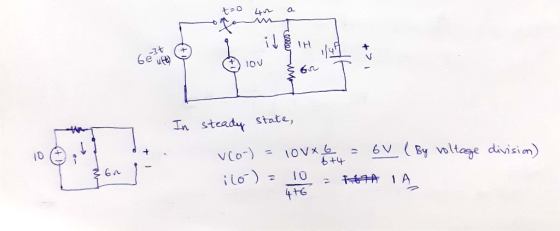
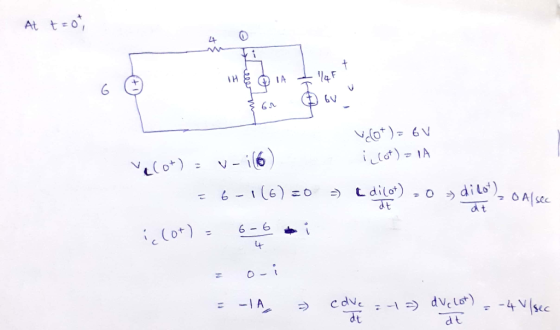
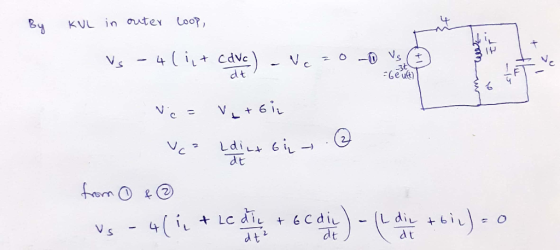
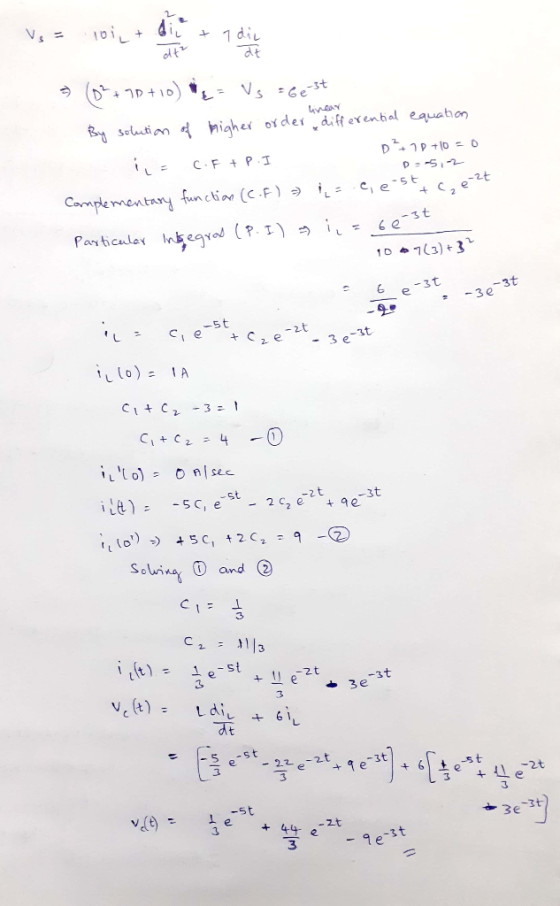
for_final.pdf Example 9.8-1: Find the complete response v(t) for t>0, assuming the circuit is at steady...
1. Find vfor t> 0 if the circuit is in steady state at t 0 Ans:...
 1. Find vfor t> 0 if the circuit is in steady state at t 0 Ans: -4e2" (cos 2t +sin 2t) +4 Volts 2Ω 1 H -0 2Ω 1
(2) The circuit is at steady state for t<0. Find v(t) for t>0. Answer t=0 ZF...
 (2) The circuit is at steady state for t<0. Find v(t) for t>0. Answer t=0 ZF Navt)14 T
1. Find Do(t) nd oolt) for t>0 in the network, assume the circuit was in steady...
 1. Find Do(t) nd oolt) for t>0 in the network, assume the circuit was in steady state before t>0. 200 μF 24v (+ volt)
Ouestion 1 (10%) The circuit shown in Fig. 1 is at steady state before t-0s. Determine...
 Ouestion 1 (10%) The circuit shown in Fig. 1 is at steady state before t-0s. Determine v(t) and i(t) for>0. 3Ω 60 |(t) 12 u() 22 ) 12Ω Fig. 1
6.3 Exercises In Exercises 1-5 find the current in the RLC circuit, assuming that E(t) =...
 6.3 Exercises In Exercises 1-5 find the current in the RLC circuit, assuming that E(t) = 0 fort > 0. 1. R = 3 ohms; L = 1 henrysC = .01 farads; Q. = 0 coulombs, 10 = 2 amperes. 11. Show that if E(t) = U coswt +V sin wt where U and V are constants then the steady state current in the RLC circuit shown in Figure 6.3.1 is w?RE(t) + (1/C - Lw?) E' (t) I where...
Find v(t) for t> 0 in the given circuit. Assume / = 4u(t) A. t=0 1H...
 Find v(t) for t> 0 in the given circuit. Assume / = 4u(t) A. t=0 1H mo of + 4.5 A ( 102 4F 522 DI - The value of v(t) = [A + (B)ect + (D)e-4.949tju(t) V where A = B = CE and D =
44 k12 t=0 6 V 11 k 2 TO+ 33 F For the circuit shown above,...
 44 k12 t=0 6 V 11 k 2 TO+ 33 F For the circuit shown above, find the capacitor voltage for t>0 (i.e after the switch opens). The solution, since this a "natural" response, should be of the form a exp(-bt) followed by appropriate units. VoO: Part #2 (0/10) For this second circuit, what is the inductor current for t>0 (again a "natural" response, going to zero as time goes to infinity)?
For the circuit below, find the complete response i(t) for t>0. 25/82 ult) nooooo 40 mF...
 For the circuit below, find the complete response i(t) for t>0. 25/82 ult) nooooo 40 mF →
The switch in the figure below OPENS at t=0. Find the total response for the current...
 The switch in the figure below OPENS at t=0. Find the total response for the current through the inductor, i(t), for t> 0 for the circuit below. HINT: source transformation helps! 20 pts OPENS 30 V mu
4. For the following circuit, solve for i(t) at t >0. t=0 42 i(o) 12 V...
 4. For the following circuit, solve for i(t) at t >0. t=0 42 i(o) 12 V ?? 20
 1. Find vfor t> 0 if the circuit is in steady state at t 0 Ans: -4e2" (cos 2t +sin 2t) +4 Volts 2Ω 1 H -0 2Ω 1
 (2) The circuit is at steady state for t<0. Find v(t) for t>0. Answer t=0 ZF Navt)14 T
 1. Find Do(t) nd oolt) for t>0 in the network, assume the circuit was in steady state before t>0. 200 μF 24v (+ volt)
 Ouestion 1 (10%) The circuit shown in Fig. 1 is at steady state before t-0s. Determine v(t) and i(t) for>0. 3Ω 60 |(t) 12 u() 22 ) 12Ω Fig. 1
 6.3 Exercises In Exercises 1-5 find the current in the RLC circuit, assuming that E(t) = 0 fort > 0. 1. R = 3 ohms; L = 1 henrysC = .01 farads; Q. = 0 coulombs, 10 = 2 amperes. 11. Show that if E(t) = U coswt +V sin wt where U and V are constants then the steady state current in the RLC circuit shown in Figure 6.3.1 is w?RE(t) + (1/C - Lw?) E' (t) I where...
 Find v(t) for t> 0 in the given circuit. Assume / = 4u(t) A. t=0 1H mo of + 4.5 A ( 102 4F 522 DI - The value of v(t) = [A + (B)ect + (D)e-4.949tju(t) V where A = B = CE and D =
 44 k12 t=0 6 V 11 k 2 TO+ 33 F For the circuit shown above, find the capacitor voltage for t>0 (i.e after the switch opens). The solution, since this a "natural" response, should be of the form a exp(-bt) followed by appropriate units. VoO: Part #2 (0/10) For this second circuit, what is the inductor current for t>0 (again a "natural" response, going to zero as time goes to infinity)?
 For the circuit below, find the complete response i(t) for t>0. 25/82 ult) nooooo 40 mF →
 The switch in the figure below OPENS at t=0. Find the total response for the current through the inductor, i(t), for t> 0 for the circuit below. HINT: source transformation helps! 20 pts OPENS 30 V mu
 4. For the following circuit, solve for i(t) at t >0. t=0 42 i(o) 12 V ?? 20
Most questions answered within 3 hours.
-
Where is the error in this code sequence?
String s1 = "Hello";
String s2 = "ello";...
asked 10 months ago -
Financial data for Joel de Paris, Inc., for last year
follow:
Joel de Paris, Inc.
Balance...
asked 10 months ago -
Consider this reaction:
Al2(SO4)3 (aq)+ BaCl3
(aq) Al2Cl6 (aq)- +
3BaSO4(s) . What is the...
asked 10 months ago -
Suppose that Savneet is considering increasing her
recent random sample from 20 car rentals to 40...
asked 10 months ago -
Trucks arrive at an unloading terminal at an average rate of 120
per hour.
Trucks arrive...
asked 10 months ago -
Why are methanol and ethanol completely soluble in water while
octanol is not very little soluble....
asked 10 months ago -
A facilities manager at a university reads in a research report
that the mean amount of...
asked 10 months ago -
When the CuSO4 is rehydrated by adding water to the anhydrous
compound, is this an endothermic...
asked 10 months ago -
A ray of sunlight is passing from diamond into crown glass; the
angle of incidence is...
asked 10 months ago -
A block of mass 0.249 kg is placed on top of a light, vertical
spring of...
asked 10 months ago -
how do the kidneys compensate in the presences of acidosis
a) trigger hyperventilate
b) reserve acid...
asked 10 months ago -
Question 501 pts
The rental rate of capital to the firm increases. Which of the
following...
asked 10 months ago