
Homework Answers
Add Answer to:
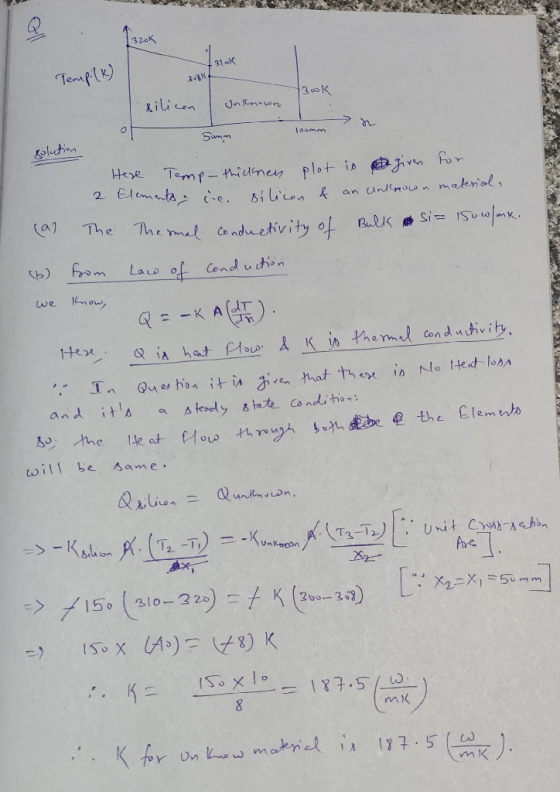
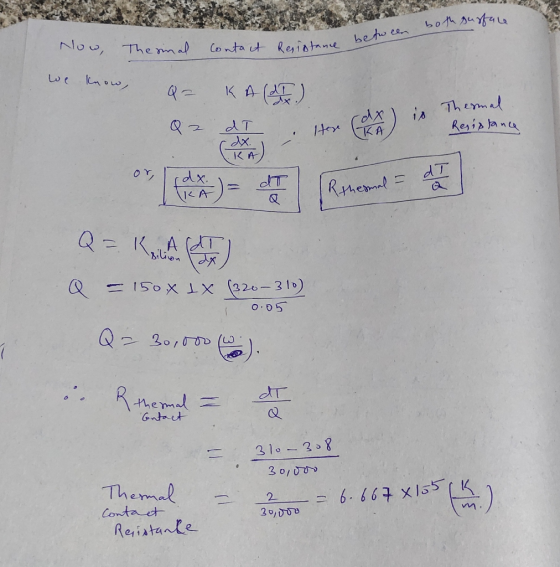
1. Consider 1D conduction along connected bars (no heat loss, steady state), with the length and...
Consider steady-state conditions for one-dimensional conduction
 Consider steady-state conditions for one-dimensional conduction in a plane wall having a thermal conductivity k = 50 W/m·K and thickness L = 0.35 m, with no internal heat generation Determine the heat flux and the unknown quantity for each case and sketch the temperature distribution, indicating the direction of the heat flux.
ENGR 135 Numerical conduction project, Part 1: 2D steady state conduction A tube with length of...
 ENGR 135 Numerical conduction project, Part 1: 2D steady state conduction A tube with length of 1 m is made from steel (k-15 W/m/K) having a square cross section with a circular hole through the center, as shown below. Calculate the steady state temperature distribution across the cross section and the total rate of heat transfer if the inner surface is held at 20 °C, and the outer surface is held at 100 °C. How does the heat rate vary...
Consider two-dimensional, steady-state conduction in a square cross section with prescribed surfa...
 need help with c and d
Consider two-dimensional, steady-state conduction in a square cross section with prescribed surface temperatures shown in the figure. 2) 100°C a) Determine the temperatures at nodes 1, 2, 3, and 4 Estimate the midpoint temperature. Reducing the mesh size by a factor of 2, determine the corresponding nodal temperatures. Compare your results with those from the coarser grid. b) 50°C 200°c c) If the body generates heat at a rate of 20,000 W/m determine the...
need help with c and d
Consider two-dimensional, steady-state conduction in a square cross section with prescribed surface temperatures shown in the figure. 2) 100°C a) Determine the temperatures at nodes 1, 2, 3, and 4 Estimate the midpoint temperature. Reducing the mesh size by a factor of 2, determine the corresponding nodal temperatures. Compare your results with those from the coarser grid. b) 50°C 200°c c) If the body generates heat at a rate of 20,000 W/m determine the...
Problem 1. (75') This is a 1-D steady state problem. Only object A generates heat per unit volume of dA 2 x 10⁶W/m3. The left surface of A is insulated and the right surface of B is exposed to a...
 Problem 1. (75') This is a 1-D steady state problem. Only object A generates heat per unit volume of dA 2 x 10⁶W/m3. The left surface of A is insulated and the right surface of B is exposed to a fluid. Temperature of the fluid is To 300 K. The convective heat transfer coefficient is h 1000 W/m2/K Thermal conductivity of A is kA 30 W/m/K, and B is k 20 W/m/K Thickness of each object is: IA-30 mm, 1':...
Steady-State Conduction 3.25 Approximately 10° discrete electrical components can single integrated circuit (chip), with 30,000 W/m...
 Steady-State Conduction 3.25 Approximately 10° discrete electrical components can single integrated circuit (chip), with 30,000 W/m 27 abe- be placed electrical heat dissipation The chip, which is very thin, is exposed to a tric liquid at its outer surface, with h, = 1000 W/m2 K and T inner surface. The thermal contact resistance between the chip and the board is 10 m K/W, and the board thickness and thermal conductivity are L and kp 1 W/m K, respectively. The other...
Exercise: Consider an unknown material of the same dimensions as the test section (diameter = 25...
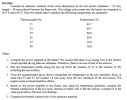 Exercise: Consider an unknown material of the same dimensions as the test section (diameter = 25 mm, length = 30 mm) placed between the brass rods. The voltage and current into the heater are measured to be 9 V and 0.92 A. Once the steady state is reached, the following temperatures are measured: Thermocouples No. T1 T2 T3 T6 T7 T8 Temperature [°C] 62.7 60.7 58.8 20.9 19.0 18.0 Tasks: 1. Compute the power supplied to the heater? We assume...
1). Consider 1D heat conduction in a solid plate as shown. The temperatures at two boundaries...
 1). Consider 1D heat conduction in a solid plate as shown. The temperatures at two boundaries are 20 K and 10 K, respectively. lm- 2 1 1 3 4 5 T20 K T = 10 K 0.25m 0.25m 0.25% 0.25 (a) Write down the governing equation for the temperature distribution inside the plate. Assume no heat source inside the entire plate. (6) The domain has been discretized using 5 equally spaced grids. Discretize the governing equation in (a) using finite...
3.68 Consider o conduction in a plane com- posite wall. The outer surfaces are exposed to...
 3.68 Consider o conduction in a plane com- posite wall. The outer surfaces are exposed to a fluid at 25°C and a convection heat transfer coefficient of 1000 Wim K. The generation q8, while there is no generation in walls A and C. The temperatures at 261°C and T2-211 C. middle wall B experiences uniform heat the interfaces are T, T. 9a k,-25 W/rm-K LA = 30 mm c-50 W/m-K L 30 mm L 20 mnm (a) Assuming negligible contact...
Be used if its thickness were to be limited to 5 mm. iation material that should d is Problem 2.3...
 how to solve it? number 2.36
t
be used if its thickness were to be limited to 5 mm. iation material that should d is Problem 2.35 2.36 The development of contact lenses has transformed the solutions that are available today for vision im- pairments. However, wearing them also poses several problems that includes the condition of dry eyes due to lack of cooling, oxygenation, and moisturizing or lubrication of the cornea, among others In the devel- opmental phase of...
how to solve it? number 2.36
t
be used if its thickness were to be limited to 5 mm. iation material that should d is Problem 2.35 2.36 The development of contact lenses has transformed the solutions that are available today for vision im- pairments. However, wearing them also poses several problems that includes the condition of dry eyes due to lack of cooling, oxygenation, and moisturizing or lubrication of the cornea, among others In the devel- opmental phase of...
summarizr the followung info and write them in your own words and break them into different...
summarizr the followung info and write them in your own words and break them into different key points. 6.5 Metering Chamber: 6.5.1 The minimum size of the metering box is governed by the metering area required to obtain a representative test area for the specimen (see 7.2) and for maintenance of reasonable test accuracy. For example, for specimens incorporating air spaces or stud spaces, the metering area shall span an integral number of spaces (see 5.5). The depth of...
 ENGR 135 Numerical conduction project, Part 1: 2D steady state conduction A tube with length of 1 m is made from steel (k-15 W/m/K) having a square cross section with a circular hole through the center, as shown below. Calculate the steady state temperature distribution across the cross section and the total rate of heat transfer if the inner surface is held at 20 °C, and the outer surface is held at 100 °C. How does the heat rate vary...
 need help with c and d
Consider two-dimensional, steady-state conduction in a square cross section with prescribed surface temperatures shown in the figure. 2) 100°C a) Determine the temperatures at nodes 1, 2, 3, and 4 Estimate the midpoint temperature. Reducing the mesh size by a factor of 2, determine the corresponding nodal temperatures. Compare your results with those from the coarser grid. b) 50°C 200°c c) If the body generates heat at a rate of 20,000 W/m determine the...
need help with c and d
Consider two-dimensional, steady-state conduction in a square cross section with prescribed surface temperatures shown in the figure. 2) 100°C a) Determine the temperatures at nodes 1, 2, 3, and 4 Estimate the midpoint temperature. Reducing the mesh size by a factor of 2, determine the corresponding nodal temperatures. Compare your results with those from the coarser grid. b) 50°C 200°c c) If the body generates heat at a rate of 20,000 W/m determine the...
 Problem 1. (75') This is a 1-D steady state problem. Only object A generates heat per unit volume of dA 2 x 10⁶W/m3. The left surface of A is insulated and the right surface of B is exposed to a fluid. Temperature of the fluid is To 300 K. The convective heat transfer coefficient is h 1000 W/m2/K Thermal conductivity of A is kA 30 W/m/K, and B is k 20 W/m/K Thickness of each object is: IA-30 mm, 1':...
 Steady-State Conduction 3.25 Approximately 10° discrete electrical components can single integrated circuit (chip), with 30,000 W/m 27 abe- be placed electrical heat dissipation The chip, which is very thin, is exposed to a tric liquid at its outer surface, with h, = 1000 W/m2 K and T inner surface. The thermal contact resistance between the chip and the board is 10 m K/W, and the board thickness and thermal conductivity are L and kp 1 W/m K, respectively. The other...
 Exercise: Consider an unknown material of the same dimensions as the test section (diameter = 25 mm, length = 30 mm) placed between the brass rods. The voltage and current into the heater are measured to be 9 V and 0.92 A. Once the steady state is reached, the following temperatures are measured: Thermocouples No. T1 T2 T3 T6 T7 T8 Temperature [°C] 62.7 60.7 58.8 20.9 19.0 18.0 Tasks: 1. Compute the power supplied to the heater? We assume...
 1). Consider 1D heat conduction in a solid plate as shown. The temperatures at two boundaries are 20 K and 10 K, respectively. lm- 2 1 1 3 4 5 T20 K T = 10 K 0.25m 0.25m 0.25% 0.25 (a) Write down the governing equation for the temperature distribution inside the plate. Assume no heat source inside the entire plate. (6) The domain has been discretized using 5 equally spaced grids. Discretize the governing equation in (a) using finite...
 3.68 Consider o conduction in a plane com- posite wall. The outer surfaces are exposed to a fluid at 25°C and a convection heat transfer coefficient of 1000 Wim K. The generation q8, while there is no generation in walls A and C. The temperatures at 261°C and T2-211 C. middle wall B experiences uniform heat the interfaces are T, T. 9a k,-25 W/rm-K LA = 30 mm c-50 W/m-K L 30 mm L 20 mnm (a) Assuming negligible contact...
 how to solve it? number 2.36
t
be used if its thickness were to be limited to 5 mm. iation material that should d is Problem 2.35 2.36 The development of contact lenses has transformed the solutions that are available today for vision im- pairments. However, wearing them also poses several problems that includes the condition of dry eyes due to lack of cooling, oxygenation, and moisturizing or lubrication of the cornea, among others In the devel- opmental phase of...
how to solve it? number 2.36
t
be used if its thickness were to be limited to 5 mm. iation material that should d is Problem 2.35 2.36 The development of contact lenses has transformed the solutions that are available today for vision im- pairments. However, wearing them also poses several problems that includes the condition of dry eyes due to lack of cooling, oxygenation, and moisturizing or lubrication of the cornea, among others In the devel- opmental phase of...
Most questions answered within 3 hours.
-
Where is the error in this code sequence?
String s1 = "Hello";
String s2 = "ello";...
asked 10 months ago -
Financial data for Joel de Paris, Inc., for last year
follow:
Joel de Paris, Inc.
Balance...
asked 10 months ago -
Consider this reaction:
Al2(SO4)3 (aq)+ BaCl3
(aq) Al2Cl6 (aq)- +
3BaSO4(s) . What is the...
asked 10 months ago -
Suppose that Savneet is considering increasing her
recent random sample from 20 car rentals to 40...
asked 10 months ago -
Trucks arrive at an unloading terminal at an average rate of 120
per hour.
Trucks arrive...
asked 10 months ago -
Why are methanol and ethanol completely soluble in water while
octanol is not very little soluble....
asked 10 months ago -
A facilities manager at a university reads in a research report
that the mean amount of...
asked 10 months ago -
When the CuSO4 is rehydrated by adding water to the anhydrous
compound, is this an endothermic...
asked 10 months ago -
A ray of sunlight is passing from diamond into crown glass; the
angle of incidence is...
asked 10 months ago -
A block of mass 0.249 kg is placed on top of a light, vertical
spring of...
asked 10 months ago -
how do the kidneys compensate in the presences of acidosis
a) trigger hyperventilate
b) reserve acid...
asked 10 months ago -
Question 501 pts
The rental rate of capital to the firm increases. Which of the
following...
asked 10 months ago