how to solve it? number 2.36
t
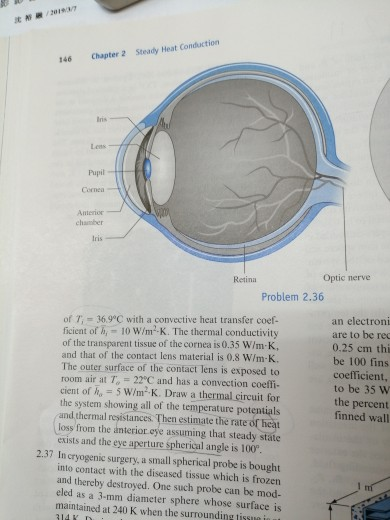
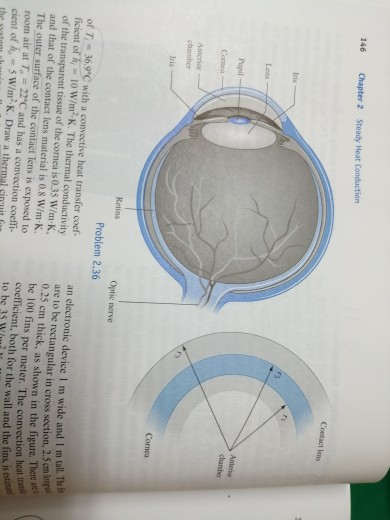
沈裕, 2019/3/7 Steady Heat Conduction Chapter 2 146 Less Pupil Cornea Antenor Retina Optic nerve Problem 2.36 of T, = 36.9°C with a convective heat transfer coef- ficient of h 10 W/m-K. The thermal conductivity of the transparent tissue of the cornea is 0.35 W/m K, and that of the contact lens material is 0.8 W/m-K. The outer surface of the contact lens is exposed to room air at Te 22°C and has a convection coeffi- cient of h, 5 W/m2 K. Draw a thermal circuit for the system showing all of the temperature potentials and thermal resistances. Then estimate the rate of heat loss from the anterior eye assuming that steady state exists and the eye aperture spherical angle is 100 an electroni are to be rec 0.25 cm thi be 100 fins coefficient, to be 35 W the percent finned wall 2.37 In cryogenic surgery, a small spherical probe is bought into contact with the diseased tissue which is frozen and thereby destroyed. One such probe can be mod- eled as a 3-mm diameter sphere whose surface is maintained at 240 K when the surrounding tiss
146 Chapter 2 Steady Heat Conduction Contact lens lris Lens nteri chamber Anterior chamber Iris Cornea Retina Optic nerve Problem 2.36 of T 36.9 C with a convective heat transfer coef- ficient of h,10 W/m K. The thermal conductivity of the transparent tissue of the cornea is 0.35 W/m-K and that of the contact lens material is 0.8 W/m K The outer surface of the contact lens is exposed to room air at T, 22°C and has a convection coeffi cient of h, 5 W/m2 K. Draw a thermal sicuit f an electronic device I m wide and I m tll Th li are to be rectangular in cross section, 2.5cm 0.25 em thick, as shown in the figure. Ther ae be 100 fins per meter. The convection heat coefficient, both for the wall and the fins, iso to be 35 Wiud
Homework Answers
- Risks and Side Effects of Using Contact Lenses. ...
- Blockage of Oxygen Supply to the Eyes. ...
- Dry Eyes. ...
- Irritation when Combined with Medication, especially Birth Control Pill. ...
- Diminished Corneal Reflex. ...
- Corneal Abrasion. ...
- Red Eye or Conjunctivitis. ...
- Ptosis.
Add Answer to:
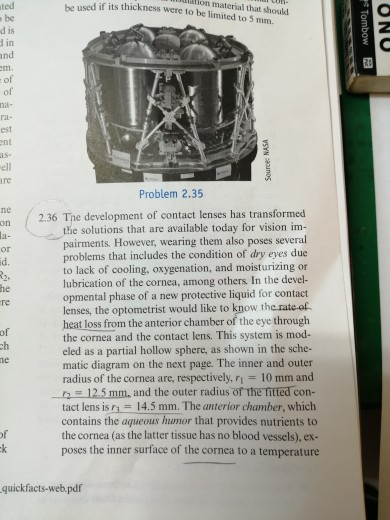
Be used if its thickness were to be limited to 5 mm. iation material that should d is Problem 2.3...
finite element method 2. Aluminum fins with rectangular profiles (5 mm wide and 1 mm thick) are used to remove heat...
 finite element method
2. Aluminum fins with rectangular profiles (5 mm wide and 1 mm thick) are used to remove heat from a surface whose temperature is 150°C. The temperature of ambient air is 20°C. The thermal conductivity of aluminium is 168 W/m.K. The natural convective coefficient associated with the surrounding air is 35 W/m2.K. The fins are 150 mm long and the heat loss from the tip of the fin may be neglected. (a) Determine the temperature distribution along...
finite element method
2. Aluminum fins with rectangular profiles (5 mm wide and 1 mm thick) are used to remove heat from a surface whose temperature is 150°C. The temperature of ambient air is 20°C. The thermal conductivity of aluminium is 168 W/m.K. The natural convective coefficient associated with the surrounding air is 35 W/m2.K. The fins are 150 mm long and the heat loss from the tip of the fin may be neglected. (a) Determine the temperature distribution along...
Problem Wall with Strip Heater The air inside a chamber is measured to be 50C and used to convectively heat a wall (h 2...
 Problem Wall with Strip Heater The air inside a chamber is measured to be 50C and used to convectively heat a wall (h 20 w/m2 K). The wall (thermal conductivity of 4 W/m K) is 200 mm thick and has a uniform heat generation of 1000 W/m2. To prevent any heat generated within the wall from being lost to the outside of the chamber a very thin electrical strip heater is placed on the outer wall to provide a uniform...
Thin-walled aluminum tubes of diameter D = 10 mm are used in the condenser of an air conditioner....
Thin-walled aluminum tubes of diameter D = 10 mm are used in the condenser of an air conditioner. Under normal operating conditions, a convection coefficient of hi = 5000 W/m2 · K is associated with condensation on the inner surface of the tubes, while a coefficient of ho = 100 W/m2 · K is maintained by airflow over the tubes. a. What is the overall heat transfer coefficient if the tubes are unfinned? b. What is the overall heat transfer...
Please help me with this problem 2. A composite cylinder is formed by a long cylindrical...
 Please help me with this problem
2. A composite cylinder is formed by a long cylindrical rod (A) and two concentric cylinders (tubes B and C). Tube B encloses trod A and its inner and outer radii are 20 mm and 40 mm, respectively. Tube C encloses tube B and its outer radius is 50 mm. A thin electrical heater is inserted between rod A and tube B. The rod (A) has a thermal conductivity of 2.5 w/m K, while...
Please help me with this problem
2. A composite cylinder is formed by a long cylindrical rod (A) and two concentric cylinders (tubes B and C). Tube B encloses trod A and its inner and outer radii are 20 mm and 40 mm, respectively. Tube C encloses tube B and its outer radius is 50 mm. A thin electrical heater is inserted between rod A and tube B. The rod (A) has a thermal conductivity of 2.5 w/m K, while...
Consider a rectangular fin (k = 180 W/m-K) of length L =10 mm, thickness i =1...
 Consider a rectangular fin (k = 180 W/m-K) of length L =10 mm, thickness i =1 mm, and width w» t. The base temperature of the finis Ty = 150°C, and the finis exposed to a fluid of temperature T, =25°C. Assuming a uniform convection coefficient of h = 110 W/m2.K over the entire fin surface, determine the fin heat transfer rate per unit width 4; efficiency ng: effectiveness es, thermal resistance per unit width and the tip temperature T...
(25pts) Consider a 1.2-m-high and 2-m-wide glass window whose thickness is 6 mm and thermal conductivity...
 (25pts) Consider a 1.2-m-high and 2-m-wide glass window whose thickness is 6 mm and thermal conductivity is k 0.78 W/m °C. Determine the steady rate of heat transfer through this glass window and the temperature of its inner surface for a day during which the room is maintained at 24°C while the temperature of the outdoors is-5°C. Take the convection heat transfer coefficients on the inner and outer surfaces of the window to be h 10 W/m2 °C and h...
The heat question and would like to have work solution. The answers are (c) 136.6 (d)...
 The heat question and would like to have work solution. The
answers are (c) 136.6 (d) < 2%. thank you.
An long cylindrical vaccuum chamber shown in Figure 1, is used to anneal single titanium rods by maintaining their temperature at 800 °C for an extended period of time. Heat is introduced into the rods internally by induction. The insulation surrounding the chamber has a thicknesss of 50 mm and thermal conductivity of 0.1 W/m.K. The convective heat transfer coefficient...
The heat question and would like to have work solution. The
answers are (c) 136.6 (d) < 2%. thank you.
An long cylindrical vaccuum chamber shown in Figure 1, is used to anneal single titanium rods by maintaining their temperature at 800 °C for an extended period of time. Heat is introduced into the rods internally by induction. The insulation surrounding the chamber has a thicknesss of 50 mm and thermal conductivity of 0.1 W/m.K. The convective heat transfer coefficient...
blem 4 (20 pts) A square chip that is 12.7mm on a side has a maximum allowable chip operating temperature -75°C. To dissipate heat produced in the chip, a 4 x 4 array of copper (k-400 W/m.K) pin fins...
 blem 4 (20 pts) A square chip that is 12.7mm on a side has a maximum allowable chip operating temperature -75°C. To dissipate heat produced in the chip, a 4 x 4 array of copper (k-400 W/m.K) pin fins is proposed to be etallurgically joined to the outer surface of the chip. The convection coefficient is h-250 W/m'K and ambient air mperature isTo-20°C. The pin fin dimeter is D,-1.5mm and length is L,-16mm. Assuming steady-state uniform chip temperature Te-75°C and...
4. An exothermic material is encased in a 1-m-long thin tubular sleeve. The material generates heat...
 4. An exothermic material is encased in a 1-m-long thin tubular sleeve. The material generates heat at a steady rate of 4800 W/m. The thermal conductivity of the exothermic material is 22 W/mK. The radius of the tube is 30 cm, and you can neglect the thickness of the sleeve. Also assume the ends of the tube are perfectly insulated. (a) If the tube is exposed to air at 20°C, and if the convection coefficient between air and the tube...
3.160 It is proposed to air-cool the cylinders of a combustion chamber by joining an aluminum...
 3.160 It is proposed to air-cool the cylinders of a combustion chamber by joining an aluminum casing with annu- lar fins (k= 240 W/m·K) to the cylinder wall (k= 50 W/m-K). Cylinder wall Aluminum casing ー2mm 8-2 mm 66 mmm 72-70mm 1.-95 mm The air is at 320 K and the corresponding convection coefficient is 100 Wm2.K. Although heating at the inner surface is periodic, it is reasonable to assume steady-state conditions with a time-averaged heat flux of 10 Wm2....
 finite element method
2. Aluminum fins with rectangular profiles (5 mm wide and 1 mm thick) are used to remove heat from a surface whose temperature is 150°C. The temperature of ambient air is 20°C. The thermal conductivity of aluminium is 168 W/m.K. The natural convective coefficient associated with the surrounding air is 35 W/m2.K. The fins are 150 mm long and the heat loss from the tip of the fin may be neglected. (a) Determine the temperature distribution along...
finite element method
2. Aluminum fins with rectangular profiles (5 mm wide and 1 mm thick) are used to remove heat from a surface whose temperature is 150°C. The temperature of ambient air is 20°C. The thermal conductivity of aluminium is 168 W/m.K. The natural convective coefficient associated with the surrounding air is 35 W/m2.K. The fins are 150 mm long and the heat loss from the tip of the fin may be neglected. (a) Determine the temperature distribution along...
 Problem Wall with Strip Heater The air inside a chamber is measured to be 50C and used to convectively heat a wall (h 20 w/m2 K). The wall (thermal conductivity of 4 W/m K) is 200 mm thick and has a uniform heat generation of 1000 W/m2. To prevent any heat generated within the wall from being lost to the outside of the chamber a very thin electrical strip heater is placed on the outer wall to provide a uniform...
 Please help me with this problem
2. A composite cylinder is formed by a long cylindrical rod (A) and two concentric cylinders (tubes B and C). Tube B encloses trod A and its inner and outer radii are 20 mm and 40 mm, respectively. Tube C encloses tube B and its outer radius is 50 mm. A thin electrical heater is inserted between rod A and tube B. The rod (A) has a thermal conductivity of 2.5 w/m K, while...
Please help me with this problem
2. A composite cylinder is formed by a long cylindrical rod (A) and two concentric cylinders (tubes B and C). Tube B encloses trod A and its inner and outer radii are 20 mm and 40 mm, respectively. Tube C encloses tube B and its outer radius is 50 mm. A thin electrical heater is inserted between rod A and tube B. The rod (A) has a thermal conductivity of 2.5 w/m K, while...
 Consider a rectangular fin (k = 180 W/m-K) of length L =10 mm, thickness i =1 mm, and width w» t. The base temperature of the finis Ty = 150°C, and the finis exposed to a fluid of temperature T, =25°C. Assuming a uniform convection coefficient of h = 110 W/m2.K over the entire fin surface, determine the fin heat transfer rate per unit width 4; efficiency ng: effectiveness es, thermal resistance per unit width and the tip temperature T...
 (25pts) Consider a 1.2-m-high and 2-m-wide glass window whose thickness is 6 mm and thermal conductivity is k 0.78 W/m °C. Determine the steady rate of heat transfer through this glass window and the temperature of its inner surface for a day during which the room is maintained at 24°C while the temperature of the outdoors is-5°C. Take the convection heat transfer coefficients on the inner and outer surfaces of the window to be h 10 W/m2 °C and h...
 The heat question and would like to have work solution. The
answers are (c) 136.6 (d) < 2%. thank you.
An long cylindrical vaccuum chamber shown in Figure 1, is used to anneal single titanium rods by maintaining their temperature at 800 °C for an extended period of time. Heat is introduced into the rods internally by induction. The insulation surrounding the chamber has a thicknesss of 50 mm and thermal conductivity of 0.1 W/m.K. The convective heat transfer coefficient...
The heat question and would like to have work solution. The
answers are (c) 136.6 (d) < 2%. thank you.
An long cylindrical vaccuum chamber shown in Figure 1, is used to anneal single titanium rods by maintaining their temperature at 800 °C for an extended period of time. Heat is introduced into the rods internally by induction. The insulation surrounding the chamber has a thicknesss of 50 mm and thermal conductivity of 0.1 W/m.K. The convective heat transfer coefficient...
 blem 4 (20 pts) A square chip that is 12.7mm on a side has a maximum allowable chip operating temperature -75°C. To dissipate heat produced in the chip, a 4 x 4 array of copper (k-400 W/m.K) pin fins is proposed to be etallurgically joined to the outer surface of the chip. The convection coefficient is h-250 W/m'K and ambient air mperature isTo-20°C. The pin fin dimeter is D,-1.5mm and length is L,-16mm. Assuming steady-state uniform chip temperature Te-75°C and...
 4. An exothermic material is encased in a 1-m-long thin tubular sleeve. The material generates heat at a steady rate of 4800 W/m. The thermal conductivity of the exothermic material is 22 W/mK. The radius of the tube is 30 cm, and you can neglect the thickness of the sleeve. Also assume the ends of the tube are perfectly insulated. (a) If the tube is exposed to air at 20°C, and if the convection coefficient between air and the tube...
 3.160 It is proposed to air-cool the cylinders of a combustion chamber by joining an aluminum casing with annu- lar fins (k= 240 W/m·K) to the cylinder wall (k= 50 W/m-K). Cylinder wall Aluminum casing ー2mm 8-2 mm 66 mmm 72-70mm 1.-95 mm The air is at 320 K and the corresponding convection coefficient is 100 Wm2.K. Although heating at the inner surface is periodic, it is reasonable to assume steady-state conditions with a time-averaged heat flux of 10 Wm2....
Most questions answered within 3 hours.
-
Where is the error in this code sequence?
String s1 = "Hello";
String s2 = "ello";...
asked 11 months ago -
Financial data for Joel de Paris, Inc., for last year
follow:
Joel de Paris, Inc.
Balance...
asked 11 months ago -
Consider this reaction:
Al2(SO4)3 (aq)+ BaCl3
(aq) Al2Cl6 (aq)- +
3BaSO4(s) . What is the...
asked 11 months ago -
Suppose that Savneet is considering increasing her
recent random sample from 20 car rentals to 40...
asked 11 months ago -
Trucks arrive at an unloading terminal at an average rate of 120
per hour.
Trucks arrive...
asked 11 months ago -
Why are methanol and ethanol completely soluble in water while
octanol is not very little soluble....
asked 11 months ago -
A facilities manager at a university reads in a research report
that the mean amount of...
asked 11 months ago -
When the CuSO4 is rehydrated by adding water to the anhydrous
compound, is this an endothermic...
asked 11 months ago -
A ray of sunlight is passing from diamond into crown glass; the
angle of incidence is...
asked 11 months ago -
A block of mass 0.249 kg is placed on top of a light, vertical
spring of...
asked 11 months ago -
how do the kidneys compensate in the presences of acidosis
a) trigger hyperventilate
b) reserve acid...
asked 11 months ago -
Question 501 pts
The rental rate of capital to the firm increases. Which of the
following...
asked 11 months ago