
Homework Answers
Add Answer to:
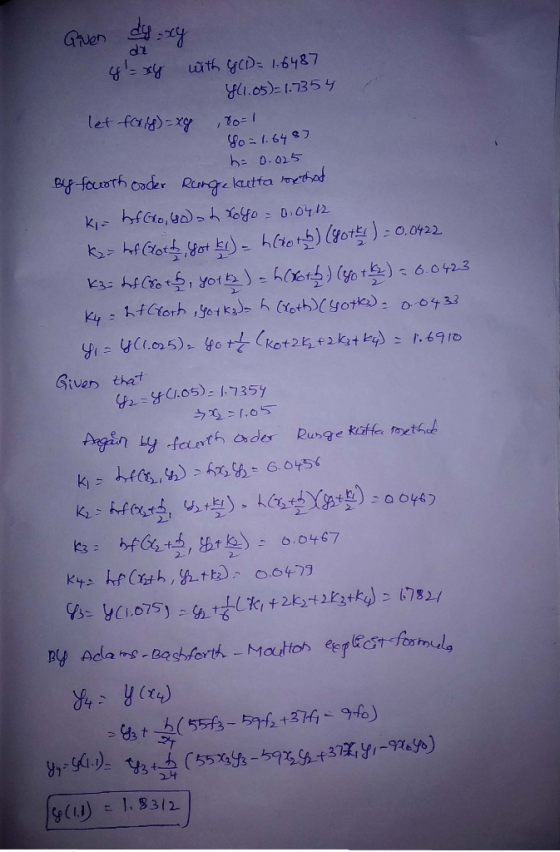
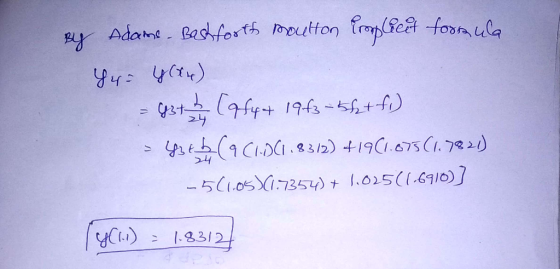
two-step explicit and implicit me ollowing differential equation with y1) 1,6487 and yt1 05)-1 7354 USE...
Question 1 Use Adam-Bashforth-Moulton two-step explicit and implicit methods to approximate y(2.4) for the following differential...
 Question 1 Use Adam-Bashforth-Moulton two-step explicit and
implicit methods to approximate y(2.4) for the following
differential equation with y(2)=14.7781 and y(2.2)=19.855 USE FOUR
DECIMAL DIGIT ROUNDING.
-y-y/x=0
Question 1 Use Adam-Bashforth-Moulton two-step explicit and
implicit methods to approximate y(2.4) for the following
differential equation with y(2)=14.7781 and y(2.2)=19.855 USE FOUR
DECIMAL DIGIT ROUNDING.
-y-y/x=0
1. (4 points) Determine whether the given function y, given explicit or implicit, is a solution...
 1. (4 points) Determine whether the given function y, given explicit or implicit, is a solution to the corresponding differential equation a) y = 2* +3e2a; y" - 3y + 2y = 0. dy 2.ry b) y - In y = r2+1, (Use implicit differentiation) dr y-1 2. (3 points) Find the solution to the initial value problem: dy = e(t+1); y(2) = 0 dr 3. (3 points) Find the general solution to the following equation. y dy ada COS
A system of two first order differential equations can be written as 0 dc A second order explicit...
 A system of two first order differential equations can be written as 0 dc A second order explicit Runge-Kutta scheme for the system of two first order equations is Consider the following second order differential equation 7+4zy 4, with y(1)-1 and y'(1)--1. Use the Runge-kutta scheme to find an approximate solution of the second order differential equation, at x = 1.2, if the step size h Maintain at least eight decimal digit accuracy throughout all your calculations You may express...
1. Determine the solution to the following differential equation (implicit if necessary): 2. Determine the general...
 1. Determine the solution to the following differential equation (implicit if necessary): 2. Determine the general solution, y(x), to the following differential equations [use synthetic division to solve a), b), and d)]. Show all your work dx3dx2 dx b)@y-4ーー3을y+18y = 0 d2 dx2 dx3 dx dx2 dx + 2-10 dy, dy _ y = 0 dx dx x f) χ +dy=kx where k is a constant dx2 dx
A system of two first order differential equations can be written as: A second order explicit R...
A system of two first order differential equations can be written as: A second order explicit Runge-Kutta scheme for the system of two first order equations is Consider the following second order differential equation: Use the Runge-kutta scheme to find an approximate solution of the second order differential equation, at x = 0.2, if the step size h = 0.1. Maintain at least eight decimal digit accuracy throughout all your calculations. You may express your answer as a five decimal...
dy (1 point) Solve the differential equation -- = 25 a. Find an implicit solution and...
 dy (1 point) Solve the differential equation -- = 25 a. Find an implicit solution and put your answer in the following form: constant. help (formulas) D. Find the equation of the solution through the point (x,y) = (5, 1). help (equations) C. Find the equation of the solution through the point (x,y) = (0,-4). Your answer should be of the form y = f(x). help (equations)
Question 12 (3 marks) Special Attempt 2 A system of two first order differential equations can be written as 0 dr A second order explicit Runge-Kutta scheme for the system of two first order equation...
 Question 12 (3 marks) Special Attempt 2 A system of two first order differential equations can be written as 0 dr A second order explicit Runge-Kutta scheme for the system of two first order equations is 1hg(n,un,vn), un+1 Consider the following second order differential equation d2 0cy-6, with v(1)-1 and y'()-o Use the Runge-kutta scheme to find an approximate solution of the second order differential equation, at x = 1.2, if the step size h Maintain at least eight decimal...
An autonomous system of two first order differential equations can be written as: A third order...
An autonomous system of two first order differential equations can be written as: A third order explicit Runge-Kutta scheme for an autonomous system of two first order equations is Consider the following second order differential equation, Use the Runge-Kutta scheme to find an approximate solutions of the second order differential equation, at t = 1.2, if the step size h = 0.1. Maintain at least eight decimal digit accuracy throughout all your calculations. You may express your answer as a...
Please find y(1.4) Question Question 12 (3 marks) Special Attempt 1 A system of two first order differential equations c...
 Please find y(1.4)
Question Question 12 (3 marks) Special Attempt 1 A system of two first order differential equations can be written as A second order explicit Runge-Kutta scheme for the system of two first order equations is k1hn,un,vn), un+1 Consider the following second order differential equation d-y + 2 y-9y with y(1) and y'(1) 4 1. , Use the Runge-kutta scheme to find an approximate solution of the second order differential equation, at x-1.4, if the step size h...
Please find y(1.4)
Question Question 12 (3 marks) Special Attempt 1 A system of two first order differential equations can be written as A second order explicit Runge-Kutta scheme for the system of two first order equations is k1hn,un,vn), un+1 Consider the following second order differential equation d-y + 2 y-9y with y(1) and y'(1) 4 1. , Use the Runge-kutta scheme to find an approximate solution of the second order differential equation, at x-1.4, if the step size h...
An autonomous system of two first order differential equations can be written as: A third order e...
 An autonomous system of two first order differential equations can be written as: A third order explicit Runge-Kutta scheme for an autonomous system of two first order equations is hg(un,vn), 63-hf(un+2k2-k㎶n +212-11), 13 hg(un+2k2-ki,un +212-4), t-4 Consider the following second order differential equation, +2dy-7y2-12, with y(0)= 4 and y'(0)=0. dt2 dt Use the Runge-Kutta scheme to find an approximate solution of the second order differential equation, at t = 0.1, if the step size h = 0.05 Maintain at least...
 Question 1 Use Adam-Bashforth-Moulton two-step explicit and
implicit methods to approximate y(2.4) for the following
differential equation with y(2)=14.7781 and y(2.2)=19.855 USE FOUR
DECIMAL DIGIT ROUNDING.
-y-y/x=0
Question 1 Use Adam-Bashforth-Moulton two-step explicit and
implicit methods to approximate y(2.4) for the following
differential equation with y(2)=14.7781 and y(2.2)=19.855 USE FOUR
DECIMAL DIGIT ROUNDING.
-y-y/x=0
 1. (4 points) Determine whether the given function y, given explicit or implicit, is a solution to the corresponding differential equation a) y = 2* +3e2a; y" - 3y + 2y = 0. dy 2.ry b) y - In y = r2+1, (Use implicit differentiation) dr y-1 2. (3 points) Find the solution to the initial value problem: dy = e(t+1); y(2) = 0 dr 3. (3 points) Find the general solution to the following equation. y dy ada COS
 A system of two first order differential equations can be written as 0 dc A second order explicit Runge-Kutta scheme for the system of two first order equations is Consider the following second order differential equation 7+4zy 4, with y(1)-1 and y'(1)--1. Use the Runge-kutta scheme to find an approximate solution of the second order differential equation, at x = 1.2, if the step size h Maintain at least eight decimal digit accuracy throughout all your calculations You may express...
 1. Determine the solution to the following differential equation (implicit if necessary): 2. Determine the general solution, y(x), to the following differential equations [use synthetic division to solve a), b), and d)]. Show all your work dx3dx2 dx b)@y-4ーー3을y+18y = 0 d2 dx2 dx3 dx dx2 dx + 2-10 dy, dy _ y = 0 dx dx x f) χ +dy=kx where k is a constant dx2 dx
 dy (1 point) Solve the differential equation -- = 25 a. Find an implicit solution and put your answer in the following form: constant. help (formulas) D. Find the equation of the solution through the point (x,y) = (5, 1). help (equations) C. Find the equation of the solution through the point (x,y) = (0,-4). Your answer should be of the form y = f(x). help (equations)
 Question 12 (3 marks) Special Attempt 2 A system of two first order differential equations can be written as 0 dr A second order explicit Runge-Kutta scheme for the system of two first order equations is 1hg(n,un,vn), un+1 Consider the following second order differential equation d2 0cy-6, with v(1)-1 and y'()-o Use the Runge-kutta scheme to find an approximate solution of the second order differential equation, at x = 1.2, if the step size h Maintain at least eight decimal...
 Please find y(1.4)
Question Question 12 (3 marks) Special Attempt 1 A system of two first order differential equations can be written as A second order explicit Runge-Kutta scheme for the system of two first order equations is k1hn,un,vn), un+1 Consider the following second order differential equation d-y + 2 y-9y with y(1) and y'(1) 4 1. , Use the Runge-kutta scheme to find an approximate solution of the second order differential equation, at x-1.4, if the step size h...
Please find y(1.4)
Question Question 12 (3 marks) Special Attempt 1 A system of two first order differential equations can be written as A second order explicit Runge-Kutta scheme for the system of two first order equations is k1hn,un,vn), un+1 Consider the following second order differential equation d-y + 2 y-9y with y(1) and y'(1) 4 1. , Use the Runge-kutta scheme to find an approximate solution of the second order differential equation, at x-1.4, if the step size h...
 An autonomous system of two first order differential equations can be written as: A third order explicit Runge-Kutta scheme for an autonomous system of two first order equations is hg(un,vn), 63-hf(un+2k2-k㎶n +212-11), 13 hg(un+2k2-ki,un +212-4), t-4 Consider the following second order differential equation, +2dy-7y2-12, with y(0)= 4 and y'(0)=0. dt2 dt Use the Runge-Kutta scheme to find an approximate solution of the second order differential equation, at t = 0.1, if the step size h = 0.05 Maintain at least...
Most questions answered within 3 hours.
-
Where is the error in this code sequence?
String s1 = "Hello";
String s2 = "ello";...
asked 10 months ago -
Financial data for Joel de Paris, Inc., for last year
follow:
Joel de Paris, Inc.
Balance...
asked 10 months ago -
Consider this reaction:
Al2(SO4)3 (aq)+ BaCl3
(aq) Al2Cl6 (aq)- +
3BaSO4(s) . What is the...
asked 10 months ago -
Suppose that Savneet is considering increasing her
recent random sample from 20 car rentals to 40...
asked 10 months ago -
Trucks arrive at an unloading terminal at an average rate of 120
per hour.
Trucks arrive...
asked 10 months ago -
Why are methanol and ethanol completely soluble in water while
octanol is not very little soluble....
asked 10 months ago -
A facilities manager at a university reads in a research report
that the mean amount of...
asked 10 months ago -
When the CuSO4 is rehydrated by adding water to the anhydrous
compound, is this an endothermic...
asked 10 months ago -
A ray of sunlight is passing from diamond into crown glass; the
angle of incidence is...
asked 10 months ago -
A block of mass 0.249 kg is placed on top of a light, vertical
spring of...
asked 10 months ago -
how do the kidneys compensate in the presences of acidosis
a) trigger hyperventilate
b) reserve acid...
asked 10 months ago -
Question 501 pts
The rental rate of capital to the firm increases. Which of the
following...
asked 10 months ago