Hello, I was wondering if you could check my answers
Homework Answers

Add Answer to:
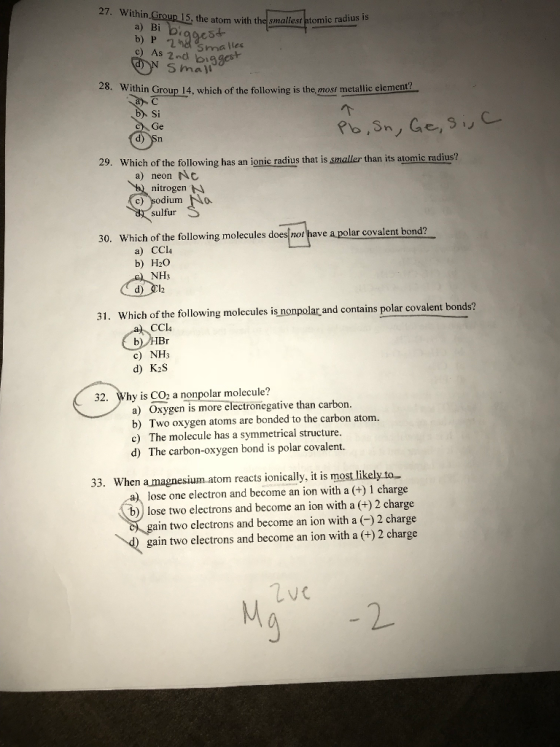
Hello, I was wondering if you could check my answers
27. Within wi:1.PBLSteatorn withthe Small stttomic...
A covalent bond is a bond in which electrons are shared between atoms of elements
 A covalent bond is a
bond in which electrons are shared between atoms of elements. A
covalent bond can be polar or nonpolar. In a nonpolar covalent
bond, the bond is between two identical atoms and the electrons are
evenly shared between the atoms.In contrast, in a
polar covalent bond, the bond is between two nonidentical atoms and
the electrons are unevenly shared between the atoms. The uneven
sharing of electrons takes place because of the difference in the
electronegativity...
A covalent bond is a
bond in which electrons are shared between atoms of elements. A
covalent bond can be polar or nonpolar. In a nonpolar covalent
bond, the bond is between two identical atoms and the electrons are
evenly shared between the atoms.In contrast, in a
polar covalent bond, the bond is between two nonidentical atoms and
the electrons are unevenly shared between the atoms. The uneven
sharing of electrons takes place because of the difference in the
electronegativity...
20. How do atoms achieve noble-gas electron configurations in single covalent bonds? a. One atom completely...
 20. How do atoms achieve noble-gas electron configurations in single covalent bonds? a. One atom completely loses two electrons to the other atom in the bond. b. Two atoms share two pairs of electrons. C. Two atoms share two electrons. d. Two atoms share one electron 21. Why do atoms share electrons in covalent bonds? a to become ions and attract each other b. to attain a noble-gas electron configuration c. to become more polar d. to increase their atomic...
In a covalent bond between two atoms, the more electronegative atom will attract more electron density...
 In a covalent bond between two atoms, the more electronegative atom will attract more electron density toward itself, producing a polar bond. The more electronegative element will carry a partial negative charge, whereas the less electronegative element will carry a partial positive charge. The direction of the bond dipole is always toward the more electronegative element. This is often indicated by an arrow, as shown in the figure. The magnitude of the bond polarity can be estimated by using the...
Pre-Lab Exercise 2-3 Chemical Bonding One of the more challenging concepts to grasp in chemistry is...
 Pre-Lab Exercise 2-3 Chemical Bonding One of the more challenging concepts to grasp in chemistry is chemical bonding, a topic that pops up again and again in A&P: We revisit it in cytology, the nervous system, blood, respiration, and digestion-to name just a few First let's do some basics. Use your textbook and this unit to answer the following questions 1. Do metals donate or accept electrons? What do they become after they donate/accept electrons? 2. Do nonmetals donate or...
1) A hydrogen bond is A) an attraction between a hydrogen atom attached to N, O, or F and an N, O, or Fatom on anot...
 1) A hydrogen bond is A) an attraction between a hydrogen atom attached to N, O, or F and an N, O, or Fatom on anothe molecule. B) a covalent bond between H and O. c) an ionic bond between H and another atom. D) a bond that is stronger than a covalent bond. E) the polar O-H bond in water. 2) Which of the following molecules can form hydrogen bonds? A) CH4 B) NaH C) NH3 D) BH3 E)...
Answer 1-4 (#3 and #4 are tables) shell provides stability to the atom. Different chemical bonds...
 Answer 1-4 (#3 and #4 are tables)
shell provides stability to the atom. Different chemical bonds are based on the way in which the atoms fill their valence shells. The major types of chemical bonds include: ionic bonds covalent bonds (both types, i.c. polar covalent and non-polar covalent bonds), and hydrogen bonds. Atoms can use two strategies to fill their valence shell: they can share electrons between their valence shells, or they can give or take electrons from other nearby...
Answer 1-4 (#3 and #4 are tables)
shell provides stability to the atom. Different chemical bonds are based on the way in which the atoms fill their valence shells. The major types of chemical bonds include: ionic bonds covalent bonds (both types, i.c. polar covalent and non-polar covalent bonds), and hydrogen bonds. Atoms can use two strategies to fill their valence shell: they can share electrons between their valence shells, or they can give or take electrons from other nearby...
1.If an atom of Magnesium (Mg) loses an electron to an atom of Oxygen (O), these...
1.If an atom of Magnesium (Mg) loses an electron to an atom of Oxygen (O), these two atoms could: A. form a covalent bond B. not interact in any way C. form an ionic bond D. share a second pair of electrons to form a double bond E. form a hydrogen bond 2. Which of the substances listed below would not be considered a lipid? A. Wax B. Glycogen C. Steroids D. Fat E. Oil 3. A community consists of:...
Answer true or false. 1. Atoms that lose electrons to achieve a filled valence shell become...
Answer true or false. 1. Atoms that lose electrons to achieve a filled valence shell become cations and form ionic bonds with anions. 2. Ionic bonds tend to form between elements on the left side of the Periodic Table, and covalent bonds tend to form between elements on the right side of the Periodic Table. 3. Electronegativity is a measure of an atom's attraction for the electrons it shares in a chemical bond with another atom. 4. Fluorine, in the...
6. The most common ion of bromine has a charge of A. +2 В. +1 C....
 6. The most common ion of bromine has a charge of A. +2 В. +1 C. -1 D. -2 E. bromine only forms covalent compounds. Which atom in Period 5 of the periodic table has the largest radius? 7. A. Xenon B. Cadmium C. Strontium D. Yttrium E. Rubidium 8. Which of the following covalent bonds is most polar? A. O-F В. Н-F C. C-F D. Cl-F None of these bonds is polar. E. 9. How many electrons are on...
Procedure: For Part 1, write the Lewis Dot (or Electron Dot) structure for each atom, followed...
Procedure: For Part 1, write the Lewis Dot (or Electron Dot) structure for each atom, followed by the ions that each element would form, the compound that would be formed from the combination of the two elements and finally the Lewis Dot structure for the compound. For Part 2, show the Lewis Dot structure for each molecules, its AXE designation and finally its Electron Pair/ Geometric Shape geometries. Also indicate any partial charges that may exist on that molecule. PART...
 A covalent bond is a
bond in which electrons are shared between atoms of elements. A
covalent bond can be polar or nonpolar. In a nonpolar covalent
bond, the bond is between two identical atoms and the electrons are
evenly shared between the atoms.In contrast, in a
polar covalent bond, the bond is between two nonidentical atoms and
the electrons are unevenly shared between the atoms. The uneven
sharing of electrons takes place because of the difference in the
electronegativity...
A covalent bond is a
bond in which electrons are shared between atoms of elements. A
covalent bond can be polar or nonpolar. In a nonpolar covalent
bond, the bond is between two identical atoms and the electrons are
evenly shared between the atoms.In contrast, in a
polar covalent bond, the bond is between two nonidentical atoms and
the electrons are unevenly shared between the atoms. The uneven
sharing of electrons takes place because of the difference in the
electronegativity...
 20. How do atoms achieve noble-gas electron configurations in single covalent bonds? a. One atom completely loses two electrons to the other atom in the bond. b. Two atoms share two pairs of electrons. C. Two atoms share two electrons. d. Two atoms share one electron 21. Why do atoms share electrons in covalent bonds? a to become ions and attract each other b. to attain a noble-gas electron configuration c. to become more polar d. to increase their atomic...
 In a covalent bond between two atoms, the more electronegative atom will attract more electron density toward itself, producing a polar bond. The more electronegative element will carry a partial negative charge, whereas the less electronegative element will carry a partial positive charge. The direction of the bond dipole is always toward the more electronegative element. This is often indicated by an arrow, as shown in the figure. The magnitude of the bond polarity can be estimated by using the...
 Pre-Lab Exercise 2-3 Chemical Bonding One of the more challenging concepts to grasp in chemistry is chemical bonding, a topic that pops up again and again in A&P: We revisit it in cytology, the nervous system, blood, respiration, and digestion-to name just a few First let's do some basics. Use your textbook and this unit to answer the following questions 1. Do metals donate or accept electrons? What do they become after they donate/accept electrons? 2. Do nonmetals donate or...
 1) A hydrogen bond is A) an attraction between a hydrogen atom attached to N, O, or F and an N, O, or Fatom on anothe molecule. B) a covalent bond between H and O. c) an ionic bond between H and another atom. D) a bond that is stronger than a covalent bond. E) the polar O-H bond in water. 2) Which of the following molecules can form hydrogen bonds? A) CH4 B) NaH C) NH3 D) BH3 E)...
 Answer 1-4 (#3 and #4 are tables)
shell provides stability to the atom. Different chemical bonds are based on the way in which the atoms fill their valence shells. The major types of chemical bonds include: ionic bonds covalent bonds (both types, i.c. polar covalent and non-polar covalent bonds), and hydrogen bonds. Atoms can use two strategies to fill their valence shell: they can share electrons between their valence shells, or they can give or take electrons from other nearby...
Answer 1-4 (#3 and #4 are tables)
shell provides stability to the atom. Different chemical bonds are based on the way in which the atoms fill their valence shells. The major types of chemical bonds include: ionic bonds covalent bonds (both types, i.c. polar covalent and non-polar covalent bonds), and hydrogen bonds. Atoms can use two strategies to fill their valence shell: they can share electrons between their valence shells, or they can give or take electrons from other nearby...
 6. The most common ion of bromine has a charge of A. +2 В. +1 C. -1 D. -2 E. bromine only forms covalent compounds. Which atom in Period 5 of the periodic table has the largest radius? 7. A. Xenon B. Cadmium C. Strontium D. Yttrium E. Rubidium 8. Which of the following covalent bonds is most polar? A. O-F В. Н-F C. C-F D. Cl-F None of these bonds is polar. E. 9. How many electrons are on...
Most questions answered within 3 hours.
-
Where is the error in this code sequence?
String s1 = "Hello";
String s2 = "ello";...
asked 11 months ago -
Financial data for Joel de Paris, Inc., for last year
follow:
Joel de Paris, Inc.
Balance...
asked 11 months ago -
Consider this reaction:
Al2(SO4)3 (aq)+ BaCl3
(aq) Al2Cl6 (aq)- +
3BaSO4(s) . What is the...
asked 11 months ago -
Suppose that Savneet is considering increasing her
recent random sample from 20 car rentals to 40...
asked 11 months ago -
Trucks arrive at an unloading terminal at an average rate of 120
per hour.
Trucks arrive...
asked 11 months ago -
Why are methanol and ethanol completely soluble in water while
octanol is not very little soluble....
asked 11 months ago -
A facilities manager at a university reads in a research report
that the mean amount of...
asked 11 months ago -
When the CuSO4 is rehydrated by adding water to the anhydrous
compound, is this an endothermic...
asked 11 months ago -
A ray of sunlight is passing from diamond into crown glass; the
angle of incidence is...
asked 11 months ago -
A block of mass 0.249 kg is placed on top of a light, vertical
spring of...
asked 11 months ago -
how do the kidneys compensate in the presences of acidosis
a) trigger hyperventilate
b) reserve acid...
asked 11 months ago -
Question 501 pts
The rental rate of capital to the firm increases. Which of the
following...
asked 11 months ago