
Homework Answers
 dj
dj
Add Answer to:
Questions 1 and 2: Draw a bond graph of each of the electrical systems shown below.
1. a. Draw two copies of the graph axes shown below. b. On one of these...
1. a. Draw two copies of the graph axes shown below. b. On one of these graphs show how G changes for an exergonic reaction and on the second show how G changes for an endergonic reaction. c. On each graph, label the activation energy. 2. On one of the graphs that you drew, show how the activation energy would change if an enzyme was used for the reaction.
Please answer questions 1-4. 1. is the reaction below illustrating a heterolytic or a homolytic bond...
 Please answer questions 1-4.
1. is the reaction below illustrating a heterolytic or a homolytic bond cleavage? Explain. 2. Which radical will be more stable? به ره وه 3. Draw the mechanism (electron pushing) for the reaction shown below: 4. Show the mechanism for the reaction below: .
Please answer questions 1-4.
1. is the reaction below illustrating a heterolytic or a homolytic bond cleavage? Explain. 2. Which radical will be more stable? به ره وه 3. Draw the mechanism (electron pushing) for the reaction shown below: 4. Show the mechanism for the reaction below: .
Draw a potential intermolecular bond for the compounds below. Draw your structure exactly as shown in...
Draw a potential intermolecular bond for the compounds below. Draw your structure exactly as shown in this question and use a dashed bond to represent the hydrogen bond. H3C-CH2-O-CH2-CH3 to NH3
For each of the velocity-time graphs shown below, draw the corresponding acceleration- time graph. 2-0 0...
 For each of the velocity-time graphs shown below, draw the corresponding acceleration- time graph. 2-0 0 2 46 8 I time (s) i time (s) I i time (s) 0 0 0 2 4 6 8 0 2 468 time (s) time (s) time (s) A car moves along a line (the positive x-axis). Fill in the table below with the sign (t or-) of the velocity and acceleration of the car for each of the motions described. 2 Acceleration...
please read thoroughly . please draw graphs for both 1&2. please explain each graph A. Draw...
 please read thoroughly .
please draw graphs for both 1&2.
please explain each graph
A. Draw yorphs showing the effect on action potentials in a cell following effective doses of each of the listed neurotoxins. Assume that the cell is normally brought to threshold by an electrical stimulus applied to it, so that any abnormality is due to the toxin. Precise values for voltage and duration are not important, just a general trend in how the action potential may be...
please read thoroughly .
please draw graphs for both 1&2.
please explain each graph
A. Draw yorphs showing the effect on action potentials in a cell following effective doses of each of the listed neurotoxins. Assume that the cell is normally brought to threshold by an electrical stimulus applied to it, so that any abnormality is due to the toxin. Precise values for voltage and duration are not important, just a general trend in how the action potential may be...
Complete the following. (a) The graph of y=g() is shown. Draw the graph of y= g(-x)+1....
 Complete the following. (a) The graph of y=g() is shown. Draw the graph of y= g(-x)+1. (b) The graph of y=16) is shown. Draw the graph of y=246)-4. X ? х 5 2
Convert the following electrical system to a bond graph. Derive the state equations in terms of the energy variables. V...
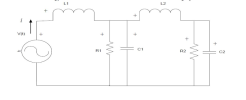 Convert the following electrical system to a bond graph. Derive
the state equations in terms of the energy variables.
V(t) R1 + w 2 +
V(t) R1 + w 2 +
Convert the following electrical system to a bond graph. Derive
the state equations in terms of the energy variables.
V(t) R1 + w 2 +
V(t) R1 + w 2 +
17. For each of the dynamical systems shown below (1) find the poles and the zeros...
 17. For each of the dynamical systems shown below (1) find the poles and the zeros (2) write an expression for the general form of the step response without solving for the inverse Laplace transform 20 c) G(s) +6S +144 d) G(s)- s +-9 e +10) (s + 5) 2
Draw a complete bond graph of a train system below. Given that bı, b2 are damper...
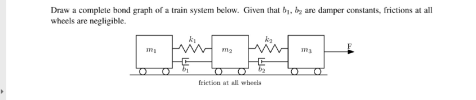 Draw a complete bond graph of a train system below. Given that bı, b2 are damper constants, frictions at all wheels are negligible. mi m2 m3 OT friction at all wheels
The graph of y =() is given below. Answer each of the questions below the graph,...
 The graph of y =() is given below. Answer each of the questions below the graph, using interval notation. Answer DNE if there is no interval il 10 9 8 7 5 3 3/1) 7101 1/1) Preview A) Where is r() increasing? Preview B) Where is a decreasing? Preview 1/1) C) Where is r(a) constant? Preview D) What is the domain of r(a)?
 Please answer questions 1-4.
1. is the reaction below illustrating a heterolytic or a homolytic bond cleavage? Explain. 2. Which radical will be more stable? به ره وه 3. Draw the mechanism (electron pushing) for the reaction shown below: 4. Show the mechanism for the reaction below: .
Please answer questions 1-4.
1. is the reaction below illustrating a heterolytic or a homolytic bond cleavage? Explain. 2. Which radical will be more stable? به ره وه 3. Draw the mechanism (electron pushing) for the reaction shown below: 4. Show the mechanism for the reaction below: .
 For each of the velocity-time graphs shown below, draw the corresponding acceleration- time graph. 2-0 0 2 46 8 I time (s) i time (s) I i time (s) 0 0 0 2 4 6 8 0 2 468 time (s) time (s) time (s) A car moves along a line (the positive x-axis). Fill in the table below with the sign (t or-) of the velocity and acceleration of the car for each of the motions described. 2 Acceleration...
 please read thoroughly .
please draw graphs for both 1&2.
please explain each graph
A. Draw yorphs showing the effect on action potentials in a cell following effective doses of each of the listed neurotoxins. Assume that the cell is normally brought to threshold by an electrical stimulus applied to it, so that any abnormality is due to the toxin. Precise values for voltage and duration are not important, just a general trend in how the action potential may be...
please read thoroughly .
please draw graphs for both 1&2.
please explain each graph
A. Draw yorphs showing the effect on action potentials in a cell following effective doses of each of the listed neurotoxins. Assume that the cell is normally brought to threshold by an electrical stimulus applied to it, so that any abnormality is due to the toxin. Precise values for voltage and duration are not important, just a general trend in how the action potential may be...
 Complete the following. (a) The graph of y=g() is shown. Draw the graph of y= g(-x)+1. (b) The graph of y=16) is shown. Draw the graph of y=246)-4. X ? х 5 2
 Convert the following electrical system to a bond graph. Derive
the state equations in terms of the energy variables.
V(t) R1 + w 2 +
V(t) R1 + w 2 +
Convert the following electrical system to a bond graph. Derive
the state equations in terms of the energy variables.
V(t) R1 + w 2 +
V(t) R1 + w 2 +
 17. For each of the dynamical systems shown below (1) find the poles and the zeros (2) write an expression for the general form of the step response without solving for the inverse Laplace transform 20 c) G(s) +6S +144 d) G(s)- s +-9 e +10) (s + 5) 2
 Draw a complete bond graph of a train system below. Given that bı, b2 are damper constants, frictions at all wheels are negligible. mi m2 m3 OT friction at all wheels
 The graph of y =() is given below. Answer each of the questions below the graph, using interval notation. Answer DNE if there is no interval il 10 9 8 7 5 3 3/1) 7101 1/1) Preview A) Where is r() increasing? Preview B) Where is a decreasing? Preview 1/1) C) Where is r(a) constant? Preview D) What is the domain of r(a)?
Most questions answered within 3 hours.
-
Where is the error in this code sequence?
String s1 = "Hello";
String s2 = "ello";...
asked 11 months ago -
Financial data for Joel de Paris, Inc., for last year
follow:
Joel de Paris, Inc.
Balance...
asked 11 months ago -
Consider this reaction:
Al2(SO4)3 (aq)+ BaCl3
(aq) Al2Cl6 (aq)- +
3BaSO4(s) . What is the...
asked 11 months ago -
Suppose that Savneet is considering increasing her
recent random sample from 20 car rentals to 40...
asked 11 months ago -
Trucks arrive at an unloading terminal at an average rate of 120
per hour.
Trucks arrive...
asked 11 months ago -
Why are methanol and ethanol completely soluble in water while
octanol is not very little soluble....
asked 11 months ago -
A facilities manager at a university reads in a research report
that the mean amount of...
asked 11 months ago -
When the CuSO4 is rehydrated by adding water to the anhydrous
compound, is this an endothermic...
asked 11 months ago -
A ray of sunlight is passing from diamond into crown glass; the
angle of incidence is...
asked 11 months ago -
A block of mass 0.249 kg is placed on top of a light, vertical
spring of...
asked 11 months ago -
how do the kidneys compensate in the presences of acidosis
a) trigger hyperventilate
b) reserve acid...
asked 11 months ago -
Question 501 pts
The rental rate of capital to the firm increases. Which of the
following...
asked 11 months ago