| 1. 1240 |

Consider the ideal Stirling cycle shown above, working between a maximum temperature of 600 K and a minimum temperature of 370 K and a minimum volume of 0.3 L and a maximum volume of 1.6 L. The working gas of the cycle is 0.10 mol of an ideal gas with c′v = 20.8 J/mol-K. Note, +Q = heat absorbed by the gas and +W = work done by the gas. |
| Part | Description | Answer | Chk | History |
| A. | What is the heat flow from
state a to state b, Qab? (include units with answer) |
A: -515 J |
Hints: 1,0 |
# tries: 2 |
| B. | What is the heat flow from
state b to state c, Qbc? (include units with answer) |
A: 478.4 J |
Hints: 1,0 |
# tries: 2 |
| C. | What is the heat flow from
state c to state d, Qcd? (include units with answer) |
A: 835 J |
Hints: 2,0 |
# tries: 3 |
| D. | What is the heat flow from
state d to state a, Qda? (include units with answer) |
A: -478.4 J |
Hints: 1,0 |
# tries: 1 |
| E. | What is the absolute pressure
at state a? (include units with answer) |
A: 192 kPa |
Hints: 1,0 |
# tries: 2 |
| F. | What is the absolute pressure
at state b? (include units with answer) |
A: 1025 kPa |
Hints: 1,0 |
# tries: 1 |
| G. | What is the absolute pressure
at state c? (include units with answer) |
A: 1662 kPa |
Hints: 1,0 |
# tries: 2 |
| H. | What is the work done in
going from state a to state b, Wab? (include units with answer) |
A: -515 J |
Hints: 1,0 |
# tries: 1 |
| I. | What is the work done in
going from state b to state c, Wbc? (include units with answer) |
A: 0 J |
Hints: 1,0 |
# tries: 1 |
| J. | What is the work done in
going from state c to state d, Wcd? (include units with answer) |
A: 835 J |
Hints: 1,0 |
# tries: 1 |
| K. | What is the work done in
going from state d to state a, Wda? (include units with answer) |
A: 0 J |
Hints: 1,0 |
# tries: 1 |
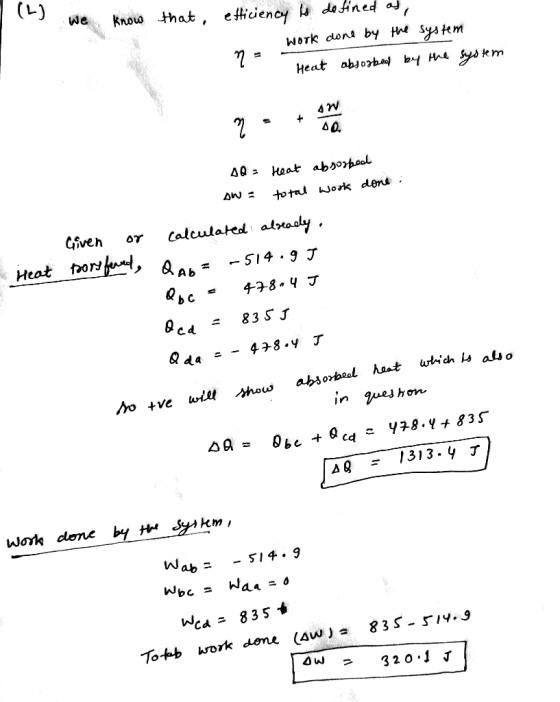
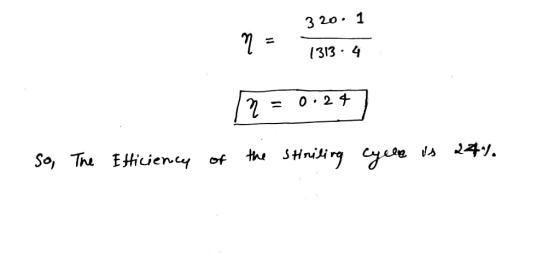
| L. | What is the efficiency of this cycle? (%) | 
2% try penalty Hints: 1,2 |
# tries: 1 |

Just need L
Homework Answers
Add Answer to:
1.
1240
Consider the ideal Stirling cycle shown above, working between a
maximum temperature of 600...
Please answer all the questions Consider the ideal Stirling cycle shown above, working between a maximum...
 Please answer all the questions
Consider the ideal Stirling cycle shown above, working between a
maximum temperature of 770 K and a minimum temperature of 420 K and
a minimum volume of 0.3 L and a maximum volume of 1.2 L. The
working gas of the cycle is 0.10 mol of an ideal gas with
c′v = 20.8 J/mol-K.
Note, +Q = heat absorbed by the gas and +W = work done
by the gas.
isothermal Pressure W isothermal V2...
Please answer all the questions
Consider the ideal Stirling cycle shown above, working between a
maximum temperature of 770 K and a minimum temperature of 420 K and
a minimum volume of 0.3 L and a maximum volume of 1.2 L. The
working gas of the cycle is 0.10 mol of an ideal gas with
c′v = 20.8 J/mol-K.
Note, +Q = heat absorbed by the gas and +W = work done
by the gas.
isothermal Pressure W isothermal V2...
Consider the ideal Stirling cycle shown above, working between a maximum temperature of 650 K
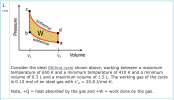 Consider the ideal Stirling cycle shown above, working between a maximum temperature of 650 K and a minimum temperature of 410 K and a minimum volume of 0.3 L and a maximum volume of 1.5 L. The working gas of the cycle is 0.10 mol of an ideal gas with C'v = 20.8 J/mol-K. Note, +Q = heat absorbed by the gas and +W = work done by the gas.Hint for Part A:Hint for Part B:Hints for Part C:Hint for...
A quantity of a monatomic ideal gas undergoes a process in which both its pressure and...
 A quantity of a monatomic ideal gas undergoes a process in which
both its pressure and volume are doubled as shown in the figure
above.
DATA:
V0 = 0.23 m3
P0 = 14500 Pa.
What is the change of the internal energy of the gas?
Tries 0/20
What was the work done by the gas during the expansion?
Tries 0/20
What amount of heat flowed into the gas during the expansion?
Tries 0/20
Post
Discussion
We were unable to transcribe...
A quantity of a monatomic ideal gas undergoes a process in which
both its pressure and volume are doubled as shown in the figure
above.
DATA:
V0 = 0.23 m3
P0 = 14500 Pa.
What is the change of the internal energy of the gas?
Tries 0/20
What was the work done by the gas during the expansion?
Tries 0/20
What amount of heat flowed into the gas during the expansion?
Tries 0/20
Post
Discussion
We were unable to transcribe...
One mole of an ideal monatomic gas is taken through the reversible cycle shown in the figure Volu...
 One mole of an ideal monatomic gas is taken through the reversible cycle shown in the figure Volume Process B-C is an adiabatic expansion with PB-13.0 atm and V-4.00x10³ m3. The volume at State C is 9.00Vg. Process A-B occurs at constant volume, and Process C A occurs at constant pressure. What is the energy added to the gas as heat for the cycle? Submit Answer Tries 0/10 What is the energy leaving the gas as heat? Submit Answer Tries...
Consider a gas of fermion at . 1) At finite temperature , find the occupation number...
Consider a gas of fermion at . 1) At finite temperature , find the occupation number of the quantum state with energy . Explain qualitatively how this distribution would influence on the specific heat of the system. T 0 We were unable to transcribe this imageWe were unable to transcribe this image T 0
ANSWER ALL PARTS As shown in the pV diagram, an ideal gas moves through a cycle...
 ANSWER ALL PARTS
As shown in the pV diagram, an ideal gas moves through a cycle from A to B to C and then back to A. From state A to state B, the ideal gas absorbs 80.0 J of heat and its internal (i.e. its thermal) energy increases by 30.0 J. From state B to state C, the internal energy of the ideal gas decreases by 20.0 J. As such, determine the following quantities: B V The work done...
ANSWER ALL PARTS
As shown in the pV diagram, an ideal gas moves through a cycle from A to B to C and then back to A. From state A to state B, the ideal gas absorbs 80.0 J of heat and its internal (i.e. its thermal) energy increases by 30.0 J. From state B to state C, the internal energy of the ideal gas decreases by 20.0 J. As such, determine the following quantities: B V The work done...
1) The SI unit of pressure is a. torr b. mmMg (millimeters of mercury) d. Pa...
1) The SI unit of pressure is a. torr b. mmMg (millimeters of mercury) d. Pa (Pascal) e. bar . . 2) What is the key difference between a barometer and a manometer? a. barometers are automated pressure measuring devices, while manometers are hand-operated (hence the prefix "man-") b. barometers are an older term for manometer c. barometers measure atmospheric pressure while manometers measure the pressures of a sample . . 3) Often during a storm pressure will drop. If...
Thermodynamics Brayton Cycle Questions! Hint for Part I: Hint for Part J: Hint for Part K:...
 Thermodynamics Brayton Cycle Questions!
Hint for Part I:
Hint for Part J:
Hint for Part K:
Hint for Part L:
2. р 1614 B с adiabatic adiabatic D А In a air-standard Brayton cycle the air enters the compressor (state a) at an absolute pressure of 95 kPa and a temperature of 291 K. The absolute pressure leaving the compressor (state b) is 1060 kPa. The maximum temperature is reached at state c, and is 1392 K. The gas has...
Thermodynamics Brayton Cycle Questions!
Hint for Part I:
Hint for Part J:
Hint for Part K:
Hint for Part L:
2. р 1614 B с adiabatic adiabatic D А In a air-standard Brayton cycle the air enters the compressor (state a) at an absolute pressure of 95 kPa and a temperature of 291 K. The absolute pressure leaving the compressor (state b) is 1060 kPa. The maximum temperature is reached at state c, and is 1392 K. The gas has...
A steam power plant operates on an ideal Rankine cycle with two of its feedwater heater...
 A steam power plant operates on an ideal Rankine cycle with two
of its feedwater heater closed as shown in the figure below and
with a net power output of 105MW. The mass flow rate of the steam
is 70kg/s and enters the high-pressure turbine at 6MPa and
and leaves at 1.5 Mpa. a fraction of x of steam is extracted at
this pressure to the closed feedwater. a fraction of y of steam is
extracted from the second stage...
A steam power plant operates on an ideal Rankine cycle with two
of its feedwater heater closed as shown in the figure below and
with a net power output of 105MW. The mass flow rate of the steam
is 70kg/s and enters the high-pressure turbine at 6MPa and
and leaves at 1.5 Mpa. a fraction of x of steam is extracted at
this pressure to the closed feedwater. a fraction of y of steam is
extracted from the second stage...
The wave pulses shown below travel along a string toward one another. 1) 2) 15. [1pt]...
 The wave pulses shown below travel along a string toward one
another.
1)
2)
15. [1pt] For each diagram above, select from
below the picture of the string at the instant of time when the two
pulses overlap completely. E.g., if the answer to 1 is A and the
answer to 2 is G, enter AG. You only have 4
tries.
A)
E)
B)
F)
C)
G)
D)
H)
- نه 10 m 1.0 m 0.5 1,0 m 1,0 m We...
The wave pulses shown below travel along a string toward one
another.
1)
2)
15. [1pt] For each diagram above, select from
below the picture of the string at the instant of time when the two
pulses overlap completely. E.g., if the answer to 1 is A and the
answer to 2 is G, enter AG. You only have 4
tries.
A)
E)
B)
F)
C)
G)
D)
H)
- نه 10 m 1.0 m 0.5 1,0 m 1,0 m We...
 Please answer all the questions
Consider the ideal Stirling cycle shown above, working between a
maximum temperature of 770 K and a minimum temperature of 420 K and
a minimum volume of 0.3 L and a maximum volume of 1.2 L. The
working gas of the cycle is 0.10 mol of an ideal gas with
c′v = 20.8 J/mol-K.
Note, +Q = heat absorbed by the gas and +W = work done
by the gas.
isothermal Pressure W isothermal V2...
Please answer all the questions
Consider the ideal Stirling cycle shown above, working between a
maximum temperature of 770 K and a minimum temperature of 420 K and
a minimum volume of 0.3 L and a maximum volume of 1.2 L. The
working gas of the cycle is 0.10 mol of an ideal gas with
c′v = 20.8 J/mol-K.
Note, +Q = heat absorbed by the gas and +W = work done
by the gas.
isothermal Pressure W isothermal V2...
 Consider the ideal Stirling cycle shown above, working between a maximum temperature of 650 K and a minimum temperature of 410 K and a minimum volume of 0.3 L and a maximum volume of 1.5 L. The working gas of the cycle is 0.10 mol of an ideal gas with C'v = 20.8 J/mol-K. Note, +Q = heat absorbed by the gas and +W = work done by the gas.Hint for Part A:Hint for Part B:Hints for Part C:Hint for...
 A quantity of a monatomic ideal gas undergoes a process in which
both its pressure and volume are doubled as shown in the figure
above.
DATA:
V0 = 0.23 m3
P0 = 14500 Pa.
What is the change of the internal energy of the gas?
Tries 0/20
What was the work done by the gas during the expansion?
Tries 0/20
What amount of heat flowed into the gas during the expansion?
Tries 0/20
Post
Discussion
We were unable to transcribe...
A quantity of a monatomic ideal gas undergoes a process in which
both its pressure and volume are doubled as shown in the figure
above.
DATA:
V0 = 0.23 m3
P0 = 14500 Pa.
What is the change of the internal energy of the gas?
Tries 0/20
What was the work done by the gas during the expansion?
Tries 0/20
What amount of heat flowed into the gas during the expansion?
Tries 0/20
Post
Discussion
We were unable to transcribe...
 One mole of an ideal monatomic gas is taken through the reversible cycle shown in the figure Volume Process B-C is an adiabatic expansion with PB-13.0 atm and V-4.00x10³ m3. The volume at State C is 9.00Vg. Process A-B occurs at constant volume, and Process C A occurs at constant pressure. What is the energy added to the gas as heat for the cycle? Submit Answer Tries 0/10 What is the energy leaving the gas as heat? Submit Answer Tries...
 ANSWER ALL PARTS
As shown in the pV diagram, an ideal gas moves through a cycle from A to B to C and then back to A. From state A to state B, the ideal gas absorbs 80.0 J of heat and its internal (i.e. its thermal) energy increases by 30.0 J. From state B to state C, the internal energy of the ideal gas decreases by 20.0 J. As such, determine the following quantities: B V The work done...
ANSWER ALL PARTS
As shown in the pV diagram, an ideal gas moves through a cycle from A to B to C and then back to A. From state A to state B, the ideal gas absorbs 80.0 J of heat and its internal (i.e. its thermal) energy increases by 30.0 J. From state B to state C, the internal energy of the ideal gas decreases by 20.0 J. As such, determine the following quantities: B V The work done...
 Thermodynamics Brayton Cycle Questions!
Hint for Part I:
Hint for Part J:
Hint for Part K:
Hint for Part L:
2. р 1614 B с adiabatic adiabatic D А In a air-standard Brayton cycle the air enters the compressor (state a) at an absolute pressure of 95 kPa and a temperature of 291 K. The absolute pressure leaving the compressor (state b) is 1060 kPa. The maximum temperature is reached at state c, and is 1392 K. The gas has...
Thermodynamics Brayton Cycle Questions!
Hint for Part I:
Hint for Part J:
Hint for Part K:
Hint for Part L:
2. р 1614 B с adiabatic adiabatic D А In a air-standard Brayton cycle the air enters the compressor (state a) at an absolute pressure of 95 kPa and a temperature of 291 K. The absolute pressure leaving the compressor (state b) is 1060 kPa. The maximum temperature is reached at state c, and is 1392 K. The gas has...
 A steam power plant operates on an ideal Rankine cycle with two
of its feedwater heater closed as shown in the figure below and
with a net power output of 105MW. The mass flow rate of the steam
is 70kg/s and enters the high-pressure turbine at 6MPa and
and leaves at 1.5 Mpa. a fraction of x of steam is extracted at
this pressure to the closed feedwater. a fraction of y of steam is
extracted from the second stage...
A steam power plant operates on an ideal Rankine cycle with two
of its feedwater heater closed as shown in the figure below and
with a net power output of 105MW. The mass flow rate of the steam
is 70kg/s and enters the high-pressure turbine at 6MPa and
and leaves at 1.5 Mpa. a fraction of x of steam is extracted at
this pressure to the closed feedwater. a fraction of y of steam is
extracted from the second stage...
 The wave pulses shown below travel along a string toward one
another.
1)
2)
15. [1pt] For each diagram above, select from
below the picture of the string at the instant of time when the two
pulses overlap completely. E.g., if the answer to 1 is A and the
answer to 2 is G, enter AG. You only have 4
tries.
A)
E)
B)
F)
C)
G)
D)
H)
- نه 10 m 1.0 m 0.5 1,0 m 1,0 m We...
The wave pulses shown below travel along a string toward one
another.
1)
2)
15. [1pt] For each diagram above, select from
below the picture of the string at the instant of time when the two
pulses overlap completely. E.g., if the answer to 1 is A and the
answer to 2 is G, enter AG. You only have 4
tries.
A)
E)
B)
F)
C)
G)
D)
H)
- نه 10 m 1.0 m 0.5 1,0 m 1,0 m We...
Most questions answered within 3 hours.
-
Where is the error in this code sequence?
String s1 = "Hello";
String s2 = "ello";...
asked 10 months ago -
Financial data for Joel de Paris, Inc., for last year
follow:
Joel de Paris, Inc.
Balance...
asked 10 months ago -
Consider this reaction:
Al2(SO4)3 (aq)+ BaCl3
(aq) Al2Cl6 (aq)- +
3BaSO4(s) . What is the...
asked 10 months ago -
Suppose that Savneet is considering increasing her
recent random sample from 20 car rentals to 40...
asked 10 months ago -
Trucks arrive at an unloading terminal at an average rate of 120
per hour.
Trucks arrive...
asked 10 months ago -
Why are methanol and ethanol completely soluble in water while
octanol is not very little soluble....
asked 10 months ago -
A facilities manager at a university reads in a research report
that the mean amount of...
asked 10 months ago -
When the CuSO4 is rehydrated by adding water to the anhydrous
compound, is this an endothermic...
asked 10 months ago -
A ray of sunlight is passing from diamond into crown glass; the
angle of incidence is...
asked 10 months ago -
A block of mass 0.249 kg is placed on top of a light, vertical
spring of...
asked 10 months ago -
how do the kidneys compensate in the presences of acidosis
a) trigger hyperventilate
b) reserve acid...
asked 10 months ago -
Question 501 pts
The rental rate of capital to the firm increases. Which of the
following...
asked 10 months ago