
Homework Answers
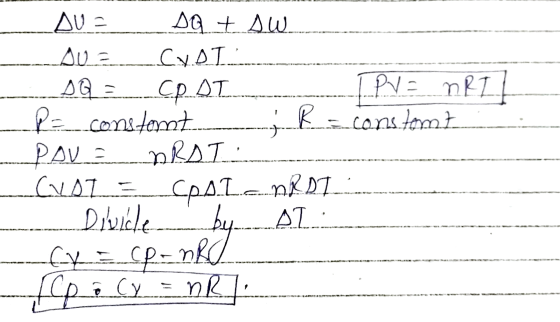
Add Answer to:
Please explain with all necessary equations and show your
work. Thanks!
8. Show that Cp -...
Please solve 22-11. The second picture is the given equations to use (22.24 and 22.23) 22-11....
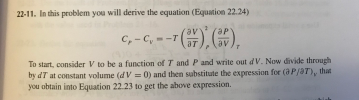 Please solve 22-11. The second picture is the given equations to
use (22.24 and 22.23)
22-11. In this problem you will derive the equation (Equation 22.24) 2 av )6). Cp - Cy=-T av P T To start, consider V to be a function of T and P and write out d V. Now divide through constant volume (d V = 0) and then substitute the expression for (a P/aT), that you obtain into Equation 22.23 to get the above expression....
Please solve 22-11. The second picture is the given equations to
use (22.24 and 22.23)
22-11. In this problem you will derive the equation (Equation 22.24) 2 av )6). Cp - Cy=-T av P T To start, consider V to be a function of T and P and write out d V. Now divide through constant volume (d V = 0) and then substitute the expression for (a P/aT), that you obtain into Equation 22.23 to get the above expression....
Please also explain the difference between delta H and delta U. Thanks! 2. Find the changes...
 Please also explain the difference between delta H and delta U.
Thanks!
2. Find the changes in internal energy (AU) and enthalpy (AH) per kmol, for air going from 10 bar, 277 K and 2.28 m3/kmol (molar volume), to 333 K and 1 atm. Use the following: 4 Cp = 29.3 kJ kmol-? K-1 Cy = 21 kJ kmol-? K-1 PV/T = constant Do not use any additional properties of ideal gases. There is no need to prove the gas...
Please also explain the difference between delta H and delta U.
Thanks!
2. Find the changes in internal energy (AU) and enthalpy (AH) per kmol, for air going from 10 bar, 277 K and 2.28 m3/kmol (molar volume), to 333 K and 1 atm. Use the following: 4 Cp = 29.3 kJ kmol-? K-1 Cy = 21 kJ kmol-? K-1 PV/T = constant Do not use any additional properties of ideal gases. There is no need to prove the gas...
Please help and show work. Thanks! (3). A sample of 1.00 mol ideal gas molecules with...
 Please help and show work. Thanks!
(3). A sample of 1.00 mol ideal gas molecules with Cp, m = 7/2 R is initially at p = 1.00 bar and V = 22.44 L and then put thought the following cycle in reversible processes: (a) constant-pressure expansion to twice its initial volume, (b) constant-volume cooling to its initial temperature, (c) isothermal-compression back to 1.00 bar. Calculate q, w, AU, AH, AS for each process and for the whole cycle. (20 pts)
Please help and show work. Thanks!
(3). A sample of 1.00 mol ideal gas molecules with Cp, m = 7/2 R is initially at p = 1.00 bar and V = 22.44 L and then put thought the following cycle in reversible processes: (a) constant-pressure expansion to twice its initial volume, (b) constant-volume cooling to its initial temperature, (c) isothermal-compression back to 1.00 bar. Calculate q, w, AU, AH, AS for each process and for the whole cycle. (20 pts)
14:03 # # Still 100% Energy and Enthalpy Changes, Heat and Work -- Monatomic Ideal Gas...
 14:03 # # Still 100% Energy and Enthalpy Changes, Heat and Work -- Monatomic Ideal Gas Pressure (atm) в - А 6 8 10 12 14 16 18 20 22 Volume (L) 2.00-mol of a monatomic ideal gas goes from State A to State D via the path ABCD: State A PA=13.5atm, VA=11.50L State BPg=13.5atm, Vg-7.00L State CPc=20.5atm, Vc=7.00L State D Pp=20.5atm, Vo=20.00L Assume that the external pressure is constant during each step and equals the final pressure of the...
Please answer the following question completely and correctly. Please show all work and write neatly. 3....
 Please answer the following question completely and correctly.
Please show all work and write neatly.
3. A sample of 1.00 mol ideal gas molecules with Cp, m = 7/2 R is initially at p = 1.00 bar and V = 22.44 L and then put thought the following cycle in reversible processes: (a) constant-pressure expansion to twice its initial volume, (b) constant-volume cooling to its initial temperature, (c) isothermal-compression back to 1.00 bar. Calculate q, w, AU, AH, AS for...
Please answer the following question completely and correctly.
Please show all work and write neatly.
3. A sample of 1.00 mol ideal gas molecules with Cp, m = 7/2 R is initially at p = 1.00 bar and V = 22.44 L and then put thought the following cycle in reversible processes: (a) constant-pressure expansion to twice its initial volume, (b) constant-volume cooling to its initial temperature, (c) isothermal-compression back to 1.00 bar. Calculate q, w, AU, AH, AS for...
Ch 19 HW Relationships between Molar Heat Capacities 9 of 23 Constants The amount of heat needed to raise the temperatu...
 Ch 19 HW Relationships between Molar Heat Capacities 9 of 23 Constants The amount of heat needed to raise the temperature of 1 mole of a substance by one Celsius degree (or, equivalently, one kelvin) is called the molar heat capacity of the system, denoted by the letter C. If a small amount of heat dQ is put into n moles of a substance, and the resulting change in temperature for the system is dT, then Part A Consider an...
4. The enthalpy H may be written as a function of temperature T and pressure P. If we have a system whose composition remains constant and using Maxwell's equations and the total differential, we...
 4. The enthalpy H may be written as a function of temperature T and pressure P. If we have a system whose composition remains constant and using Maxwell's equations and the total differential, we can write dH as avdP where Cp is the heat capacity at constant pressure and the subscript of P on the partial derivative represents the partial of volume with respect to temperature holding pressure connstant. Find the change in enthalpy (A) for an ideal gas undergoing...
please show all work, and state your assumptions please don't forget this part thanks. 1. Consider...
 please
show
all work, and state your assumptions please don't forget this part
thanks.
1. Consider steady flow of an ideal inviscid fluid with the curved streamlines. 4, = 15 42 = 20 (a). Find the volume flow rate per unit width (out of the plane of the paper) between the two streamlines. (4 points) # (b). Will the pressures of the two streamlines be the same? If not, which one has higher pressure? (4 points)
please
show
all work, and state your assumptions please don't forget this part
thanks.
1. Consider steady flow of an ideal inviscid fluid with the curved streamlines. 4, = 15 42 = 20 (a). Find the volume flow rate per unit width (out of the plane of the paper) between the two streamlines. (4 points) # (b). Will the pressures of the two streamlines be the same? If not, which one has higher pressure? (4 points)
Given the ideal gas law, PV = nRT, show that (a)-←←=-1 8. (b) From thermodynamics, the...
 Given the ideal gas law, PV = nRT, show that (a)-←←=-1 8. (b) From thermodynamics, the relationship between Cp (heat capacity at constant pressure) and C, (heat capacity at constant volume) for an ideal gas is given by: C, ) Simplify the right hand side. (i) Can we conclude that C, > C, for an ideal gas? OT
I need help with part 2, thanks! Problem 4 (1) Use first law to directly prove...
 I need help with part 2, thanks!
Problem 4 (1) Use first law to directly prove that work done by an ideal gas during an adiabatic process is CV (Ti -Tf), where T1 and Tf are the initial and final temperatures of the system. (2) Show that the heat transferred to an ideal gas system during an infinitesimal reversible process can be written as where c and ?,, are specific heat capacities under constant volume and pressure, respectively. Use this...
I need help with part 2, thanks!
Problem 4 (1) Use first law to directly prove that work done by an ideal gas during an adiabatic process is CV (Ti -Tf), where T1 and Tf are the initial and final temperatures of the system. (2) Show that the heat transferred to an ideal gas system during an infinitesimal reversible process can be written as where c and ?,, are specific heat capacities under constant volume and pressure, respectively. Use this...
 Please solve 22-11. The second picture is the given equations to
use (22.24 and 22.23)
22-11. In this problem you will derive the equation (Equation 22.24) 2 av )6). Cp - Cy=-T av P T To start, consider V to be a function of T and P and write out d V. Now divide through constant volume (d V = 0) and then substitute the expression for (a P/aT), that you obtain into Equation 22.23 to get the above expression....
Please solve 22-11. The second picture is the given equations to
use (22.24 and 22.23)
22-11. In this problem you will derive the equation (Equation 22.24) 2 av )6). Cp - Cy=-T av P T To start, consider V to be a function of T and P and write out d V. Now divide through constant volume (d V = 0) and then substitute the expression for (a P/aT), that you obtain into Equation 22.23 to get the above expression....
 Please also explain the difference between delta H and delta U.
Thanks!
2. Find the changes in internal energy (AU) and enthalpy (AH) per kmol, for air going from 10 bar, 277 K and 2.28 m3/kmol (molar volume), to 333 K and 1 atm. Use the following: 4 Cp = 29.3 kJ kmol-? K-1 Cy = 21 kJ kmol-? K-1 PV/T = constant Do not use any additional properties of ideal gases. There is no need to prove the gas...
Please also explain the difference between delta H and delta U.
Thanks!
2. Find the changes in internal energy (AU) and enthalpy (AH) per kmol, for air going from 10 bar, 277 K and 2.28 m3/kmol (molar volume), to 333 K and 1 atm. Use the following: 4 Cp = 29.3 kJ kmol-? K-1 Cy = 21 kJ kmol-? K-1 PV/T = constant Do not use any additional properties of ideal gases. There is no need to prove the gas...
 Please help and show work. Thanks!
(3). A sample of 1.00 mol ideal gas molecules with Cp, m = 7/2 R is initially at p = 1.00 bar and V = 22.44 L and then put thought the following cycle in reversible processes: (a) constant-pressure expansion to twice its initial volume, (b) constant-volume cooling to its initial temperature, (c) isothermal-compression back to 1.00 bar. Calculate q, w, AU, AH, AS for each process and for the whole cycle. (20 pts)
Please help and show work. Thanks!
(3). A sample of 1.00 mol ideal gas molecules with Cp, m = 7/2 R is initially at p = 1.00 bar and V = 22.44 L and then put thought the following cycle in reversible processes: (a) constant-pressure expansion to twice its initial volume, (b) constant-volume cooling to its initial temperature, (c) isothermal-compression back to 1.00 bar. Calculate q, w, AU, AH, AS for each process and for the whole cycle. (20 pts)
 14:03 # # Still 100% Energy and Enthalpy Changes, Heat and Work -- Monatomic Ideal Gas Pressure (atm) в - А 6 8 10 12 14 16 18 20 22 Volume (L) 2.00-mol of a monatomic ideal gas goes from State A to State D via the path ABCD: State A PA=13.5atm, VA=11.50L State BPg=13.5atm, Vg-7.00L State CPc=20.5atm, Vc=7.00L State D Pp=20.5atm, Vo=20.00L Assume that the external pressure is constant during each step and equals the final pressure of the...
 Please answer the following question completely and correctly.
Please show all work and write neatly.
3. A sample of 1.00 mol ideal gas molecules with Cp, m = 7/2 R is initially at p = 1.00 bar and V = 22.44 L and then put thought the following cycle in reversible processes: (a) constant-pressure expansion to twice its initial volume, (b) constant-volume cooling to its initial temperature, (c) isothermal-compression back to 1.00 bar. Calculate q, w, AU, AH, AS for...
Please answer the following question completely and correctly.
Please show all work and write neatly.
3. A sample of 1.00 mol ideal gas molecules with Cp, m = 7/2 R is initially at p = 1.00 bar and V = 22.44 L and then put thought the following cycle in reversible processes: (a) constant-pressure expansion to twice its initial volume, (b) constant-volume cooling to its initial temperature, (c) isothermal-compression back to 1.00 bar. Calculate q, w, AU, AH, AS for...
 Ch 19 HW Relationships between Molar Heat Capacities 9 of 23 Constants The amount of heat needed to raise the temperature of 1 mole of a substance by one Celsius degree (or, equivalently, one kelvin) is called the molar heat capacity of the system, denoted by the letter C. If a small amount of heat dQ is put into n moles of a substance, and the resulting change in temperature for the system is dT, then Part A Consider an...
 4. The enthalpy H may be written as a function of temperature T and pressure P. If we have a system whose composition remains constant and using Maxwell's equations and the total differential, we can write dH as avdP where Cp is the heat capacity at constant pressure and the subscript of P on the partial derivative represents the partial of volume with respect to temperature holding pressure connstant. Find the change in enthalpy (A) for an ideal gas undergoing...
 please
show
all work, and state your assumptions please don't forget this part
thanks.
1. Consider steady flow of an ideal inviscid fluid with the curved streamlines. 4, = 15 42 = 20 (a). Find the volume flow rate per unit width (out of the plane of the paper) between the two streamlines. (4 points) # (b). Will the pressures of the two streamlines be the same? If not, which one has higher pressure? (4 points)
please
show
all work, and state your assumptions please don't forget this part
thanks.
1. Consider steady flow of an ideal inviscid fluid with the curved streamlines. 4, = 15 42 = 20 (a). Find the volume flow rate per unit width (out of the plane of the paper) between the two streamlines. (4 points) # (b). Will the pressures of the two streamlines be the same? If not, which one has higher pressure? (4 points)
 Given the ideal gas law, PV = nRT, show that (a)-←←=-1 8. (b) From thermodynamics, the relationship between Cp (heat capacity at constant pressure) and C, (heat capacity at constant volume) for an ideal gas is given by: C, ) Simplify the right hand side. (i) Can we conclude that C, > C, for an ideal gas? OT
 I need help with part 2, thanks!
Problem 4 (1) Use first law to directly prove that work done by an ideal gas during an adiabatic process is CV (Ti -Tf), where T1 and Tf are the initial and final temperatures of the system. (2) Show that the heat transferred to an ideal gas system during an infinitesimal reversible process can be written as where c and ?,, are specific heat capacities under constant volume and pressure, respectively. Use this...
I need help with part 2, thanks!
Problem 4 (1) Use first law to directly prove that work done by an ideal gas during an adiabatic process is CV (Ti -Tf), where T1 and Tf are the initial and final temperatures of the system. (2) Show that the heat transferred to an ideal gas system during an infinitesimal reversible process can be written as where c and ?,, are specific heat capacities under constant volume and pressure, respectively. Use this...
Most questions answered within 3 hours.
-
Where is the error in this code sequence?
String s1 = "Hello";
String s2 = "ello";...
asked 10 months ago -
Financial data for Joel de Paris, Inc., for last year
follow:
Joel de Paris, Inc.
Balance...
asked 10 months ago -
Consider this reaction:
Al2(SO4)3 (aq)+ BaCl3
(aq) Al2Cl6 (aq)- +
3BaSO4(s) . What is the...
asked 10 months ago -
Suppose that Savneet is considering increasing her
recent random sample from 20 car rentals to 40...
asked 10 months ago -
Trucks arrive at an unloading terminal at an average rate of 120
per hour.
Trucks arrive...
asked 10 months ago -
Why are methanol and ethanol completely soluble in water while
octanol is not very little soluble....
asked 10 months ago -
A facilities manager at a university reads in a research report
that the mean amount of...
asked 10 months ago -
When the CuSO4 is rehydrated by adding water to the anhydrous
compound, is this an endothermic...
asked 10 months ago -
A ray of sunlight is passing from diamond into crown glass; the
angle of incidence is...
asked 10 months ago -
A block of mass 0.249 kg is placed on top of a light, vertical
spring of...
asked 10 months ago -
how do the kidneys compensate in the presences of acidosis
a) trigger hyperventilate
b) reserve acid...
asked 10 months ago -
Question 501 pts
The rental rate of capital to the firm increases. Which of the
following...
asked 10 months ago