
Homework Answers
Add Answer to:
Moment of Inertia/Conservation of Angular Momentum 10) Consider a cat in free-fall, as shown above (assume...
The physics students wish to test the law of conservation of angular momentum perform a completely...
The physics students wish to test the law of conservation of angular momentum perform a completely inelastic collision between two discs. They attach disc 1 (from part 1) to the rotational sensor then give it a spin. After about 4 seconds, they drop disc 2 on top of disc 1. The whole process takes only ~10 seconds total. Use the rate of change of the single disc angular velocity and the duration of the collision to find a corrected value...
24 4 points Conservation of angular momentum: A disk with moment of inertia I1 = 3kgm...
 24 4 points Conservation of angular momentum: A disk with moment of inertia I1 = 3kgm rotates about a frictionless, vertical axle with angular speed wi = 8Rad/s. A second disk, this one having moment of inertia 12 = 1kgm and initially not rotating, drops onto the first disk. Because of friction between the surfaces, the two eventually reach the same angular speed W2 . What is w2? 13 Before After 24 Rad/s 12 Rad/s 6 Rad/s 16 Rad/s 4...
A disk with moment of inertia 9.15 × 10⁻³ kg∙m^2 initially rotates about its center at...
A disk with moment of inertia 9.15 × 10⁻³ kg∙m^2 initially rotates about its center at angular velocity 5.32 rad/s. A non-rotating ring with moment of inertia 4.86 × 10⁻³ kg∙m^2 right above the disk’s center is suddenly dropped onto the disk. Finally, the two objects rotate at the same angular velocity ?? about the same axis. There is no external torque acting on the system during the collision. Please compute the system’s quantities below. 1. Initial angular momentum ??...
(3) A disk with moment of inertia 9.15 × 10⁻³ kg∙m 2 initially rotates about its...
(3) A disk with moment of inertia 9.15 × 10⁻³ kg∙m 2 initially rotates about its center at angular velocity 5.32 rad/s. A non-rotating ring with moment of inertia 4.86 × 10⁻³ kg∙m 2 right above the disk’s center is suddenly dropped onto the disk. Finally, the two objects rotate at the same angular velocity ?? about the same axis. There is no external torque acting on the system during the collision. Please compute the system’s quantities below. 1. Initial...
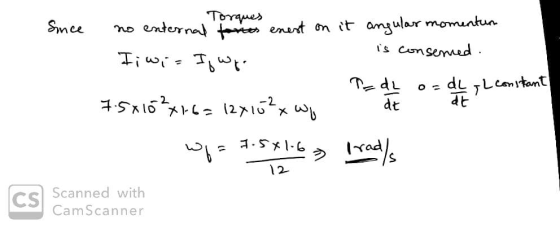
To understand how to use conservation of angular momentum to solve problems involving collisions of rotating...
 To understand how to use conservation of angular momentum to solve problems involving collisions of rotating bodies. Consider a turntable to be a circular disk of moment of inertia I_t rotating at a constant angular velocity omega_i around an axis through the center and perpendicular to the plane of the disk (the disk's "primary axis of symmetry"). The axis of the disk is vertical and the disk is supported by frictionless bearings. The motor of the turntable is off, so...
To understand how to use conservation of angular momentum to solve problems involving collisions of rotating bodies. (...
To understand how to use conservation of angular momentum to solve problems involving collisions of rotating bodies. (Figure 1) Consider a turntable to be a circular disk of moment of inertia It rotating at a constant angular velocity ωi around an axis through the center and perpendicular to the plane of the disk (the disk's "primary axis of symmetry"). The axis of the disk is vertical and the disk is supported by frictionless bearings. The motor of the turntable is...
need help on C. Conservation of angular momentum A spherical star with radius R1 7.96 x...
 need help on C.
Conservation of angular momentum A spherical star with radius R1 7.96 x 10 km and rotating with angular speed (o 3,92 x 10s rad/s suddenly collapses into a neutron star. The neutron star emits a beam of X-rays directed radially outward that can be seen by an observatory on the earth r 4.55 x 10⁴ km from the star. The X-ray beam sweeps past the earth with a tangential speed v 7.40 x 10 km/s each...
need help on C.
Conservation of angular momentum A spherical star with radius R1 7.96 x 10 km and rotating with angular speed (o 3,92 x 10s rad/s suddenly collapses into a neutron star. The neutron star emits a beam of X-rays directed radially outward that can be seen by an observatory on the earth r 4.55 x 10⁴ km from the star. The X-ray beam sweeps past the earth with a tangential speed v 7.40 x 10 km/s each...
10*) The Sun has approximate radius 7×10⁸ m, and rotates around its axis once every 27...
 10*) The Sun has approximate radius 7×10⁸ m, and rotates around
its axis once every 27 days. a) Find its angular velocity in rad/s,
and (assuming it is a uniform sphere) write a formula for its
angular momentum expressing it in terms of its mass M (you do not
need to substitute a value for M). b) Suppose the Sun were to
collapse to a neutron star, which is a much denser state, without
losing any mass and without being...
10*) The Sun has approximate radius 7×10⁸ m, and rotates around
its axis once every 27 days. a) Find its angular velocity in rad/s,
and (assuming it is a uniform sphere) write a formula for its
angular momentum expressing it in terms of its mass M (you do not
need to substitute a value for M). b) Suppose the Sun were to
collapse to a neutron star, which is a much denser state, without
losing any mass and without being...
Consider a turntable to be a circular disk of moment of inertia 0.142 kg⋅m2 rotating at...
Consider a turntable to be a circular disk of moment of inertia 0.142 kg⋅m2 rotating at a constant angular velocity 4.80 rad/s2 around an axis through the center and perpendicular to the plane of the disk (the disk's "primary axis of symmetry"). The axis of the disk is vertical and the disk is supported by frictionless bearings. The motor of the turntable is off, so there is no external torque being applied to the axis. Another disk (a record) is...
Problem 1 Two identical pucks, each of inertia m, are connected to a rod of length...
 Problem 1 Two identical pucks, each of inertia m, are connected to a rod of length 2r and negligible inertia that is pivoted about its center (that is, there is some sort of pin though its center, around which it can rotate without friction). A third puck of inertia m/2 strikes one of the connected pucks perpendicular to the rod with a speed vi. Assume the collision is elastic. (a) Draw a diagram of the situation, clearly labeling the direction...
 24 4 points Conservation of angular momentum: A disk with moment of inertia I1 = 3kgm rotates about a frictionless, vertical axle with angular speed wi = 8Rad/s. A second disk, this one having moment of inertia 12 = 1kgm and initially not rotating, drops onto the first disk. Because of friction between the surfaces, the two eventually reach the same angular speed W2 . What is w2? 13 Before After 24 Rad/s 12 Rad/s 6 Rad/s 16 Rad/s 4...
 To understand how to use conservation of angular momentum to solve problems involving collisions of rotating bodies. Consider a turntable to be a circular disk of moment of inertia I_t rotating at a constant angular velocity omega_i around an axis through the center and perpendicular to the plane of the disk (the disk's "primary axis of symmetry"). The axis of the disk is vertical and the disk is supported by frictionless bearings. The motor of the turntable is off, so...
 need help on C.
Conservation of angular momentum A spherical star with radius R1 7.96 x 10 km and rotating with angular speed (o 3,92 x 10s rad/s suddenly collapses into a neutron star. The neutron star emits a beam of X-rays directed radially outward that can be seen by an observatory on the earth r 4.55 x 10⁴ km from the star. The X-ray beam sweeps past the earth with a tangential speed v 7.40 x 10 km/s each...
need help on C.
Conservation of angular momentum A spherical star with radius R1 7.96 x 10 km and rotating with angular speed (o 3,92 x 10s rad/s suddenly collapses into a neutron star. The neutron star emits a beam of X-rays directed radially outward that can be seen by an observatory on the earth r 4.55 x 10⁴ km from the star. The X-ray beam sweeps past the earth with a tangential speed v 7.40 x 10 km/s each...
 10*) The Sun has approximate radius 7×10⁸ m, and rotates around
its axis once every 27 days. a) Find its angular velocity in rad/s,
and (assuming it is a uniform sphere) write a formula for its
angular momentum expressing it in terms of its mass M (you do not
need to substitute a value for M). b) Suppose the Sun were to
collapse to a neutron star, which is a much denser state, without
losing any mass and without being...
10*) The Sun has approximate radius 7×10⁸ m, and rotates around
its axis once every 27 days. a) Find its angular velocity in rad/s,
and (assuming it is a uniform sphere) write a formula for its
angular momentum expressing it in terms of its mass M (you do not
need to substitute a value for M). b) Suppose the Sun were to
collapse to a neutron star, which is a much denser state, without
losing any mass and without being...
 Problem 1 Two identical pucks, each of inertia m, are connected to a rod of length 2r and negligible inertia that is pivoted about its center (that is, there is some sort of pin though its center, around which it can rotate without friction). A third puck of inertia m/2 strikes one of the connected pucks perpendicular to the rod with a speed vi. Assume the collision is elastic. (a) Draw a diagram of the situation, clearly labeling the direction...
Most questions answered within 3 hours.
-
Where is the error in this code sequence?
String s1 = "Hello";
String s2 = "ello";...
asked 11 months ago -
Financial data for Joel de Paris, Inc., for last year
follow:
Joel de Paris, Inc.
Balance...
asked 11 months ago -
Consider this reaction:
Al2(SO4)3 (aq)+ BaCl3
(aq) Al2Cl6 (aq)- +
3BaSO4(s) . What is the...
asked 11 months ago -
Suppose that Savneet is considering increasing her
recent random sample from 20 car rentals to 40...
asked 11 months ago -
Trucks arrive at an unloading terminal at an average rate of 120
per hour.
Trucks arrive...
asked 11 months ago -
Why are methanol and ethanol completely soluble in water while
octanol is not very little soluble....
asked 11 months ago -
A facilities manager at a university reads in a research report
that the mean amount of...
asked 11 months ago -
When the CuSO4 is rehydrated by adding water to the anhydrous
compound, is this an endothermic...
asked 11 months ago -
A ray of sunlight is passing from diamond into crown glass; the
angle of incidence is...
asked 11 months ago -
A block of mass 0.249 kg is placed on top of a light, vertical
spring of...
asked 11 months ago -
how do the kidneys compensate in the presences of acidosis
a) trigger hyperventilate
b) reserve acid...
asked 11 months ago -
Question 501 pts
The rental rate of capital to the firm increases. Which of the
following...
asked 11 months ago