Please show that answer step by step! Thx!!! 3. What are the advantage and drawbacks of...
Please show that answer step by step! Thx!!!
3. What are the advantage and drawbacks of Virtual Memory with paging?
4. Which kind of fragmentation (external or internal) will be influenced by the page size? What will happen if the page size goes smaller? What is the drawback(s) of small page size?
These are all question has, if need more information to answer, please let me know which kind of information needed.
Homework Answers
3.
Virtual Memory is a storage mechanism which offers user an illusion of having a very big main memory. It is done by treating a part of secondary memory as the main memory. In Virtual memory, the user can store processes with a bigger size than the available main memory.
Therefore, instead of loading one long process in the main memory, the OS loads the various parts of more than one process in the main memory. Virtual memory is mostly implemented with demand paging and demand segmentation.
Advantages of Virtual Memory:
Here, are pros/benefits of using Virtual Memory:
Virtual memory helps to gain speed when only a particular
segment of the program is required for the execution of the
program.
It is very helpful in implementing a multiprogramming
environment.
It allows you to run more applications at once.
It helps you to fit many large programs into smaller
programs.
Common data or code may be shared between memory.
Process may become even larger than all of the physical
memory.
Data / code should be read from disk whenever required.
The code can be placed anywhere in physical memory without
requiring relocation.
More processes should be maintained in the main memory, which
increases the effective use of CPU.
Each page is stored on a disk until it is required after that, it
will be removed.
It allows more applications to be run at the same time.
There is no specific limit on the degree of multiprogramming.
Large programs should be written, as virtual address space
available is more compared to physical memory.
Disadvantages of Virtual Memory:
Here, are drawbacks/cons of using virtual memory:
Applications may run slower if the system is using virtual
memory.
Likely takes more time to switch between applications.
Offers lesser hard drive space for your use.
It reduces system stability.
It allows larger applications to run in systems that don't offer
enough physical RAM alone to run them.
It doesn't offer the same performance as RAM.
It negatively affects the overall performance of a system.
Occupy the storage space, which may be used otherwise for long term
data storage.
4.
In operating system internals and design principles (7th edition), there is a sentence "the smaller the page size the lesser the amount of internal fragmentation".
Let say your process has 12 bytes of executable code, 34 bytes of read only data and 56 bytes of read/write data. Note that each of these areas have different access permissions, and therefore (for most CPUs where permissions are associated with pages) they can't share pages.
If the page size is 100 bytes then the 12 bytes of executable code is going to have to consume 100 bytes (a whole page) and 88 bytes of that will be wasted (internal fragmentation); and the whole process will waste 198 bytes due to internal fragmentation (because the size of each of the 3 areas will need to be rounding up to the page size). If the page size is 16384 bytes then the same process would waste 49050 bytes; and if the page size was 10 bytes it'd waste 18 bytes.
More specifically; if N processes have M unique areas (where a unique area may be shared by multiple processes) you'd expect/assume that the average amount of bytes wasted due to internal fragmentation will be "M * PAGE_SIZE/2".
Rarely do processes require the use of an exact number of pages. As a result, the last page will likely only be partially full, wasting some amount of memory. Larger page sizes increase the potential for wasted memory this way, as more potentially unused portions of memory are loaded into main memory. Smaller page sizes ensure a closer match to the actual amount of memory required in an allocation.
large pages:
pro - smaller page table, less page faults, less overhead in
reading/writing of pages
con - more internal fragmentation, worse locality of
reference
smaller pages:
pro - reduces internal fragmentation, better with locality of
reference
con - bigger page table, more page faults, overhead in reading/writing of pages
Add Answer to:
Please show that answer step by step! Thx!!!
3. What are the advantage and drawbacks of...
Please assist with below: Please label answer with number. Also, please draw diagram as indicated for...
Please assist with below: Please label answer with number. Also, please draw diagram as indicated for 3.1 #3: 3.1) Draw a diagram showing how addresses are translated on a virtual memory system 3.2) Explain temporal locality and how it is used in memory paging systems. 3.3) Explain what a stub is 3.4) Explain external fragmentation 3.5) Explain internal fragmentation
Please show the answer step by step, thx!!! What is the main purpose of using Dropout...
Please show the answer step by step, thx!!! What is the main purpose of using Dropout during training in a deep neural network? Select the one (1) best answer of the following: To speed up training To avoid underfitting To avoid overfitting To increase accuracy on the training set
Please show that answer step by step and explain clearly, thx!!!! 3. Give two reasons why...
Please show that answer step by step and explain clearly, thx!!!! 3. Give two reasons why memorizing the training data and doing table look ups is a bad strategy for learning.
Number Name 3. Assuming no page fault on a page table access, what is the processor...
 Number Name 3. Assuming no page fault on a page table access, what is the processor memory access time for the system depicted in the above figure, for a physical memory with 50ns read/write times? 4. Now, assume that the memory system has a translation look-aside buffer (TLB). The TLB requires 10 ns to determine a hit or mess. The physical memory system has an access time of 50ns. You may assume that page fault rate for the application is...
Please provide corret answer and explan, thanks. Incorrect Question 5 0/6.25 pts Numerical answer. Pay attention...
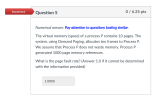 Please provide corret answer
and explan, thanks.
Incorrect Question 5 0/6.25 pts Numerical answer. Pay attention to questions looking similar. The virtual memory (space) of a process P contains 10 pages. The system, using Demand Paging, allocates ten frames to Process P. We assume that Process P does not waste memory. Process P generated 1000 page memory references What is the page fault rate? (Answer 1.0 if it cannot be determined with the information provided) 1.0000
Please provide corret answer
and explan, thanks.
Incorrect Question 5 0/6.25 pts Numerical answer. Pay attention to questions looking similar. The virtual memory (space) of a process P contains 10 pages. The system, using Demand Paging, allocates ten frames to Process P. We assume that Process P does not waste memory. Process P generated 1000 page memory references What is the page fault rate? (Answer 1.0 if it cannot be determined with the information provided) 1.0000
Please show that answer step by step and explain clearly, thx!!!! 1. Give an example of...
Please show that answer step by step and explain clearly, thx!!!! 1. Give an example of a low dimensional (approx. 20 dimensions), medium dimensional (approx. 1000 dimensions) and high dimensional (approx. 100000 dimensions) problem that you care about. 2. What does the decision boundary of 1 nearest neighbor classifier for 2 points (one positive, one negative) look like?
Please answer the following questions about paged memory... A) How much space needs to be allocated...
Please answer the following questions about paged memory... A) How much space needs to be allocated in the minimum and maximum cases for a two-level page table for a machine with a 32-bit virtual memory address, a 1K page size, and which has four times as many inner pages as outer pages? Assume any stored page table value requires 32 bits. B) For the two-level paging approach above, if a Translation Lookaside Buffer (TLB) is used and can cache both...
Name Olbinna COSC414/514 Quiz3 (1) Suppose a computer has 4 physical pages, and a process referen...
 Name Olbinna COSC414/514 Quiz3 (1) Suppose a computer has 4 physical pages, and a process references its virtual pages (page o through page 7) in the following order: 021354637473355311172341 Also suppose the first four pages have been loaded in the physical memory as the following figure: Frame 0 Frame 1 Frame 2 Frame 3 a. Suppose the kernel uses First-In-First-Out (FIFO) page replacement algorithm. How many page faults would the process have? Which page references are page faults? b. Suppose...
READ THIS WELL: If you answer with something stupid/inccorect (e.g. telling me what a depolarizat...
READ THIS WELL: If you answer with something stupid/inccorect (e.g. telling me what a depolarization is or telling me that a small postsynaptic cell helps a signal carry, I'll give you no credit) One property of electrical synapses is that the postsynaptic neuron tends to be smaller than the presynaptic neuron. Based on what you know about the relationship between neuron size and input resistance, what is the advantage of this arrangement? Please answer this in terms of Ohm's law...
READ THIS WELL: If you answer with something stupid/inccorect (e.g. telling me what a depolarization is...
READ THIS WELL: If you answer with something stupid/inccorect (e.g. telling me what a depolarization is or telling me that a small postsynaptic cell helps a signal carry, I'll give you no credit) One property of electrical synapses is that the postsynaptic neuron tends to be smaller than the presynaptic neuron. Based on what you know about the relationship between neuron size and input resistance, what is the advantage of this arrangement? Please answer this in terms of Ohm's law...
 Number Name 3. Assuming no page fault on a page table access, what is the processor memory access time for the system depicted in the above figure, for a physical memory with 50ns read/write times? 4. Now, assume that the memory system has a translation look-aside buffer (TLB). The TLB requires 10 ns to determine a hit or mess. The physical memory system has an access time of 50ns. You may assume that page fault rate for the application is...
 Please provide corret answer
and explan, thanks.
Incorrect Question 5 0/6.25 pts Numerical answer. Pay attention to questions looking similar. The virtual memory (space) of a process P contains 10 pages. The system, using Demand Paging, allocates ten frames to Process P. We assume that Process P does not waste memory. Process P generated 1000 page memory references What is the page fault rate? (Answer 1.0 if it cannot be determined with the information provided) 1.0000
Please provide corret answer
and explan, thanks.
Incorrect Question 5 0/6.25 pts Numerical answer. Pay attention to questions looking similar. The virtual memory (space) of a process P contains 10 pages. The system, using Demand Paging, allocates ten frames to Process P. We assume that Process P does not waste memory. Process P generated 1000 page memory references What is the page fault rate? (Answer 1.0 if it cannot be determined with the information provided) 1.0000
 Name Olbinna COSC414/514 Quiz3 (1) Suppose a computer has 4 physical pages, and a process references its virtual pages (page o through page 7) in the following order: 021354637473355311172341 Also suppose the first four pages have been loaded in the physical memory as the following figure: Frame 0 Frame 1 Frame 2 Frame 3 a. Suppose the kernel uses First-In-First-Out (FIFO) page replacement algorithm. How many page faults would the process have? Which page references are page faults? b. Suppose...
Most questions answered within 3 hours.
-
Where is the error in this code sequence?
String s1 = "Hello";
String s2 = "ello";...
asked 10 months ago -
Financial data for Joel de Paris, Inc., for last year
follow:
Joel de Paris, Inc.
Balance...
asked 10 months ago -
Consider this reaction:
Al2(SO4)3 (aq)+ BaCl3
(aq) Al2Cl6 (aq)- +
3BaSO4(s) . What is the...
asked 10 months ago -
Suppose that Savneet is considering increasing her
recent random sample from 20 car rentals to 40...
asked 10 months ago -
Trucks arrive at an unloading terminal at an average rate of 120
per hour.
Trucks arrive...
asked 10 months ago -
Why are methanol and ethanol completely soluble in water while
octanol is not very little soluble....
asked 10 months ago -
A facilities manager at a university reads in a research report
that the mean amount of...
asked 10 months ago -
When the CuSO4 is rehydrated by adding water to the anhydrous
compound, is this an endothermic...
asked 10 months ago -
A ray of sunlight is passing from diamond into crown glass; the
angle of incidence is...
asked 10 months ago -
A block of mass 0.249 kg is placed on top of a light, vertical
spring of...
asked 10 months ago -
how do the kidneys compensate in the presences of acidosis
a) trigger hyperventilate
b) reserve acid...
asked 10 months ago -
Question 501 pts
The rental rate of capital to the firm increases. Which of the
following...
asked 10 months ago