3. Problems and Applications Q3
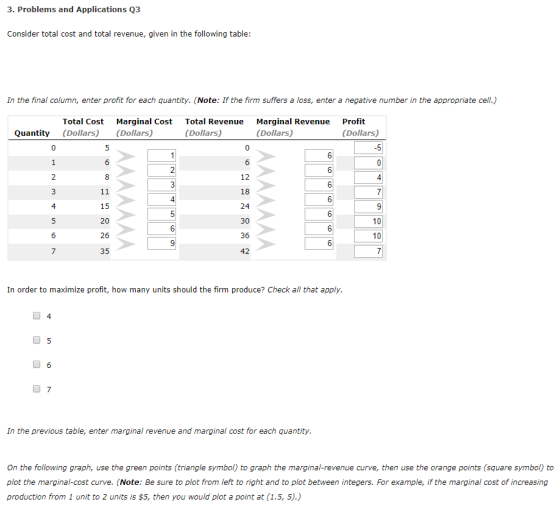
Consider total cost and total revenue, given in the following table:

Homework Answers

Add Answer to:
3. Problems and Applications Q3
Consider total cost and total revenue, given in the following
table:...
Consider total cost and total revenue, given in the following table: In the final column, enter...
 Consider total cost and total revenue, given in the following
table:
In the final column, enter profit for each quantity.
(Note: If the firm suffers a loss, enter a
negative number in the appropriate cell.)
Quantity
Total Cost
Marginal Cost
Total Revenue
Marginal Revenue
Profit
(Dollars)
(Dollars)
(Dollars)
(Dollars)
(Dollars)
0
6
0
1
8
7
2
10
14
3
13
21
4
17
28
5
24
35
6
32
42
7
42
49
In order to maximize profit, how...
Consider total cost and total revenue, given in the following
table:
In the final column, enter profit for each quantity.
(Note: If the firm suffers a loss, enter a
negative number in the appropriate cell.)
Quantity
Total Cost
Marginal Cost
Total Revenue
Marginal Revenue
Profit
(Dollars)
(Dollars)
(Dollars)
(Dollars)
(Dollars)
0
6
0
1
8
7
2
10
14
3
13
21
4
17
28
5
24
35
6
32
42
7
42
49
In order to maximize profit, how...
5. Consider total cost and total revenue given in the following table:
 5. Consider total cost and total revenue given in the following table: a. Calculate profit for each quantity. How much should the firm produce to maximize profit? b. Calculate marginal revenue and marginal cost for each quantity. Graph them. (Hint: Put the points between whole numbers. For example, the marginal cost between 2 and 3 should be graphed at 2/½.) c. At what quantity do the curves in part b cross? How does this relate to your answer to part a.? d. Can you...
Consider total cost and total revenue given in the table below:
. Consider total cost and total revenue given in the table below:QUANTITY 0 1 2 3 4 5 6 7Total cost $8 $9 $10 $11 $13 $19 $27 $37Total revenue 0 8 16 24 32 40 48 56a. Calculate profit for each quantity. How much should the firm produce to maximize profit?b. Calculate marginal revenue and marginal cost for each quantity. Graph them. (Hint: Put the points between whole numbers. For example, the marginal cost between 2 and 3 should...
Consider total cost and total revenue given in the following: (Quantity/Total Cost/Total Revenue): (0/8/0), (1/9/8), (2/10/16), (3/11/24), (4/13/32), (5/19/40), (6/27/48), (7/37/56) Can you tell whether this firm is in a competitive industry
Consider total cost and total revenue given in the following: (Quantity/Total Cost/Total Revenue): (0/8/0), (1/9/8), (2/10/16), (3/11/24), (4/13/32), (5/19/40), (6/27/48), (7/37/56) Can you tell whether this firm is in a competitive industry? If so, can you tell whether the industry is in a long-run equilibrium? Isn't this firm a competitive industry since the price is equal to the marginal revenue? This is obviously a competitive industry because the average revenue is always the same. But the euqilibrium is not the...
Suppose that a firm produces baseball bats in a monopolistically competitive market. The following graph shows its demand curve, marginal revenue (MR) curve, marginal cost (MC) curve, and average total cost (ATC) curve.
 3. Is monopolistic competition efficient? Suppose that a firm produces baseball bats in a monopolistically competitive market. The following graph shows its demand curve, marginal revenue (MR) curve, marginal cost (MC) curve, and average total cost (ATC) curve. Place a black point (plus symbol) on the graph to indicate the long-run monopolistically competitive equilibrium price and quantity for this firm. Next, place a grey point (star symbol) to indicate the minimum average total cost the firm faces and the quantity associated with...
9. Problems and Applications Q4 Consider total cost and total revenue, given in the following table:...
9. Problems and Applications Q4 Consider total cost and total revenue, given in the following table: In the final column, enter profit for each quantity. (Note: If the firm suffers a loss, enter a negative number in the appropriate cell.) Quantity Total Cost Marginal Cost Total Revenue Marginal Revenue Profit (Dollars) (Dollars) (Dollars) (Dollars) (Dollars) 0 8 0 1 9 8 2 10 16 3 11 24 4 13 32 5 19 40 6 27 48 7 37 56 In...
6. Deriving the short-run supply curve Consider the competitive market for halogen lamps. The following graph...
 6. Deriving the short-run supply curve Consider the competitive market for halogen lamps. The following graph shows the marginal cost (MC), average total cost (ATC), and average variable cost (AVC) curves for a typical firm in the industry. COSTS (Dollars) DAVC МСП 0 10 90 100 20 30 40 50 60 70 80 QUANTITY (Thousands of lamps) We were unable to transcribe this imageWe were unable to transcribe this imageWe were unable to transcribe this image
3. Problems and Applications Q3 A commercial fisherman notices the following relationship between hours spent fishing...
 3. Problems and Applications Q3 A commercial fisherman notices the following relationship between hours spent fishing and the quantity of fish caught: Quantity of Fish (Pounds) Hours uw No 25 28 30 Complete the following table with the marginal product of each hour spent fishing. Quantity of Fish (Pounds) Marginal Product (Pounds) Hours o N M LD On the following graph, use the blue points (circle symbol) to graph the fisherman's production function. A + Production Function + + +...
Consider a perfectly competitive market with many identical firms. Each firm has a long-run marginal cost...
Consider a perfectly competitive market with many identical firms. Each firm has a long-run marginal cost function given by LRMC(y) = y ^2 + 1. We do not know the firms’ LRAT C function, but we know that at a quantity of 3 it is equal to LRMC. In other words: LRAT C(3) = LRMC(3). (a) Find an expression for an individual firm’s long-run inverse supply curve: this will be p as a function of y. Note that it will...
Suppose that a firm produces baseball bats in a monopolistically competitive market. The following graph shows...
 Suppose that a firm produces baseball bats in a monopolistically competitive market. The following graph shows its demand curve, marginal revenue (MR) curve, marginal cost (MC) curve, and average total cost (ATC) curve.Place a block point (plus symbol) on the graph to indicate the long-run monopolistically competitive equilibrium price and quantity for this firm. Next, place a grey point (star symbol) to indicate the minimum average total cost the firm faces and the quantity associated with that cost.Because this market...
 Consider total cost and total revenue, given in the following
table:
In the final column, enter profit for each quantity.
(Note: If the firm suffers a loss, enter a
negative number in the appropriate cell.)
Quantity
Total Cost
Marginal Cost
Total Revenue
Marginal Revenue
Profit
(Dollars)
(Dollars)
(Dollars)
(Dollars)
(Dollars)
0
6
0
1
8
7
2
10
14
3
13
21
4
17
28
5
24
35
6
32
42
7
42
49
In order to maximize profit, how...
Consider total cost and total revenue, given in the following
table:
In the final column, enter profit for each quantity.
(Note: If the firm suffers a loss, enter a
negative number in the appropriate cell.)
Quantity
Total Cost
Marginal Cost
Total Revenue
Marginal Revenue
Profit
(Dollars)
(Dollars)
(Dollars)
(Dollars)
(Dollars)
0
6
0
1
8
7
2
10
14
3
13
21
4
17
28
5
24
35
6
32
42
7
42
49
In order to maximize profit, how...
 6. Deriving the short-run supply curve Consider the competitive market for halogen lamps. The following graph shows the marginal cost (MC), average total cost (ATC), and average variable cost (AVC) curves for a typical firm in the industry. COSTS (Dollars) DAVC МСП 0 10 90 100 20 30 40 50 60 70 80 QUANTITY (Thousands of lamps) We were unable to transcribe this imageWe were unable to transcribe this imageWe were unable to transcribe this image
 3. Problems and Applications Q3 A commercial fisherman notices the following relationship between hours spent fishing and the quantity of fish caught: Quantity of Fish (Pounds) Hours uw No 25 28 30 Complete the following table with the marginal product of each hour spent fishing. Quantity of Fish (Pounds) Marginal Product (Pounds) Hours o N M LD On the following graph, use the blue points (circle symbol) to graph the fisherman's production function. A + Production Function + + +...
Most questions answered within 3 hours.
-
Where is the error in this code sequence?
String s1 = "Hello";
String s2 = "ello";...
asked 10 months ago -
Financial data for Joel de Paris, Inc., for last year
follow:
Joel de Paris, Inc.
Balance...
asked 10 months ago -
Consider this reaction:
Al2(SO4)3 (aq)+ BaCl3
(aq) Al2Cl6 (aq)- +
3BaSO4(s) . What is the...
asked 10 months ago -
Suppose that Savneet is considering increasing her
recent random sample from 20 car rentals to 40...
asked 10 months ago -
Trucks arrive at an unloading terminal at an average rate of 120
per hour.
Trucks arrive...
asked 10 months ago -
Why are methanol and ethanol completely soluble in water while
octanol is not very little soluble....
asked 10 months ago -
A facilities manager at a university reads in a research report
that the mean amount of...
asked 10 months ago -
When the CuSO4 is rehydrated by adding water to the anhydrous
compound, is this an endothermic...
asked 10 months ago -
A ray of sunlight is passing from diamond into crown glass; the
angle of incidence is...
asked 10 months ago -
A block of mass 0.249 kg is placed on top of a light, vertical
spring of...
asked 10 months ago -
how do the kidneys compensate in the presences of acidosis
a) trigger hyperventilate
b) reserve acid...
asked 10 months ago -
Question 501 pts
The rental rate of capital to the firm increases. Which of the
following...
asked 10 months ago