answer each question
Homework Answers
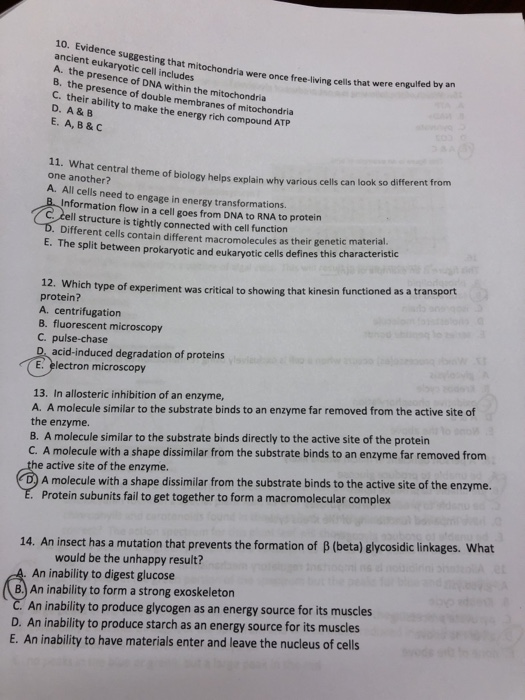
10, Mitochondria and chloroplasts likely evolved from engulfed prokaryotes that once lived as independent organisms. At some point, a eukaryotic cell engulfed an aerobic prokaryote, which then formed an endosymbiotic relationship with the host eukaryote, gradually developing into a mitochondrion. Eukaryotic cells containing mitochondria then engulfed photosynthetic prokaryotes, which evolved to become specialized chloroplast organelles. all A,B,C are correct.
11. All living things are composed of cells. Cells are the basic units of life and all tissues and organs are composed of cells. They are so small that they must be viewed with a microscope. There are different types of cells. Cells can either be eukaryotic or prokaryotic. Eukaryotic cells have a nucleus and membrane bound organelles. Plant and animal cells are eukaryotes. Plant cells are generally a square shape while animal cells are usually circular. Plant cells and animal cells have evolved different organelles to perform specific functions. Plant cells have chloroplasts, a cell wall and a central vacuole. Animal cells lack these three organelles. Plant cells have chloroplasts because they make their own food. Plant cells have a cell wall so that they do not burst when the central vacuole fills up with water. Prokaryotes do not have a nucleus, and lack membrane bound organelles. They are the oldest cells on earth. Bacteria are prokaryotes. Prokaryotes often move using special structures such as flagella or cilia.
Cells have many structures inside of them called organelles. These organelles are like the organs in a human and they help the cell stay alive. Each organelle has it’s own specific function to help the cell survive. The nucleus of a eukaryotic cell directs the cell’s activities and stores DNA. Eukaryotes also have a golgi apparatus that packages and distributes proteins. Mitochondria are the power house of the cell and provide the cell with energy. Both plant and animal cells have mitochondria. Lysosomes are like the stomach of the cell. They contain enzymes that digest the cell’s used parts. All of the cell’s organelles must work together to keep the cell healthy.
The cell membrane is the protective barrier that surrounds the cell and prevents unwanted material from getting into it. The cell membrane has many functions, but one main function that it has is to transport materials (salts, electrolytes, glucose and other necessary molecules) into the cell to support necessary life functions. Not only does the membrane let molecules into the cell, but it also lets wastes such as carbon dioxide out of the cell. The cell membrane is made up of a phosholipid bilayer. Each phopholipid contains a hydrophilic, or water loving head and ahydrophobic, or water fearing tail. These properties that the phospholipids have and the specific orientation they are arranged in provide the cell with an selectively permeable barrier.
12. An electron microscope is a microscope that uses a beam of accelerated electrons as a source of illumination. As the wavelength of an electron can be up to 100,000 times shorter than that of visible light photons, electron microscopes have a higher resolving power than light microscopes and can reveal the structure of smaller objects. A scanning transmission electron microscope has achieved better than 50 pm resolution in annular dark-field imaging modea and magnifications of up to about 10,000,000× whereas most light microscopes are limited by diffraction to about 200 nm resolution and useful magnifications below 2000×.
Electron microscopes have electron optical lens systems that are analogous to the glass lenses of an optical light microscope.
Electron microscopes are used to investigate the ultrastructure of a wide range of biological and inorganic specimens including microorganisms, cells, large molecules, biopsy samples, metals, and crystals. Industrially, electron microscopes are often used for quality control and failure analysis. Modern electron microscopes produce electron micrographs using specialized digital cameras and frame grabbers to capture the images.
13. In biochemistry, allosteric regulation (or allosteric control) is the regulation of an enzyme by binding an effector molecule at a site other than the enzyme's active site.
The site to which the effector binds is termed the allosteric site or regulatory site. Allosteric sites allow effectors to bind to the protein, often resulting in a conformational changeinvolving protein dynamics. Effectors that enhance the protein's activity are referred to as allosteric activators, whereas those that decrease the protein's activity are called allosteric inhibitors.
Allosteric regulations are a natural example of control loops, such as feedback from downstream products or feedforward from upstream substrates. Long-range allostery is especially important in cell signaling. Allosteric regulation is also particularly important in the cell's ability to adjust enzymeactivity.
14. An exoskeleton, in contrast to an endoskeleton, is an external anatomical feature that supports and protects an animal's body.All arthropods (such as insects, spiders and crustaceans) and many other invertebrate animals (such as shelled mollusks) have exoskeletons.Lobsters, for example, have tough outer shell systems which provide rigidity and shape to their bodies.
answer each question with an explanation of each answer please the rest of question 3 1....
 answer each question with an explanation of each answer
please
the rest of question 3
1. Multiple Choice Question 43 The partnership form of business organization a. b. has limited liability. is a separate legal entity. is a common form of organization for service-type businesses. enjoys an unlimited life. c. d. Answer: 2. Multiple Choice Question 48 An advantage of the corporate form of business is that b. it is simple to establish its owner's personal resources are at stake....
answer each question with an explanation of each answer
please
the rest of question 3
1. Multiple Choice Question 43 The partnership form of business organization a. b. has limited liability. is a separate legal entity. is a common form of organization for service-type businesses. enjoys an unlimited life. c. d. Answer: 2. Multiple Choice Question 48 An advantage of the corporate form of business is that b. it is simple to establish its owner's personal resources are at stake....
answer each question with an explnation of each answer please 6. Multiple Choice Question 73 Which...
 answer each question with an explnation of each answer
please
6. Multiple Choice Question 73 Which of the following statements concerning users of accounting information is incorrect? b. a. Regulatory authorities are considered internal users. Taxing authorities are considered external users. Present creditors are considered external users. Management is considered an internal user c. d. Answer: 7. Multiple Choice Question 80 Issuing shares of stock in exchange for cash is an example of a(n) I investing activity operating activity financing...
answer each question with an explnation of each answer
please
6. Multiple Choice Question 73 Which of the following statements concerning users of accounting information is incorrect? b. a. Regulatory authorities are considered internal users. Taxing authorities are considered external users. Present creditors are considered external users. Management is considered an internal user c. d. Answer: 7. Multiple Choice Question 80 Issuing shares of stock in exchange for cash is an example of a(n) I investing activity operating activity financing...
answer each question with an explnation of each answer please 12. Multiple Choice Question 121 Finney...
 answer each question with an explnation of each answer
please
12. Multiple Choice Question 121 Finney Company began the year by issuing $80000 of common stock for cash. The company recorded revenues of $740000, expenses of $640000, and paid dividends of $40000. What was Finney's net income for the year? b. $60000 $140000 $100000 $180000 c. d. Answer: 13. Multiple Choice Question 125 A balance sheet shows b. revenues, expenses, and dividends. assets, liabilities, and stockholders' equity. revenues, liabilities, and...
answer each question with an explnation of each answer
please
12. Multiple Choice Question 121 Finney Company began the year by issuing $80000 of common stock for cash. The company recorded revenues of $740000, expenses of $640000, and paid dividends of $40000. What was Finney's net income for the year? b. $60000 $140000 $100000 $180000 c. d. Answer: 13. Multiple Choice Question 125 A balance sheet shows b. revenues, expenses, and dividends. assets, liabilities, and stockholders' equity. revenues, liabilities, and...
answer each question with an explnation of each answer please the rest of question 11 9....
 answer each question with an explnation of each answer
please
the rest of question 11
9. Multiple Choice Question 102 Which of the following statements is true? a. Amounts received from issuing stock are revenues. b. Amounts received from issued stock are reported on the income statement. Amounts paid out as dividends are not expenses. Amounts paid out as dividends are reported on the income statement. C. d. Answer: 10. Multiple Choice Question 112 An income statement I reports the...
answer each question with an explnation of each answer
please
the rest of question 11
9. Multiple Choice Question 102 Which of the following statements is true? a. Amounts received from issuing stock are revenues. b. Amounts received from issued stock are reported on the income statement. Amounts paid out as dividends are not expenses. Amounts paid out as dividends are reported on the income statement. C. d. Answer: 10. Multiple Choice Question 112 An income statement I reports the...
answer each question with an explnation of each answer please 4. Multiple Choice Question 61 Which...
 answer each question with an explnation of each answer
please
4. Multiple Choice Question 61 Which of the following is the most appropriate and modern definition of accounting? a. b. The information system that identifies, records, and communicates the economic events of an organization to interested users. The interconnected network of subsystems necessary to operate a business, Electronic collection, organization, and communication of vast amounts of information A means of collecting information. C. d. Answer: 1 5. Multiple Choice Question...
answer each question with an explnation of each answer
please
4. Multiple Choice Question 61 Which of the following is the most appropriate and modern definition of accounting? a. b. The information system that identifies, records, and communicates the economic events of an organization to interested users. The interconnected network of subsystems necessary to operate a business, Electronic collection, organization, and communication of vast amounts of information A means of collecting information. C. d. Answer: 1 5. Multiple Choice Question...
Please help answer these question Please help to answer these question below for each drug Question...
Please help answer these question Please help to answer these question below for each drug Question 1. Therapeutic Mechanism (& medication class): 2. Indications (specifically for THIS patient): 3. Adverse Effects (seen and anticipated): 4. Usual Dose Range: 5. Contraindication: 6. Used with Caution: 7. Nursing Considerations: Dugs name: ezetimibe ferrous gluconate memantine multivitamin pregabalin senna pantoprazole acetaminophen ascorbic acid aspirin calcium vitamin d cholecalciferol clonazepam docusate enoxaparin Above are 15 drugs Please answer all this questions below for each...
These are the options for each question, what is the answer for each option? Question 5...
 These are the options for each question, what is the answer for
each option?
Question 5 40 pts For the following chemical reaction, what is the coefficient of the following compounds after the chemical equations are balanced? Potassium phosphate reacts with iron (II) chloride. iron (II) chloride ✓ Choose ] 5 4 2 potassium phosphate 3 6 1
These are the options for each question, what is the answer for
each option?
Question 5 40 pts For the following chemical reaction, what is the coefficient of the following compounds after the chemical equations are balanced? Potassium phosphate reacts with iron (II) chloride. iron (II) chloride ✓ Choose ] 5 4 2 potassium phosphate 3 6 1
Long Answer: Answer each question completely 9. (14 Points each) For each of the following species:...
 Long Answer: Answer each question completely 9. (14 Points each) For each of the following species: a. Draw the correct three dimensional structure b. Give the base shape and molecule shape c. Assign the appropriate point group d. Perform a complete vibrational analysis including the representations for translational, rotational and vibrational modes e. For the vibrational modes, determine which are IR active and which are Raman active SeF4
Multiple Choice; Pick the SINGLE BEST answer to each question. (4 pts each) QUESTION 1 Which...
 Multiple Choice; Pick the SINGLE BEST answer to each question. (4 pts each) QUESTION 1 Which of these is 2-methyl-3-heptanone? are QUESTION 2 Which of these is the alkene that went into this diels-alder reaction? ca
i know these question have the same answer but i really need exact answer for each...
 i know these question have the same answer but i really need
exact answer for each question. please write answer for each
one.
8. what is the babinski reflex 9. how is babinski reflex elisestet? 10. when is babinski reflex normal?
i know these question have the same answer but i really need
exact answer for each question. please write answer for each
one.
8. what is the babinski reflex 9. how is babinski reflex elisestet? 10. when is babinski reflex normal?
 answer each question with an explanation of each answer
please
the rest of question 3
1. Multiple Choice Question 43 The partnership form of business organization a. b. has limited liability. is a separate legal entity. is a common form of organization for service-type businesses. enjoys an unlimited life. c. d. Answer: 2. Multiple Choice Question 48 An advantage of the corporate form of business is that b. it is simple to establish its owner's personal resources are at stake....
answer each question with an explanation of each answer
please
the rest of question 3
1. Multiple Choice Question 43 The partnership form of business organization a. b. has limited liability. is a separate legal entity. is a common form of organization for service-type businesses. enjoys an unlimited life. c. d. Answer: 2. Multiple Choice Question 48 An advantage of the corporate form of business is that b. it is simple to establish its owner's personal resources are at stake....
 answer each question with an explnation of each answer
please
6. Multiple Choice Question 73 Which of the following statements concerning users of accounting information is incorrect? b. a. Regulatory authorities are considered internal users. Taxing authorities are considered external users. Present creditors are considered external users. Management is considered an internal user c. d. Answer: 7. Multiple Choice Question 80 Issuing shares of stock in exchange for cash is an example of a(n) I investing activity operating activity financing...
answer each question with an explnation of each answer
please
6. Multiple Choice Question 73 Which of the following statements concerning users of accounting information is incorrect? b. a. Regulatory authorities are considered internal users. Taxing authorities are considered external users. Present creditors are considered external users. Management is considered an internal user c. d. Answer: 7. Multiple Choice Question 80 Issuing shares of stock in exchange for cash is an example of a(n) I investing activity operating activity financing...
 answer each question with an explnation of each answer
please
12. Multiple Choice Question 121 Finney Company began the year by issuing $80000 of common stock for cash. The company recorded revenues of $740000, expenses of $640000, and paid dividends of $40000. What was Finney's net income for the year? b. $60000 $140000 $100000 $180000 c. d. Answer: 13. Multiple Choice Question 125 A balance sheet shows b. revenues, expenses, and dividends. assets, liabilities, and stockholders' equity. revenues, liabilities, and...
answer each question with an explnation of each answer
please
12. Multiple Choice Question 121 Finney Company began the year by issuing $80000 of common stock for cash. The company recorded revenues of $740000, expenses of $640000, and paid dividends of $40000. What was Finney's net income for the year? b. $60000 $140000 $100000 $180000 c. d. Answer: 13. Multiple Choice Question 125 A balance sheet shows b. revenues, expenses, and dividends. assets, liabilities, and stockholders' equity. revenues, liabilities, and...
 answer each question with an explnation of each answer
please
the rest of question 11
9. Multiple Choice Question 102 Which of the following statements is true? a. Amounts received from issuing stock are revenues. b. Amounts received from issued stock are reported on the income statement. Amounts paid out as dividends are not expenses. Amounts paid out as dividends are reported on the income statement. C. d. Answer: 10. Multiple Choice Question 112 An income statement I reports the...
answer each question with an explnation of each answer
please
the rest of question 11
9. Multiple Choice Question 102 Which of the following statements is true? a. Amounts received from issuing stock are revenues. b. Amounts received from issued stock are reported on the income statement. Amounts paid out as dividends are not expenses. Amounts paid out as dividends are reported on the income statement. C. d. Answer: 10. Multiple Choice Question 112 An income statement I reports the...
 answer each question with an explnation of each answer
please
4. Multiple Choice Question 61 Which of the following is the most appropriate and modern definition of accounting? a. b. The information system that identifies, records, and communicates the economic events of an organization to interested users. The interconnected network of subsystems necessary to operate a business, Electronic collection, organization, and communication of vast amounts of information A means of collecting information. C. d. Answer: 1 5. Multiple Choice Question...
answer each question with an explnation of each answer
please
4. Multiple Choice Question 61 Which of the following is the most appropriate and modern definition of accounting? a. b. The information system that identifies, records, and communicates the economic events of an organization to interested users. The interconnected network of subsystems necessary to operate a business, Electronic collection, organization, and communication of vast amounts of information A means of collecting information. C. d. Answer: 1 5. Multiple Choice Question...
 These are the options for each question, what is the answer for
each option?
Question 5 40 pts For the following chemical reaction, what is the coefficient of the following compounds after the chemical equations are balanced? Potassium phosphate reacts with iron (II) chloride. iron (II) chloride ✓ Choose ] 5 4 2 potassium phosphate 3 6 1
These are the options for each question, what is the answer for
each option?
Question 5 40 pts For the following chemical reaction, what is the coefficient of the following compounds after the chemical equations are balanced? Potassium phosphate reacts with iron (II) chloride. iron (II) chloride ✓ Choose ] 5 4 2 potassium phosphate 3 6 1
 Long Answer: Answer each question completely 9. (14 Points each) For each of the following species: a. Draw the correct three dimensional structure b. Give the base shape and molecule shape c. Assign the appropriate point group d. Perform a complete vibrational analysis including the representations for translational, rotational and vibrational modes e. For the vibrational modes, determine which are IR active and which are Raman active SeF4
 Multiple Choice; Pick the SINGLE BEST answer to each question. (4 pts each) QUESTION 1 Which of these is 2-methyl-3-heptanone? are QUESTION 2 Which of these is the alkene that went into this diels-alder reaction? ca
 i know these question have the same answer but i really need
exact answer for each question. please write answer for each
one.
8. what is the babinski reflex 9. how is babinski reflex elisestet? 10. when is babinski reflex normal?
i know these question have the same answer but i really need
exact answer for each question. please write answer for each
one.
8. what is the babinski reflex 9. how is babinski reflex elisestet? 10. when is babinski reflex normal?
Most questions answered within 3 hours.
-
Where is the error in this code sequence?
String s1 = "Hello";
String s2 = "ello";...
asked 10 months ago -
Financial data for Joel de Paris, Inc., for last year
follow:
Joel de Paris, Inc.
Balance...
asked 10 months ago -
Consider this reaction:
Al2(SO4)3 (aq)+ BaCl3
(aq) Al2Cl6 (aq)- +
3BaSO4(s) . What is the...
asked 10 months ago -
Suppose that Savneet is considering increasing her
recent random sample from 20 car rentals to 40...
asked 10 months ago -
Trucks arrive at an unloading terminal at an average rate of 120
per hour.
Trucks arrive...
asked 10 months ago -
Why are methanol and ethanol completely soluble in water while
octanol is not very little soluble....
asked 10 months ago -
A facilities manager at a university reads in a research report
that the mean amount of...
asked 10 months ago -
When the CuSO4 is rehydrated by adding water to the anhydrous
compound, is this an endothermic...
asked 10 months ago -
A ray of sunlight is passing from diamond into crown glass; the
angle of incidence is...
asked 10 months ago -
A block of mass 0.249 kg is placed on top of a light, vertical
spring of...
asked 10 months ago -
how do the kidneys compensate in the presences of acidosis
a) trigger hyperventilate
b) reserve acid...
asked 10 months ago -
Question 501 pts
The rental rate of capital to the firm increases. Which of the
following...
asked 10 months ago