2. Calculate E[X].

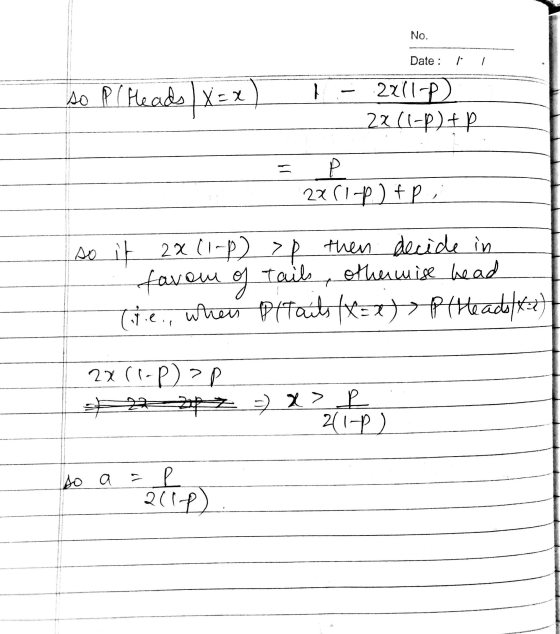
2. The MAP rule decides in favor of Heads if X<a and in favor of Tails if X>a. What is a?
Homework Answers
![Co Axire(x) si it -te(0,77 to ow. /2x it at [011] ow. fxlt (x) - = inconditional pdf fx(x) of x. fx) = pfxth (x) + (1-P) fx 1](http://img.homeworklib.com/questions/9516f6f0-a3bf-11ea-a39b-49002876406b.png?x-oss-process=image/resize,w_560)
![No. Date : 1 1 P ( Tails (X= 14) = fxl7 () x (1-2) fxt (%) * 11-p] + fxlu cu) x (2x 44 x (1-2) (R$ %)* C1-P) + (1 Jxp so IP (](http://img.homeworklib.com/questions/95c60700-a3bf-11ea-bd95-cf04fefe1032.png?x-oss-process=image/resize,w_560)
Add Answer to:
2. Calculate E[X].
2. The MAP rule decides in favor of Heads if
X<a and in...
A random variable X is generated as follows. We flip a coin. With probability p ,...
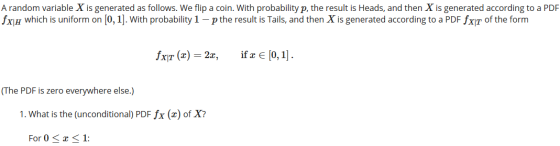
A random variable X is generated as follows. We flip a coin. With probability p , the result is Heads, and then X is generated according to a PDF f X|H which is uniform on [0,1] . With probability 1−p the result is Tails, and then X is generated according to a PDF f X|T of the form f X|T (x)=2x,if x∈[0,1]. (The PDF is zero everywhere else.) 1. What is the (unconditional) PDF f X (x) of X ?...
You flip a coin 100 times. Let X= the number of heads in 100 flips. Assume...
You flip a coin 100 times. Let X= the number of heads in 100 flips. Assume we don’t know the probability, p, the coin lands on heads (we don’t know its a fair coin). So, let Y be distributed uniformly on the interval [0,1]. Assume the value of Y = the probability that the coin lands on heads. So, we are given Y is uniformly distributed on [0,1] and X given Y=p is binomially distributed on (100,p). Find E(X) and...
Q3. Suppose we toss a coin until we see a heads, and let X be the...
Q3. Suppose we toss a coin until we see a heads, and let X be the number of tosses. Recall that this is what we called the geometric distribution. Assume that it is a fair coin (equal probability of heads and tails). What is the p.m.f. of X? (I.e., for an integer i, what is P(X=i)? What is ?[X]? ({} this is a discrete variable that takes infinitely many values.)
9.74. Suppose we toss a biased coin independently until we get two heads or two tails...
9.74. Suppose we toss a biased coin independently until we get two heads or two tails in total. The coin produces a head with probability p on any toss. 1. What is the sample space of this experiment? 2. What is the probability function? 3. What is the probability that the experiment stops with two heads?
A coin has a probability x of landing heads and 1-x of landing tails, where x...
A coin has a probability x of landing heads and 1-x of landing tails, where x has a value between 0 and 1. Prove that the SMI of the coin toss is maximized when x = 1/2. * Edit: I'm not sure what SMI is, maybe Shannon Mutual Information?
A coin has a probability x of landing heads and 1-x of landing tails, where x has a value between...
A coin has a probability x of landing heads and 1-x of landing tails, where x has a value between 0 and 1. Prove that the SMI of the coin toss is maximized when x = 1/2. * Edit: I'm not sure what SMI is, maybe Shannon Mutual Information?
2. SUPPLEMENTAL QUESTION 1 (a) Toss a fair coin so that with probability pheads occurs and...
 2. SUPPLEMENTAL QUESTION 1 (a) Toss a fair coin so that with probability pheads occurs and with probability p tails occurs. Let X be the number of heads and Y be the number of tails. Prove X and Y are dependent (b) Now, toss the same coin n times, where n is a random integer with Poisson distribution: n~Poisson(A) Let X be the random variable counting the number of heads, Y the random variable counting the number of tails. Prove...
A box contains five coins. For each coin there is a different probability that a head...
A box contains five coins. For each coin there is a different probability that a head will be obtained when the coin is tossed. (Some of the coins are not fair coins!) Let pi denote the probability of a head when the i th coin is tossed (i = 1, . . . , 5), and suppose that p1 = 0, p2 =1/4, p3 =1/2, p4 =3/4, p5 =1. The experiment we are interested in consists in selecting at random...
2. Let X be the number of Heads when we toss a coin 3 times. Find...
 2. Let X be the number of Heads when we toss a coin 3 times. Find the probability distribution (that is, the probability function) for X.
Question 2 Suppose you have a fair coin (a coin is considered fair if there is...
 Question 2 Suppose you have a fair coin (a coin is considered fair if there is an equal probability of being heads or tails after a flip). In other words, each coin flip i follows an independent Bernoulli distribution X Ber(1/2). Define the random variable X, as: i if coin flip i results in heads 10 if coin flip i results in tails a. Suppose you flip the coin n = 10 times. Define the number of heads you observe...
 2. SUPPLEMENTAL QUESTION 1 (a) Toss a fair coin so that with probability pheads occurs and with probability p tails occurs. Let X be the number of heads and Y be the number of tails. Prove X and Y are dependent (b) Now, toss the same coin n times, where n is a random integer with Poisson distribution: n~Poisson(A) Let X be the random variable counting the number of heads, Y the random variable counting the number of tails. Prove...
 2. Let X be the number of Heads when we toss a coin 3 times. Find the probability distribution (that is, the probability function) for X.
 Question 2 Suppose you have a fair coin (a coin is considered fair if there is an equal probability of being heads or tails after a flip). In other words, each coin flip i follows an independent Bernoulli distribution X Ber(1/2). Define the random variable X, as: i if coin flip i results in heads 10 if coin flip i results in tails a. Suppose you flip the coin n = 10 times. Define the number of heads you observe...
Most questions answered within 3 hours.
-
Where is the error in this code sequence?
String s1 = "Hello";
String s2 = "ello";...
asked 11 months ago -
Financial data for Joel de Paris, Inc., for last year
follow:
Joel de Paris, Inc.
Balance...
asked 11 months ago -
Consider this reaction:
Al2(SO4)3 (aq)+ BaCl3
(aq) Al2Cl6 (aq)- +
3BaSO4(s) . What is the...
asked 11 months ago -
Suppose that Savneet is considering increasing her
recent random sample from 20 car rentals to 40...
asked 11 months ago -
Trucks arrive at an unloading terminal at an average rate of 120
per hour.
Trucks arrive...
asked 11 months ago -
Why are methanol and ethanol completely soluble in water while
octanol is not very little soluble....
asked 11 months ago -
A facilities manager at a university reads in a research report
that the mean amount of...
asked 11 months ago -
When the CuSO4 is rehydrated by adding water to the anhydrous
compound, is this an endothermic...
asked 11 months ago -
A ray of sunlight is passing from diamond into crown glass; the
angle of incidence is...
asked 11 months ago -
A block of mass 0.249 kg is placed on top of a light, vertical
spring of...
asked 11 months ago -
how do the kidneys compensate in the presences of acidosis
a) trigger hyperventilate
b) reserve acid...
asked 11 months ago -
Question 501 pts
The rental rate of capital to the firm increases. Which of the
following...
asked 11 months ago