
Homework Answers
Add Answer to:
Can you explain drawing a direction field for this please? Its
not supoosed to be solved...
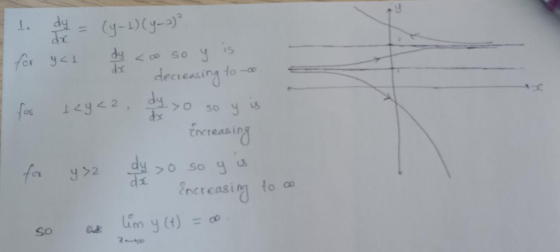
3. Draw the direction field of the following differential equation: = (1-y)y dt What happens for the solution satisfying y(0)-2, 1, 0.5,-1 as t-> oo? If y(2)-β and limt→oo y(t) = 1. Find all possi...
 3. Draw the direction field of the following differential equation: = (1-y)y dt What happens for the solution satisfying y(0)-2, 1, 0.5,-1 as t-> oo? If y(2)-β and limt→oo y(t) = 1. Find all possible values of β.
3. Draw the direction field of the following differential equation: = (1-y)y dt What happens for the solution satisfying y(0)-2, 1, 0.5,-1 as t-> oo? If y(2)-β and limt→oo y(t) = 1. Find all possible values of β.
3. Draw the direction field of the following differential equation: = (1-y)y dt What happens for the solution satisfying y(0)-2, 1, 0.5,-1 as t-> oo? If y(2)-β and limt→oo y(t) = 1. Find all possible values of β.
6, (9 marks) For each of the following direction field plots, write down a function f(t....
 6, (9 marks) For each of the following direction field plots, write down a function f(t. y) such that the differential equation dy = f(t, y) dt could have this direction field. equation could have the direction field shown. In each case, give reasons why you think your differential 3.5 1IITT1 1T1 111I 1 tIFI I 1 111 1111 111I1 11TTII rrrr 2.5 ttttt 1 ! 2 15 Y 0.5 -111 1 -0.5. 1 t -1 1 111-1 tT t...
problem 34 Equations with the Independent Variable Missing. If a second order differential equation has the...
 problem 34
Equations with the Independent Variable Missing. If a second order differential equation has the form y"f(y, y), then the independent variable t does not appear explicitly, but only through the dependent variable y. If we let y', then we obtain dv/dt-f(y, v). Since the right side of this equation depends on y and v, rather than on and v, this equation is not of the form of the first order equations discussed in Chapter 2. However, if we...
problem 34
Equations with the Independent Variable Missing. If a second order differential equation has the form y"f(y, y), then the independent variable t does not appear explicitly, but only through the dependent variable y. If we let y', then we obtain dv/dt-f(y, v). Since the right side of this equation depends on y and v, rather than on and v, this equation is not of the form of the first order equations discussed in Chapter 2. However, if we...
please help on all! mostly on 32, how can i tell from the directional field? dN 18) Given the differential equati...
 please help on all! mostly on 32, how can i tell from the
directional field?
dN 18) Given the differential equation dt and the initial condition No-5000 determine the limit. 4200 04N (1-N1) A) lim N(t) Does Not Exist Pihn 4200 4 00 B) lim N(t) t-n 04200 O lim N(t)-o t D) lim N(t)-4200 33) Sterile fruit flies are used in an experiment wshere the proportion that survive at least t days is given by e 0.25t The experiment...
please help on all! mostly on 32, how can i tell from the
directional field?
dN 18) Given the differential equation dt and the initial condition No-5000 determine the limit. 4200 04N (1-N1) A) lim N(t) Does Not Exist Pihn 4200 4 00 B) lim N(t) t-n 04200 O lim N(t)-o t D) lim N(t)-4200 33) Sterile fruit flies are used in an experiment wshere the proportion that survive at least t days is given by e 0.25t The experiment...
Consider the differential equation y′ = 3y − 9. (a) (1 pt) Make a direction field...
Consider the differential equation y′ = 3y − 9. (a) (1 pt) Make a direction field plot for this function which includes the point (t, y) = (0, 2). (b) (2 pts) Solve the equation by dividing 3y − 9 and using the method outlined in Section 1.2. (c) (1 pt) Find the solution which corresponds to y(0) = 2. (d) (1 pt) Plot the solution corresponding to y(0) = 2 on your direction field plot.
1. Consider the differential equation" = y2 - 4y - 5. a) Find any equilibrium solution(s)....
 1. Consider the differential equation" = y2 - 4y - 5. a) Find any equilibrium solution(s). b) Create an appropriate table of values and then sketch (using the grid provided) a direction field for this differential equation on OSIS 3. Be sure to label values on your axes. c) Using the direction field, describe in detail the behavior of y ast approaches infinity. 2. Short answer: State whether or not the differential equation is linear. If it is linear, state...
Draw a direction field for the given differential equation and state whether you think that the...
 Draw a direction field for the given differential equation and state whether you think that the solutions for t >0 are converging or diverging. yy(3 ty) - Converge. Diverge Converge for y 20,diverge for y< 0 Converge for y<U, diverge for y 2 0
Draw a direction field for the given differential equation and state whether you think that the solutions for t >0 are converging or diverging. yy(3 ty) - Converge. Diverge Converge for y 20,diverge for y
Draw a direction field for the given differential equation and state whether you think that the solutions for t >0 are converging or diverging. yy(3 ty) - Converge. Diverge Converge for y 20,diverge for y< 0 Converge for y<U, diverge for y 2 0
Draw a direction field for the given differential equation and state whether you think that the solutions for t >0 are converging or diverging. yy(3 ty) - Converge. Diverge Converge for y 20,diverge for y
Please explain step by step on how you get your answer b) 2 - th(y)+ Solve...
 Please explain step by step on how you get your answer
b) 2 - th(y)+ Solve the following differential equations: dy 5 + 2x a) 1 - v3y dy c) ; y(2) = 0 dx y 21 dy 1 + y d) My(0) = -1 2 dt 1 + 2 y dx 1 + x dy dy y e) X + 2 y = x'; x > = x'; x > 0; y(1) = 0 f) X = x; x...
Please explain step by step on how you get your answer
b) 2 - th(y)+ Solve the following differential equations: dy 5 + 2x a) 1 - v3y dy c) ; y(2) = 0 dx y 21 dy 1 + y d) My(0) = -1 2 dt 1 + 2 y dx 1 + x dy dy y e) X + 2 y = x'; x > = x'; x > 0; y(1) = 0 f) X = x; x...
need help please 2) a) Solve the IVP using either variation of parameters or integration factor....
 need help please
2) a) Solve the IVP using either variation of parameters or integration factor. Clearly indicate what the varying parameter is if you use variation of parameters or what the integration factor is if you use that method. Also, indicate the general solution to the homogeneous equation. dy 1 dt sin(t) – y, y(0) = 2 b) Draw the direction field and draw in the graph of the particular solution that you found.
need help please
2) a) Solve the IVP using either variation of parameters or integration factor. Clearly indicate what the varying parameter is if you use variation of parameters or what the integration factor is if you use that method. Also, indicate the general solution to the homogeneous equation. dy 1 dt sin(t) – y, y(0) = 2 b) Draw the direction field and draw in the graph of the particular solution that you found.
Can you please help with this question? Please answer the question in MATLAB coding. Thank you in advance!! A storage tank (shown below) contains a liquid at depth y where y 0 when the tank is half f...
 Can you please help with this question? Please answer the
question in MATLAB coding. Thank you in advance!!
A storage tank (shown below) contains a liquid at depth y where y 0 when the tank is half full. Liquid is withdrawn at a constant flow rate Q to meet demands. The contents are resupplied at a sinusoidal rate 3Qsin2(t) A. The change in volume can be written as d(y) 30 sin2(t) Q dt where A is the surface area and...
Can you please help with this question? Please answer the
question in MATLAB coding. Thank you in advance!!
A storage tank (shown below) contains a liquid at depth y where y 0 when the tank is half full. Liquid is withdrawn at a constant flow rate Q to meet demands. The contents are resupplied at a sinusoidal rate 3Qsin2(t) A. The change in volume can be written as d(y) 30 sin2(t) Q dt where A is the surface area and...
 3. Draw the direction field of the following differential equation: = (1-y)y dt What happens for the solution satisfying y(0)-2, 1, 0.5,-1 as t-> oo? If y(2)-β and limt→oo y(t) = 1. Find all possible values of β.
3. Draw the direction field of the following differential equation: = (1-y)y dt What happens for the solution satisfying y(0)-2, 1, 0.5,-1 as t-> oo? If y(2)-β and limt→oo y(t) = 1. Find all possible values of β.
3. Draw the direction field of the following differential equation: = (1-y)y dt What happens for the solution satisfying y(0)-2, 1, 0.5,-1 as t-> oo? If y(2)-β and limt→oo y(t) = 1. Find all possible values of β.
 6, (9 marks) For each of the following direction field plots, write down a function f(t. y) such that the differential equation dy = f(t, y) dt could have this direction field. equation could have the direction field shown. In each case, give reasons why you think your differential 3.5 1IITT1 1T1 111I 1 tIFI I 1 111 1111 111I1 11TTII rrrr 2.5 ttttt 1 ! 2 15 Y 0.5 -111 1 -0.5. 1 t -1 1 111-1 tT t...
 problem 34
Equations with the Independent Variable Missing. If a second order differential equation has the form y"f(y, y), then the independent variable t does not appear explicitly, but only through the dependent variable y. If we let y', then we obtain dv/dt-f(y, v). Since the right side of this equation depends on y and v, rather than on and v, this equation is not of the form of the first order equations discussed in Chapter 2. However, if we...
problem 34
Equations with the Independent Variable Missing. If a second order differential equation has the form y"f(y, y), then the independent variable t does not appear explicitly, but only through the dependent variable y. If we let y', then we obtain dv/dt-f(y, v). Since the right side of this equation depends on y and v, rather than on and v, this equation is not of the form of the first order equations discussed in Chapter 2. However, if we...
 please help on all! mostly on 32, how can i tell from the
directional field?
dN 18) Given the differential equation dt and the initial condition No-5000 determine the limit. 4200 04N (1-N1) A) lim N(t) Does Not Exist Pihn 4200 4 00 B) lim N(t) t-n 04200 O lim N(t)-o t D) lim N(t)-4200 33) Sterile fruit flies are used in an experiment wshere the proportion that survive at least t days is given by e 0.25t The experiment...
please help on all! mostly on 32, how can i tell from the
directional field?
dN 18) Given the differential equation dt and the initial condition No-5000 determine the limit. 4200 04N (1-N1) A) lim N(t) Does Not Exist Pihn 4200 4 00 B) lim N(t) t-n 04200 O lim N(t)-o t D) lim N(t)-4200 33) Sterile fruit flies are used in an experiment wshere the proportion that survive at least t days is given by e 0.25t The experiment...
 1. Consider the differential equation" = y2 - 4y - 5. a) Find any equilibrium solution(s). b) Create an appropriate table of values and then sketch (using the grid provided) a direction field for this differential equation on OSIS 3. Be sure to label values on your axes. c) Using the direction field, describe in detail the behavior of y ast approaches infinity. 2. Short answer: State whether or not the differential equation is linear. If it is linear, state...
 Draw a direction field for the given differential equation and state whether you think that the solutions for t >0 are converging or diverging. yy(3 ty) - Converge. Diverge Converge for y 20,diverge for y< 0 Converge for y<U, diverge for y 2 0
Draw a direction field for the given differential equation and state whether you think that the solutions for t >0 are converging or diverging. yy(3 ty) - Converge. Diverge Converge for y 20,diverge for y
Draw a direction field for the given differential equation and state whether you think that the solutions for t >0 are converging or diverging. yy(3 ty) - Converge. Diverge Converge for y 20,diverge for y< 0 Converge for y<U, diverge for y 2 0
Draw a direction field for the given differential equation and state whether you think that the solutions for t >0 are converging or diverging. yy(3 ty) - Converge. Diverge Converge for y 20,diverge for y
 Please explain step by step on how you get your answer
b) 2 - th(y)+ Solve the following differential equations: dy 5 + 2x a) 1 - v3y dy c) ; y(2) = 0 dx y 21 dy 1 + y d) My(0) = -1 2 dt 1 + 2 y dx 1 + x dy dy y e) X + 2 y = x'; x > = x'; x > 0; y(1) = 0 f) X = x; x...
Please explain step by step on how you get your answer
b) 2 - th(y)+ Solve the following differential equations: dy 5 + 2x a) 1 - v3y dy c) ; y(2) = 0 dx y 21 dy 1 + y d) My(0) = -1 2 dt 1 + 2 y dx 1 + x dy dy y e) X + 2 y = x'; x > = x'; x > 0; y(1) = 0 f) X = x; x...
 need help please
2) a) Solve the IVP using either variation of parameters or integration factor. Clearly indicate what the varying parameter is if you use variation of parameters or what the integration factor is if you use that method. Also, indicate the general solution to the homogeneous equation. dy 1 dt sin(t) – y, y(0) = 2 b) Draw the direction field and draw in the graph of the particular solution that you found.
need help please
2) a) Solve the IVP using either variation of parameters or integration factor. Clearly indicate what the varying parameter is if you use variation of parameters or what the integration factor is if you use that method. Also, indicate the general solution to the homogeneous equation. dy 1 dt sin(t) – y, y(0) = 2 b) Draw the direction field and draw in the graph of the particular solution that you found.
 Can you please help with this question? Please answer the
question in MATLAB coding. Thank you in advance!!
A storage tank (shown below) contains a liquid at depth y where y 0 when the tank is half full. Liquid is withdrawn at a constant flow rate Q to meet demands. The contents are resupplied at a sinusoidal rate 3Qsin2(t) A. The change in volume can be written as d(y) 30 sin2(t) Q dt where A is the surface area and...
Can you please help with this question? Please answer the
question in MATLAB coding. Thank you in advance!!
A storage tank (shown below) contains a liquid at depth y where y 0 when the tank is half full. Liquid is withdrawn at a constant flow rate Q to meet demands. The contents are resupplied at a sinusoidal rate 3Qsin2(t) A. The change in volume can be written as d(y) 30 sin2(t) Q dt where A is the surface area and...
Most questions answered within 3 hours.
-
Where is the error in this code sequence?
String s1 = "Hello";
String s2 = "ello";...
asked 10 months ago -
Financial data for Joel de Paris, Inc., for last year
follow:
Joel de Paris, Inc.
Balance...
asked 10 months ago -
Consider this reaction:
Al2(SO4)3 (aq)+ BaCl3
(aq) Al2Cl6 (aq)- +
3BaSO4(s) . What is the...
asked 10 months ago -
Suppose that Savneet is considering increasing her
recent random sample from 20 car rentals to 40...
asked 10 months ago -
Trucks arrive at an unloading terminal at an average rate of 120
per hour.
Trucks arrive...
asked 10 months ago -
Why are methanol and ethanol completely soluble in water while
octanol is not very little soluble....
asked 10 months ago -
A facilities manager at a university reads in a research report
that the mean amount of...
asked 10 months ago -
When the CuSO4 is rehydrated by adding water to the anhydrous
compound, is this an endothermic...
asked 10 months ago -
A ray of sunlight is passing from diamond into crown glass; the
angle of incidence is...
asked 10 months ago -
A block of mass 0.249 kg is placed on top of a light, vertical
spring of...
asked 10 months ago -
how do the kidneys compensate in the presences of acidosis
a) trigger hyperventilate
b) reserve acid...
asked 10 months ago -
Question 501 pts
The rental rate of capital to the firm increases. Which of the
following...
asked 10 months ago