EOC Problem 12.028
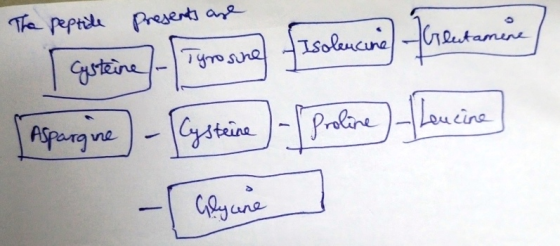
Name each of the amino acid residues in the oligopeptide shown
below. Order your answers from N terminus to C terminus.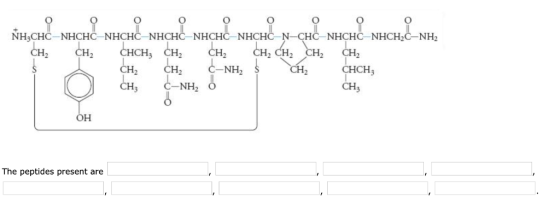
Homework Answers
Add Answer to:
EOC Problem 12.028
Name each of the amino acid residues in the oligopeptide shown
below. Order...
From N to C terminus, name the amino acids in the polypeptide shown below using single-letter...
 From N to C terminus, name the amino acids in the polypeptide shown below using single-letter codes. (Do not use punctuation marks or spaces to separate the letter (ie. if the 3 amino acids are A, B and C, write the sequence as ABC) 0 - 0- CH3 6- H₃C CH₂ Han CH2 CH2 CH-CH3 CH2 CH3 CH2 CH2 NH3 Which of the following is NOT a naturally occurring amino acid? OA) H3NCH-Coo OB) H3NCH-Coo CH2 он Oc) HNCH-Coo CH-OH...
Explain this question please! Name (4 ofer to the Table of Amino Acids at the beginning of the exam to help solve this problem. Polypeptide I is a 12-mer and has the following amino acid compositi...
 Explain this question please!
Name (4 ofer to the Table of Amino Acids at the beginning of the exam to help solve this problem. Polypeptide I is a 12-mer and has the following amino acid composition: Ala, Arg, 2 His, Leu, 2 Lys, 2 Phe, Ser, Thr, Trp Edman degradation of I shows that its N-terminal amino acid is His. Chymotrypsin cleavage of I yields peptide fragments A-D.Trypsin cleavage of I gives peptide fragments E-G. Shown below is the amino...
Explain this question please!
Name (4 ofer to the Table of Amino Acids at the beginning of the exam to help solve this problem. Polypeptide I is a 12-mer and has the following amino acid composition: Ala, Arg, 2 His, Leu, 2 Lys, 2 Phe, Ser, Thr, Trp Edman degradation of I shows that its N-terminal amino acid is His. Chymotrypsin cleavage of I yields peptide fragments A-D.Trypsin cleavage of I gives peptide fragments E-G. Shown below is the amino...
A chain GIVEQCCASVCSLYQLENYCN B chain FVNQHLCGSHLVEALYLVCGERGFFYTPKA Shown above is the amino acid sequence of the hormone...
 A chain GIVEQCCASVCSLYQLENYCN B chain FVNQHLCGSHLVEALYLVCGERGFFYTPKA Shown above is the amino acid sequence of the hormone insulin. This structure was determined by Frederick Sanger and his coworkers. Most of this work is described in a series of articles published in the Biochemical Journal from 1945 to 1955. When Sanger and colleagues began their work in 1945, it was known that insulin was a small protein consisting of two or four polypeptide chains linked by disulfide bonds. Sanger and his coworkers...
2. The structure of the solid phase Wang resin linker and the first amino acid that we will use i...
 2. The structure of the solid phase Wang resin linker and the first amino acid that we will use in this lab is shown below Fmoc first amino acid linker a) (1 pt) If the resin has 0.72 mmol/g of this linker on the surface of the beads, and you use 300 mg of resin for the reaction, how many mmol of linker do you have? b) (3 pts) All peptides will use alanine at the C-tenminus (position 1), Fmoc-L-valine...
Identify each amino shown below in Fischer projection. Indicate whether the D or L-enantiomer is shown....
 Identify each amino shown below in Fischer projection. Indicate whether the D or L-enantiomer is shown. - Part A HSHC- COOⓇ Spell out the full name of the amino acid. Submit Request Answer - Part B 4,-¢-COOB CH(CH3)OH Spell out the full name of the amino acid. Submit Request Answer - Part 20oc ——(CH,)CONH ONH Spell out the full name of the amino acid. Submit Request Answer
CHM 230 F'19 Amino acids/peptides Worksheet 1. Draw the structure, at pH 7, of a tetrapeptide...
 CHM 230 F'19 Amino acids/peptides Worksheet 1. Draw the structure, at pH 7, of a tetrapeptide that is composed of four different amino acid residues, each from a different category (classification). Draw an arrow to every peptide bond in this peptide. Identify by name the C-terminal residue and the N-terminal residue. Give the abbreviation of this tetrapeptide using three-letter codes. 2. Identify the amino acid residue whose R groun is drawn below in the "clothes line" format
Sanger's reagent is used A) to determine the amino acid sequence of a peptide. B) to...
 Sanger's reagent is used A) to determine the amino acid sequence of a peptide. B) to determine the C-terminal amino acid of a peptide. C) to determine the isoelectric point of a peptide. D) to determine the number of amino acids in a peptide. E) to determine the N-terminal amino acid of a peptide. Ninhydrin is used A) to determine the N-terminal amino acid of a peptide. B) to sequence amino acids in a peptide. C) to detect amino acids...
page 2 Chem 102 Work Shot 9.0 Dr.O. Amino Acids NAME_Sheena Thompson For each amino acid:...
 page 2 Chem 102 Work Shot 9.0 Dr.O. Amino Acids NAME_Sheena Thompson For each amino acid: A. Draw a circle around the carboxylic acid group B. Drow a triangle around the c-amino group C. Draw a box (or rectangle or polygon) around the Rgroup in each amino acid D. Use hi-lighters or colored pencils on each name to classify the amino acids as one of the following: 1. Nonpolar 2. Polar neutral 3. Polar acidic 4. Polor basic NH CO_H...
In an a helix, the R groups on the amino acid residues: Question 1 Not yet...
 In an a helix, the R groups on the amino acid residues: Question 1 Not yet answered Points out of 5.00 P Flag question Select one: A. generate the hydrogen bonds that form the helix B. cause only right-handed helices to form. C. alternate between the outside and the inside of the helix D. are found on the outside of the helix spiral. Estack within the interior of the helix. Next page Question 2 Identify the pair of peptides below...
(a) Draw three different amino acid residues connected by two peptide bonds. (b) label each residue...
 (a) Draw three different amino acid residues connected by two peptide bonds. (b) label each residue (3-letter code is OK). (c) Note bonds that do not rotate with a star (d) Note bonds that do rotate with a semi-circle arrow, including those found in each side chain (e) Of the residues in your drawing, which one contributes most to the entropy of the polypeptide (assume an unfolded state)?
 From N to C terminus, name the amino acids in the polypeptide shown below using single-letter codes. (Do not use punctuation marks or spaces to separate the letter (ie. if the 3 amino acids are A, B and C, write the sequence as ABC) 0 - 0- CH3 6- H₃C CH₂ Han CH2 CH2 CH-CH3 CH2 CH3 CH2 CH2 NH3 Which of the following is NOT a naturally occurring amino acid? OA) H3NCH-Coo OB) H3NCH-Coo CH2 он Oc) HNCH-Coo CH-OH...
 Explain this question please!
Name (4 ofer to the Table of Amino Acids at the beginning of the exam to help solve this problem. Polypeptide I is a 12-mer and has the following amino acid composition: Ala, Arg, 2 His, Leu, 2 Lys, 2 Phe, Ser, Thr, Trp Edman degradation of I shows that its N-terminal amino acid is His. Chymotrypsin cleavage of I yields peptide fragments A-D.Trypsin cleavage of I gives peptide fragments E-G. Shown below is the amino...
Explain this question please!
Name (4 ofer to the Table of Amino Acids at the beginning of the exam to help solve this problem. Polypeptide I is a 12-mer and has the following amino acid composition: Ala, Arg, 2 His, Leu, 2 Lys, 2 Phe, Ser, Thr, Trp Edman degradation of I shows that its N-terminal amino acid is His. Chymotrypsin cleavage of I yields peptide fragments A-D.Trypsin cleavage of I gives peptide fragments E-G. Shown below is the amino...
 A chain GIVEQCCASVCSLYQLENYCN B chain FVNQHLCGSHLVEALYLVCGERGFFYTPKA Shown above is the amino acid sequence of the hormone insulin. This structure was determined by Frederick Sanger and his coworkers. Most of this work is described in a series of articles published in the Biochemical Journal from 1945 to 1955. When Sanger and colleagues began their work in 1945, it was known that insulin was a small protein consisting of two or four polypeptide chains linked by disulfide bonds. Sanger and his coworkers...
 2. The structure of the solid phase Wang resin linker and the first amino acid that we will use in this lab is shown below Fmoc first amino acid linker a) (1 pt) If the resin has 0.72 mmol/g of this linker on the surface of the beads, and you use 300 mg of resin for the reaction, how many mmol of linker do you have? b) (3 pts) All peptides will use alanine at the C-tenminus (position 1), Fmoc-L-valine...
 Identify each amino shown below in Fischer projection. Indicate whether the D or L-enantiomer is shown. - Part A HSHC- COOⓇ Spell out the full name of the amino acid. Submit Request Answer - Part B 4,-¢-COOB CH(CH3)OH Spell out the full name of the amino acid. Submit Request Answer - Part 20oc ——(CH,)CONH ONH Spell out the full name of the amino acid. Submit Request Answer
 CHM 230 F'19 Amino acids/peptides Worksheet 1. Draw the structure, at pH 7, of a tetrapeptide that is composed of four different amino acid residues, each from a different category (classification). Draw an arrow to every peptide bond in this peptide. Identify by name the C-terminal residue and the N-terminal residue. Give the abbreviation of this tetrapeptide using three-letter codes. 2. Identify the amino acid residue whose R groun is drawn below in the "clothes line" format
 Sanger's reagent is used A) to determine the amino acid sequence of a peptide. B) to determine the C-terminal amino acid of a peptide. C) to determine the isoelectric point of a peptide. D) to determine the number of amino acids in a peptide. E) to determine the N-terminal amino acid of a peptide. Ninhydrin is used A) to determine the N-terminal amino acid of a peptide. B) to sequence amino acids in a peptide. C) to detect amino acids...
 page 2 Chem 102 Work Shot 9.0 Dr.O. Amino Acids NAME_Sheena Thompson For each amino acid: A. Draw a circle around the carboxylic acid group B. Drow a triangle around the c-amino group C. Draw a box (or rectangle or polygon) around the Rgroup in each amino acid D. Use hi-lighters or colored pencils on each name to classify the amino acids as one of the following: 1. Nonpolar 2. Polar neutral 3. Polar acidic 4. Polor basic NH CO_H...
 In an a helix, the R groups on the amino acid residues: Question 1 Not yet answered Points out of 5.00 P Flag question Select one: A. generate the hydrogen bonds that form the helix B. cause only right-handed helices to form. C. alternate between the outside and the inside of the helix D. are found on the outside of the helix spiral. Estack within the interior of the helix. Next page Question 2 Identify the pair of peptides below...
 (a) Draw three different amino acid residues connected by two peptide bonds. (b) label each residue (3-letter code is OK). (c) Note bonds that do not rotate with a star (d) Note bonds that do rotate with a semi-circle arrow, including those found in each side chain (e) Of the residues in your drawing, which one contributes most to the entropy of the polypeptide (assume an unfolded state)?
Most questions answered within 3 hours.
-
Where is the error in this code sequence?
String s1 = "Hello";
String s2 = "ello";...
asked 11 months ago -
Financial data for Joel de Paris, Inc., for last year
follow:
Joel de Paris, Inc.
Balance...
asked 11 months ago -
Consider this reaction:
Al2(SO4)3 (aq)+ BaCl3
(aq) Al2Cl6 (aq)- +
3BaSO4(s) . What is the...
asked 11 months ago -
Suppose that Savneet is considering increasing her
recent random sample from 20 car rentals to 40...
asked 11 months ago -
Trucks arrive at an unloading terminal at an average rate of 120
per hour.
Trucks arrive...
asked 11 months ago -
Why are methanol and ethanol completely soluble in water while
octanol is not very little soluble....
asked 11 months ago -
A facilities manager at a university reads in a research report
that the mean amount of...
asked 11 months ago -
When the CuSO4 is rehydrated by adding water to the anhydrous
compound, is this an endothermic...
asked 11 months ago -
A ray of sunlight is passing from diamond into crown glass; the
angle of incidence is...
asked 11 months ago -
A block of mass 0.249 kg is placed on top of a light, vertical
spring of...
asked 11 months ago -
how do the kidneys compensate in the presences of acidosis
a) trigger hyperventilate
b) reserve acid...
asked 11 months ago -
Question 501 pts
The rental rate of capital to the firm increases. Which of the
following...
asked 11 months ago