
Homework Answers
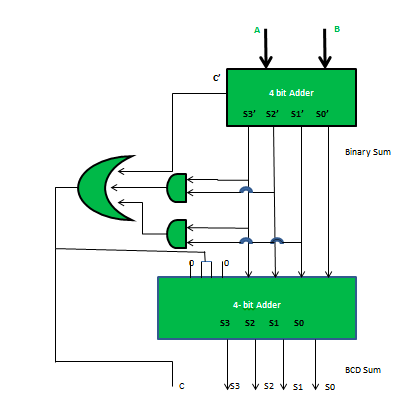
Construct a BCD adder-subtractor circuit using a BCD adder and a 9’s complementer. [block diagram of...
Construct a BCD adder-subtractor circuit using a BCD adder and a 9’s complementer. [block diagram of the BCD adder has 9 inputs (two BCD digits and a carry in) and 5 outputs (one BCD digit and a carry out] a. Define Block diagram for a BCD Adder b. Define the Block diagram for the 9’s complementer c. Define a block diagram for a select circuit to select between Adding or subtracting. d. Combine the block diagrams for the completed circuit.
1. Given the single-digit BCD adder shown in lecture slides, use four single-digit BCD adders to ...
 1. Given the single-digit BCD adder shown in lecture slides, use four single-digit BCD adders to construct a four-digit BCD adder. Make sure you properly connect the carries. Note: you don't need to design a single-digit BCD adder, but rather use four single-digit BCD adders and any additional logic gates that might be needed to construct the four-digit BCD adder. (20 pints)
1. Given the single-digit BCD adder shown in lecture slides, use four single-digit BCD adders to construct a...
1. Given the single-digit BCD adder shown in lecture slides, use four single-digit BCD adders to construct a four-digit BCD adder. Make sure you properly connect the carries. Note: you don't need to design a single-digit BCD adder, but rather use four single-digit BCD adders and any additional logic gates that might be needed to construct the four-digit BCD adder. (20 pints)
1. Given the single-digit BCD adder shown in lecture slides, use four single-digit BCD adders to construct a...
Q4: Design a BCD counter that counts from 0 to 9 and repeats, using D flip...
 Q4: Design a BCD counter that counts from 0 to 9 and repeats, using D flip flop. 15 pts.
Using single bit Full Adder (FA) blocks (as shown below) and required gates, construct a 6-bit...
 Using single bit Full Adder (FA) blocks (as shown below) and
required gates, construct a 6-bit Adder/Subtractor for signed
numbers.
Use the signed two’s complement system for the signed
numbers.
Verify your design for the following addition and subtraction by
specifying A as A5A4A3A2A1A0 and B as B5B6B3B2B1B0, determining the
inputs to the FAs and their outputs and showing that the outputs
correspond to the correct results:
a) A-B with A = -13, B = +20 (5 points)
b) A+B...
Using single bit Full Adder (FA) blocks (as shown below) and
required gates, construct a 6-bit Adder/Subtractor for signed
numbers.
Use the signed two’s complement system for the signed
numbers.
Verify your design for the following addition and subtraction by
specifying A as A5A4A3A2A1A0 and B as B5B6B3B2B1B0, determining the
inputs to the FAs and their outputs and showing that the outputs
correspond to the correct results:
a) A-B with A = -13, B = +20 (5 points)
b) A+B...
by using VIVADO , design 16 bit adder ( code + Testbench) - half adder - full adder using half adder - 4 bit adder using full adder -16 bit adder using 4 bit adder
by using VIVADO , design 16 bit adder ( code + Testbench) - half adder - full adder using half adder - 4 bit adder using full adder -16 bit adder using 4 bit adder
16. Design a logic circuit which will add/subtract/complement 2-digit BCD numbers. You are given ...
 16. Design a logic circuit which will add/subtract/complement 2-digit BCD numbers. You are given 1-digit BCD adders, imultiplexers, 9's complement units. There will be two control signal ADD and C: When ADD-1, C-0 the circuit will perform addition, when ADD-0, C 0 the circuit will perform subtraction, when C Complements of inputs are not available. You can use logic levels 1 and 0. Use a minimum nümber of additional gätes. the circuit will find the 9's complement of the input...
Design and Test an 8-bit Adder using 4-bit adder. Use 4-bit adder coded in class using...
Design and Test an 8-bit Adder using 4-bit adder. Use 4-bit adder coded in class using full adder that is coded using data flow model. Use test bench to test 8-bit adder and consider at least five different test vectors to test it.
Introduction: This experiment studies the design of an 8-bit adder/subtractor circuit using VHDL capture. The experiment...
 Introduction: This experiment studies the design of an 8-bit adder/subtractor circuit using VHDL capture. The experiment investigates the implementation of addition and subtraction operations with circuits. This lab uses the virtual simulation environment to validate the design practically in the FPGA board. Equipment: • This experiment requires Quartus Prime and the Intel's DE2-115 FPGA board. • All students should have the Intel QP and ModelSim-Intel-Starter-Edition softwares installed in personal computers. • VPN connection to UNB Network and remote desktop software...
1. Design the PAL implementation of Full Adder for the following Boolean expression: 12 OR Design...
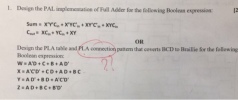 1. Design the PAL implementation of Full Adder for the following Boolean expression: 12 OR Design the PLA table and PLA connection pattern that coverts BCD to Braillie for the following Boolean expression: W=A·D + C + B + A D' X=A'C'D' + C D + A D + BC
Q4. Write an 8051 assembly program (using Keil/edsim) to convert a series of ASCII numbers to...
 Q4. Write an 8051 assembly program (using Keil/edsim) to convert a series of ASCII numbers to packed BCD. Assume that the ASCII data is located in ROM locations starting at 300H. Place the BCD data in RAM locations starting at 60H. Attach snapshot of your work. ORG 300H MYDATA: DB "87675649"
 1. Given the single-digit BCD adder shown in lecture slides, use four single-digit BCD adders to construct a four-digit BCD adder. Make sure you properly connect the carries. Note: you don't need to design a single-digit BCD adder, but rather use four single-digit BCD adders and any additional logic gates that might be needed to construct the four-digit BCD adder. (20 pints)
1. Given the single-digit BCD adder shown in lecture slides, use four single-digit BCD adders to construct a...
1. Given the single-digit BCD adder shown in lecture slides, use four single-digit BCD adders to construct a four-digit BCD adder. Make sure you properly connect the carries. Note: you don't need to design a single-digit BCD adder, but rather use four single-digit BCD adders and any additional logic gates that might be needed to construct the four-digit BCD adder. (20 pints)
1. Given the single-digit BCD adder shown in lecture slides, use four single-digit BCD adders to construct a...
 Q4: Design a BCD counter that counts from 0 to 9 and repeats, using D flip flop. 15 pts.
 Using single bit Full Adder (FA) blocks (as shown below) and
required gates, construct a 6-bit Adder/Subtractor for signed
numbers.
Use the signed two’s complement system for the signed
numbers.
Verify your design for the following addition and subtraction by
specifying A as A5A4A3A2A1A0 and B as B5B6B3B2B1B0, determining the
inputs to the FAs and their outputs and showing that the outputs
correspond to the correct results:
a) A-B with A = -13, B = +20 (5 points)
b) A+B...
Using single bit Full Adder (FA) blocks (as shown below) and
required gates, construct a 6-bit Adder/Subtractor for signed
numbers.
Use the signed two’s complement system for the signed
numbers.
Verify your design for the following addition and subtraction by
specifying A as A5A4A3A2A1A0 and B as B5B6B3B2B1B0, determining the
inputs to the FAs and their outputs and showing that the outputs
correspond to the correct results:
a) A-B with A = -13, B = +20 (5 points)
b) A+B...
 16. Design a logic circuit which will add/subtract/complement 2-digit BCD numbers. You are given 1-digit BCD adders, imultiplexers, 9's complement units. There will be two control signal ADD and C: When ADD-1, C-0 the circuit will perform addition, when ADD-0, C 0 the circuit will perform subtraction, when C Complements of inputs are not available. You can use logic levels 1 and 0. Use a minimum nümber of additional gätes. the circuit will find the 9's complement of the input...
 Introduction: This experiment studies the design of an 8-bit adder/subtractor circuit using VHDL capture. The experiment investigates the implementation of addition and subtraction operations with circuits. This lab uses the virtual simulation environment to validate the design practically in the FPGA board. Equipment: • This experiment requires Quartus Prime and the Intel's DE2-115 FPGA board. • All students should have the Intel QP and ModelSim-Intel-Starter-Edition softwares installed in personal computers. • VPN connection to UNB Network and remote desktop software...
 1. Design the PAL implementation of Full Adder for the following Boolean expression: 12 OR Design the PLA table and PLA connection pattern that coverts BCD to Braillie for the following Boolean expression: W=A·D + C + B + A D' X=A'C'D' + C D + A D + BC
 Q4. Write an 8051 assembly program (using Keil/edsim) to convert a series of ASCII numbers to packed BCD. Assume that the ASCII data is located in ROM locations starting at 300H. Place the BCD data in RAM locations starting at 60H. Attach snapshot of your work. ORG 300H MYDATA: DB "87675649"
Most questions answered within 3 hours.
-
Where is the error in this code sequence?
String s1 = "Hello";
String s2 = "ello";...
asked 10 months ago -
Financial data for Joel de Paris, Inc., for last year
follow:
Joel de Paris, Inc.
Balance...
asked 10 months ago -
Consider this reaction:
Al2(SO4)3 (aq)+ BaCl3
(aq) Al2Cl6 (aq)- +
3BaSO4(s) . What is the...
asked 10 months ago -
Suppose that Savneet is considering increasing her
recent random sample from 20 car rentals to 40...
asked 10 months ago -
Trucks arrive at an unloading terminal at an average rate of 120
per hour.
Trucks arrive...
asked 10 months ago -
Why are methanol and ethanol completely soluble in water while
octanol is not very little soluble....
asked 10 months ago -
A facilities manager at a university reads in a research report
that the mean amount of...
asked 10 months ago -
When the CuSO4 is rehydrated by adding water to the anhydrous
compound, is this an endothermic...
asked 10 months ago -
A ray of sunlight is passing from diamond into crown glass; the
angle of incidence is...
asked 10 months ago -
A block of mass 0.249 kg is placed on top of a light, vertical
spring of...
asked 10 months ago -
how do the kidneys compensate in the presences of acidosis
a) trigger hyperventilate
b) reserve acid...
asked 10 months ago -
Question 501 pts
The rental rate of capital to the firm increases. Which of the
following...
asked 10 months ago