
Homework Answers
Add Answer to:
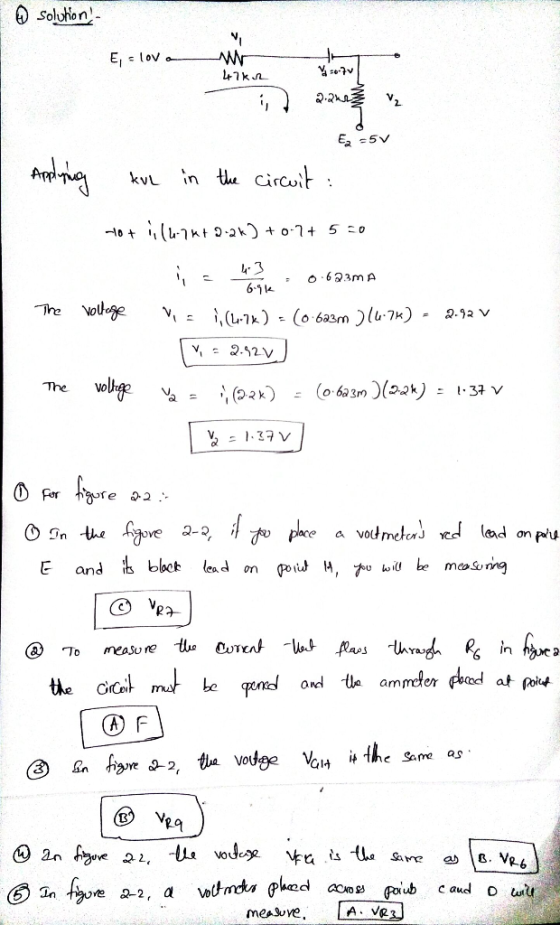
4).- (5 Points) Determine V, and Vi 7 ETOV 220 V2 E5V IN THE CIRCUIT BELOW...
TITLE: SERIES PARALLEL CIRCUITSI OBJECTIVE: To verify current, voltage, and resistance relati parallel circuit. ance relationships...
 TITLE: SERIES PARALLEL CIRCUITSI OBJECTIVE: To verify current, voltage, and resistance relati parallel circuit. ance relationships in a series- PRELIMINARY: Before beginning the experiment, each student solution for the circuits of FIG.1 and FIG. 2. The student should solve voltage and current that the experiment asks him to measure. student must submit a detailed Puld solve for every value of EQUIPMENT: Feedback Kit DC Ammeter, AD R = 10002 R = 680 2 Rs = 4702 R. = 8202 R....
For the circuit in the Figure below and given Vin=9 V with a frequency of 1.55...
 For the circuit in the Figure below and given Vin=9 V with a frequency of 1.55 kHz, R1 =752, R2=85 2, Rz=352, and C=0.64 UF, - R1 R3 What is the total current (Itot) coming from the source? 46.48 mA What is the phase angle (@)? 55.957 What is VR1? 3.486 What is VR2? -2.3987 What is VR3? 1.0043 x V What is Vc? 7.4571
Can someone help me finish my prelab please? PROCEDURE (Pre-lab) Series: Draw a schematic diagram of...
Can someone help me finish my prelab please? PROCEDURE (Pre-lab) Series: Draw a schematic diagram of a series circuit consisting of a 24V d-c voltage source and 5 series resistors. Label the resistors R1 through R5. Use standard symbols to represent the voltage source and resistors. Also, make sure to label the REFERENCE (lowest point of potential). The resistor values to be used in the experiment are 220 Ω, 330 Ω, 470 Ω, 560 Ω, and 680 Ω. Label points...
Question 1 (15 Marks): The electrical circuit shown consists of resistors and voltage sources. We can determine the current in each resistor, using the mesh current method based on Kirchhoffs voltage...
 Question 1 (15 Marks): The electrical circuit shown consists of resistors and voltage sources. We can determine the current in each resistor, using the mesh current method based on Kirchhoffs voltage law. (Kirchhoff's voltage law states that the sum of the voltage around a closed circuit is zero) 2 Σ vsource-IR = 0 i3 IH - Note: if two currents passes through one resistor we should use difference or summation between them based on direction of the currents i.e ii-j^,....
Questions #4-5: consider the circuit below: 10012 W- E = 10 V 4. A real ammeter...
 Questions #4-5: consider the circuit below: 10012 W- E = 10 V 4. A real ammeter with an internal resistance of 1.0 2 is connected to the circuit shown. When the ammeter is properly connected, the power delivered by the battery: a) Decreases b) Increases c) Stays the same d) Depends on how the ammeter is connected 5. A real voltmeter with an internal resistance of 1.0 kN is connected to the circuit shown. When the voltmeter is properly connected,...
Consider the circuit shown below. All three batteries are ideal. The voltmeter and ammeter are also...
 Consider the circuit shown below. All three batteries are ideal. The voltmeter and ammeter are also ideal. 7.00V 崇弓= 12.0V v) R 5.00 R2 6.00 Ω = 8.00 V A. What is the internal resistance of the batteries? B. What is the internal resistance of the voltmeter? C. what is the internal resistance of the ammeter? D. Based on your answers to questions A-C draw a simpler equivalent circuit (in the space above to the right of the original circuit)...
4) Given the circuit below. The voltage is 5 volts and each resistor is 10 ohms....
 4) Given the circuit below. The voltage is 5 volts and each
resistor is 10 ohms. The current flowing through the circuit (when
measured by an ideal ammeter) is 1 amp.
a) Show current through the circuit is 1 A.
Next, assume you put a DMM (in ammeter mode) which has a
resistance of one ohm at point A. Recalculate the equivalent
resistance of the circuit.
b) What is the current flowing through the circuit now.
This is the current...
4) Given the circuit below. The voltage is 5 volts and each
resistor is 10 ohms. The current flowing through the circuit (when
measured by an ideal ammeter) is 1 amp.
a) Show current through the circuit is 1 A.
Next, assume you put a DMM (in ammeter mode) which has a
resistance of one ohm at point A. Recalculate the equivalent
resistance of the circuit.
b) What is the current flowing through the circuit now.
This is the current...
(50 points) Consider the circuit shown below. The resistance R is 7.00, and E = 25V...
 (50 points) Consider the circuit shown below. The resistance R is 7.00, and E = 25V a. Write the loop equation (Kirchoff's law) for the loop cdefc, b. Write the loop equation for the loop cdeac. c. Solve for the currents /1, 12, and 13. d. What is the current through the ammeter? e. What is the voltage read by the voltmeter? 12.0 V *** R 2.0.2 8.0 V 7.00
1. (50 points) Consider the circuit shown below. The resistance Ris 7.00, and 8 = 25v....
 1. (50 points) Consider the circuit shown below. The resistance Ris 7.00, and 8 = 25v. a. Write the loop equation (Kirchoff's law) for the loop cdefc. b. Write the loop equation for the loop cdeac. c. Solve for the currents 11, 12, and 13. d. What is the current through the ammeter? e. What is the voltage read by the voltmeter? 12.0V 202 HE 8.0 V 7.00 Focus glish (United States) stv AN E
V1 = 4, V2 = 6, V3 = 4 [10 points) Consider the electrical circuit below....
 V1 = 4, V2 = 6, V3 = 4
[10 points) Consider the electrical circuit below. Remember this is an exercise in applying linear algebra, it is not an exercise in high-school physics. If you studied circuits before, do not use rules for resistances in series and parallel to solve this problem. (a) Write down the conservation of charge (current) at the point A. (b) Write down the voltage equation for the circuit ADEF. (c) Write down the voltage equation...
V1 = 4, V2 = 6, V3 = 4
[10 points) Consider the electrical circuit below. Remember this is an exercise in applying linear algebra, it is not an exercise in high-school physics. If you studied circuits before, do not use rules for resistances in series and parallel to solve this problem. (a) Write down the conservation of charge (current) at the point A. (b) Write down the voltage equation for the circuit ADEF. (c) Write down the voltage equation...
 TITLE: SERIES PARALLEL CIRCUITSI OBJECTIVE: To verify current, voltage, and resistance relati parallel circuit. ance relationships in a series- PRELIMINARY: Before beginning the experiment, each student solution for the circuits of FIG.1 and FIG. 2. The student should solve voltage and current that the experiment asks him to measure. student must submit a detailed Puld solve for every value of EQUIPMENT: Feedback Kit DC Ammeter, AD R = 10002 R = 680 2 Rs = 4702 R. = 8202 R....
 For the circuit in the Figure below and given Vin=9 V with a frequency of 1.55 kHz, R1 =752, R2=85 2, Rz=352, and C=0.64 UF, - R1 R3 What is the total current (Itot) coming from the source? 46.48 mA What is the phase angle (@)? 55.957 What is VR1? 3.486 What is VR2? -2.3987 What is VR3? 1.0043 x V What is Vc? 7.4571
 Question 1 (15 Marks): The electrical circuit shown consists of resistors and voltage sources. We can determine the current in each resistor, using the mesh current method based on Kirchhoffs voltage law. (Kirchhoff's voltage law states that the sum of the voltage around a closed circuit is zero) 2 Σ vsource-IR = 0 i3 IH - Note: if two currents passes through one resistor we should use difference or summation between them based on direction of the currents i.e ii-j^,....
 Questions #4-5: consider the circuit below: 10012 W- E = 10 V 4. A real ammeter with an internal resistance of 1.0 2 is connected to the circuit shown. When the ammeter is properly connected, the power delivered by the battery: a) Decreases b) Increases c) Stays the same d) Depends on how the ammeter is connected 5. A real voltmeter with an internal resistance of 1.0 kN is connected to the circuit shown. When the voltmeter is properly connected,...
 Consider the circuit shown below. All three batteries are ideal. The voltmeter and ammeter are also ideal. 7.00V 崇弓= 12.0V v) R 5.00 R2 6.00 Ω = 8.00 V A. What is the internal resistance of the batteries? B. What is the internal resistance of the voltmeter? C. what is the internal resistance of the ammeter? D. Based on your answers to questions A-C draw a simpler equivalent circuit (in the space above to the right of the original circuit)...
 4) Given the circuit below. The voltage is 5 volts and each
resistor is 10 ohms. The current flowing through the circuit (when
measured by an ideal ammeter) is 1 amp.
a) Show current through the circuit is 1 A.
Next, assume you put a DMM (in ammeter mode) which has a
resistance of one ohm at point A. Recalculate the equivalent
resistance of the circuit.
b) What is the current flowing through the circuit now.
This is the current...
4) Given the circuit below. The voltage is 5 volts and each
resistor is 10 ohms. The current flowing through the circuit (when
measured by an ideal ammeter) is 1 amp.
a) Show current through the circuit is 1 A.
Next, assume you put a DMM (in ammeter mode) which has a
resistance of one ohm at point A. Recalculate the equivalent
resistance of the circuit.
b) What is the current flowing through the circuit now.
This is the current...
 (50 points) Consider the circuit shown below. The resistance R is 7.00, and E = 25V a. Write the loop equation (Kirchoff's law) for the loop cdefc, b. Write the loop equation for the loop cdeac. c. Solve for the currents /1, 12, and 13. d. What is the current through the ammeter? e. What is the voltage read by the voltmeter? 12.0 V *** R 2.0.2 8.0 V 7.00
 1. (50 points) Consider the circuit shown below. The resistance Ris 7.00, and 8 = 25v. a. Write the loop equation (Kirchoff's law) for the loop cdefc. b. Write the loop equation for the loop cdeac. c. Solve for the currents 11, 12, and 13. d. What is the current through the ammeter? e. What is the voltage read by the voltmeter? 12.0V 202 HE 8.0 V 7.00 Focus glish (United States) stv AN E
 V1 = 4, V2 = 6, V3 = 4
[10 points) Consider the electrical circuit below. Remember this is an exercise in applying linear algebra, it is not an exercise in high-school physics. If you studied circuits before, do not use rules for resistances in series and parallel to solve this problem. (a) Write down the conservation of charge (current) at the point A. (b) Write down the voltage equation for the circuit ADEF. (c) Write down the voltage equation...
V1 = 4, V2 = 6, V3 = 4
[10 points) Consider the electrical circuit below. Remember this is an exercise in applying linear algebra, it is not an exercise in high-school physics. If you studied circuits before, do not use rules for resistances in series and parallel to solve this problem. (a) Write down the conservation of charge (current) at the point A. (b) Write down the voltage equation for the circuit ADEF. (c) Write down the voltage equation...
Most questions answered within 3 hours.
-
Where is the error in this code sequence?
String s1 = "Hello";
String s2 = "ello";...
asked 10 months ago -
Financial data for Joel de Paris, Inc., for last year
follow:
Joel de Paris, Inc.
Balance...
asked 10 months ago -
Consider this reaction:
Al2(SO4)3 (aq)+ BaCl3
(aq) Al2Cl6 (aq)- +
3BaSO4(s) . What is the...
asked 10 months ago -
Suppose that Savneet is considering increasing her
recent random sample from 20 car rentals to 40...
asked 10 months ago -
Trucks arrive at an unloading terminal at an average rate of 120
per hour.
Trucks arrive...
asked 10 months ago -
Why are methanol and ethanol completely soluble in water while
octanol is not very little soluble....
asked 10 months ago -
A facilities manager at a university reads in a research report
that the mean amount of...
asked 10 months ago -
When the CuSO4 is rehydrated by adding water to the anhydrous
compound, is this an endothermic...
asked 10 months ago -
A ray of sunlight is passing from diamond into crown glass; the
angle of incidence is...
asked 10 months ago -
A block of mass 0.249 kg is placed on top of a light, vertical
spring of...
asked 10 months ago -
how do the kidneys compensate in the presences of acidosis
a) trigger hyperventilate
b) reserve acid...
asked 10 months ago -
Question 501 pts
The rental rate of capital to the firm increases. Which of the
following...
asked 10 months ago