
Homework Answers
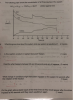
Average rate:
dC/dt = C2-C1/(dt2-dt1) = (0.82-1)/(10-0) = -0.018 M/s
instantaneous rate at 60 s...
average between next 2 points:
dC/dt = C2-C1/(dt2-dt1) = (0.36-0.40)/(100) = -0.0004 M/s
dC/dt = C3-C2/(dt3-dt2) = (0.40-0.48)/(100) = -0.0008M/s
average = 0.0006 M/s
Q19
X must be a reactant, since it sconcentration is being lowered as time passes by
b
the rate is going slower, since the "slope" at initial times is steep
vs. the last time, which has almost a flat slope
c
absolute greater --> difference betwen 1-2 is greater than thatn of 2-3
(rate is slowing down)
Add Answer to:
Need help for these questions?
This graph shows the concentration of the reactant A in the...
33. Consider the reaction: H2(g) + Br2(g) → 2 HBr (9) The graph shows the concentration...
 33. Consider the reaction: H2(g) + Br2(g) → 2 HBr (9) The graph shows the concentration of Br, as a function of time. 0.85 M Concentration (M) 068 ML 15s... Br To 0 50 100 150 a. Use the graph to calculate each quantity: i. the average rate of the reaction between 0 and 25 s ii. the instantaneous rate of the reaction at 25 s iii. the instantaneous rate of formation of HBr at 25
Can you do 4,5,7,8 please Graph Practice Problems -v vs.t PHYS&114 Name: Use the graph below...
 Can you do 4,5,7,8 please
Graph Practice Problems -v vs.t PHYS&114 Name: Use the graph below to answer questions 1-11. The graph represents the velocity of a particle as a function of time. The positive direction is right and the negative direction is left. 25 20 15 10 7 8 9 o -5 -10 -15 -20 25 time (s) 1. What is the instantaneous velocity of the particle at t-3.00s? 2. What is the instantaneous velocity of the particle at...
Can you do 4,5,7,8 please
Graph Practice Problems -v vs.t PHYS&114 Name: Use the graph below to answer questions 1-11. The graph represents the velocity of a particle as a function of time. The positive direction is right and the negative direction is left. 25 20 15 10 7 8 9 o -5 -10 -15 -20 25 time (s) 1. What is the instantaneous velocity of the particle at t-3.00s? 2. What is the instantaneous velocity of the particle at...
The following graph shows the concentration of all three species of the system 1. COC2 0)+ HEAT p...
 The following graph shows the concentration of all three species of the system 1. COC2 0)+ HEAT plotted against time. CO a)+ Ch o Co C2 (mol/L) cock 0 5 10 15 20 25 30 35 40 45 50 55 Time (s) a) What things are true about this system (and any system) at equilibrium? (2 marks) ) Is this reaction, product or reactant favoured? Explain. (1 mark) Describe what happens between 20 and 30 seconds and why it happens....
6 The graph shows the effect of substrate concentration on the rate of an enzyme- controlled...
 6 The graph shows the effect of substrate concentration on the rate of an enzyme- controlled reaction. The enzyme concentration is constant. reaction rate Which statement about the graph is correct? A Between Wand X, the substrate concentration number of enzyme molecules is limiting. Between X and Y, the number of enzyme molecules is limiting. Between X and Y, the number of substrate molecules is limiting. Between X and Y, the product concentration remains the same. Thanh in the nammanni...
Reading Velocity Graphs motion diasrams to each s ons for Y and a Given the following...
 Reading Velocity Graphs motion diasrams to each s ons for Y and a Given the following velocity vs. time graphs answer the questions that follow A for a raphs 1D Is graph A speeding up or slowing down? Explain. 2) Is graph B speeding up or slowing down? Explain. Slow: 31 A(s store 3) Is the acceleration of A positive or negative? How about for B? Explain. A:Tes, pos ólope B:nes, nes slope Which graph has a greater magnitude of...
(a) Sketch a general drawing that shows how reaction rate varies with initial concentration of reactant...
(a) Sketch a general drawing that shows how reaction rate varies with initial concentration of reactant [A] for a second-order reaction. (b ) How does the rate of reaction changes when reactant [A] is doubled if the reaction is second- order with respect to A? © The reaction A?B has been experimentally determined to be second order. The initial rate is 0.0100 M/s at an initial concentration of A of 0.100 M. What is the initial rate at [A] =...
Part D In a certain hypothetical experiment, the initial concentration of the reactant R is 1.00...
 Part D
In a certain hypothetical experiment, the initial concentration
of the reactant R is 1.00 mol⋅L−1 , and its rate constant is 0.0150
mol⋅L−1⋅s−1. It follows a zero-order reaction mechanism for the
consumption of reactant R.
Plot the graph of concentration versus time. Consider the time
intervals as 0, 10, 20, 30, 40, and 50 s.
To sketch the graph first click on .
Then select the appropriate graph and plot the appropriate
points.
Part D
In a certain hypothetical experiment, the initial concentration
of the reactant R is 1.00 mol⋅L−1 , and its rate constant is 0.0150
mol⋅L−1⋅s−1. It follows a zero-order reaction mechanism for the
consumption of reactant R.
Plot the graph of concentration versus time. Consider the time
intervals as 0, 10, 20, 30, 40, and 50 s.
To sketch the graph first click on .
Then select the appropriate graph and plot the appropriate
points.
Dr. Raphael Shell created a concentration vs time graph for the following chemical reaction
Dr. Raphael Shell created a concentration vs time graph for the following chemical reaction: 2 AB2 〓 4 B + 2 A. He observed that it took one hour to complete the first half-life, 30 min to complete its second half-life and 15 minutes to complete the third half-life. Also, doubling or tripling the concentration of the reactant shows no effect on the rate of reaction.a) Determine the (general or incomplete) RATE LAW for this reaction based on the information provided above. b) Using...
The rate of the reaction in terms of the "disappearance of reactant" includes the change in...
The rate of the reaction in terms of the "disappearance of reactant" includes the change in the concentration of the reactant, the time interval, and the coefficient of the reactant. Consider the following reaction: 2A+3B→3C+2D The concentrations of reactant A at three different time intervals are given. Use the following data to determine the average rate of reaction in terms of the disappearance of reactant A between time = 0 s and time = 20 s. Time (s) 0 20 40...
You don’t have to do every single problem. I would just like help to get me...
 You don’t have to do every single problem. I would just like
help to get me started. So if there’s two or theee of almost the
same question then you can just do one of these. For an example for
the position graph; you only have to do problems: 1 , 2, 4, 6.
Thank you so much!
くBack Graphs-xt.pdfaビ山 Graph Practice Problems-x vs. t PHYS&114 Name: Complete all these problems on a separate sheet of paper. The graph represents...
You don’t have to do every single problem. I would just like
help to get me started. So if there’s two or theee of almost the
same question then you can just do one of these. For an example for
the position graph; you only have to do problems: 1 , 2, 4, 6.
Thank you so much!
くBack Graphs-xt.pdfaビ山 Graph Practice Problems-x vs. t PHYS&114 Name: Complete all these problems on a separate sheet of paper. The graph represents...
 33. Consider the reaction: H2(g) + Br2(g) → 2 HBr (9) The graph shows the concentration of Br, as a function of time. 0.85 M Concentration (M) 068 ML 15s... Br To 0 50 100 150 a. Use the graph to calculate each quantity: i. the average rate of the reaction between 0 and 25 s ii. the instantaneous rate of the reaction at 25 s iii. the instantaneous rate of formation of HBr at 25
 Can you do 4,5,7,8 please
Graph Practice Problems -v vs.t PHYS&114 Name: Use the graph below to answer questions 1-11. The graph represents the velocity of a particle as a function of time. The positive direction is right and the negative direction is left. 25 20 15 10 7 8 9 o -5 -10 -15 -20 25 time (s) 1. What is the instantaneous velocity of the particle at t-3.00s? 2. What is the instantaneous velocity of the particle at...
Can you do 4,5,7,8 please
Graph Practice Problems -v vs.t PHYS&114 Name: Use the graph below to answer questions 1-11. The graph represents the velocity of a particle as a function of time. The positive direction is right and the negative direction is left. 25 20 15 10 7 8 9 o -5 -10 -15 -20 25 time (s) 1. What is the instantaneous velocity of the particle at t-3.00s? 2. What is the instantaneous velocity of the particle at...
 The following graph shows the concentration of all three species of the system 1. COC2 0)+ HEAT plotted against time. CO a)+ Ch o Co C2 (mol/L) cock 0 5 10 15 20 25 30 35 40 45 50 55 Time (s) a) What things are true about this system (and any system) at equilibrium? (2 marks) ) Is this reaction, product or reactant favoured? Explain. (1 mark) Describe what happens between 20 and 30 seconds and why it happens....
 6 The graph shows the effect of substrate concentration on the rate of an enzyme- controlled reaction. The enzyme concentration is constant. reaction rate Which statement about the graph is correct? A Between Wand X, the substrate concentration number of enzyme molecules is limiting. Between X and Y, the number of enzyme molecules is limiting. Between X and Y, the number of substrate molecules is limiting. Between X and Y, the product concentration remains the same. Thanh in the nammanni...
 Reading Velocity Graphs motion diasrams to each s ons for Y and a Given the following velocity vs. time graphs answer the questions that follow A for a raphs 1D Is graph A speeding up or slowing down? Explain. 2) Is graph B speeding up or slowing down? Explain. Slow: 31 A(s store 3) Is the acceleration of A positive or negative? How about for B? Explain. A:Tes, pos ólope B:nes, nes slope Which graph has a greater magnitude of...
 Part D
In a certain hypothetical experiment, the initial concentration
of the reactant R is 1.00 mol⋅L−1 , and its rate constant is 0.0150
mol⋅L−1⋅s−1. It follows a zero-order reaction mechanism for the
consumption of reactant R.
Plot the graph of concentration versus time. Consider the time
intervals as 0, 10, 20, 30, 40, and 50 s.
To sketch the graph first click on .
Then select the appropriate graph and plot the appropriate
points.
Part D
In a certain hypothetical experiment, the initial concentration
of the reactant R is 1.00 mol⋅L−1 , and its rate constant is 0.0150
mol⋅L−1⋅s−1. It follows a zero-order reaction mechanism for the
consumption of reactant R.
Plot the graph of concentration versus time. Consider the time
intervals as 0, 10, 20, 30, 40, and 50 s.
To sketch the graph first click on .
Then select the appropriate graph and plot the appropriate
points.
 You don’t have to do every single problem. I would just like
help to get me started. So if there’s two or theee of almost the
same question then you can just do one of these. For an example for
the position graph; you only have to do problems: 1 , 2, 4, 6.
Thank you so much!
くBack Graphs-xt.pdfaビ山 Graph Practice Problems-x vs. t PHYS&114 Name: Complete all these problems on a separate sheet of paper. The graph represents...
You don’t have to do every single problem. I would just like
help to get me started. So if there’s two or theee of almost the
same question then you can just do one of these. For an example for
the position graph; you only have to do problems: 1 , 2, 4, 6.
Thank you so much!
くBack Graphs-xt.pdfaビ山 Graph Practice Problems-x vs. t PHYS&114 Name: Complete all these problems on a separate sheet of paper. The graph represents...
Most questions answered within 3 hours.
-
Where is the error in this code sequence?
String s1 = "Hello";
String s2 = "ello";...
asked 10 months ago -
Financial data for Joel de Paris, Inc., for last year
follow:
Joel de Paris, Inc.
Balance...
asked 10 months ago -
Consider this reaction:
Al2(SO4)3 (aq)+ BaCl3
(aq) Al2Cl6 (aq)- +
3BaSO4(s) . What is the...
asked 10 months ago -
Suppose that Savneet is considering increasing her
recent random sample from 20 car rentals to 40...
asked 10 months ago -
Trucks arrive at an unloading terminal at an average rate of 120
per hour.
Trucks arrive...
asked 10 months ago -
Why are methanol and ethanol completely soluble in water while
octanol is not very little soluble....
asked 10 months ago -
A facilities manager at a university reads in a research report
that the mean amount of...
asked 10 months ago -
When the CuSO4 is rehydrated by adding water to the anhydrous
compound, is this an endothermic...
asked 10 months ago -
A ray of sunlight is passing from diamond into crown glass; the
angle of incidence is...
asked 10 months ago -
A block of mass 0.249 kg is placed on top of a light, vertical
spring of...
asked 10 months ago -
how do the kidneys compensate in the presences of acidosis
a) trigger hyperventilate
b) reserve acid...
asked 10 months ago -
Question 501 pts
The rental rate of capital to the firm increases. Which of the
following...
asked 10 months ago