
Homework Answers
Add Answer to:
QUESTION 9 Regulation of gene expression by eukaryotes is more complicated that in prokaryotes. The promoter...
QUESTION 9 Regulation of gene expression by eukaryotes is more complicated that in prokaryotes. The promoter...
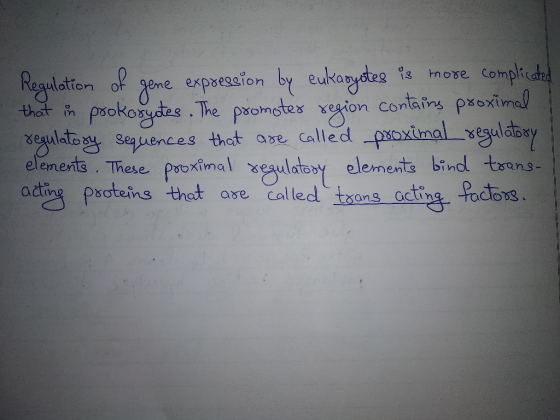
 QUESTION 9 Regulation of gene expression by eukaryotes is more complicated that in prokaryotes. The promoter region contains proximal regulatory sequences that are called _regulatory elements. These proximal regulatory elements bind trans-acting proteins that are called __factors.
What gene regulation mechanism do eukaryotes share with prokaryotes? OA) Varying the promoter sequence to vary...
 What gene regulation mechanism do eukaryotes share with prokaryotes? OA) Varying the promoter sequence to vary the binding affinity of general transcription factors. OB) Regulating the expression from a single gene with several specific transcription factors. C) Controlling gene expression by restricting access to the promoter. D) Driving the expression of several genes with one promoter. OE) Controlling the expression from a single gene with several general transcription factors.
There are some significant differences in how transcription is regulated in prokaryotes like E. coli versus...
 There are some significant differences in how transcription is regulated in prokaryotes like E. coli versus eukaryotes. Which of the following statements concerning gene regulation is TRUE only in eukaryotes? (CHOOSE ALL THAT APPLY AND NO INCORRECT ANSWERS) The promoter of a gene can act in a position and distance-independent manner. The genes involved in one process are usually situated next to each other in the genome and are transcribed in one mRNA. The default state of gene transcription is...
What are transcription factors? regulatory DNA sequences that bind to the promoter region of a gene...
 What are transcription factors? regulatory DNA sequences that bind to the promoter region of a gene regulatory DNA sequences that bind to a protein regulatory motifs that bind to the promoter region of a gene regulatory proteins that bind to specific DNA sequences
Describe three mechanisms of regulation of gene expression in eukaryotes that are not used by prokaryotes....
Describe three mechanisms of regulation of gene expression in eukaryotes that are not used by prokaryotes. Give examples.
Which of the following is not true regarding regulation of gene expression in eukaryotes? In eukaryotic...
Which of the following is not true regarding regulation of gene expression in eukaryotes? In eukaryotic cells, transcriptional activators often work by recruiting the transcriptional macinery to gene promoters DNA methylation is an example of an epigenetic mark that can be inherited Acetylation of histones can result in a more open chromatin structure to allow transcription to occur Different genes can be turned off or on between different organs or stages of development Transcription factor DNA sequences are bound by...
How are the activators and repressors different in eukaryotes vs prokaryotes for regulation of gene expression?
How are the activators and repressors different in eukaryotes vs prokaryotes for regulation of gene expression?
Transcriptional control of gene regulation is common in both prokaryotes and eukaryotes. Which of the following is not true? Both prokaryotes and eukaryotes: A. exhibit both positive and negative cont...
Transcriptional control of gene regulation is common in both prokaryotes and eukaryotes. Which of the following is not true? Both prokaryotes and eukaryotes: A. exhibit both positive and negative control. B. have repressors that impact expression. C. often requires interactions with DNA that is not proximal to structural genes. D. have genes that are closely related in function located proximally on a chromosome
Which of the following mechanisms to regulate gene expression are observed in eukaryotes, but are not...
Which of the following mechanisms to regulate gene expression are observed in eukaryotes, but are not generally observed in prokaryotes? Choose all that apply. Genes are grouped into operons, which allows transcriptional regulation to turn them all on together. RNA silencing selectively targets mRNA and destroys it to prevent further translation. Proteins can be activated or deactivated as a form of post-translational regulation. Epigenetic regulation can open or condense sectiosn of a chromosome, regulating which genes are transcribed. Regulatory proteins...
Q1)Which of the following is not involved in control of gene expression in eukaryotes? A. Change...
Q1)Which of the following is not involved in control of gene expression in eukaryotes? A. Change to DNA sequence. B. Alternative splicing. C. Export of mRNA from the nucleus. D. Transcriptional repression. E. Destruction of mRNA Q2) Trans-acting regulators of gene expression include? A. promoters. B. histone deacetylases C. introns D. silencers E. the TATA box. Q3) Gene regulation in eukaryotes often involves which of the following, which are not also used by prokaryotes? A.RNA polymerase B.Transcription factors C.Histone modification...
 QUESTION 9 Regulation of gene expression by eukaryotes is more complicated that in prokaryotes. The promoter region contains proximal regulatory sequences that are called _regulatory elements. These proximal regulatory elements bind trans-acting proteins that are called __factors.
 What gene regulation mechanism do eukaryotes share with prokaryotes? OA) Varying the promoter sequence to vary the binding affinity of general transcription factors. OB) Regulating the expression from a single gene with several specific transcription factors. C) Controlling gene expression by restricting access to the promoter. D) Driving the expression of several genes with one promoter. OE) Controlling the expression from a single gene with several general transcription factors.
 There are some significant differences in how transcription is regulated in prokaryotes like E. coli versus eukaryotes. Which of the following statements concerning gene regulation is TRUE only in eukaryotes? (CHOOSE ALL THAT APPLY AND NO INCORRECT ANSWERS) The promoter of a gene can act in a position and distance-independent manner. The genes involved in one process are usually situated next to each other in the genome and are transcribed in one mRNA. The default state of gene transcription is...
 What are transcription factors? regulatory DNA sequences that bind to the promoter region of a gene regulatory DNA sequences that bind to a protein regulatory motifs that bind to the promoter region of a gene regulatory proteins that bind to specific DNA sequences
Most questions answered within 3 hours.
-
Where is the error in this code sequence?
String s1 = "Hello";
String s2 = "ello";...
asked 10 months ago -
Financial data for Joel de Paris, Inc., for last year
follow:
Joel de Paris, Inc.
Balance...
asked 10 months ago -
Consider this reaction:
Al2(SO4)3 (aq)+ BaCl3
(aq) Al2Cl6 (aq)- +
3BaSO4(s) . What is the...
asked 10 months ago -
Suppose that Savneet is considering increasing her
recent random sample from 20 car rentals to 40...
asked 10 months ago -
Trucks arrive at an unloading terminal at an average rate of 120
per hour.
Trucks arrive...
asked 10 months ago -
Why are methanol and ethanol completely soluble in water while
octanol is not very little soluble....
asked 10 months ago -
A facilities manager at a university reads in a research report
that the mean amount of...
asked 10 months ago -
When the CuSO4 is rehydrated by adding water to the anhydrous
compound, is this an endothermic...
asked 10 months ago -
A ray of sunlight is passing from diamond into crown glass; the
angle of incidence is...
asked 10 months ago -
A block of mass 0.249 kg is placed on top of a light, vertical
spring of...
asked 10 months ago -
how do the kidneys compensate in the presences of acidosis
a) trigger hyperventilate
b) reserve acid...
asked 10 months ago -
Question 501 pts
The rental rate of capital to the firm increases. Which of the
following...
asked 10 months ago