
Homework Answers
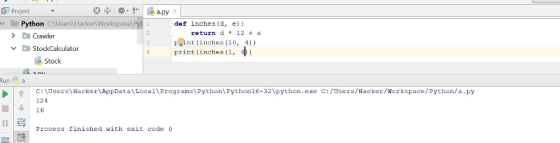
def inches(d, e):
    return d * 12 + e
print(inches(10, 4))
print(inches(1, 4))
Add Answer to:
Write a Python function that converts a measurement in d feet and e inches to a...
1. In Python, Write a function to convert inches into yards, feet and inches. The functions...
1. In Python, Write a function to convert inches into yards, feet and inches. The functions should take one parameter, 'inches', and print out the number of yards, feet, and inches equivalent to the value of the argument. Call the function after prompting the user to enter the number of inches. Don't forget to convert the input to an 'int'. 2. In Python,Write a function to convert celsius to fahrenheit. The function should return a value, which you should assign...
Python Programming 4th Edition: Write a program that asks the user for the number of feet....
Python Programming 4th Edition: Write a program that asks the user for the number of feet. The program converts those feet to inches by using the formula ’12 * feet’. Hint: Define main () program Get the number of feet from the user Define variables Call a function feet_to_inches(feet) The function receives the number of feet and returns the number of inches in that many feet. The output should look like as follows: Enter the number of feet: If the...
Python (Convert milliseconds to hours, minutes, and seconds) Write a function that converts milliseconds to hours,...
Python (Convert milliseconds to hours, minutes, and seconds) Write a function that converts milliseconds to hours, minutes, and seconds using the following header: def convertMillis(millis): The function returns a string as hours:minutes:seconds. For example, convertMillis(5500) returns the string 0:0:5, convertMillis(100000) returns the string 0:1:40, and convertMillis(555550000) returns the string 154:19:10. Write a test program that prompts the user to enter a value for milliseconds and displays a string in the format of hours:minutes:seconds. Sample Run Enter time in milliseconds: 555550000...
Write a python function that prints all odd numbers between two given numbers print_odd_numbers(10,20) → 11...
Write a python function that prints all odd numbers between two given numbers print_odd_numbers(10,20) → 11 13 15 17 19 print_odd_numbers(4,12) → 5 7 9 11 ### Your code here def print_odd_numbers(n1, n2):
Python: P2 Write a function that reverses a python list using recursion (Chapter 6-3 in our...
Python: P2 Write a function that reverses a python list using recursion (Chapter 6-3 in our textbook) E.g.: Input: [9, 8, 7, 6, 5, 4, 3, 2, 1, 0] Output: [0, 1, 2, 3, 4, 5, 6, 7, 8, 9] Constraints: - List elements are integers - The function should return a reversed array, not print its elements You may use the following code as template: def reverse(my_list, index = None): # your code here
Code in Python Problem 1 (2 Points) 1. Write a function randomWalk(.. .) which simulates one...
 Code in Python
Problem 1 (2 Points) 1. Write a function randomWalk(.. .) which simulates one path (or trajectory) of a simple symmetric random walk with 2N time steps (i.e. from 0,1,2,...,2N) starting at So-0 nput: lengthofRandomWalk2N Output: samplePath: Array of length 2N+1 with the entire path of the random walk on 0,1,2,..,2N In def randomwalk(lengthofRandomwalk): ## WRITE YOUR OWN CODE HERE # HINT: USE np. random . choice ( ) TO SIMULATE THE INCREMENTS return samplePath In [ ]:...
Code in Python
Problem 1 (2 Points) 1. Write a function randomWalk(.. .) which simulates one path (or trajectory) of a simple symmetric random walk with 2N time steps (i.e. from 0,1,2,...,2N) starting at So-0 nput: lengthofRandomWalk2N Output: samplePath: Array of length 2N+1 with the entire path of the random walk on 0,1,2,..,2N In def randomwalk(lengthofRandomwalk): ## WRITE YOUR OWN CODE HERE # HINT: USE np. random . choice ( ) TO SIMULATE THE INCREMENTS return samplePath In [ ]:...
Code in Python Problem 1 (2 Points) 1. Write a function randomWalk(.. .) which simulates one path (or trajectory) of a s...
 Code in Python
Problem 1 (2 Points) 1. Write a function randomWalk(.. .) which simulates one path (or trajectory) of a simple symmetric random walk with 2N time steps (i.e. from 0,1,2,...,2N) starting at So-0 nput: lengthofRandomWalk2N Output: samplePath: Array of length 2N+1 with the entire path of the random walk on 0,1,2,..,2N In def randomwalk(lengthofRandomwalk): ## WRITE YOUR OWN CODE HERE # HINT: USE np. random . choice ( ) TO SIMULATE THE INCREMENTS return samplePath In [ ]:...
Code in Python
Problem 1 (2 Points) 1. Write a function randomWalk(.. .) which simulates one path (or trajectory) of a simple symmetric random walk with 2N time steps (i.e. from 0,1,2,...,2N) starting at So-0 nput: lengthofRandomWalk2N Output: samplePath: Array of length 2N+1 with the entire path of the random walk on 0,1,2,..,2N In def randomwalk(lengthofRandomwalk): ## WRITE YOUR OWN CODE HERE # HINT: USE np. random . choice ( ) TO SIMULATE THE INCREMENTS return samplePath In [ ]:...
Write a function in python that takes a set A and a relation R(x, y) on...
 Write a function in python that takes a set A and a relation
R(x, y) on A (as a python function such that R(x, y) returns true
if and only if the relation xRy holds), and returns True if and
only if the relation R is reflexive. Here is the function signature
you need to use.
def is reflexive(A, R): You can test your code as follows. s = {1,2,3} def y(x, y): return x == y def n(x, y):...
Write a function in python that takes a set A and a relation
R(x, y) on A (as a python function such that R(x, y) returns true
if and only if the relation xRy holds), and returns True if and
only if the relation R is reflexive. Here is the function signature
you need to use.
def is reflexive(A, R): You can test your code as follows. s = {1,2,3} def y(x, y): return x == y def n(x, y):...
C++ programming language , I need help writing the code . Please explain if you can...
 C++
programming language , I need help writing the code . Please
explain if you can .
Exercise 10: Unit conversion (10 points) Write a console program that converts meters into feet and inches. The program starts by asking the user for a measurement in meters. The program should accept a floating point number. After getting the number, the program computes the number of feet and inches equal to the specified number of meters. The program outputs feet and inches...
C++
programming language , I need help writing the code . Please
explain if you can .
Exercise 10: Unit conversion (10 points) Write a console program that converts meters into feet and inches. The program starts by asking the user for a measurement in meters. The program should accept a floating point number. After getting the number, the program computes the number of feet and inches equal to the specified number of meters. The program outputs feet and inches...
Jupyter code (PYTHON) True error Write a function called trueError that takes the following inputs: •...
 Jupyter code (PYTHON)
True error Write a function called trueError that takes the following inputs: • X, the new value • Xtrue, the previous value And returns the following output: • error, the calculated relative error The formula for the relative error is shown below: errue = 11100% In (): def trueError(x,xtrue): # YOUR CODE HERE raise Not ImplementedError() In (): # You can call and test your function here # YOUR CODE HERE raise Not ImplementedError()
Jupyter code (PYTHON)
True error Write a function called trueError that takes the following inputs: • X, the new value • Xtrue, the previous value And returns the following output: • error, the calculated relative error The formula for the relative error is shown below: errue = 11100% In (): def trueError(x,xtrue): # YOUR CODE HERE raise Not ImplementedError() In (): # You can call and test your function here # YOUR CODE HERE raise Not ImplementedError()
 Code in Python
Problem 1 (2 Points) 1. Write a function randomWalk(.. .) which simulates one path (or trajectory) of a simple symmetric random walk with 2N time steps (i.e. from 0,1,2,...,2N) starting at So-0 nput: lengthofRandomWalk2N Output: samplePath: Array of length 2N+1 with the entire path of the random walk on 0,1,2,..,2N In def randomwalk(lengthofRandomwalk): ## WRITE YOUR OWN CODE HERE # HINT: USE np. random . choice ( ) TO SIMULATE THE INCREMENTS return samplePath In [ ]:...
Code in Python
Problem 1 (2 Points) 1. Write a function randomWalk(.. .) which simulates one path (or trajectory) of a simple symmetric random walk with 2N time steps (i.e. from 0,1,2,...,2N) starting at So-0 nput: lengthofRandomWalk2N Output: samplePath: Array of length 2N+1 with the entire path of the random walk on 0,1,2,..,2N In def randomwalk(lengthofRandomwalk): ## WRITE YOUR OWN CODE HERE # HINT: USE np. random . choice ( ) TO SIMULATE THE INCREMENTS return samplePath In [ ]:...
 Code in Python
Problem 1 (2 Points) 1. Write a function randomWalk(.. .) which simulates one path (or trajectory) of a simple symmetric random walk with 2N time steps (i.e. from 0,1,2,...,2N) starting at So-0 nput: lengthofRandomWalk2N Output: samplePath: Array of length 2N+1 with the entire path of the random walk on 0,1,2,..,2N In def randomwalk(lengthofRandomwalk): ## WRITE YOUR OWN CODE HERE # HINT: USE np. random . choice ( ) TO SIMULATE THE INCREMENTS return samplePath In [ ]:...
Code in Python
Problem 1 (2 Points) 1. Write a function randomWalk(.. .) which simulates one path (or trajectory) of a simple symmetric random walk with 2N time steps (i.e. from 0,1,2,...,2N) starting at So-0 nput: lengthofRandomWalk2N Output: samplePath: Array of length 2N+1 with the entire path of the random walk on 0,1,2,..,2N In def randomwalk(lengthofRandomwalk): ## WRITE YOUR OWN CODE HERE # HINT: USE np. random . choice ( ) TO SIMULATE THE INCREMENTS return samplePath In [ ]:...
 Write a function in python that takes a set A and a relation
R(x, y) on A (as a python function such that R(x, y) returns true
if and only if the relation xRy holds), and returns True if and
only if the relation R is reflexive. Here is the function signature
you need to use.
def is reflexive(A, R): You can test your code as follows. s = {1,2,3} def y(x, y): return x == y def n(x, y):...
Write a function in python that takes a set A and a relation
R(x, y) on A (as a python function such that R(x, y) returns true
if and only if the relation xRy holds), and returns True if and
only if the relation R is reflexive. Here is the function signature
you need to use.
def is reflexive(A, R): You can test your code as follows. s = {1,2,3} def y(x, y): return x == y def n(x, y):...
 C++
programming language , I need help writing the code . Please
explain if you can .
Exercise 10: Unit conversion (10 points) Write a console program that converts meters into feet and inches. The program starts by asking the user for a measurement in meters. The program should accept a floating point number. After getting the number, the program computes the number of feet and inches equal to the specified number of meters. The program outputs feet and inches...
C++
programming language , I need help writing the code . Please
explain if you can .
Exercise 10: Unit conversion (10 points) Write a console program that converts meters into feet and inches. The program starts by asking the user for a measurement in meters. The program should accept a floating point number. After getting the number, the program computes the number of feet and inches equal to the specified number of meters. The program outputs feet and inches...
 Jupyter code (PYTHON)
True error Write a function called trueError that takes the following inputs: • X, the new value • Xtrue, the previous value And returns the following output: • error, the calculated relative error The formula for the relative error is shown below: errue = 11100% In (): def trueError(x,xtrue): # YOUR CODE HERE raise Not ImplementedError() In (): # You can call and test your function here # YOUR CODE HERE raise Not ImplementedError()
Jupyter code (PYTHON)
True error Write a function called trueError that takes the following inputs: • X, the new value • Xtrue, the previous value And returns the following output: • error, the calculated relative error The formula for the relative error is shown below: errue = 11100% In (): def trueError(x,xtrue): # YOUR CODE HERE raise Not ImplementedError() In (): # You can call and test your function here # YOUR CODE HERE raise Not ImplementedError()
Most questions answered within 3 hours.
-
Where is the error in this code sequence?
String s1 = "Hello";
String s2 = "ello";...
asked 10 months ago -
Financial data for Joel de Paris, Inc., for last year
follow:
Joel de Paris, Inc.
Balance...
asked 10 months ago -
Consider this reaction:
Al2(SO4)3 (aq)+ BaCl3
(aq) Al2Cl6 (aq)- +
3BaSO4(s) . What is the...
asked 10 months ago -
Suppose that Savneet is considering increasing her
recent random sample from 20 car rentals to 40...
asked 10 months ago -
Trucks arrive at an unloading terminal at an average rate of 120
per hour.
Trucks arrive...
asked 10 months ago -
Why are methanol and ethanol completely soluble in water while
octanol is not very little soluble....
asked 10 months ago -
A facilities manager at a university reads in a research report
that the mean amount of...
asked 10 months ago -
When the CuSO4 is rehydrated by adding water to the anhydrous
compound, is this an endothermic...
asked 10 months ago -
A ray of sunlight is passing from diamond into crown glass; the
angle of incidence is...
asked 10 months ago -
A block of mass 0.249 kg is placed on top of a light, vertical
spring of...
asked 10 months ago -
how do the kidneys compensate in the presences of acidosis
a) trigger hyperventilate
b) reserve acid...
asked 10 months ago -
Question 501 pts
The rental rate of capital to the firm increases. Which of the
following...
asked 10 months ago