Task: Simulate the growth of a biological population. The Game of Life, invented by John H....
Task: Simulate the growth of a biological population. The Game of Life, invented by John H. Conway, is supposed to model the genetic laws for birth, survival, and death. Our implementation of the game will use a 2-dimensional array with 12 rows and 12 columns. Each cell of the array will hold either a 1 (an organism is present) or a 0 (no organism there). You will calculate 4 generations of the organisms’ birth, survival, and death.
An organism’s neighbors affect its survival. Each organism has 8 adjoining cells where its neighbors may live, as shown in this grid:
|
0 |
0 |
1 |
||
|
1 |
X |
0 |
||
|
0 |
1 |
0 |
||
The neighbors for cell X would be located in the 8 shaded cells surrounding it. In the situation illustrated, X has 3 neighbors.
Rules for the game:
Birth: An organism will be born in each empty location that has exactly 3 neighbors.
Death: An organism with 4 or more organisms as neighbors will die from overcrowding. An organism with 1 or 0 neighbors will die of loneliness.
Survival: An organism with 2 or 3 neighbors will survive to the next generation.
You will not have to process the border cells (i.e., rows 0 and 11, and columns 0 and 11)
of the game, but the border cells’ contents will affect the internal cells. Assume that border cells are infertile regions where organisms can neither survive nor be born.
The population configuration as shown below will be the initial contents of one array. For each generation, calculate the results of the first array’s births, deaths, and survivals, and store those results in a second array. After printing the results, copy the second array’s data back into the first one (replacing the original data), and repeat the process to calculate the next generation.
Input: The first array will be initialized as follows:
int life[12][12] =
{ {0,0,0,0,0,0,0,0,0,0,0,0},
{0,0,0,0,1,0,1,0,1,0,0,0},
{0,0,0,1,0,1,0,1,0,0,0,0},
{0,0,0,0,0,0,0,0,0,0,0,0},
{0,0,0,0,1,0,1,0,1,0,0,0},
{0,0,0,1,0,1,0,1,0,0,0,0},
{0,1,1,1,1,1,1,1,1,1,1,0},
{0,0,0,0,1,1,1,1,0,0,0,0},
{0,0,0,0,1,0,1,0,1,0,0,0},
{0,0,0,1,0,1,0,1,0,0,0,0},
{0,0,0,0,1,0,1,0,1,0,0,0},
{0,0,0,0,0,0,0,0,0,0,0,0} };
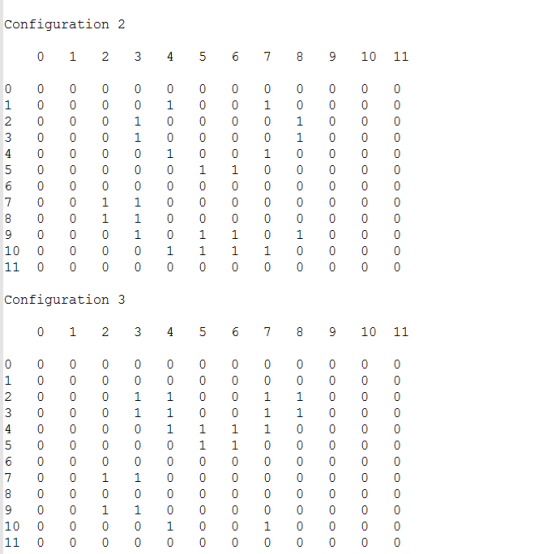
Output: You will print out the initial situation and the results of each of 4 generations of growth. Send all the print output to a single external file. Provide header information (including name and date) in your printed version, and include row numbers and column numbers. Line up the columns. The initial generation would look something like this:
Game of Life
---------------
Original Configuration:
0 1 2 3 4 5 6 7 8 9 10 11
0 0 0 0 0 0 0 0 0 0 0 0 0
1 0 0 0 0 1 0 1 0 1 0 0 0
2 0 0 0 1 0 1 0 1 0 0 0 0
3 0 0 0 0 0 0 0 0 0 0 0 0
4 0 0 0 0 1 0 1 0 1 0 0 0
5 0 0 0 1 0 1 0 1 0 0 0 0
6 0 1 1 1 1 1 1 1 1 1 1 0
7 0 0 0 0 1 1 1 1 0 0 0 0
8 0 0 0 0 1 0 1 0 1 0 0 0
9 0 0 0 1 0 1 0 1 0 0 0 0
10 0 0 0 0 1 0 1 0 1 0 0 0
11 0 0 0 0 0 0 0 0 0 0 0 0
---------------------------------------------------------------------------------------------------------------------------------------------
So here is code and I want the output to send to the data file, not on the console, Also, it should run 4 generations.
Please, help me!
#include <iostream>
#include <fstream>
using namespace std;
const int SIZE = 12;
const int ALIVE = 1;
const int DEAD = 0;
void printWorld(int x[SIZE][SIZE], fstream &fout)
{
int i, j;
cout<<"\n";
fout<<"\n";
for(i = 0; i < SIZE; i++)
{
for(j = 0; j < SIZE; j++)
if(x[i][j] == ALIVE)
{
cout << " 1 ";
fout << " 1 ";
}
else
{
cout << " 0 ";
fout << " 0 ";
}
cout << "\n";
fout << "\n";
}
}
int evolve(int x[][SIZE], int row, int col)
{
int i = row;
int j = col;
return x[i-1][j-1] + x[i-1][j] + x[i-1][j+1] + x[i][j-1] +
x[i][j+1] + x[i+1][j-1] + x[i+1][j] +x[i+1][j+1];
}
void copyWorld(int x[][SIZE], int y[][SIZE])
{
int i, j;
for(i = 0; i < SIZE; i++)
for(j = 0; j < SIZE; j++)
y[i][j] = x[i][j];
}
int extinct(int x[][SIZE])
{
int i, j, flag = 0;
for(i = 0; i < SIZE; i++)
for(j = 0; j < SIZE; j++)
if(x[i][j] == 1)
return 1;
return flag;
}
int main()
{
int i, j;
int nextGeneration[SIZE][SIZE];
int currentGeneration[SIZE][SIZE] = {
{0,0,0,0,0,0,0,0,0,0,0,0},
{0,0,0,0,1,0,1,0,1,0,0,0},
{0,0,0,1,0,1,0,1,0,0,0,0},
{0,0,0,0,0,0,0,0,0,0,0,0},
{0,0,0,0,1,0,1,0,1,0,0,0},
{0,0,0,1,0,1,0,1,0,0,0,0},
{0,1,1,1,1,1,1,1,1,1,1,0},
{0,0,0,0,1,1,1,1,0,0,0,0},
{0,0,0,0,1,0,1,0,1,0,0,0},
{0,0,0,1,0,1,0,1,0,0,0,0},
{0,0,0,0,1,0,1,0,1,0,0,0},
{0,0,0,0,0,0,0,0,0,0,0,0} };
char choice;
fstream fout;
fout.open("ConwayGenerations.txt", fstream::app);
while(1)
{
copyWorld(currentGeneration, nextGeneration);
for(i = 1; i < SIZE-1; i++)
for(j = 1; j < SIZE-1; j++)
if(evolve(currentGeneration, i, j) < 2 ||
evolve(currentGeneration, i, j) > 3)
nextGeneration[i][j] = DEAD;
else if(evolve(currentGeneration, i, j) == 3)
nextGeneration[i][j] = ALIVE;
cout << "OldWorld:\n";
printWorld(currentGeneration, fout);
cout << endl;
cout <<"NewWorld:\n";
printWorld(nextGeneration, fout);
cout << endl;
cout << "Do you want to evolve into further
generation?(Y/N): ";
cin >>choice;
copyWorld(nextGeneration, currentGeneration);
if(choice == 'N' || choice == 'n')
return 0;
}
}
Homework Answers
// C++ program to simulate Game of life for the given original configuration and write the output for 4 generations in a file
#include <iostream>
#include <fstream>
using namespace std;
const int SIZE = 12;
const int ALIVE = 1;
const int DEAD = 0;
void printWorld(int x[SIZE][SIZE], fstream &fout);
int evolve(int x[][SIZE], int row, int col);
void copyWorld(int x[][SIZE], int y[][SIZE]);
int extinct(int x[][SIZE]);
int main() {
int i, j;
int nextGeneration[SIZE][SIZE];
int currentGeneration[SIZE][SIZE] = { {0,0,0,0,0,0,0,0,0,0,0,0},
{0,0,0,0,1,0,1,0,1,0,0,0},
{0,0,0,1,0,1,0,1,0,0,0,0},
{0,0,0,0,0,0,0,0,0,0,0,0},
{0,0,0,0,1,0,1,0,1,0,0,0},
{0,0,0,1,0,1,0,1,0,0,0,0},
{0,1,1,1,1,1,1,1,1,1,1,0},
{0,0,0,0,1,1,1,1,0,0,0,0},
{0,0,0,0,1,0,1,0,1,0,0,0},
{0,0,0,1,0,1,0,1,0,0,0,0},
{0,0,0,0,1,0,1,0,1,0,0,0},
{0,0,0,0,0,0,0,0,0,0,0,0} };
// open the file in append mode
fstream fout;
fout.open("ConwayGenerations.txt", fstream::app);
int num_generation = 0;
fout<<"\t\tGame of life\n";
fout<<"\t\t---------------------\n\n";
fout<<"Original Configuration:\n";
printWorld(currentGeneration, fout);
// loop to simulate for 4 generation of growth
while(num_generation < 4)
{
copyWorld(currentGeneration, nextGeneration);
for(i = 1; i < SIZE-1; i++)
for(j = 1; j < SIZE-1; j++)
if(evolve(currentGeneration, i, j) < 2 || evolve(currentGeneration, i, j) > 3)
nextGeneration[i][j] = DEAD;
else if(evolve(currentGeneration, i, j) == 3)
nextGeneration[i][j] = ALIVE;
fout <<"Configuration "<<(num_generation+1)<<"\n";
printWorld(nextGeneration, fout);
copyWorld(nextGeneration, currentGeneration);
num_generation++;
}
fout.close();
return 0;
}
void printWorld(int x[SIZE][SIZE], fstream &fout)
{
int i, j;
fout<<"\n\t";
for(i=0;i<SIZE;i++)
{
fout<<i<<"\t";
}
fout<<"\n\n";
for(i = 0; i < SIZE; i++)
{
fout<<i<<"\t";
for(j = 0; j < SIZE; j++)
{
fout<<x[i][j]<<"\t";
}
fout << "\n";
}
fout<<"\n";
}
int evolve(int x[][SIZE], int row, int col)
{
int i = row;
int j = col;
return x[i-1][j-1] + x[i-1][j] + x[i-1][j+1] + x[i][j-1] + x[i][j+1] + x[i+1][j-1] + x[i+1][j] +x[i+1][j+1];
}
void copyWorld(int x[][SIZE], int y[][SIZE])
{
int i, j;
for(i = 0; i < SIZE; i++)
for(j = 0; j < SIZE; j++)
y[i][j] = x[i][j];
}
int extinct(int x[][SIZE])
{
int i, j, flag = 0;
for(i = 0; i < SIZE; i++)
for(j = 0; j < SIZE; j++)
if(x[i][j] == 1)
return 1;
return flag;
}
// end of program
Output:


Add Answer to:
Task: Simulate the growth of a biological
population. The Game of Life, invented by John H....
This is for C++ The mathematician John Horton Conway invented the “Game of Life.” Though not...
This is for C++ The mathematician John Horton Conway invented the “Game of Life.” Though not a “game” in any traditional sense, it provides interesting behavior that is specified with only a few rules. This project asks you to write a program that allows you to specify an initial configuration. The program follows the rules of Life (listed shortly) to show the continuing behavior of the configuration. LIFE is an organism that lives in a discrete, two-dimensional world. While this...
Write a modular program using visual c++ to simulate the Game of Life and investigate the...
Write a modular program using visual c++ to simulate the Game of Life and investigate the patterns produced by various initial configurations. Some configurations die off rather rapidly; others repeat after a certain number of generations; others change shape and size and may move across the array; and still others may produce ‘gliders’ that detach themselves from the society and sail off into space! Since the game requires an array of cells that continually expands/shrinks, you would want to use...
Hello, I am trying to write this program and have received a "Segmentation Fault" error but...
Hello, I am trying to write this program and have received a "Segmentation Fault" error but cannot seem to figure out where. I haven't been able to find it and have been looking for quite a while. The goal is to basically create a version of Conway's Game of Life. I am able to generate a table if the input values for rows and columns are equal, but if they are not I receive a segmentation fault and cannot continue...
Write a program that consists of a 10 by 10 game board, with 10 generations. Project...
 Write a program that consists of a 10 by 10 game board, with 10
generations.
Project The Game of Life The life game consists of a board with size of NxN cells and cells are occupied by creatures. Each cell can have at most one creature. The surrounding cells are called the neighbors of this cell. Each game state is called "generation". The game progresses from one generation to the next according to the following rules: A creature that has...
Write a program that consists of a 10 by 10 game board, with 10
generations.
Project The Game of Life The life game consists of a board with size of NxN cells and cells are occupied by creatures. Each cell can have at most one creature. The surrounding cells are called the neighbors of this cell. Each game state is called "generation". The game progresses from one generation to the next according to the following rules: A creature that has...
Please use C++, thank you! The life game consists of a board with size of NxN cells and cells are occupied by creatures. Each cell can have at most one creature. The surrounding cells are called the...
 Please use C++, thank you!
The life game consists of a board with size of NxN cells and cells are occupied by creatures. Each cell can have at most one creature. The surrounding cells are called the neighbors of this cell Each game state is called "generation". The game progresses from one generation to the next according to the following rules: A creature that has more than 3 neighbors- dies of crowding. Its cell will be empty in the next...
Please use C++, thank you!
The life game consists of a board with size of NxN cells and cells are occupied by creatures. Each cell can have at most one creature. The surrounding cells are called the neighbors of this cell Each game state is called "generation". The game progresses from one generation to the next according to the following rules: A creature that has more than 3 neighbors- dies of crowding. Its cell will be empty in the next...
You are going to be implementing the classic computer science simulation, Conway's Game of Life. Conway's...
 You are going to be implementing the classic computer science
simulation, Conway's Game of Life.
Conway's Life is played on a matrix of cells, kind of like a
chess board but theoretically extending infinitely in every
direction. Each individual cell in the matrix can either be alive
or dead. A live cell in the matrix is shown in our simulation by
printing an asterisk (*) to the screen. A dead cell is shown by
leaving that area of the matrix...
You are going to be implementing the classic computer science
simulation, Conway's Game of Life.
Conway's Life is played on a matrix of cells, kind of like a
chess board but theoretically extending infinitely in every
direction. Each individual cell in the matrix can either be alive
or dead. A live cell in the matrix is shown in our simulation by
printing an asterisk (*) to the screen. A dead cell is shown by
leaving that area of the matrix...
Write this Game of Life program in Java. The Game of Life is a well-known mathematical...
Write this Game of Life program in Java. The Game of Life is a well-known mathematical game that gives rise to amazingly complex behavior, although it can be specified by a few simple rules. Here are the rules. The game is played on a rectangular board. Each square can be either empty or occupied. At the beginning, you can specify empty and occupied cells using 1's and 0's; then the game runs automatically. In each generation, the next generation is...
Objective: Write a program that implements the Game of Life cellular automata system invented by John...
Objective: Write a program that implements the Game of Life cellular automata system invented by John Conway. 1. Create two game grids of size at least 50x50. These grid cells can be either Boolean or integer. In the following, I’ll refer to these as gridOne and gridTwo. 2. Set all cells in both grids to false. 3. Start by initializing gridOne. Allow the user to specify two different ways of initializing the grid: 1) by specifying a pattern file to...
Write this Game of Life program in Java. The Game of Life is a well-known mathematical...
Write this Game of Life program in Java. The Game of Life is a well-known mathematical game that gives rise to amazingly complex behavior, although it can be specified by a few simple rules. Here are the rules. The game is played on a rectangular board. Each square can be either empty or occupied. At the beginning, you can specify empty and occupied cells using 1's and 0's; then the game runs automatically. In each generation, the next generation is...
 Write a program that consists of a 10 by 10 game board, with 10
generations.
Project The Game of Life The life game consists of a board with size of NxN cells and cells are occupied by creatures. Each cell can have at most one creature. The surrounding cells are called the neighbors of this cell. Each game state is called "generation". The game progresses from one generation to the next according to the following rules: A creature that has...
Write a program that consists of a 10 by 10 game board, with 10
generations.
Project The Game of Life The life game consists of a board with size of NxN cells and cells are occupied by creatures. Each cell can have at most one creature. The surrounding cells are called the neighbors of this cell. Each game state is called "generation". The game progresses from one generation to the next according to the following rules: A creature that has...
 Please use C++, thank you!
The life game consists of a board with size of NxN cells and cells are occupied by creatures. Each cell can have at most one creature. The surrounding cells are called the neighbors of this cell Each game state is called "generation". The game progresses from one generation to the next according to the following rules: A creature that has more than 3 neighbors- dies of crowding. Its cell will be empty in the next...
Please use C++, thank you!
The life game consists of a board with size of NxN cells and cells are occupied by creatures. Each cell can have at most one creature. The surrounding cells are called the neighbors of this cell Each game state is called "generation". The game progresses from one generation to the next according to the following rules: A creature that has more than 3 neighbors- dies of crowding. Its cell will be empty in the next...
 You are going to be implementing the classic computer science
simulation, Conway's Game of Life.
Conway's Life is played on a matrix of cells, kind of like a
chess board but theoretically extending infinitely in every
direction. Each individual cell in the matrix can either be alive
or dead. A live cell in the matrix is shown in our simulation by
printing an asterisk (*) to the screen. A dead cell is shown by
leaving that area of the matrix...
You are going to be implementing the classic computer science
simulation, Conway's Game of Life.
Conway's Life is played on a matrix of cells, kind of like a
chess board but theoretically extending infinitely in every
direction. Each individual cell in the matrix can either be alive
or dead. A live cell in the matrix is shown in our simulation by
printing an asterisk (*) to the screen. A dead cell is shown by
leaving that area of the matrix...
Most questions answered within 3 hours.
-
Where is the error in this code sequence?
String s1 = "Hello";
String s2 = "ello";...
asked 10 months ago -
Financial data for Joel de Paris, Inc., for last year
follow:
Joel de Paris, Inc.
Balance...
asked 10 months ago -
Consider this reaction:
Al2(SO4)3 (aq)+ BaCl3
(aq) Al2Cl6 (aq)- +
3BaSO4(s) . What is the...
asked 10 months ago -
Suppose that Savneet is considering increasing her
recent random sample from 20 car rentals to 40...
asked 10 months ago -
Trucks arrive at an unloading terminal at an average rate of 120
per hour.
Trucks arrive...
asked 10 months ago -
Why are methanol and ethanol completely soluble in water while
octanol is not very little soluble....
asked 10 months ago -
A facilities manager at a university reads in a research report
that the mean amount of...
asked 10 months ago -
When the CuSO4 is rehydrated by adding water to the anhydrous
compound, is this an endothermic...
asked 10 months ago -
A ray of sunlight is passing from diamond into crown glass; the
angle of incidence is...
asked 10 months ago -
A block of mass 0.249 kg is placed on top of a light, vertical
spring of...
asked 10 months ago -
how do the kidneys compensate in the presences of acidosis
a) trigger hyperventilate
b) reserve acid...
asked 10 months ago -
Question 501 pts
The rental rate of capital to the firm increases. Which of the
following...
asked 10 months ago