


Homework Answers
ANSWER :
Given that :
Dipole moment :
the electric dipole moment is a measure of the separation of positive and negative electrical charges within a system, that is, a measure of the system's overall polarity. The electric field strength of the dipole is proportional to the magnitude of dipole moment.
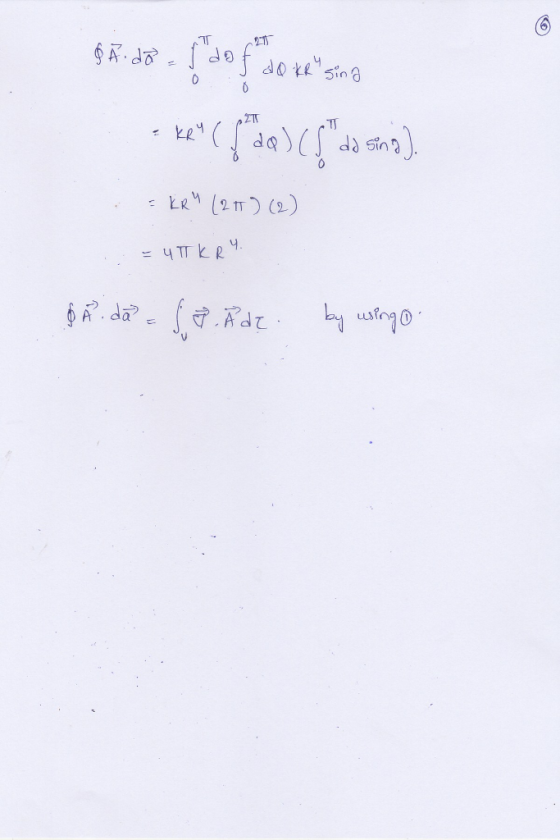
![,271 = Jordao dp (psino [ 4ks 48c05a]). The integrand is independent of 430, we use Sd0-277 Saarde = 10fdfocare a stino a 21](http://img.homeworklib.com/questions/387ba190-a92b-11ea-9283-ad17aeb849b8.png?x-oss-process=image/resize,w_560)
Add Answer to:
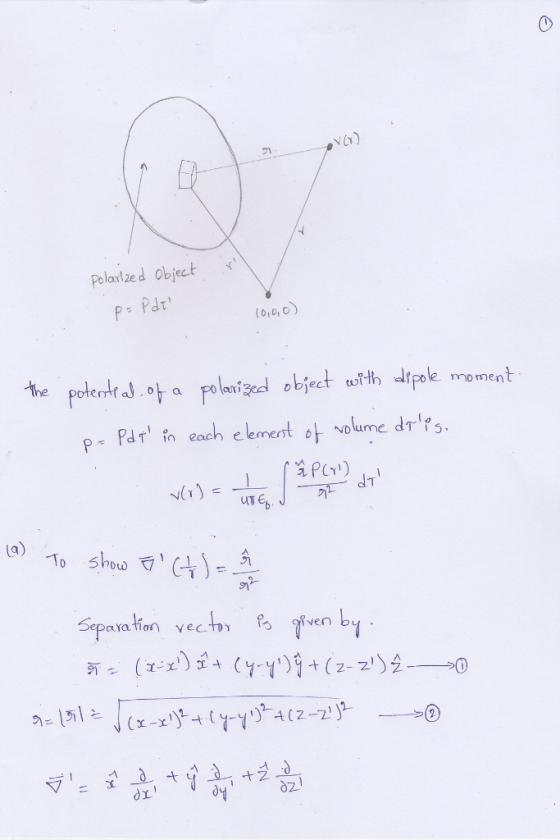
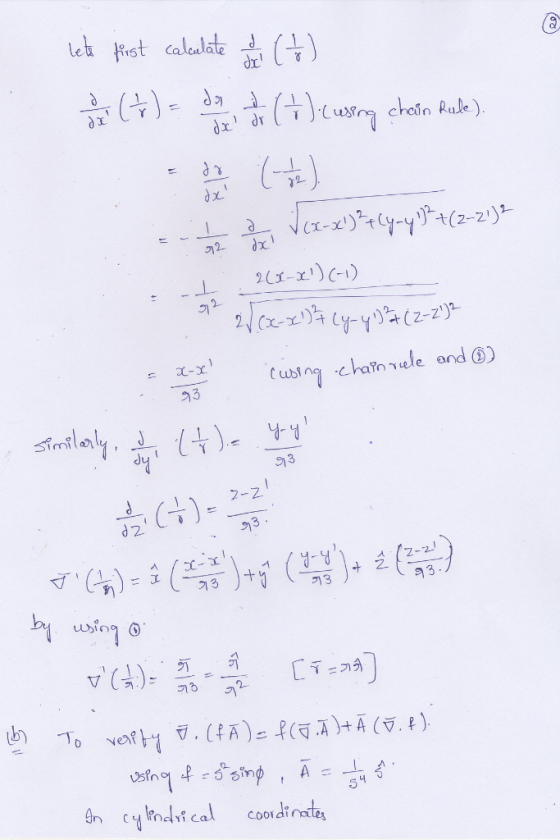
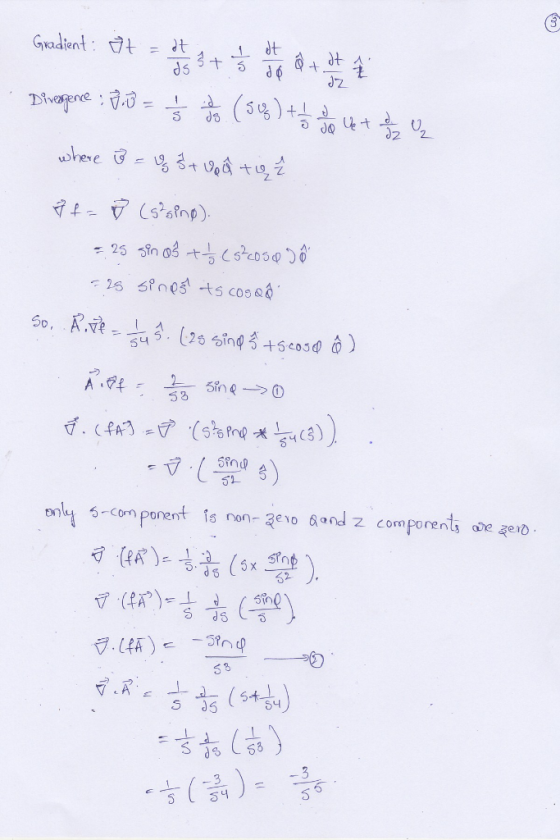
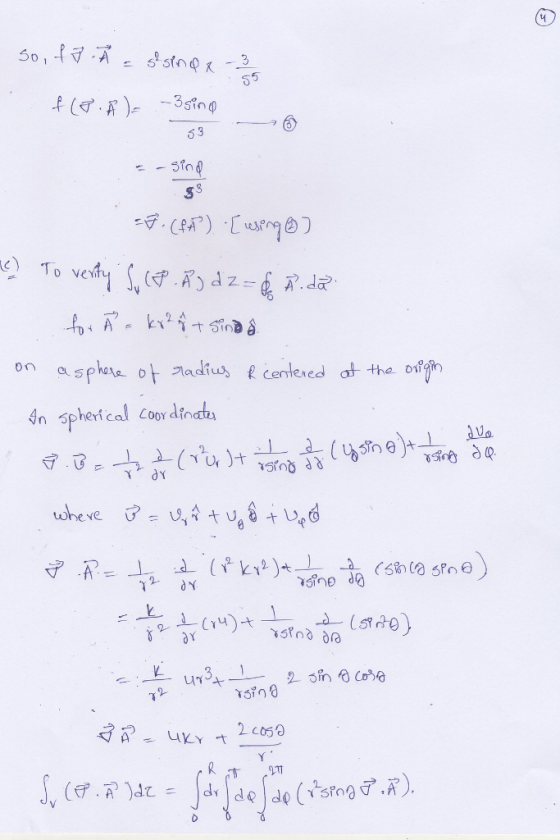
In Griffiths' section 4.2.1, we saw that the potential of a polarized object with dipole moment...
Please answer all parts uhlqueness!I so, in what way or ways would the proof and the result differ from those given above? IV-25 In the text we defined the gradient in terms of certain par...
 Please answer all parts
uhlqueness!I so, in what way or ways would the proof and the result differ from those given above? IV-25 In the text we defined the gradient in terms of certain partial de- rivatives. It is possible to give an alternative definition similar in form to our definitions of the divergence and the curl. Thus, Here/is a scalar function of position, s a closed surface, and Δν the volume it encloses. As usual, n is a unit...
Please answer all parts
uhlqueness!I so, in what way or ways would the proof and the result differ from those given above? IV-25 In the text we defined the gradient in terms of certain partial de- rivatives. It is possible to give an alternative definition similar in form to our definitions of the divergence and the curl. Thus, Here/is a scalar function of position, s a closed surface, and Δν the volume it encloses. As usual, n is a unit...
Answer all parts please uhlqueness!I so, in what way or ways would the proof and the result differ from those given above? IV-25 In the text we defined the gradient in terms of certain par...
 Answer all parts please
uhlqueness!I so, in what way or ways would the proof and the result differ from those given above? IV-25 In the text we defined the gradient in terms of certain partial de- rivatives. It is possible to give an alternative definition similar in form to our definitions of the divergence and the curl. Thus, Here/is a scalar function of position, s a closed surface, and Δν the volume it encloses. As usual, n is a unit...
Answer all parts please
uhlqueness!I so, in what way or ways would the proof and the result differ from those given above? IV-25 In the text we defined the gradient in terms of certain partial de- rivatives. It is possible to give an alternative definition similar in form to our definitions of the divergence and the curl. Thus, Here/is a scalar function of position, s a closed surface, and Δν the volume it encloses. As usual, n is a unit...
2. Consider the vector field F = (yz - eyiz sinx)i + (x2 + eyiz cosz)j...
 2. Consider the vector field F = (yz - eyiz sinx)i + (x2 + eyiz cosz)j + (cy + eylz cos.) k. (a) Show that F is a gradient vector field by finding a function o such that F = Vº. (b) Show that F is conservative by showing for any loop C, which is a(t) for te (a, b) satisfying a(a) = a(6), ff.dr = $. 14. dr = 0. Hint: the explicit o from (a) is not needed....
MARK WHICH OF THE FOLLOWING ARE TRUE/FALSE A. The component of flux, given flux density F,...
 MARK WHICH OF THE FOLLOWING ARE TRUE/FALSE
A. The component of flux, given flux density F, crossing the surface dsu F.ûdsu OB. In spherical coordinates the following is true for any point, r= Rsin o cos 6î + Rsin o sin oſ + R cos and de =R c. The gradient in the u, v, w coordinates is 1 0 1 0 V= ü+T V .hu du h, du + 1 0 hw dw Then, the component of flux, given...
MARK WHICH OF THE FOLLOWING ARE TRUE/FALSE
A. The component of flux, given flux density F, crossing the surface dsu F.ûdsu OB. In spherical coordinates the following is true for any point, r= Rsin o cos 6î + Rsin o sin oſ + R cos and de =R c. The gradient in the u, v, w coordinates is 1 0 1 0 V= ü+T V .hu du h, du + 1 0 hw dw Then, the component of flux, given...
Physics 2: Dipole Moment and Electric Potential Having a hard time with some of these questions....
 Physics 2: Dipole Moment and Electric Potential
Having a hard time with some of these questions. Help would be
greatly appreciated. If you could put in all equations used and
show your work it would be greatly appreciated. I want to compare
the answers I got. You will be rewarded! Thanks :-)
A long cylindrical conductor shell has a uniform positive charge distribution per unit length, +2 lambda and with inner radius r and the outer radius 2r.A long wire...
Physics 2: Dipole Moment and Electric Potential
Having a hard time with some of these questions. Help would be
greatly appreciated. If you could put in all equations used and
show your work it would be greatly appreciated. I want to compare
the answers I got. You will be rewarded! Thanks :-)
A long cylindrical conductor shell has a uniform positive charge distribution per unit length, +2 lambda and with inner radius r and the outer radius 2r.A long wire...
+ cos(y) is conservative by responding to the 2. Show that the vector field F(x,y) =...
 + cos(y) is conservative by responding to the 2. Show that the vector field F(x,y) = (ye* + sin(y))i + ( following steps: a.) Determine both P(x,y) and Q(x,y) given F. b.) Demonstrate your answers in a.) satisfy Clairaut's theorem. c.) Partially integrate P with respect to r to obtain the potential S(= y) = P(x,y)da = (1.x) + C) where (a,b) is the anti-derivative of P(x,y) with respect to r and C(y) is a function of y such that...
Please help with 3 and 4. 518 Guided Projects Guided Project 77: Planimeters and vector fields...
 Please help with 3 and 4.
518 Guided Projects Guided Project 77: Planimeters and vector fields Topics and skills: Vector calculus, Stokes' Theorem The planimeter is an ingenious device that allows one to trace a closed curve in the plane and determine the area of the region R enclosed by the curve (Figure 1). For this reason, it is an example of an "integrator," a mechanical device that computes areas of regions bounded by curves. The original planimeter was invented...
Please help with 3 and 4.
518 Guided Projects Guided Project 77: Planimeters and vector fields Topics and skills: Vector calculus, Stokes' Theorem The planimeter is an ingenious device that allows one to trace a closed curve in the plane and determine the area of the region R enclosed by the curve (Figure 1). For this reason, it is an example of an "integrator," a mechanical device that computes areas of regions bounded by curves. The original planimeter was invented...
Question 1. Determine whether or not
Question 1. Determine whether or not \(\mathrm{F}(x, y)=e^{x} \sin y \mathbf{i}+e^{x} \cos y_{\mathbf{j}}\) is a conservative field. If it is, find its potential function \(f\).Question 2. Find the curl and the divergence of the vector field \(\mathbf{F}=\sin y z \mathbf{i}+\sin z x \mathbf{j}+\sin x y \mathbf{k}\)Question 3. Find the flux of the vector field \(\mathbf{F}=z \mathbf{i}+y \mathbf{j}+x \mathbf{k}\) across the surface \(r(u, v)=\langle u \cos v, u \sin v, v\rangle, 0 \leq u \leq 1,0 \leq v \leq \pi\) with...
Consider a cylindrical capacitor like that shown in Fig. 24.6. Let d = rb − ra...
 Consider a cylindrical capacitor like that shown in Fig. 24.6. Let d = rb − ra be the spacing between the inner and outer conductors. (a) Let the radii of the two conductors be only slightly different, so that d << ra. Show that the result derived in Example 24.4 (Section 24.1) for the capacitance of a cylindrical capacitor then reduces to Eq. (24.2), the equation for the capacitance of a parallel-plate capacitor, with A being the surface area of...
 Please answer all parts
uhlqueness!I so, in what way or ways would the proof and the result differ from those given above? IV-25 In the text we defined the gradient in terms of certain partial de- rivatives. It is possible to give an alternative definition similar in form to our definitions of the divergence and the curl. Thus, Here/is a scalar function of position, s a closed surface, and Δν the volume it encloses. As usual, n is a unit...
Please answer all parts
uhlqueness!I so, in what way or ways would the proof and the result differ from those given above? IV-25 In the text we defined the gradient in terms of certain partial de- rivatives. It is possible to give an alternative definition similar in form to our definitions of the divergence and the curl. Thus, Here/is a scalar function of position, s a closed surface, and Δν the volume it encloses. As usual, n is a unit...
 Answer all parts please
uhlqueness!I so, in what way or ways would the proof and the result differ from those given above? IV-25 In the text we defined the gradient in terms of certain partial de- rivatives. It is possible to give an alternative definition similar in form to our definitions of the divergence and the curl. Thus, Here/is a scalar function of position, s a closed surface, and Δν the volume it encloses. As usual, n is a unit...
Answer all parts please
uhlqueness!I so, in what way or ways would the proof and the result differ from those given above? IV-25 In the text we defined the gradient in terms of certain partial de- rivatives. It is possible to give an alternative definition similar in form to our definitions of the divergence and the curl. Thus, Here/is a scalar function of position, s a closed surface, and Δν the volume it encloses. As usual, n is a unit...
 2. Consider the vector field F = (yz - eyiz sinx)i + (x2 + eyiz cosz)j + (cy + eylz cos.) k. (a) Show that F is a gradient vector field by finding a function o such that F = Vº. (b) Show that F is conservative by showing for any loop C, which is a(t) for te (a, b) satisfying a(a) = a(6), ff.dr = $. 14. dr = 0. Hint: the explicit o from (a) is not needed....
 MARK WHICH OF THE FOLLOWING ARE TRUE/FALSE
A. The component of flux, given flux density F, crossing the surface dsu F.ûdsu OB. In spherical coordinates the following is true for any point, r= Rsin o cos 6î + Rsin o sin oſ + R cos and de =R c. The gradient in the u, v, w coordinates is 1 0 1 0 V= ü+T V .hu du h, du + 1 0 hw dw Then, the component of flux, given...
MARK WHICH OF THE FOLLOWING ARE TRUE/FALSE
A. The component of flux, given flux density F, crossing the surface dsu F.ûdsu OB. In spherical coordinates the following is true for any point, r= Rsin o cos 6î + Rsin o sin oſ + R cos and de =R c. The gradient in the u, v, w coordinates is 1 0 1 0 V= ü+T V .hu du h, du + 1 0 hw dw Then, the component of flux, given...
 Physics 2: Dipole Moment and Electric Potential
Having a hard time with some of these questions. Help would be
greatly appreciated. If you could put in all equations used and
show your work it would be greatly appreciated. I want to compare
the answers I got. You will be rewarded! Thanks :-)
A long cylindrical conductor shell has a uniform positive charge distribution per unit length, +2 lambda and with inner radius r and the outer radius 2r.A long wire...
Physics 2: Dipole Moment and Electric Potential
Having a hard time with some of these questions. Help would be
greatly appreciated. If you could put in all equations used and
show your work it would be greatly appreciated. I want to compare
the answers I got. You will be rewarded! Thanks :-)
A long cylindrical conductor shell has a uniform positive charge distribution per unit length, +2 lambda and with inner radius r and the outer radius 2r.A long wire...
 + cos(y) is conservative by responding to the 2. Show that the vector field F(x,y) = (ye* + sin(y))i + ( following steps: a.) Determine both P(x,y) and Q(x,y) given F. b.) Demonstrate your answers in a.) satisfy Clairaut's theorem. c.) Partially integrate P with respect to r to obtain the potential S(= y) = P(x,y)da = (1.x) + C) where (a,b) is the anti-derivative of P(x,y) with respect to r and C(y) is a function of y such that...
 Please help with 3 and 4.
518 Guided Projects Guided Project 77: Planimeters and vector fields Topics and skills: Vector calculus, Stokes' Theorem The planimeter is an ingenious device that allows one to trace a closed curve in the plane and determine the area of the region R enclosed by the curve (Figure 1). For this reason, it is an example of an "integrator," a mechanical device that computes areas of regions bounded by curves. The original planimeter was invented...
Please help with 3 and 4.
518 Guided Projects Guided Project 77: Planimeters and vector fields Topics and skills: Vector calculus, Stokes' Theorem The planimeter is an ingenious device that allows one to trace a closed curve in the plane and determine the area of the region R enclosed by the curve (Figure 1). For this reason, it is an example of an "integrator," a mechanical device that computes areas of regions bounded by curves. The original planimeter was invented...
 Consider a cylindrical capacitor like that shown in Fig. 24.6. Let d = rb − ra be the spacing between the inner and outer conductors. (a) Let the radii of the two conductors be only slightly different, so that d << ra. Show that the result derived in Example 24.4 (Section 24.1) for the capacitance of a cylindrical capacitor then reduces to Eq. (24.2), the equation for the capacitance of a parallel-plate capacitor, with A being the surface area of...
Most questions answered within 3 hours.
-
Where is the error in this code sequence?
String s1 = "Hello";
String s2 = "ello";...
asked 10 months ago -
Financial data for Joel de Paris, Inc., for last year
follow:
Joel de Paris, Inc.
Balance...
asked 10 months ago -
Consider this reaction:
Al2(SO4)3 (aq)+ BaCl3
(aq) Al2Cl6 (aq)- +
3BaSO4(s) . What is the...
asked 10 months ago -
Suppose that Savneet is considering increasing her
recent random sample from 20 car rentals to 40...
asked 10 months ago -
Trucks arrive at an unloading terminal at an average rate of 120
per hour.
Trucks arrive...
asked 10 months ago -
Why are methanol and ethanol completely soluble in water while
octanol is not very little soluble....
asked 10 months ago -
A facilities manager at a university reads in a research report
that the mean amount of...
asked 10 months ago -
When the CuSO4 is rehydrated by adding water to the anhydrous
compound, is this an endothermic...
asked 10 months ago -
A ray of sunlight is passing from diamond into crown glass; the
angle of incidence is...
asked 10 months ago -
A block of mass 0.249 kg is placed on top of a light, vertical
spring of...
asked 10 months ago -
how do the kidneys compensate in the presences of acidosis
a) trigger hyperventilate
b) reserve acid...
asked 10 months ago -
Question 501 pts
The rental rate of capital to the firm increases. Which of the
following...
asked 10 months ago