

Homework Answers


Add Answer to:
6. Use the construction in Theorem 4.1 to find nfa's that accept (a) L ((ab) "a)...
Find nfa’s that accept (a) L ((ab)∗ a∗) ∩ L (baa∗) (b) L (ab∗a∗) ∩ L...
Find nfa’s that accept (a) L ((ab)∗ a∗) ∩ L (baa∗) (b) L (ab∗a∗) ∩ L (a∗b∗a) Could someone show me how to construct these and explain their reasoning at each step? Thanks!
dn 6. Use the theorem, L {t" f(t)} = (-1)" den! F(s), to find each of...
 dn 6. Use the theorem, L {t" f(t)} = (-1)" den! F(s), to find each of the following: (a) L {t cos 2t} (b) L {t sint}
3 > . No credit for 5. Use the Convolution Theorem to find L any other...
 3 > . No credit for 5. Use the Convolution Theorem to find L any other method. (10 points)
THEOREM 3.1 Let r be a regular expression. Then there exists some nondeteministic finite accepter that...
 THEOREM 3.1 Let r be a regular expression. Then there exists some nondeteministic finite accepter that accepts L (r) Consequently, L () is a regular language. Proof: We begin with automata that accept the languages for the simple regular expressions ø, 2, and a E . These are shown in Figure 3.1(a), (b), and (c), respectively. Assume now that we have automata M (r) and M (r) that accept languages denoted by regular expressions ri and r respectively. We need...
9. Use the construction in the proof of the Chinese remainder theorem to find a solution to the system of congruences X 1 mod 2 x 2 mod 3 x 3 mod 5 x 4 mod 11 10. Use Fermats little theorem to fin...
 9. Use the construction in the proof of the Chinese remainder theorem to find a solution to the system of congruences X 1 mod 2 x 2 mod 3 x 3 mod 5 x 4 mod 11 10. Use Fermats little theorem to find 712 mod 13 11. What sequence of pseudorandom numbers is generated using the linear congruential generator Xn+1 (4xn + 1) mod 7 with seed xo 3?
9. Use the construction in the proof of the Chinese...
9. Use the construction in the proof of the Chinese remainder theorem to find a solution to the system of congruences X 1 mod 2 x 2 mod 3 x 3 mod 5 x 4 mod 11 10. Use Fermats little theorem to find 712 mod 13 11. What sequence of pseudorandom numbers is generated using the linear congruential generator Xn+1 (4xn + 1) mod 7 with seed xo 3?
9. Use the construction in the proof of the Chinese...
1. Use the construction of Theorem 2.2 to convert the nfa in Figure 2.10 to a...
 1. Use the construction of Theorem 2.2 to convert the nfa in Figure 2.10 to a dfa. Can you see a simpler answer more directly?
1. Construct a DFSM to accept the language: L w E ab): w contains at least 3 as and no more than 3 bs) 2. Let E (acgt a...
 1. Construct a DFSM to accept the language: L w E ab): w contains at least 3 as and no more than 3 bs) 2. Let E (acgt and let L be the language of strings consisting of repeated copies of the pairs at, ta, cg. ge. Construct both a DFSM to accept the language and a regular expression that represents the language. 3. Let ab. For a string w E , let w denote the string w with the...
6. Use the power theorem to find the value of the following integr sinc Answer:
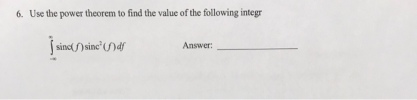 6. Use the power theorem to find the value of the following integr sinc Answer:
Use Theorem 7.1.1 to find L{f(t)}. (Write your answer as a function of s.) f(t) =...
 Use Theorem 7.1.1 to find L{f(t)}. (Write your answer as a function of s.) f(t) = 282 - 4 sin(56) L{f(t)}
Use Theorem 7.1.1 to find L{f(t)}. (Write your answer as a function of s.) f(t) =...
 Use Theorem 7.1.1 to find L{f(t)}. (Write your answer as a function of s.) f(t) = (2t - 1)3 %3D L{f(t)} =
 dn 6. Use the theorem, L {t" f(t)} = (-1)" den! F(s), to find each of the following: (a) L {t cos 2t} (b) L {t sint}
 3 > . No credit for 5. Use the Convolution Theorem to find L any other method. (10 points)
 THEOREM 3.1 Let r be a regular expression. Then there exists some nondeteministic finite accepter that accepts L (r) Consequently, L () is a regular language. Proof: We begin with automata that accept the languages for the simple regular expressions ø, 2, and a E . These are shown in Figure 3.1(a), (b), and (c), respectively. Assume now that we have automata M (r) and M (r) that accept languages denoted by regular expressions ri and r respectively. We need...
 9. Use the construction in the proof of the Chinese remainder theorem to find a solution to the system of congruences X 1 mod 2 x 2 mod 3 x 3 mod 5 x 4 mod 11 10. Use Fermats little theorem to find 712 mod 13 11. What sequence of pseudorandom numbers is generated using the linear congruential generator Xn+1 (4xn + 1) mod 7 with seed xo 3?
9. Use the construction in the proof of the Chinese...
9. Use the construction in the proof of the Chinese remainder theorem to find a solution to the system of congruences X 1 mod 2 x 2 mod 3 x 3 mod 5 x 4 mod 11 10. Use Fermats little theorem to find 712 mod 13 11. What sequence of pseudorandom numbers is generated using the linear congruential generator Xn+1 (4xn + 1) mod 7 with seed xo 3?
9. Use the construction in the proof of the Chinese...
 1. Use the construction of Theorem 2.2 to convert the nfa in Figure 2.10 to a dfa. Can you see a simpler answer more directly?
 1. Construct a DFSM to accept the language: L w E ab): w contains at least 3 as and no more than 3 bs) 2. Let E (acgt and let L be the language of strings consisting of repeated copies of the pairs at, ta, cg. ge. Construct both a DFSM to accept the language and a regular expression that represents the language. 3. Let ab. For a string w E , let w denote the string w with the...
 6. Use the power theorem to find the value of the following integr sinc Answer:
 Use Theorem 7.1.1 to find L{f(t)}. (Write your answer as a function of s.) f(t) = 282 - 4 sin(56) L{f(t)}
 Use Theorem 7.1.1 to find L{f(t)}. (Write your answer as a function of s.) f(t) = (2t - 1)3 %3D L{f(t)} =
Most questions answered within 3 hours.
-
Where is the error in this code sequence?
String s1 = "Hello";
String s2 = "ello";...
asked 10 months ago -
Financial data for Joel de Paris, Inc., for last year
follow:
Joel de Paris, Inc.
Balance...
asked 10 months ago -
Consider this reaction:
Al2(SO4)3 (aq)+ BaCl3
(aq) Al2Cl6 (aq)- +
3BaSO4(s) . What is the...
asked 10 months ago -
Suppose that Savneet is considering increasing her
recent random sample from 20 car rentals to 40...
asked 10 months ago -
Trucks arrive at an unloading terminal at an average rate of 120
per hour.
Trucks arrive...
asked 10 months ago -
Why are methanol and ethanol completely soluble in water while
octanol is not very little soluble....
asked 10 months ago -
A facilities manager at a university reads in a research report
that the mean amount of...
asked 10 months ago -
When the CuSO4 is rehydrated by adding water to the anhydrous
compound, is this an endothermic...
asked 10 months ago -
A ray of sunlight is passing from diamond into crown glass; the
angle of incidence is...
asked 10 months ago -
A block of mass 0.249 kg is placed on top of a light, vertical
spring of...
asked 10 months ago -
how do the kidneys compensate in the presences of acidosis
a) trigger hyperventilate
b) reserve acid...
asked 10 months ago -
Question 501 pts
The rental rate of capital to the firm increases. Which of the
following...
asked 10 months ago