Is micelle same as chylomicrons?
Homework Answers
Question: Is micelle same as chylomicrons?
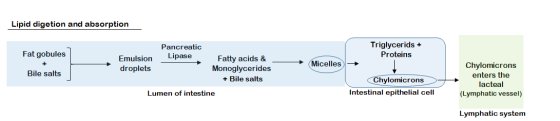
Answer: During the process of fat digestion, the pancreatic lipase gets secreted into the lumen of the small intestine. With the help of bile salts, pancreatic lipase digest triglycerides to monoglycerides and fatty acids and gets packaged into small water-soluble molecules called micelles. Intestinal mucosal cells absorb digested fats that leave from these micelle molecules. Intestinal cells package these digestive products into lipoproteins called chylomicrons. After entering the intestinal mucosal cells, these end products of fat digestion combine with the proteins inside the Golgi apparatus and get repackaged into Chylomicrons. Chylomicrons that move out of the intestinal cells carry these end products of fat digestion into the lymph vessels and transport them into the lymph and thus enter the circulation to the body tissues.
Micelles consist of monoglycerides, free fatty acids along with bile salts. Chylomicrons consist of triglycerides, cholesterol, phospholipids, and protein.
Which one of the following statements about chylomicrons is correct? a. Chylomicrons are made inside intestinal...
Which one of the following statements about chylomicrons is correct? a. Chylomicrons are made inside intestinal cells and secreted into lymph. b. The core of chylomicrons contains triacylglycerol and phospholipids. c. Chylomicron remnants differ from chylomicrons in that they are smaller and contain a lower proportion of triacylglycerol and a higher proportion of cholesterol. d. Chylomicrons are taken up by the liver.
In fat digestion, fats form micelles. Which of the following must happen prior to micelle formation?...
 In fat digestion, fats form micelles. Which of the following must happen prior to micelle formation? (Select any/all that apply) O Lipases must cleave triacylglycerols O Bile salts must interact with fat ONone of given answers (i.e. all of the given answers must happen prior to micelle formation in fat digestion) Chylomicrons must form Which is a molecule with high phosphoryl transfer potential? (Select any/all that apply) ATP O 1,3-Bisphosphoglycerate 2-Phosphoglycerate Phosphoenolpyruvate In general, oxidation releases energy and is associated...
(a) Calculate the free energies of micellisation at each temperature, ΔG°micelle, the enthalpy of micellisation, ΔH°micelle,...
(a) Calculate the free energies of micellisation at each temperature, ΔG°micelle, the enthalpy of micellisation, ΔH°micelle, and the entropy of micellisation, ΔS°micelle, from the data given below. CMC at 25°C (10–3 M) CMC at 40°C (10–3 M) 1.04 4.46
Chylomicrons are involved in fat digestion and absorption in which of the following ways? Triglycerides synthesized...
 Chylomicrons are involved in fat digestion and absorption in which of the following ways? Triglycerides synthesized in the liver are packaged in chylomicrons for delivery to the muscle and adipose tissue Bile salts emulsify lipid from the diet into small droplets called chylomicrons Triglycerides reassembled in enterocytes are packaged in chylomicrons for delivery into the body Chylomicrons are released from the pancreas to help break down triglycerides in the digestive tract
1. Which of the following is true regarding lipoproteins? a. Mature chylomicrons have B100 and B48...
1. Which of the following is true regarding lipoproteins? a. Mature chylomicrons have B100 and B48 apolipoproteins. b. Nascent chylomicrons are produced in the liver. c. The main function of the CII apolipoprotein is binding to LDL receptors. d. Nascent chylomicrons travel in the lymphatic system to the bloodstream, where they mature.
Why does micelle form because of a gain in entropy of water?
Why does micelle form because of a gain in entropy of water?
In the intestinal mucosa, chylomicrons are necessary because ingested fats are hdyrophilic fats are transported readily...
 In the intestinal mucosa, chylomicrons are necessary because ingested fats are hdyrophilic fats are transported readily in blood but need chylomicrons to transport cholesterol ingested fats are nonpolar and are packaged in lipoproteins for transport bile salts are packaged with ingested fats for transport to tissues
B48 is the B apolipoprotein produced in the small intestines, and carried by chylomicrons. True or...
B48 is the B apolipoprotein produced in the small intestines, and carried by chylomicrons. True or False
Explain the independence of surface tension on surfactant concentration above the CMC (critical micelle concentration).
Explain the independence of surface tension on surfactant concentration above the CMC (critical micelle concentration).
The casein micelle is destabilized by Group of answer choices Increasing pH to 7.6 Decreasing pH...
The casein micelle is destabilized by Group of answer choices Increasing pH to 7.6 Decreasing pH to 4.6 Heating milk to 85C
 In fat digestion, fats form micelles. Which of the following must happen prior to micelle formation? (Select any/all that apply) O Lipases must cleave triacylglycerols O Bile salts must interact with fat ONone of given answers (i.e. all of the given answers must happen prior to micelle formation in fat digestion) Chylomicrons must form Which is a molecule with high phosphoryl transfer potential? (Select any/all that apply) ATP O 1,3-Bisphosphoglycerate 2-Phosphoglycerate Phosphoenolpyruvate In general, oxidation releases energy and is associated...
 Chylomicrons are involved in fat digestion and absorption in which of the following ways? Triglycerides synthesized in the liver are packaged in chylomicrons for delivery to the muscle and adipose tissue Bile salts emulsify lipid from the diet into small droplets called chylomicrons Triglycerides reassembled in enterocytes are packaged in chylomicrons for delivery into the body Chylomicrons are released from the pancreas to help break down triglycerides in the digestive tract
 In the intestinal mucosa, chylomicrons are necessary because ingested fats are hdyrophilic fats are transported readily in blood but need chylomicrons to transport cholesterol ingested fats are nonpolar and are packaged in lipoproteins for transport bile salts are packaged with ingested fats for transport to tissues
Most questions answered within 3 hours.
-
Where is the error in this code sequence?
String s1 = "Hello";
String s2 = "ello";...
asked 10 months ago -
Financial data for Joel de Paris, Inc., for last year
follow:
Joel de Paris, Inc.
Balance...
asked 10 months ago -
Consider this reaction:
Al2(SO4)3 (aq)+ BaCl3
(aq) Al2Cl6 (aq)- +
3BaSO4(s) . What is the...
asked 10 months ago -
Suppose that Savneet is considering increasing her
recent random sample from 20 car rentals to 40...
asked 10 months ago -
Trucks arrive at an unloading terminal at an average rate of 120
per hour.
Trucks arrive...
asked 10 months ago -
Why are methanol and ethanol completely soluble in water while
octanol is not very little soluble....
asked 10 months ago -
A facilities manager at a university reads in a research report
that the mean amount of...
asked 10 months ago -
When the CuSO4 is rehydrated by adding water to the anhydrous
compound, is this an endothermic...
asked 10 months ago -
A ray of sunlight is passing from diamond into crown glass; the
angle of incidence is...
asked 10 months ago -
A block of mass 0.249 kg is placed on top of a light, vertical
spring of...
asked 10 months ago -
how do the kidneys compensate in the presences of acidosis
a) trigger hyperventilate
b) reserve acid...
asked 10 months ago -
Question 501 pts
The rental rate of capital to the firm increases. Which of the
following...
asked 10 months ago