
Homework Answers
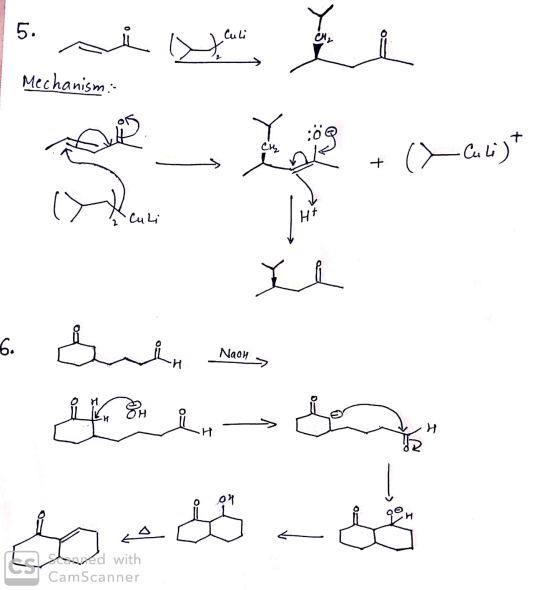
5- Gilman reagent here act as a nucleophile and attack at the beta position of alpha-beta unsaturated ketone given because of its soft nature it attack at double bond not carbonyl center. Then after protonation the desired product is formed . As shown in mechanism given below.
6- The given example is type of intramolecular aldol reaction where the base first abstract the proton of alpha carbon of ketone not aldehyde due formation of more stable substituted enolate. The intramolecular attack occur as carbanion form attack the carbonyl of aldehyde to form two 6 membered cyclic structure .At last the elimination of water molecule occur to form alpha beta unsaturated cyclic ketone.
Add Answer to:
CHEM 2602 Exam 2 March 25, 2020 For questions 5 and 6 Show the major product...
For questions 3 and 4: Show the major product for each of the reactions, paying attention...
 For questions 3 and 4: Show the major product for each of the reactions, paying attention to stereo and regiochemistry where necessary. Draw the mechanism (show all relevant lone pairs, formal charges, curved arrows etc.) for ONE of the reactions (your choice, circle the letter for the mechanism you want me to grade) 1) KCN, HẠO 2) H 1) NaBHA 2) H,09
2. Provide the complete mechanism (curved arrows) to show how the product is formed. Include all...
 2. Provide the complete mechanism (curved arrows) to show how the product is formed. Include all lone pairs, formal charges, curved arrows, intermediates, and products. You do not need to draw the structures of transition states. If there is a carbocation rearrangement and/or a proton transfer, be sure to include it (them) in your mechanism. (Remember to start by drawing all ionic compounds as ions/drawing out the structure of all reagents, and drawing in all lone pairs.) HCI 3. Which...
Write a reaction mechanism to show how the major mononitrated product forms when protonated methyl benzoate...
Write a reaction mechanism to show how the major mononitrated product forms when protonated methyl benzoate (a nucleophile) combines with nitronium ion (an electrophile). Use the curved-arrow formalism. Show all lone pairs and formal charges.
2) Draw a rational mechanism for the reaction shown below. Use curved arrows appropriately. Show all relevant intermedi...
 2) Draw a rational mechanism for the reaction shown below. Use curved arrows appropriately. Show all relevant intermediate(s) and lone pairs of electrons and formal charges where appropriate. Show ALL STEPS (i.e Reaction 2) 1) Na O Et, EtOH Et 2) H20, HCI Et
please help 3. (3 pts) First, draw the major product. Be sure to show correct stereochemistry....
 please help
3. (3 pts) First, draw the major product. Be sure to show correct stereochemistry. Second, draw a mechanism. Use curved arrow notation. Show all electron lone-pairs and formal charges. Hint: ethanol is a protic-nucleophilic solvent. Brą, ethanol
please help
3. (3 pts) First, draw the major product. Be sure to show correct stereochemistry. Second, draw a mechanism. Use curved arrow notation. Show all electron lone-pairs and formal charges. Hint: ethanol is a protic-nucleophilic solvent. Brą, ethanol
3. (3 pts) First, draw the major product. Be sure to show correct stereochemistry. Second, draw a mechanism. Use curved...
 3. (3 pts) First, draw the major product. Be sure to show correct stereochemistry. Second, draw a mechanism. Use curved arrow notation. Show all electron lone-pairs and formal charges. Hint: ethanol is a protic-nucleophilic solvent. Br2, ethanol
To earn full credit and receive feedback, please show all work for all problems. 1. Circle...
 To earn full credit and receive feedback, please show all work for all problems. 1. Circle the compound that is the stronger acid. Explain and justify your choice using a combination of words and chemical structures. 2. Provide the complete mechanism (curved arrows) to show how the product is formed. Include all lone pairs, formal charges, curved arrows, intermediates, and products. You do not need to draw the structures of transition states. If there is a carbocation rearrangement and/or a...
1. Provide the major product(s) that you would obtain in the following reactions. CH,Br وAIBr 2....
 1. Provide the major product(s) that you would obtain in the following reactions. CH,Br وAIBr 2. Provide a mechanism for the following reaction. Use arrows to indicate the movement of electrons. Be sure to show necessary lone pair electrons and formal charges. لملم .هم
1)Draw all alkene prodcuts that could form 2) Circle the major alkene product expected 3) Draw...
 1)Draw all alkene prodcuts that could form
2) Circle the major alkene product expected
3) Draw a complete arrow pushing mechanism how the major
product is formed. (Show all srrows, intermediate structures,
formal charges)
2. (19pts) The alcohol dehydration product below is of the El type elimination. (i) Draw all of the alkene products that could possibly form. (ii) Circle the major alkene product expected. (ii) Draw a complete curved arrow-pushing mechanism illustrating how the major product is formed. Be...
1)Draw all alkene prodcuts that could form
2) Circle the major alkene product expected
3) Draw a complete arrow pushing mechanism how the major
product is formed. (Show all srrows, intermediate structures,
formal charges)
2. (19pts) The alcohol dehydration product below is of the El type elimination. (i) Draw all of the alkene products that could possibly form. (ii) Circle the major alkene product expected. (ii) Draw a complete curved arrow-pushing mechanism illustrating how the major product is formed. Be...
CHEM 3020 Practice exam 3 Give the major organic product for the following reactions: R0, H.2...
 CHEM 3020 Practice exam 3 Give the major organic product for the following reactions: R0, H.2 HO HO Bry 1) Lithium Disopropylamide (LDA) 2) CIES o spomen 1) Lithium Disopropyl anide (LDA) OCH, CITOTT 1) OHI 2) CHI OH Give all possible products from the following mixed aldol reaction and show how they can be formed. Show the mechanism for the keto enol tautomerization of 2-propanone in both acid and in base.
 For questions 3 and 4: Show the major product for each of the reactions, paying attention to stereo and regiochemistry where necessary. Draw the mechanism (show all relevant lone pairs, formal charges, curved arrows etc.) for ONE of the reactions (your choice, circle the letter for the mechanism you want me to grade) 1) KCN, HẠO 2) H 1) NaBHA 2) H,09
 2. Provide the complete mechanism (curved arrows) to show how the product is formed. Include all lone pairs, formal charges, curved arrows, intermediates, and products. You do not need to draw the structures of transition states. If there is a carbocation rearrangement and/or a proton transfer, be sure to include it (them) in your mechanism. (Remember to start by drawing all ionic compounds as ions/drawing out the structure of all reagents, and drawing in all lone pairs.) HCI 3. Which...
 2) Draw a rational mechanism for the reaction shown below. Use curved arrows appropriately. Show all relevant intermediate(s) and lone pairs of electrons and formal charges where appropriate. Show ALL STEPS (i.e Reaction 2) 1) Na O Et, EtOH Et 2) H20, HCI Et
 please help
3. (3 pts) First, draw the major product. Be sure to show correct stereochemistry. Second, draw a mechanism. Use curved arrow notation. Show all electron lone-pairs and formal charges. Hint: ethanol is a protic-nucleophilic solvent. Brą, ethanol
please help
3. (3 pts) First, draw the major product. Be sure to show correct stereochemistry. Second, draw a mechanism. Use curved arrow notation. Show all electron lone-pairs and formal charges. Hint: ethanol is a protic-nucleophilic solvent. Brą, ethanol
 3. (3 pts) First, draw the major product. Be sure to show correct stereochemistry. Second, draw a mechanism. Use curved arrow notation. Show all electron lone-pairs and formal charges. Hint: ethanol is a protic-nucleophilic solvent. Br2, ethanol
 To earn full credit and receive feedback, please show all work for all problems. 1. Circle the compound that is the stronger acid. Explain and justify your choice using a combination of words and chemical structures. 2. Provide the complete mechanism (curved arrows) to show how the product is formed. Include all lone pairs, formal charges, curved arrows, intermediates, and products. You do not need to draw the structures of transition states. If there is a carbocation rearrangement and/or a...
 1. Provide the major product(s) that you would obtain in the following reactions. CH,Br وAIBr 2. Provide a mechanism for the following reaction. Use arrows to indicate the movement of electrons. Be sure to show necessary lone pair electrons and formal charges. لملم .هم
 1)Draw all alkene prodcuts that could form
2) Circle the major alkene product expected
3) Draw a complete arrow pushing mechanism how the major
product is formed. (Show all srrows, intermediate structures,
formal charges)
2. (19pts) The alcohol dehydration product below is of the El type elimination. (i) Draw all of the alkene products that could possibly form. (ii) Circle the major alkene product expected. (ii) Draw a complete curved arrow-pushing mechanism illustrating how the major product is formed. Be...
1)Draw all alkene prodcuts that could form
2) Circle the major alkene product expected
3) Draw a complete arrow pushing mechanism how the major
product is formed. (Show all srrows, intermediate structures,
formal charges)
2. (19pts) The alcohol dehydration product below is of the El type elimination. (i) Draw all of the alkene products that could possibly form. (ii) Circle the major alkene product expected. (ii) Draw a complete curved arrow-pushing mechanism illustrating how the major product is formed. Be...
 CHEM 3020 Practice exam 3 Give the major organic product for the following reactions: R0, H.2 HO HO Bry 1) Lithium Disopropylamide (LDA) 2) CIES o spomen 1) Lithium Disopropyl anide (LDA) OCH, CITOTT 1) OHI 2) CHI OH Give all possible products from the following mixed aldol reaction and show how they can be formed. Show the mechanism for the keto enol tautomerization of 2-propanone in both acid and in base.
Most questions answered within 3 hours.
-
Where is the error in this code sequence?
String s1 = "Hello";
String s2 = "ello";...
asked 11 months ago -
Financial data for Joel de Paris, Inc., for last year
follow:
Joel de Paris, Inc.
Balance...
asked 11 months ago -
Consider this reaction:
Al2(SO4)3 (aq)+ BaCl3
(aq) Al2Cl6 (aq)- +
3BaSO4(s) . What is the...
asked 11 months ago -
Suppose that Savneet is considering increasing her
recent random sample from 20 car rentals to 40...
asked 11 months ago -
Trucks arrive at an unloading terminal at an average rate of 120
per hour.
Trucks arrive...
asked 11 months ago -
Why are methanol and ethanol completely soluble in water while
octanol is not very little soluble....
asked 11 months ago -
A facilities manager at a university reads in a research report
that the mean amount of...
asked 11 months ago -
When the CuSO4 is rehydrated by adding water to the anhydrous
compound, is this an endothermic...
asked 11 months ago -
A ray of sunlight is passing from diamond into crown glass; the
angle of incidence is...
asked 11 months ago -
A block of mass 0.249 kg is placed on top of a light, vertical
spring of...
asked 11 months ago -
how do the kidneys compensate in the presences of acidosis
a) trigger hyperventilate
b) reserve acid...
asked 11 months ago -
Question 501 pts
The rental rate of capital to the firm increases. Which of the
following...
asked 11 months ago