
Can you also go into detail about drawing the HOMO and LUMO, like how to know how many molecular orbitals there should be and how many orbitals I should draw? Thanks!
Homework Answers
Request Answer!
We need at least 10 more requests to produce the answer.
0 / 10 have requested this problem solution
The more requests, the faster the answer.
Add Answer to:
Can you also go into detail about drawing the HOMO and LUMO,
like how to know...
4a. A Diels-Alder reaction occurs when the highest occupied molecular orbital (HOMO) of the diene interacts...
 4a. A Diels-Alder reaction occurs when the highest occupied molecular orbital (HOMO) of the diene interacts with the lowest unoccupied molecular orbital (LUMO) of the dienophile. Fill the molecular orbital diagrams given to identify the HOMO and LUMO and show how the orbitals interact to give the product
Please help!! Questions 1. Why does the trans conformation of a diene, in reaction with a...
 Please help!!
Questions 1. Why does the trans conformation of a diene, in reaction with a dienophile, not lead to a Diels-Alder reaction product? 2. Complete the following Diels-Alder reactions. Provide the major endo-product(s). Diene Dienophile Product(s) Domov - 0.0- 3. How many a electrons are there in a molecule of 1.3-butadiene? 106 4. What is the maximum number of electrons that can reside in a molecular orbital? (Hint: It is the same maximum number that can fit into an...
Please help!!
Questions 1. Why does the trans conformation of a diene, in reaction with a dienophile, not lead to a Diels-Alder reaction product? 2. Complete the following Diels-Alder reactions. Provide the major endo-product(s). Diene Dienophile Product(s) Domov - 0.0- 3. How many a electrons are there in a molecule of 1.3-butadiene? 106 4. What is the maximum number of electrons that can reside in a molecular orbital? (Hint: It is the same maximum number that can fit into an...
Question 2&3 Post-Lab: Experiment 9 1. Define the terms diene and dienophile as they apply to...
 Question 2&3
Post-Lab: Experiment 9 1. Define the terms diene and dienophile as they apply to the Diels-Alder reaction Based on the amount of cyclopentadiene you used, how many grams is this? 2. The cyclopentadiene collected from the retro-Diels-Alder reaction must be kept cooled and used fairly soon. Why? 3. 159 Experiment 9 Cycloadditions: The Dieis-Alder Reaction Lab Report: Experiment 9 Preparation of the Adduct Molecular Weight Reagent Grams Moles 6l6-105 0.076 0.05l Cyclopentadiene S1 maleic Anhydride Maleic anhydride The...
Question 2&3
Post-Lab: Experiment 9 1. Define the terms diene and dienophile as they apply to the Diels-Alder reaction Based on the amount of cyclopentadiene you used, how many grams is this? 2. The cyclopentadiene collected from the retro-Diels-Alder reaction must be kept cooled and used fairly soon. Why? 3. 159 Experiment 9 Cycloadditions: The Dieis-Alder Reaction Lab Report: Experiment 9 Preparation of the Adduct Molecular Weight Reagent Grams Moles 6l6-105 0.076 0.05l Cyclopentadiene S1 maleic Anhydride Maleic anhydride The...
How would I calculate the theoretical yield of endo-cis-norbornene-5,6-endo-dicarboxylic anhydride and endo-cis-norbornene-5,6-dicarboxylic acid? Can you please...
 How would I calculate the theoretical yield of
endo-cis-norbornene-5,6-endo-dicarboxylic anhydride and
endo-cis-norbornene-5,6-dicarboxylic acid? Can you please show me
step by step? Can you show me the balanced chemical equation (with
molecular formulas, not the pictures) with the mole ratios as well?
How do we figure out the limiting reagent? Can you also show how to
convert mL to grams for cyclopentadiene, if needed?
We used:
2g of maleic acid
6mL of ethyl acetate
6mL of ligroin (hexanes)
2mL of cyclopentadiene...
How would I calculate the theoretical yield of
endo-cis-norbornene-5,6-endo-dicarboxylic anhydride and
endo-cis-norbornene-5,6-dicarboxylic acid? Can you please show me
step by step? Can you show me the balanced chemical equation (with
molecular formulas, not the pictures) with the mole ratios as well?
How do we figure out the limiting reagent? Can you also show how to
convert mL to grams for cyclopentadiene, if needed?
We used:
2g of maleic acid
6mL of ethyl acetate
6mL of ligroin (hexanes)
2mL of cyclopentadiene...
Predict the structure of A Refluxing Xylene OMOM How would you make B from a Diels...
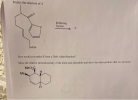 Predict the structure of A Refluxing Xylene OMOM How would you make B from a Diels Alder Reaction? Show the relative stereochemistry of the diene and dienophile and show the other product (the exo product) Me029 Me
8 8) (E)-4-methylpenta-2,4-dien-1-ol and cyclopent-4-ene-1,3-dione can undergo a Diels Alder type reaction. First, draw the Huckel...
 8
8) (E)-4-methylpenta-2,4-dien-1-ol and cyclopent-4-ene-1,3-dione can undergo a Diels Alder type reaction. First, draw the Huckel M.O. diagram for this system. Indicate which orbital is the HOMO and which is the LUMO for the diene and dienophile. Second, clearly sketch the cartoons that show which orbitals interact to allow cyclization. Based on your analysis, is this reaction allowed by heating? (15 points) (E)-4-methylpenta-2,4-dien-1-ol a OH + cyclopent-4-ene-1,3-dione
8
8) (E)-4-methylpenta-2,4-dien-1-ol and cyclopent-4-ene-1,3-dione can undergo a Diels Alder type reaction. First, draw the Huckel M.O. diagram for this system. Indicate which orbital is the HOMO and which is the LUMO for the diene and dienophile. Second, clearly sketch the cartoons that show which orbitals interact to allow cyclization. Based on your analysis, is this reaction allowed by heating? (15 points) (E)-4-methylpenta-2,4-dien-1-ol a OH + cyclopent-4-ene-1,3-dione
What is the objective of this experiment? The reaction solvent for this experiment is xylene. What...
 What is the objective of this experiment?
The reaction solvent for this experiment is xylene. What
property of this solvent makes it a better choice than toluene or
benzene?
Draw the orbitals involved in the 4+2 electrocyclization for
this reaction. Draw the structures of the reactants as best you
can. It may be appropriate to abbreviate the structure of
anthracene.
IR is not provided for this reaction product. Why is IR not
useful for monitoring the reaction or characterizing the...
What is the objective of this experiment?
The reaction solvent for this experiment is xylene. What
property of this solvent makes it a better choice than toluene or
benzene?
Draw the orbitals involved in the 4+2 electrocyclization for
this reaction. Draw the structures of the reactants as best you
can. It may be appropriate to abbreviate the structure of
anthracene.
IR is not provided for this reaction product. Why is IR not
useful for monitoring the reaction or characterizing the...
a. Draw a curved arrow mechanism for the formation of the diels alder product you obtained...
a. Draw a curved arrow mechanism for the formation of the diels alder product you obtained by combining alpha-phellandrene and maleic anhydride. b. How many possible diels alder products could be formed in this reaction (draw them and state how they are related to each other)? c. Which one is formed as the major product in the reaction and why?
D Question 3 3 pts (This is the same reaction from #2.) You repeat the Diels-Alder...
D Question 3 3 pts (This is the same reaction from #2.) You repeat the Diels-Alder reaction from lab using 3.4 g of maleic anhydride (98.06 g/mol) and 2.5 g of cyclopentadiene (66.1 g/mol) to form the final solid product (164.16 g/mol). All compounds are in a 1:1 ratio in the balanced equation. Assuming all the limiting reagent reacts, how much of the other reagent is there in excess? 0.469 g 0 0.309 g O 1.71 g O 0.208 g...
please explain as well, thank you. (8) 1. Draw all the molecular orbitals for the X-system of the allyl anion. Indic...
 please explain as well, thank you.
(8) 1. Draw all the molecular orbitals for the X-system of the allyl anion. Indicate which orbital is the HOMO. (20) 2. Provide reasonable product structures for the following reactions. Indicate clearly if you expect one isomer to predominate. NBS/ROOH D-Br (1 mg) +25°C (1g) -40 °C ) Br (1 e -78 "C (12) 3. Provide product structures for the following Diels-Alder reactions. The second Diels-Alder product eliminates a neutral substance upon further heating....
please explain as well, thank you.
(8) 1. Draw all the molecular orbitals for the X-system of the allyl anion. Indicate which orbital is the HOMO. (20) 2. Provide reasonable product structures for the following reactions. Indicate clearly if you expect one isomer to predominate. NBS/ROOH D-Br (1 mg) +25°C (1g) -40 °C ) Br (1 e -78 "C (12) 3. Provide product structures for the following Diels-Alder reactions. The second Diels-Alder product eliminates a neutral substance upon further heating....
 4a. A Diels-Alder reaction occurs when the highest occupied molecular orbital (HOMO) of the diene interacts with the lowest unoccupied molecular orbital (LUMO) of the dienophile. Fill the molecular orbital diagrams given to identify the HOMO and LUMO and show how the orbitals interact to give the product
 Please help!!
Questions 1. Why does the trans conformation of a diene, in reaction with a dienophile, not lead to a Diels-Alder reaction product? 2. Complete the following Diels-Alder reactions. Provide the major endo-product(s). Diene Dienophile Product(s) Domov - 0.0- 3. How many a electrons are there in a molecule of 1.3-butadiene? 106 4. What is the maximum number of electrons that can reside in a molecular orbital? (Hint: It is the same maximum number that can fit into an...
Please help!!
Questions 1. Why does the trans conformation of a diene, in reaction with a dienophile, not lead to a Diels-Alder reaction product? 2. Complete the following Diels-Alder reactions. Provide the major endo-product(s). Diene Dienophile Product(s) Domov - 0.0- 3. How many a electrons are there in a molecule of 1.3-butadiene? 106 4. What is the maximum number of electrons that can reside in a molecular orbital? (Hint: It is the same maximum number that can fit into an...
 Question 2&3
Post-Lab: Experiment 9 1. Define the terms diene and dienophile as they apply to the Diels-Alder reaction Based on the amount of cyclopentadiene you used, how many grams is this? 2. The cyclopentadiene collected from the retro-Diels-Alder reaction must be kept cooled and used fairly soon. Why? 3. 159 Experiment 9 Cycloadditions: The Dieis-Alder Reaction Lab Report: Experiment 9 Preparation of the Adduct Molecular Weight Reagent Grams Moles 6l6-105 0.076 0.05l Cyclopentadiene S1 maleic Anhydride Maleic anhydride The...
Question 2&3
Post-Lab: Experiment 9 1. Define the terms diene and dienophile as they apply to the Diels-Alder reaction Based on the amount of cyclopentadiene you used, how many grams is this? 2. The cyclopentadiene collected from the retro-Diels-Alder reaction must be kept cooled and used fairly soon. Why? 3. 159 Experiment 9 Cycloadditions: The Dieis-Alder Reaction Lab Report: Experiment 9 Preparation of the Adduct Molecular Weight Reagent Grams Moles 6l6-105 0.076 0.05l Cyclopentadiene S1 maleic Anhydride Maleic anhydride The...
 How would I calculate the theoretical yield of
endo-cis-norbornene-5,6-endo-dicarboxylic anhydride and
endo-cis-norbornene-5,6-dicarboxylic acid? Can you please show me
step by step? Can you show me the balanced chemical equation (with
molecular formulas, not the pictures) with the mole ratios as well?
How do we figure out the limiting reagent? Can you also show how to
convert mL to grams for cyclopentadiene, if needed?
We used:
2g of maleic acid
6mL of ethyl acetate
6mL of ligroin (hexanes)
2mL of cyclopentadiene...
How would I calculate the theoretical yield of
endo-cis-norbornene-5,6-endo-dicarboxylic anhydride and
endo-cis-norbornene-5,6-dicarboxylic acid? Can you please show me
step by step? Can you show me the balanced chemical equation (with
molecular formulas, not the pictures) with the mole ratios as well?
How do we figure out the limiting reagent? Can you also show how to
convert mL to grams for cyclopentadiene, if needed?
We used:
2g of maleic acid
6mL of ethyl acetate
6mL of ligroin (hexanes)
2mL of cyclopentadiene...
 Predict the structure of A Refluxing Xylene OMOM How would you make B from a Diels Alder Reaction? Show the relative stereochemistry of the diene and dienophile and show the other product (the exo product) Me029 Me
 8
8) (E)-4-methylpenta-2,4-dien-1-ol and cyclopent-4-ene-1,3-dione can undergo a Diels Alder type reaction. First, draw the Huckel M.O. diagram for this system. Indicate which orbital is the HOMO and which is the LUMO for the diene and dienophile. Second, clearly sketch the cartoons that show which orbitals interact to allow cyclization. Based on your analysis, is this reaction allowed by heating? (15 points) (E)-4-methylpenta-2,4-dien-1-ol a OH + cyclopent-4-ene-1,3-dione
8
8) (E)-4-methylpenta-2,4-dien-1-ol and cyclopent-4-ene-1,3-dione can undergo a Diels Alder type reaction. First, draw the Huckel M.O. diagram for this system. Indicate which orbital is the HOMO and which is the LUMO for the diene and dienophile. Second, clearly sketch the cartoons that show which orbitals interact to allow cyclization. Based on your analysis, is this reaction allowed by heating? (15 points) (E)-4-methylpenta-2,4-dien-1-ol a OH + cyclopent-4-ene-1,3-dione
 What is the objective of this experiment?
The reaction solvent for this experiment is xylene. What
property of this solvent makes it a better choice than toluene or
benzene?
Draw the orbitals involved in the 4+2 electrocyclization for
this reaction. Draw the structures of the reactants as best you
can. It may be appropriate to abbreviate the structure of
anthracene.
IR is not provided for this reaction product. Why is IR not
useful for monitoring the reaction or characterizing the...
What is the objective of this experiment?
The reaction solvent for this experiment is xylene. What
property of this solvent makes it a better choice than toluene or
benzene?
Draw the orbitals involved in the 4+2 electrocyclization for
this reaction. Draw the structures of the reactants as best you
can. It may be appropriate to abbreviate the structure of
anthracene.
IR is not provided for this reaction product. Why is IR not
useful for monitoring the reaction or characterizing the...
 please explain as well, thank you.
(8) 1. Draw all the molecular orbitals for the X-system of the allyl anion. Indicate which orbital is the HOMO. (20) 2. Provide reasonable product structures for the following reactions. Indicate clearly if you expect one isomer to predominate. NBS/ROOH D-Br (1 mg) +25°C (1g) -40 °C ) Br (1 e -78 "C (12) 3. Provide product structures for the following Diels-Alder reactions. The second Diels-Alder product eliminates a neutral substance upon further heating....
please explain as well, thank you.
(8) 1. Draw all the molecular orbitals for the X-system of the allyl anion. Indicate which orbital is the HOMO. (20) 2. Provide reasonable product structures for the following reactions. Indicate clearly if you expect one isomer to predominate. NBS/ROOH D-Br (1 mg) +25°C (1g) -40 °C ) Br (1 e -78 "C (12) 3. Provide product structures for the following Diels-Alder reactions. The second Diels-Alder product eliminates a neutral substance upon further heating....
Most questions answered within 3 hours.
-
Where is the error in this code sequence?
String s1 = "Hello";
String s2 = "ello";...
asked 10 months ago -
Financial data for Joel de Paris, Inc., for last year
follow:
Joel de Paris, Inc.
Balance...
asked 10 months ago -
Consider this reaction:
Al2(SO4)3 (aq)+ BaCl3
(aq) Al2Cl6 (aq)- +
3BaSO4(s) . What is the...
asked 10 months ago -
Suppose that Savneet is considering increasing her
recent random sample from 20 car rentals to 40...
asked 10 months ago -
Trucks arrive at an unloading terminal at an average rate of 120
per hour.
Trucks arrive...
asked 10 months ago -
Why are methanol and ethanol completely soluble in water while
octanol is not very little soluble....
asked 10 months ago -
A facilities manager at a university reads in a research report
that the mean amount of...
asked 10 months ago -
When the CuSO4 is rehydrated by adding water to the anhydrous
compound, is this an endothermic...
asked 10 months ago -
A ray of sunlight is passing from diamond into crown glass; the
angle of incidence is...
asked 10 months ago -
A block of mass 0.249 kg is placed on top of a light, vertical
spring of...
asked 10 months ago -
how do the kidneys compensate in the presences of acidosis
a) trigger hyperventilate
b) reserve acid...
asked 10 months ago -
Question 501 pts
The rental rate of capital to the firm increases. Which of the
following...
asked 10 months ago