

Homework Answers
Add Answer to:
Please help!!
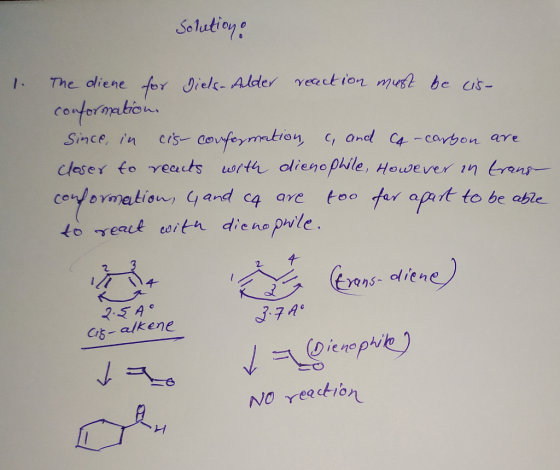
Questions 1. Why does the trans conformation of a diene, in reaction with a...
5. Molecular orbitals are formed by the overlap of atomic orbitals. Thus, n atomic orbitals can combine (overlap) t...
 5. Molecular orbitals are formed by the overlap of atomic orbitals. Thus, n atomic orbitals can combine (overlap) to form n molecular orbitals. In 1,3-butadiene there are four atomic p orbitals which can combine to form four 7 molecular orbitals. In ethene there are two atomic p orbitals which can combine to form two y molecular orbitals. The drawings below show the different ways in which the p orbitals of ethene and 1,3- butadiene can be combined to form the...
Questions 1. Why does the trans conformation of a diene, in reaction with a dienophile, not lead to a Diels-Alder r...
 Questions 1. Why does the trans conformation of a diene, in reaction with a dienophile, not lead to a Diels-Alder reaction product? 2. Complete the following Diels-Alder reactions. Provide the major endo-product(s). Dienophile Product(s) 3. How many i electrons are there in a molecule of 1,3-butadiene?
4a. A Diels-Alder reaction occurs when the highest occupied molecular orbital (HOMO) of the diene interacts...
 4a. A Diels-Alder reaction occurs when the highest occupied molecular orbital (HOMO) of the diene interacts with the lowest unoccupied molecular orbital (LUMO) of the dienophile. Fill the molecular orbital diagrams given to identify the HOMO and LUMO and show how the orbitals interact to give the product
8 8) (E)-4-methylpenta-2,4-dien-1-ol and cyclopent-4-ene-1,3-dione can undergo a Diels Alder type reaction. First, draw the Huckel...
 8
8) (E)-4-methylpenta-2,4-dien-1-ol and cyclopent-4-ene-1,3-dione can undergo a Diels Alder type reaction. First, draw the Huckel M.O. diagram for this system. Indicate which orbital is the HOMO and which is the LUMO for the diene and dienophile. Second, clearly sketch the cartoons that show which orbitals interact to allow cyclization. Based on your analysis, is this reaction allowed by heating? (15 points) (E)-4-methylpenta-2,4-dien-1-ol a OH + cyclopent-4-ene-1,3-dione
8
8) (E)-4-methylpenta-2,4-dien-1-ol and cyclopent-4-ene-1,3-dione can undergo a Diels Alder type reaction. First, draw the Huckel M.O. diagram for this system. Indicate which orbital is the HOMO and which is the LUMO for the diene and dienophile. Second, clearly sketch the cartoons that show which orbitals interact to allow cyclization. Based on your analysis, is this reaction allowed by heating? (15 points) (E)-4-methylpenta-2,4-dien-1-ol a OH + cyclopent-4-ene-1,3-dione
Can you also go into detail about drawing the HOMO and LUMO, like how to know...
 Can you also go into detail about drawing the HOMO and LUMO,
like how to know how many molecular orbitals there should be and
how many orbitals I should draw? Thanks!
LUH III. (16 pts). The Diels-Alder reaction of 1,3-cyclopentadiene with maleic anhydride (A) gives B as the major product. В a. (4 pts). Can product B be designated endo or exo? Explain b. (8 pts). Draw the highest occupied and lowest unoccupied molecular orbitals of the diene and of...
Can you also go into detail about drawing the HOMO and LUMO,
like how to know how many molecular orbitals there should be and
how many orbitals I should draw? Thanks!
LUH III. (16 pts). The Diels-Alder reaction of 1,3-cyclopentadiene with maleic anhydride (A) gives B as the major product. В a. (4 pts). Can product B be designated endo or exo? Explain b. (8 pts). Draw the highest occupied and lowest unoccupied molecular orbitals of the diene and of...
18, 22, 23 16) What diene and dienophile would react to give the product below? diere...
 18, 22, 23
16) What diene and dienophile would react to give the product below? diere 17) Which of the following compounds is the most reactive dienophile in a Diels-Alder reaction with 1,3-butadiene? A) CH-CHOCH B) CH2-CHCHO C) CH3CHCHCH3 D) (CH3CH2 5) C .CH 18) Using resonance structures, explain the regiochemistry observed in this reaction OCH H.CO heat 19) Provide the major organic product of the following reaction H.CO ÇOCH H.COM 20) Provide the major organic product of the following...
18, 22, 23
16) What diene and dienophile would react to give the product below? diere 17) Which of the following compounds is the most reactive dienophile in a Diels-Alder reaction with 1,3-butadiene? A) CH-CHOCH B) CH2-CHCHO C) CH3CHCHCH3 D) (CH3CH2 5) C .CH 18) Using resonance structures, explain the regiochemistry observed in this reaction OCH H.CO heat 19) Provide the major organic product of the following reaction H.CO ÇOCH H.COM 20) Provide the major organic product of the following...
Please help with all the parts Part 2: Reactivity ore on this section, no more than...
 Please help with all the parts
Part 2: Reactivity ore on this section, no more than 5 errors are permitted. reaction is a (4+2] cycloaddition reaction used to form cyclohexene. Shade in the orbitals appropriately for the ground state of butadiene and HOMO and LUMO and draw in all electrons ethene. Label the Ground State Ground State Shade in the orbitals involved in the reaction and indicate constractive or destructive overlap for thermal conditions. Hint: The LUMO comes from ethene...
Please help with all the parts
Part 2: Reactivity ore on this section, no more than 5 errors are permitted. reaction is a (4+2] cycloaddition reaction used to form cyclohexene. Shade in the orbitals appropriately for the ground state of butadiene and HOMO and LUMO and draw in all electrons ethene. Label the Ground State Ground State Shade in the orbitals involved in the reaction and indicate constractive or destructive overlap for thermal conditions. Hint: The LUMO comes from ethene...
1. (a) Why does buta-1,3-diene (max 217 nm) have a longer-wavelength (lower-energy) UV-Vis absorption peak as...
 1. (a) Why does buta-1,3-diene (max 217 nm) have a longer-wavelength (lower-energy) UV-Vis absorption peak as compared to ethene (max 171 nm)? Include an energy level diagram with your answer. (b) What would you expect to happen as you add on to this structure with additional double bonds? Hint: consider the total number of p atomic orbitals contributing to each molecule, as depicted below. ?-? Ethene Butadiene
1. How many bonding MOs does butadiene have? 2. How many p-orbitals in butadiene can participate...
1. How many bonding MOs does butadiene have? 2. How many p-orbitals in butadiene can participate in pi-bonding? 3. Are the energies of the HUMO and LUMO increased when electrons in a conjugated system are excited? 4. How many antibonding MOs does butadiene have? 5. Does the bonding or antibonding MO have no electron density overlap? 6. How many p-orbitals in ethylene can participate in pi-bonding? 7. How many bonding MOs does ethylene have? 8. How many antibonding MOs does...
Q 2(a) [70 Marks] The secular equations for describing the overlap of the four unhybridised p orb...
 Q 2(a) [70 Marks] The secular equations for describing the overlap of the four unhybridised p orbitals in butadiene (shown above) lead to a matrix of the form H11- ES ES12 H13- ES13H14-ES14 H21- ES21 H22- ES22 H23 - ES23 H24- ES24 H31- ES31 H32 - ES32 H33 - ES33 H34- ES34 41 - ES41 H42 - ES42 H43- ES43 H44- ES44 where Hy is the Hamiltonian integral for orbitals i and j and Sj is the overlap integral for...
 5. Molecular orbitals are formed by the overlap of atomic orbitals. Thus, n atomic orbitals can combine (overlap) to form n molecular orbitals. In 1,3-butadiene there are four atomic p orbitals which can combine to form four 7 molecular orbitals. In ethene there are two atomic p orbitals which can combine to form two y molecular orbitals. The drawings below show the different ways in which the p orbitals of ethene and 1,3- butadiene can be combined to form the...
 Questions 1. Why does the trans conformation of a diene, in reaction with a dienophile, not lead to a Diels-Alder reaction product? 2. Complete the following Diels-Alder reactions. Provide the major endo-product(s). Dienophile Product(s) 3. How many i electrons are there in a molecule of 1,3-butadiene?
 4a. A Diels-Alder reaction occurs when the highest occupied molecular orbital (HOMO) of the diene interacts with the lowest unoccupied molecular orbital (LUMO) of the dienophile. Fill the molecular orbital diagrams given to identify the HOMO and LUMO and show how the orbitals interact to give the product
 8
8) (E)-4-methylpenta-2,4-dien-1-ol and cyclopent-4-ene-1,3-dione can undergo a Diels Alder type reaction. First, draw the Huckel M.O. diagram for this system. Indicate which orbital is the HOMO and which is the LUMO for the diene and dienophile. Second, clearly sketch the cartoons that show which orbitals interact to allow cyclization. Based on your analysis, is this reaction allowed by heating? (15 points) (E)-4-methylpenta-2,4-dien-1-ol a OH + cyclopent-4-ene-1,3-dione
8
8) (E)-4-methylpenta-2,4-dien-1-ol and cyclopent-4-ene-1,3-dione can undergo a Diels Alder type reaction. First, draw the Huckel M.O. diagram for this system. Indicate which orbital is the HOMO and which is the LUMO for the diene and dienophile. Second, clearly sketch the cartoons that show which orbitals interact to allow cyclization. Based on your analysis, is this reaction allowed by heating? (15 points) (E)-4-methylpenta-2,4-dien-1-ol a OH + cyclopent-4-ene-1,3-dione
 Can you also go into detail about drawing the HOMO and LUMO,
like how to know how many molecular orbitals there should be and
how many orbitals I should draw? Thanks!
LUH III. (16 pts). The Diels-Alder reaction of 1,3-cyclopentadiene with maleic anhydride (A) gives B as the major product. В a. (4 pts). Can product B be designated endo or exo? Explain b. (8 pts). Draw the highest occupied and lowest unoccupied molecular orbitals of the diene and of...
Can you also go into detail about drawing the HOMO and LUMO,
like how to know how many molecular orbitals there should be and
how many orbitals I should draw? Thanks!
LUH III. (16 pts). The Diels-Alder reaction of 1,3-cyclopentadiene with maleic anhydride (A) gives B as the major product. В a. (4 pts). Can product B be designated endo or exo? Explain b. (8 pts). Draw the highest occupied and lowest unoccupied molecular orbitals of the diene and of...
 18, 22, 23
16) What diene and dienophile would react to give the product below? diere 17) Which of the following compounds is the most reactive dienophile in a Diels-Alder reaction with 1,3-butadiene? A) CH-CHOCH B) CH2-CHCHO C) CH3CHCHCH3 D) (CH3CH2 5) C .CH 18) Using resonance structures, explain the regiochemistry observed in this reaction OCH H.CO heat 19) Provide the major organic product of the following reaction H.CO ÇOCH H.COM 20) Provide the major organic product of the following...
18, 22, 23
16) What diene and dienophile would react to give the product below? diere 17) Which of the following compounds is the most reactive dienophile in a Diels-Alder reaction with 1,3-butadiene? A) CH-CHOCH B) CH2-CHCHO C) CH3CHCHCH3 D) (CH3CH2 5) C .CH 18) Using resonance structures, explain the regiochemistry observed in this reaction OCH H.CO heat 19) Provide the major organic product of the following reaction H.CO ÇOCH H.COM 20) Provide the major organic product of the following...
 Please help with all the parts
Part 2: Reactivity ore on this section, no more than 5 errors are permitted. reaction is a (4+2] cycloaddition reaction used to form cyclohexene. Shade in the orbitals appropriately for the ground state of butadiene and HOMO and LUMO and draw in all electrons ethene. Label the Ground State Ground State Shade in the orbitals involved in the reaction and indicate constractive or destructive overlap for thermal conditions. Hint: The LUMO comes from ethene...
Please help with all the parts
Part 2: Reactivity ore on this section, no more than 5 errors are permitted. reaction is a (4+2] cycloaddition reaction used to form cyclohexene. Shade in the orbitals appropriately for the ground state of butadiene and HOMO and LUMO and draw in all electrons ethene. Label the Ground State Ground State Shade in the orbitals involved in the reaction and indicate constractive or destructive overlap for thermal conditions. Hint: The LUMO comes from ethene...
 1. (a) Why does buta-1,3-diene (max 217 nm) have a longer-wavelength (lower-energy) UV-Vis absorption peak as compared to ethene (max 171 nm)? Include an energy level diagram with your answer. (b) What would you expect to happen as you add on to this structure with additional double bonds? Hint: consider the total number of p atomic orbitals contributing to each molecule, as depicted below. ?-? Ethene Butadiene
 Q 2(a) [70 Marks] The secular equations for describing the overlap of the four unhybridised p orbitals in butadiene (shown above) lead to a matrix of the form H11- ES ES12 H13- ES13H14-ES14 H21- ES21 H22- ES22 H23 - ES23 H24- ES24 H31- ES31 H32 - ES32 H33 - ES33 H34- ES34 41 - ES41 H42 - ES42 H43- ES43 H44- ES44 where Hy is the Hamiltonian integral for orbitals i and j and Sj is the overlap integral for...
Most questions answered within 3 hours.
-
Where is the error in this code sequence?
String s1 = "Hello";
String s2 = "ello";...
asked 10 months ago -
Financial data for Joel de Paris, Inc., for last year
follow:
Joel de Paris, Inc.
Balance...
asked 10 months ago -
Consider this reaction:
Al2(SO4)3 (aq)+ BaCl3
(aq) Al2Cl6 (aq)- +
3BaSO4(s) . What is the...
asked 10 months ago -
Suppose that Savneet is considering increasing her
recent random sample from 20 car rentals to 40...
asked 10 months ago -
Trucks arrive at an unloading terminal at an average rate of 120
per hour.
Trucks arrive...
asked 10 months ago -
Why are methanol and ethanol completely soluble in water while
octanol is not very little soluble....
asked 10 months ago -
A facilities manager at a university reads in a research report
that the mean amount of...
asked 10 months ago -
When the CuSO4 is rehydrated by adding water to the anhydrous
compound, is this an endothermic...
asked 10 months ago -
A ray of sunlight is passing from diamond into crown glass; the
angle of incidence is...
asked 10 months ago -
A block of mass 0.249 kg is placed on top of a light, vertical
spring of...
asked 10 months ago -
how do the kidneys compensate in the presences of acidosis
a) trigger hyperventilate
b) reserve acid...
asked 10 months ago -
Question 501 pts
The rental rate of capital to the firm increases. Which of the
following...
asked 10 months ago