
Homework Answers
Add Answer to:
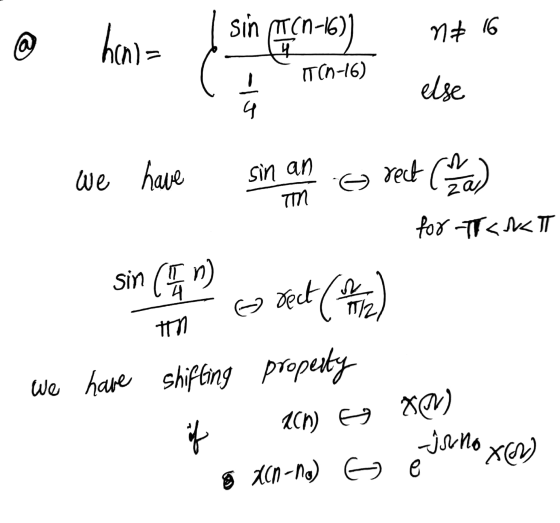
sin((n-16)/4) (n-16) Consider an LTI discrete-time system that has impulse respo 6)/4) if n #16 if...
sin(r(n-18/6) r(n-18) n#18 if Consider an LTI discrete-time system that has impulse response h[n] = if...
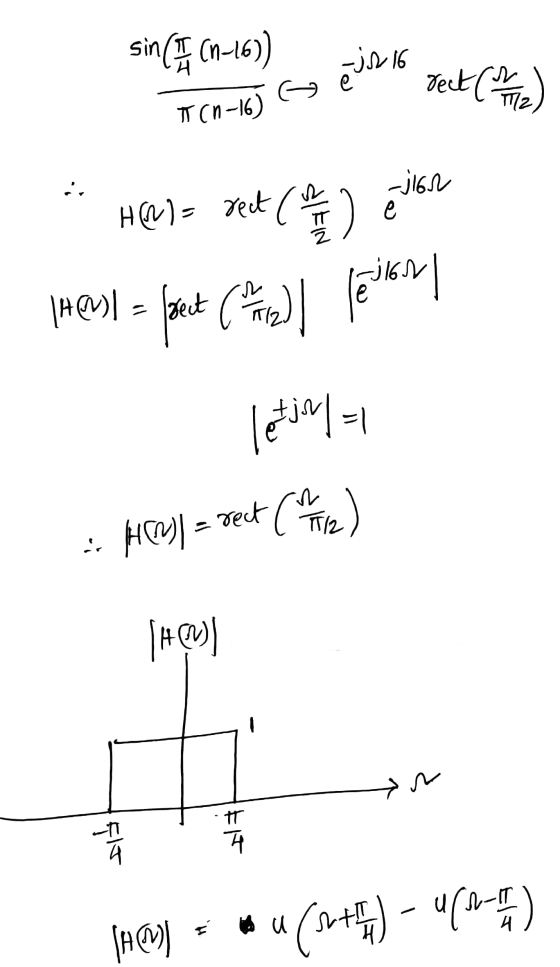
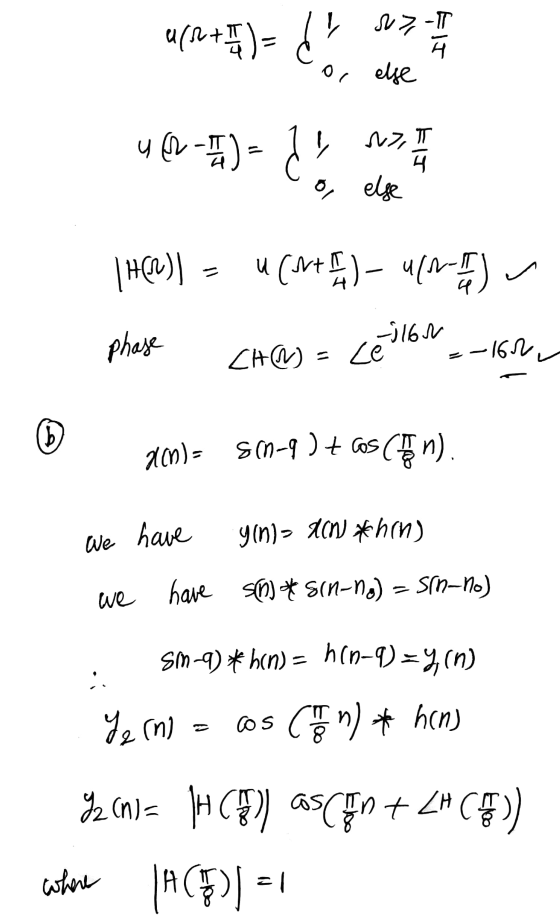
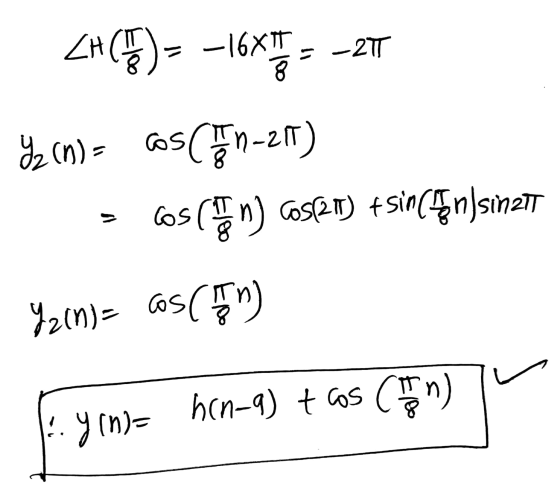
 sin(r(n-18/6) r(n-18) n#18 if Consider an LTI discrete-time system that has impulse response h[n] = if otherwise a) Determine the magnitude lH(Q)I and the phase response LH(Q) for-r < Ω < π. Enter Ω as "O" and enter the piecewise function H(S2) using the heaviside function. IH(Q)| = LH(S2) = b) Determine the output of the system, y[n], if the input is given by x[n] = δ[n-71+ cos(쮜. Enter your answer in terms of h[n]. y[n] = In your answers,...
Consider an LTI discrete-time system that has impulse response h n Tn-12) 1 if otherwise a) Deter...
 Consider an LTI discrete-time system that has impulse response h n Tn-12) 1 if otherwise a) Determine the magnitude H(Q and the phase response LH(D for-r < Ω < π Enter Ω as "and enter the piecev se function Η Ω using the hea side function b)Determine the output of the system, rn, if the input is given by z n-Sn-9 +com( ) Enter your answer in terms of hin y[n] = In your answers, enter 2(n) for a discrete-time...
Consider an LTI system whose input x[n] and output y[n] are related by the difference equation...
 Consider an LTI system whose input x[n] and output y[n] are related by the difference equation y[n – 1] + 3 y[n] + $y[n + 1] = x[n]. Determine the three possible choices for the impulse response that makes this system 1) causal, 2) two-sided and 3) anti-causal. Then for each case, determine if the system is stable or not. Causality Impulse Response Stability Causal Unstable v two-sided Unstable anti-Causal Unstable y In your answers, enter z(n) for a discrete-time...
6) Consider a discrete-time LTI system with impulse response h[n] = response h[n] = ( 1)...
 6) Consider a discrete-time LTI system with impulse response h[n] = response h[n] = ( 1) u[n]. Use Fourie transforms to determine the response of this system to the input x[n] = ml + un).
Consider the cascade of LTI discrete-time systems shown in Figure P2.37. LTI System 1 hi[n], H...
 Consider the cascade of LTI discrete-time systems shown in Figure P2.37. LTI System 1 hi[n], H (el) LTI System 2 h2[n], H2(eje) Figure P2.37 The first system is described by the frequency response Hi(j =c-joo < 0.25% 11 0.25% < and the second system is described by <A hain) = 2 Sin(0.57) (a) Determine an equation that defines the frequency response, H(e)®), of the overall system over the range -- SUSA. (b) Sketch the magnitude. He"), and the phase, ZH(e)),...
Discrete-time convolution. Use of shift invariance for LTI systems. A discrete-time LTI system is described the...
 Discrete-time convolution. Use of shift invariance for LTI systems. A discrete-time LTI system is described the its impulse response h[n]. h[n] = (5)"u[n]. n-3 1 An input x[n] = u[n – 4) is applied. The output of the system y[n] is given by: x[r] – 54 G)" ()") un 14 The correct answer is not provided gắn] = [16(5)” – 54(5) ] n] y[n] = [16()" – 54(+)"] uſn – 4
For a causal LTI discrete-time system described by the difference equation:
For a causal LTI discrete-time system described by the difference equation: y[n] + y[n – 1] = x[n] a) Find the transfer function H(z).b) Find poles and zeros and then mark them on the z-plane (pole-zero plot). Is this system BIBO? c) Find its impulse response h[n]. d) Draw the z-domain block diagram (using the unit delay block z-1) of the discrete-time system. e) Find the output y[n] for input x[n] = 10 u[n] if all initial conditions are 0.
BC:9.4 A LTI discrete time system has an impulse response h[n] = (−0.6)nu[n] + (0.95)nu[n −...
 BC:9.4 A LTI discrete time system has an impulse response h[n] =
(−0.6)nu[n] + (0.95)nu[n − 1] Find the transfer function, Hˆ (e jωˆ
), in the normalized frequency domain. Use Matlab to plot the
magnitude and phase (in degrees) of Hˆ (e jωˆ ) in the range of −π
≤ ωˆ ≤ π. Attach your Matlab source code with the plots.
BC:9.4 A LTI discrete time system has an impulse response h[n] = (-0.6)"u[n] + (0.95)"u[n-1] Find the transfer...
BC:9.4 A LTI discrete time system has an impulse response h[n] =
(−0.6)nu[n] + (0.95)nu[n − 1] Find the transfer function, Hˆ (e jωˆ
), in the normalized frequency domain. Use Matlab to plot the
magnitude and phase (in degrees) of Hˆ (e jωˆ ) in the range of −π
≤ ωˆ ≤ π. Attach your Matlab source code with the plots.
BC:9.4 A LTI discrete time system has an impulse response h[n] = (-0.6)"u[n] + (0.95)"u[n-1] Find the transfer...
Problem 1 You are given the discrete-time LTI system with impulse response, Calculate the Fourier series coefficients o...
 Problem 1 You are given the discrete-time LTI system with impulse response, Calculate the Fourier series coefficients of the output of this system when the input is x[n] = cos(n+π)
Problem 1 You are given the discrete-time LTI system with impulse response, Calculate the Fourier series coefficients of the output of this system when the input is x[n] = cos(n+π)
Problem 1 You are given the discrete-time LTI system with impulse response, Calculate the Fourier series coefficients of the output of this system when the input is x[n] = cos(n+π)
For the discrete-time LTI system hn l [a] with S n =0,1,2,...,5 10, otherwise find y[n]...
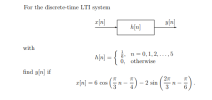 For the discrete-time LTI system hn l [a] with S n =0,1,2,...,5 10, otherwise find y[n] if z[n] = 6 cos (5 » - ) – 2 sin (51 - 5).
 sin(r(n-18/6) r(n-18) n#18 if Consider an LTI discrete-time system that has impulse response h[n] = if otherwise a) Determine the magnitude lH(Q)I and the phase response LH(Q) for-r < Ω < π. Enter Ω as "O" and enter the piecewise function H(S2) using the heaviside function. IH(Q)| = LH(S2) = b) Determine the output of the system, y[n], if the input is given by x[n] = δ[n-71+ cos(쮜. Enter your answer in terms of h[n]. y[n] = In your answers,...
 Consider an LTI discrete-time system that has impulse response h n Tn-12) 1 if otherwise a) Determine the magnitude H(Q and the phase response LH(D for-r < Ω < π Enter Ω as "and enter the piecev se function Η Ω using the hea side function b)Determine the output of the system, rn, if the input is given by z n-Sn-9 +com( ) Enter your answer in terms of hin y[n] = In your answers, enter 2(n) for a discrete-time...
 Consider an LTI system whose input x[n] and output y[n] are related by the difference equation y[n – 1] + 3 y[n] + $y[n + 1] = x[n]. Determine the three possible choices for the impulse response that makes this system 1) causal, 2) two-sided and 3) anti-causal. Then for each case, determine if the system is stable or not. Causality Impulse Response Stability Causal Unstable v two-sided Unstable anti-Causal Unstable y In your answers, enter z(n) for a discrete-time...
 6) Consider a discrete-time LTI system with impulse response h[n] = response h[n] = ( 1) u[n]. Use Fourie transforms to determine the response of this system to the input x[n] = ml + un).
 Consider the cascade of LTI discrete-time systems shown in Figure P2.37. LTI System 1 hi[n], H (el) LTI System 2 h2[n], H2(eje) Figure P2.37 The first system is described by the frequency response Hi(j =c-joo < 0.25% 11 0.25% < and the second system is described by <A hain) = 2 Sin(0.57) (a) Determine an equation that defines the frequency response, H(e)®), of the overall system over the range -- SUSA. (b) Sketch the magnitude. He"), and the phase, ZH(e)),...
 Discrete-time convolution. Use of shift invariance for LTI systems. A discrete-time LTI system is described the its impulse response h[n]. h[n] = (5)"u[n]. n-3 1 An input x[n] = u[n – 4) is applied. The output of the system y[n] is given by: x[r] – 54 G)" ()") un 14 The correct answer is not provided gắn] = [16(5)” – 54(5) ] n] y[n] = [16()" – 54(+)"] uſn – 4
 BC:9.4 A LTI discrete time system has an impulse response h[n] =
(−0.6)nu[n] + (0.95)nu[n − 1] Find the transfer function, Hˆ (e jωˆ
), in the normalized frequency domain. Use Matlab to plot the
magnitude and phase (in degrees) of Hˆ (e jωˆ ) in the range of −π
≤ ωˆ ≤ π. Attach your Matlab source code with the plots.
BC:9.4 A LTI discrete time system has an impulse response h[n] = (-0.6)"u[n] + (0.95)"u[n-1] Find the transfer...
BC:9.4 A LTI discrete time system has an impulse response h[n] =
(−0.6)nu[n] + (0.95)nu[n − 1] Find the transfer function, Hˆ (e jωˆ
), in the normalized frequency domain. Use Matlab to plot the
magnitude and phase (in degrees) of Hˆ (e jωˆ ) in the range of −π
≤ ωˆ ≤ π. Attach your Matlab source code with the plots.
BC:9.4 A LTI discrete time system has an impulse response h[n] = (-0.6)"u[n] + (0.95)"u[n-1] Find the transfer...
 Problem 1 You are given the discrete-time LTI system with impulse response, Calculate the Fourier series coefficients of the output of this system when the input is x[n] = cos(n+π)
Problem 1 You are given the discrete-time LTI system with impulse response, Calculate the Fourier series coefficients of the output of this system when the input is x[n] = cos(n+π)
Problem 1 You are given the discrete-time LTI system with impulse response, Calculate the Fourier series coefficients of the output of this system when the input is x[n] = cos(n+π)
 For the discrete-time LTI system hn l [a] with S n =0,1,2,...,5 10, otherwise find y[n] if z[n] = 6 cos (5 » - ) – 2 sin (51 - 5).
Most questions answered within 3 hours.
-
Where is the error in this code sequence?
String s1 = "Hello";
String s2 = "ello";...
asked 10 months ago -
Financial data for Joel de Paris, Inc., for last year
follow:
Joel de Paris, Inc.
Balance...
asked 10 months ago -
Consider this reaction:
Al2(SO4)3 (aq)+ BaCl3
(aq) Al2Cl6 (aq)- +
3BaSO4(s) . What is the...
asked 10 months ago -
Suppose that Savneet is considering increasing her
recent random sample from 20 car rentals to 40...
asked 10 months ago -
Trucks arrive at an unloading terminal at an average rate of 120
per hour.
Trucks arrive...
asked 10 months ago -
Why are methanol and ethanol completely soluble in water while
octanol is not very little soluble....
asked 10 months ago -
A facilities manager at a university reads in a research report
that the mean amount of...
asked 10 months ago -
When the CuSO4 is rehydrated by adding water to the anhydrous
compound, is this an endothermic...
asked 10 months ago -
A ray of sunlight is passing from diamond into crown glass; the
angle of incidence is...
asked 10 months ago -
A block of mass 0.249 kg is placed on top of a light, vertical
spring of...
asked 10 months ago -
how do the kidneys compensate in the presences of acidosis
a) trigger hyperventilate
b) reserve acid...
asked 10 months ago -
Question 501 pts
The rental rate of capital to the firm increases. Which of the
following...
asked 10 months ago