![sin(r(n-18/6) r(n-18) n#18 if Consider an LTI discrete-time system that has impulse response h[n] = if otherwise a) Determine](http://img.homeworklib.com/questions/65810fc0-4691-11eb-8ee2-3f07005fe5f8.png?x-oss-process=image/resize,w_560)
Homework Answers
11![a) Given n 18 him I = ( sinal (n-18) (6) el 16 Ti (n-18) n=18 We know that nstorm sinan I rect (wa) Tin xn-no] eft ejuno xier](http://img.homeworklib.com/questions/5e4de8c0-4692-11eb-8cb6-39b179c5209d.png?x-oss-process=image/resize,w_560)
![Given x [n] = b[n–1] + Cos (9) for a sinusoidal signal, the steady state output XCH): cowon] yan] - Ihlesw.)) cos (wont (Hete](http://img.homeworklib.com/questions/5ef1edf0-4692-11eb-a272-379bd66091d6.png?x-oss-process=image/resize,w_560)
Add Answer to:
sin(r(n-18/6) r(n-18) n#18 if Consider an LTI discrete-time system that has impulse response h[n] = if...
Consider an LTI discrete-time system that has impulse response h n Tn-12) 1 if otherwise a) Deter...
 Consider an LTI discrete-time system that has impulse response h n Tn-12) 1 if otherwise a) Determine the magnitude H(Q and the phase response LH(D for-r < Ω < π Enter Ω as "and enter the piecev se function Η Ω using the hea side function b)Determine the output of the system, rn, if the input is given by z n-Sn-9 +com( ) Enter your answer in terms of hin y[n] = In your answers, enter 2(n) for a discrete-time...
sin((n-16)/4) (n-16) Consider an LTI discrete-time system that has impulse respo 6)/4) if n #16 if...
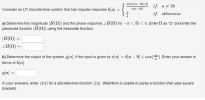 sin((n-16)/4) (n-16) Consider an LTI discrete-time system that has impulse respo 6)/4) if n #16 if otherwise a) Determine the magnitude H(12) and the phase response ZH(12) for –< 1 < . Enter 12 as “O” and enter the piecewise function |H(12) using the heaviside function. |H(12) = ZH(12) = b) Determine the output of the system, y[n], if the input is given by x[n] = S[n – 9] + cos( 72 ). Enter your answer in terms of h[n]....
BC:9.4 A LTI discrete time system has an impulse response h[n] = (−0.6)nu[n] + (0.95)nu[n −...
 BC:9.4 A LTI discrete time system has an impulse response h[n] =
(−0.6)nu[n] + (0.95)nu[n − 1] Find the transfer function, Hˆ (e jωˆ
), in the normalized frequency domain. Use Matlab to plot the
magnitude and phase (in degrees) of Hˆ (e jωˆ ) in the range of −π
≤ ωˆ ≤ π. Attach your Matlab source code with the plots.
BC:9.4 A LTI discrete time system has an impulse response h[n] = (-0.6)"u[n] + (0.95)"u[n-1] Find the transfer...
BC:9.4 A LTI discrete time system has an impulse response h[n] =
(−0.6)nu[n] + (0.95)nu[n − 1] Find the transfer function, Hˆ (e jωˆ
), in the normalized frequency domain. Use Matlab to plot the
magnitude and phase (in degrees) of Hˆ (e jωˆ ) in the range of −π
≤ ωˆ ≤ π. Attach your Matlab source code with the plots.
BC:9.4 A LTI discrete time system has an impulse response h[n] = (-0.6)"u[n] + (0.95)"u[n-1] Find the transfer...
6) Consider a discrete-time LTI system with impulse response h[n] = response h[n] = ( 1)...
 6) Consider a discrete-time LTI system with impulse response h[n] = response h[n] = ( 1) u[n]. Use Fourie transforms to determine the response of this system to the input x[n] = ml + un).
Consider an LTI system whose input x[n] and output y[n] are related by the difference equation...
 Consider an LTI system whose input x[n] and output y[n] are related by the difference equation y[n – 1] + 3 y[n] + $y[n + 1] = x[n]. Determine the three possible choices for the impulse response that makes this system 1) causal, 2) two-sided and 3) anti-causal. Then for each case, determine if the system is stable or not. Causality Impulse Response Stability Causal Unstable v two-sided Unstable anti-Causal Unstable y In your answers, enter z(n) for a discrete-time...
1. A discrete-time LTI system has the system function H(z) given below: H(2)1 2 (e) Determine the impulse response hin] associated with the stable system defined by this system function. (f) Make a c...
 1. A discrete-time LTI system has the system function H(z) given below: H(2)1 2 (e) Determine the impulse response hin] associated with the stable system defined by this system function. (f) Make a careful sketch of the frequency response magnitude, i.е., IH(ew), of this system for lwl S T. Label your sketch!
1. A discrete-time LTI system has the system function H(z) given below: H(2)1 2 (e) Determine the impulse response hin] associated with the stable system defined by this...
1. A discrete-time LTI system has the system function H(z) given below: H(2)1 2 (e) Determine the impulse response hin] associated with the stable system defined by this system function. (f) Make a careful sketch of the frequency response magnitude, i.е., IH(ew), of this system for lwl S T. Label your sketch!
1. A discrete-time LTI system has the system function H(z) given below: H(2)1 2 (e) Determine the impulse response hin] associated with the stable system defined by this...
5 pts D Question 1 A system has the following impulse response: .2 Sample number, n From the choices below, select the frequency response of this system. H (eju)-e(1.5 ) (2 sin( 1.5ώ) +...
 5 pts D Question 1 A system has the following impulse response: .2 Sample number, n From the choices below, select the frequency response of this system. H (eju)-e(1.5 ) (2 sin( 1.5ώ) + 4 sin(0.δώ)) H (ee) = e-j(1.5e-5) (cos( 1.5 ) +2 cos(0.54)) @ H (ee)-e-n1.si) (sin( 1.54) t. 2 sin(0.δώ)) (sin(l.50) +4sin(0.0) H (ee)-e-j(1.5i) (2 cos( 1.5ώ) + 4 cos(0.5a)) H (efo)-e-n1.5u) (cos( 1.50) + 2 cos(0.50)) https://rmitinstructure.comcoursesy 5 pts DQuestion 2 A system has the following...
Consider a discrete-time LTI system with impulse response Sketch the magnitude of the frequency response of...
 Consider a discrete-time LTI system with impulse response
Sketch the magnitude of the frequency response
of the system. Provide enough details in your sketch to convey the
pattern.
sin((2n/3)n hln h[n] =
Consider a discrete-time LTI system with impulse response
Sketch the magnitude of the frequency response
of the system. Provide enough details in your sketch to convey the
pattern.
sin((2n/3)n hln h[n] =
Problem 1 You are given the discrete-time LTI system with impulse response, Calculate the Fourier series coefficients o...
 Problem 1 You are given the discrete-time LTI system with impulse response, Calculate the Fourier series coefficients of the output of this system when the input is x[n] = cos(n+π)
Problem 1 You are given the discrete-time LTI system with impulse response, Calculate the Fourier series coefficients of the output of this system when the input is x[n] = cos(n+π)
Problem 1 You are given the discrete-time LTI system with impulse response, Calculate the Fourier series coefficients of the output of this system when the input is x[n] = cos(n+π)
For the LTI system with the difference equation y[n] = 0.25x[n] +0.5x[n-1] + 0.25x[n-2] a. Find...
For the LTI system with the difference equation y[n] = 0.25x[n] +0.5x[n-1] + 0.25x[n-2] a. Find the impulse response h[n] (this is y[n] when x[n] = δ[n] ) b. Find the frequency response function H(?^?ω). Your result should be in the form of A(?^?θ(?) )[cos(αω)+β]. Specify values for A, ?(?), α,and β c. Evaluate H(?^?ω) for ω = π , π/2 , π/4, 0, -π/4, - π/2, -π d. Plot H(?^?ω) in magnitude and phase for –π < ω <...
 Consider an LTI discrete-time system that has impulse response h n Tn-12) 1 if otherwise a) Determine the magnitude H(Q and the phase response LH(D for-r < Ω < π Enter Ω as "and enter the piecev se function Η Ω using the hea side function b)Determine the output of the system, rn, if the input is given by z n-Sn-9 +com( ) Enter your answer in terms of hin y[n] = In your answers, enter 2(n) for a discrete-time...
 sin((n-16)/4) (n-16) Consider an LTI discrete-time system that has impulse respo 6)/4) if n #16 if otherwise a) Determine the magnitude H(12) and the phase response ZH(12) for –< 1 < . Enter 12 as “O” and enter the piecewise function |H(12) using the heaviside function. |H(12) = ZH(12) = b) Determine the output of the system, y[n], if the input is given by x[n] = S[n – 9] + cos( 72 ). Enter your answer in terms of h[n]....
 BC:9.4 A LTI discrete time system has an impulse response h[n] =
(−0.6)nu[n] + (0.95)nu[n − 1] Find the transfer function, Hˆ (e jωˆ
), in the normalized frequency domain. Use Matlab to plot the
magnitude and phase (in degrees) of Hˆ (e jωˆ ) in the range of −π
≤ ωˆ ≤ π. Attach your Matlab source code with the plots.
BC:9.4 A LTI discrete time system has an impulse response h[n] = (-0.6)"u[n] + (0.95)"u[n-1] Find the transfer...
BC:9.4 A LTI discrete time system has an impulse response h[n] =
(−0.6)nu[n] + (0.95)nu[n − 1] Find the transfer function, Hˆ (e jωˆ
), in the normalized frequency domain. Use Matlab to plot the
magnitude and phase (in degrees) of Hˆ (e jωˆ ) in the range of −π
≤ ωˆ ≤ π. Attach your Matlab source code with the plots.
BC:9.4 A LTI discrete time system has an impulse response h[n] = (-0.6)"u[n] + (0.95)"u[n-1] Find the transfer...
 6) Consider a discrete-time LTI system with impulse response h[n] = response h[n] = ( 1) u[n]. Use Fourie transforms to determine the response of this system to the input x[n] = ml + un).
 Consider an LTI system whose input x[n] and output y[n] are related by the difference equation y[n – 1] + 3 y[n] + $y[n + 1] = x[n]. Determine the three possible choices for the impulse response that makes this system 1) causal, 2) two-sided and 3) anti-causal. Then for each case, determine if the system is stable or not. Causality Impulse Response Stability Causal Unstable v two-sided Unstable anti-Causal Unstable y In your answers, enter z(n) for a discrete-time...
 1. A discrete-time LTI system has the system function H(z) given below: H(2)1 2 (e) Determine the impulse response hin] associated with the stable system defined by this system function. (f) Make a careful sketch of the frequency response magnitude, i.е., IH(ew), of this system for lwl S T. Label your sketch!
1. A discrete-time LTI system has the system function H(z) given below: H(2)1 2 (e) Determine the impulse response hin] associated with the stable system defined by this...
1. A discrete-time LTI system has the system function H(z) given below: H(2)1 2 (e) Determine the impulse response hin] associated with the stable system defined by this system function. (f) Make a careful sketch of the frequency response magnitude, i.е., IH(ew), of this system for lwl S T. Label your sketch!
1. A discrete-time LTI system has the system function H(z) given below: H(2)1 2 (e) Determine the impulse response hin] associated with the stable system defined by this...
 5 pts D Question 1 A system has the following impulse response: .2 Sample number, n From the choices below, select the frequency response of this system. H (eju)-e(1.5 ) (2 sin( 1.5ώ) + 4 sin(0.δώ)) H (ee) = e-j(1.5e-5) (cos( 1.5 ) +2 cos(0.54)) @ H (ee)-e-n1.si) (sin( 1.54) t. 2 sin(0.δώ)) (sin(l.50) +4sin(0.0) H (ee)-e-j(1.5i) (2 cos( 1.5ώ) + 4 cos(0.5a)) H (efo)-e-n1.5u) (cos( 1.50) + 2 cos(0.50)) https://rmitinstructure.comcoursesy 5 pts DQuestion 2 A system has the following...
 Consider a discrete-time LTI system with impulse response
Sketch the magnitude of the frequency response
of the system. Provide enough details in your sketch to convey the
pattern.
sin((2n/3)n hln h[n] =
Consider a discrete-time LTI system with impulse response
Sketch the magnitude of the frequency response
of the system. Provide enough details in your sketch to convey the
pattern.
sin((2n/3)n hln h[n] =
 Problem 1 You are given the discrete-time LTI system with impulse response, Calculate the Fourier series coefficients of the output of this system when the input is x[n] = cos(n+π)
Problem 1 You are given the discrete-time LTI system with impulse response, Calculate the Fourier series coefficients of the output of this system when the input is x[n] = cos(n+π)
Problem 1 You are given the discrete-time LTI system with impulse response, Calculate the Fourier series coefficients of the output of this system when the input is x[n] = cos(n+π)
Most questions answered within 3 hours.
-
Where is the error in this code sequence?
String s1 = "Hello";
String s2 = "ello";...
asked 11 months ago -
Financial data for Joel de Paris, Inc., for last year
follow:
Joel de Paris, Inc.
Balance...
asked 11 months ago -
Consider this reaction:
Al2(SO4)3 (aq)+ BaCl3
(aq) Al2Cl6 (aq)- +
3BaSO4(s) . What is the...
asked 11 months ago -
Suppose that Savneet is considering increasing her
recent random sample from 20 car rentals to 40...
asked 11 months ago -
Trucks arrive at an unloading terminal at an average rate of 120
per hour.
Trucks arrive...
asked 11 months ago -
Why are methanol and ethanol completely soluble in water while
octanol is not very little soluble....
asked 11 months ago -
A facilities manager at a university reads in a research report
that the mean amount of...
asked 11 months ago -
When the CuSO4 is rehydrated by adding water to the anhydrous
compound, is this an endothermic...
asked 11 months ago -
A ray of sunlight is passing from diamond into crown glass; the
angle of incidence is...
asked 11 months ago -
A block of mass 0.249 kg is placed on top of a light, vertical
spring of...
asked 11 months ago -
how do the kidneys compensate in the presences of acidosis
a) trigger hyperventilate
b) reserve acid...
asked 11 months ago -
Question 501 pts
The rental rate of capital to the firm increases. Which of the
following...
asked 11 months ago