
Homework Answers
All answers are below thank you.
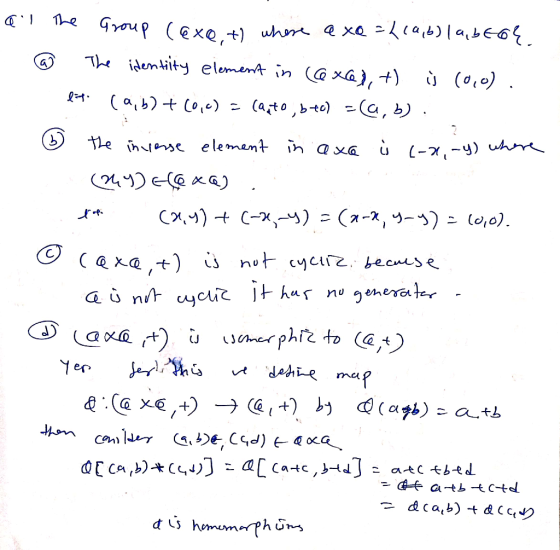
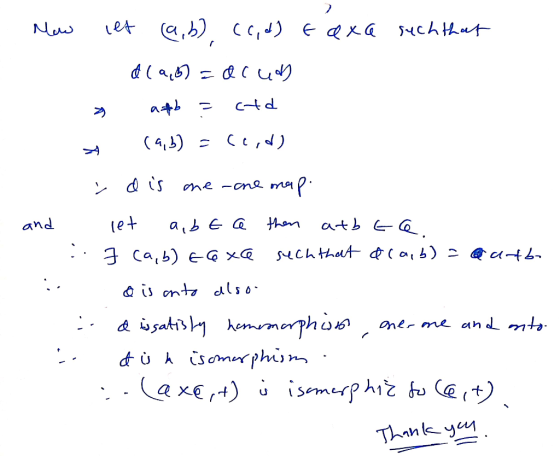
Q3 Consider the group (Z3 x Z3, +), where again Z3 x Z3 = {(a,b) a,...
 Q3 Consider the group (Z3 x Z3, +), where again Z3 x Z3 = {(a,b) a, b e Z3}, and we define addition by (a, b) + (c,d) = (a + cb+d). So, for instance, (1, 2) + (0,2)=(1,1). (a) List all of the subgroups of (Z3 X Z3, +). You should explain why your list is complete (i.e., why there are no subgroups other than the ones you have written). (b) Which of these subgroups are cyclic? You do...
1- (2,5+2,5 mark) Consider in GL(2, Q), the subset (a=1 or a=-1),bez Prove that H, with multiplication, is a subgroup of GL(2,Q) a) Is the function b) an homomorphism of groups? Justify your answ...
 1- (2,5+2,5 mark) Consider in GL(2, Q), the subset (a=1 or a=-1),bez Prove that H, with multiplication, is a subgroup of GL(2,Q) a) Is the function b) an homomorphism of groups? Justify your answer 2 (3 marks) Let G be a group and a E G an element of order 12. Find the orders of each of the elements of (a) 3- (1+1,5 marks) Let G be a group such that any non-identity element has order 2. Prove that a)...
4. (a) For n eZ, define multiplication mod n by ao b-a b (where indicates regular...
 4. (a) For n eZ, define multiplication mod n by ao b-a b (where indicates regular real number multiplication), prove that On is a binary operation on Zn. That is, (Hint your proof will be very similar to the proof for homework 4 problem 7ab) (b) Let n E Z. Is the binary algebraic structure 〈L,On) always a group? Explain. (c) Prove There exists be Zn such that a n I if and only if (a, n)1. (d) It is...
(a) Let G be a group of order 4 with identity e. Show that G is either cyclic or a2-e for all (b)...
 (Abstract Algebra) Please answer a-d clearly. Show your work and
explain your answer.
(a) Let G be a group of order 4 with identity e. Show that G is either cyclic or a2-e for all (b) Does the result of part (a) generalize to groups of order p2 for any positive integer p? In other words, is it the case that if G is a group of order p2 with identity e, then is either cyclic or a- e for...
(Abstract Algebra) Please answer a-d clearly. Show your work and
explain your answer.
(a) Let G be a group of order 4 with identity e. Show that G is either cyclic or a2-e for all (b) Does the result of part (a) generalize to groups of order p2 for any positive integer p? In other words, is it the case that if G is a group of order p2 with identity e, then is either cyclic or a- e for...
Let G be a group of order 6 and let X be the set (a, b,c) E G3: abc That is, X is the set of trip...
 Let G be a group of order 6 and let X be the set (a, b,c) E G3: abc That is, X is the set of triples of elements of G with the product of its coordinates equals the identity element of G (a) How many elements does X have? Hint: Every triple (a, b, c) in X is completely determined by the choice of a and b. Because once you choose a and b then c must be (ab)-1...
、 9. (d) Recall that the symbol Qt represents all positive rationals. Is the group (Z,...
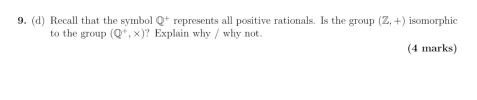 、
9. (d) Recall that the symbol Qt represents all positive rationals. Is the group (Z, +) isomorphic to the group (Q+, x)? Explain why / why not. (4 marks)
、
9. (d) Recall that the symbol Qt represents all positive rationals. Is the group (Z, +) isomorphic to the group (Q+, x)? Explain why / why not. (4 marks)
Consider the set G {e, a, b, c} (a) Fill in the table below so that...
 Consider the set G {e, a, b, c} (a) Fill in the table below so that it defines an operation identity e where (G, ) is a group with C a b C operation where (G, *) is a group (b) Fill in another table below so that it defines an with identity e. e C C (c) Prove that there are only two non-isomorphic group structures on a set of 4 elements Le., the group tables from (a) and...
(6) Consider the direct product group Z4 x 25 x 215 (a) Explain how the elements...
 (6) Consider the direct product group Z4 x 25 x 215 (a) Explain how the elements in this group look like and how is the operation defined. (b) What is the order of the group ZA * Z; x Z1s? Explain. (e) is the group Z4 Zs Zis cyclic? Why or why not? We were unable to transcribe this image
show that it is a group by verifying:closure law, associativity, identity element and the inverse. Camp...
 show that it is a group
by verifying:closure law, associativity, identity element and
the inverse.
Camp e Set of matrices of order 2 x 2 of real entries is a group under matrix addition. i.e. S={[a b] : a, b, c, d E R} is a group under addition defined by [ 2]+(203 ) Cho are the Verify closure and associativity yourself.
show that it is a group
by verifying:closure law, associativity, identity element and
the inverse.
Camp e Set of matrices of order 2 x 2 of real entries is a group under matrix addition. i.e. S={[a b] : a, b, c, d E R} is a group under addition defined by [ 2]+(203 ) Cho are the Verify closure and associativity yourself.
8. Let n be a positive integer. The n-th cyclotomic polynomial Ф,a(z) E Z[2] is defined recursively in the following way: 1. Ф1(x)-x-1. 2. If n > 1, then Фп(x)- , (where in the product in the...
 8. Let n be a positive integer. The n-th cyclotomic polynomial Ф,a(z) E Z[2] is defined recursively in the following way: 1. Ф1(x)-x-1. 2. If n > 1, then Фп(x)- , (where in the product in the denomina- tor, d runs through all divisors of n less than n). . A. Calculate Ф2(x), Ф4(x) and Ф8(z): . B. n(x) is the minimal polynomial for the primitive n-th root of unity over Q. Let f(x) = "8-1 E Q[a] and ω...
 Q3 Consider the group (Z3 x Z3, +), where again Z3 x Z3 = {(a,b) a, b e Z3}, and we define addition by (a, b) + (c,d) = (a + cb+d). So, for instance, (1, 2) + (0,2)=(1,1). (a) List all of the subgroups of (Z3 X Z3, +). You should explain why your list is complete (i.e., why there are no subgroups other than the ones you have written). (b) Which of these subgroups are cyclic? You do...
 1- (2,5+2,5 mark) Consider in GL(2, Q), the subset (a=1 or a=-1),bez Prove that H, with multiplication, is a subgroup of GL(2,Q) a) Is the function b) an homomorphism of groups? Justify your answer 2 (3 marks) Let G be a group and a E G an element of order 12. Find the orders of each of the elements of (a) 3- (1+1,5 marks) Let G be a group such that any non-identity element has order 2. Prove that a)...
 4. (a) For n eZ, define multiplication mod n by ao b-a b (where indicates regular real number multiplication), prove that On is a binary operation on Zn. That is, (Hint your proof will be very similar to the proof for homework 4 problem 7ab) (b) Let n E Z. Is the binary algebraic structure 〈L,On) always a group? Explain. (c) Prove There exists be Zn such that a n I if and only if (a, n)1. (d) It is...
 (Abstract Algebra) Please answer a-d clearly. Show your work and
explain your answer.
(a) Let G be a group of order 4 with identity e. Show that G is either cyclic or a2-e for all (b) Does the result of part (a) generalize to groups of order p2 for any positive integer p? In other words, is it the case that if G is a group of order p2 with identity e, then is either cyclic or a- e for...
(Abstract Algebra) Please answer a-d clearly. Show your work and
explain your answer.
(a) Let G be a group of order 4 with identity e. Show that G is either cyclic or a2-e for all (b) Does the result of part (a) generalize to groups of order p2 for any positive integer p? In other words, is it the case that if G is a group of order p2 with identity e, then is either cyclic or a- e for...
 Let G be a group of order 6 and let X be the set (a, b,c) E G3: abc That is, X is the set of triples of elements of G with the product of its coordinates equals the identity element of G (a) How many elements does X have? Hint: Every triple (a, b, c) in X is completely determined by the choice of a and b. Because once you choose a and b then c must be (ab)-1...
 、
9. (d) Recall that the symbol Qt represents all positive rationals. Is the group (Z, +) isomorphic to the group (Q+, x)? Explain why / why not. (4 marks)
、
9. (d) Recall that the symbol Qt represents all positive rationals. Is the group (Z, +) isomorphic to the group (Q+, x)? Explain why / why not. (4 marks)
 Consider the set G {e, a, b, c} (a) Fill in the table below so that it defines an operation identity e where (G, ) is a group with C a b C operation where (G, *) is a group (b) Fill in another table below so that it defines an with identity e. e C C (c) Prove that there are only two non-isomorphic group structures on a set of 4 elements Le., the group tables from (a) and...
 (6) Consider the direct product group Z4 x 25 x 215 (a) Explain how the elements in this group look like and how is the operation defined. (b) What is the order of the group ZA * Z; x Z1s? Explain. (e) is the group Z4 Zs Zis cyclic? Why or why not? We were unable to transcribe this image
 show that it is a group
by verifying:closure law, associativity, identity element and
the inverse.
Camp e Set of matrices of order 2 x 2 of real entries is a group under matrix addition. i.e. S={[a b] : a, b, c, d E R} is a group under addition defined by [ 2]+(203 ) Cho are the Verify closure and associativity yourself.
show that it is a group
by verifying:closure law, associativity, identity element and
the inverse.
Camp e Set of matrices of order 2 x 2 of real entries is a group under matrix addition. i.e. S={[a b] : a, b, c, d E R} is a group under addition defined by [ 2]+(203 ) Cho are the Verify closure and associativity yourself.
 8. Let n be a positive integer. The n-th cyclotomic polynomial Ф,a(z) E Z[2] is defined recursively in the following way: 1. Ф1(x)-x-1. 2. If n > 1, then Фп(x)- , (where in the product in the denomina- tor, d runs through all divisors of n less than n). . A. Calculate Ф2(x), Ф4(x) and Ф8(z): . B. n(x) is the minimal polynomial for the primitive n-th root of unity over Q. Let f(x) = "8-1 E Q[a] and ω...
Most questions answered within 3 hours.
-
Where is the error in this code sequence?
String s1 = "Hello";
String s2 = "ello";...
asked 10 months ago -
Financial data for Joel de Paris, Inc., for last year
follow:
Joel de Paris, Inc.
Balance...
asked 10 months ago -
Consider this reaction:
Al2(SO4)3 (aq)+ BaCl3
(aq) Al2Cl6 (aq)- +
3BaSO4(s) . What is the...
asked 10 months ago -
Suppose that Savneet is considering increasing her
recent random sample from 20 car rentals to 40...
asked 10 months ago -
Trucks arrive at an unloading terminal at an average rate of 120
per hour.
Trucks arrive...
asked 10 months ago -
Why are methanol and ethanol completely soluble in water while
octanol is not very little soluble....
asked 10 months ago -
A facilities manager at a university reads in a research report
that the mean amount of...
asked 10 months ago -
When the CuSO4 is rehydrated by adding water to the anhydrous
compound, is this an endothermic...
asked 10 months ago -
A ray of sunlight is passing from diamond into crown glass; the
angle of incidence is...
asked 10 months ago -
A block of mass 0.249 kg is placed on top of a light, vertical
spring of...
asked 10 months ago -
how do the kidneys compensate in the presences of acidosis
a) trigger hyperventilate
b) reserve acid...
asked 10 months ago -
Question 501 pts
The rental rate of capital to the firm increases. Which of the
following...
asked 10 months ago