
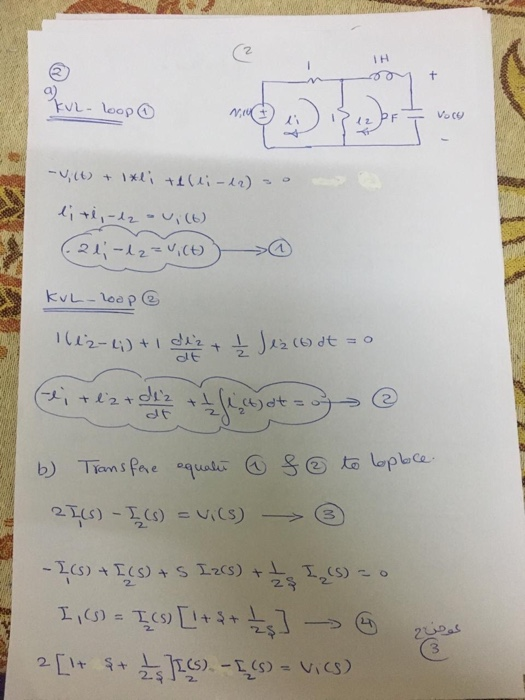
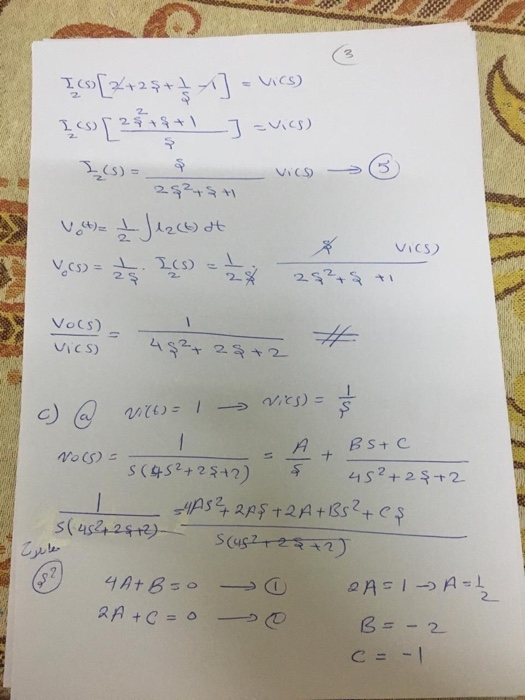
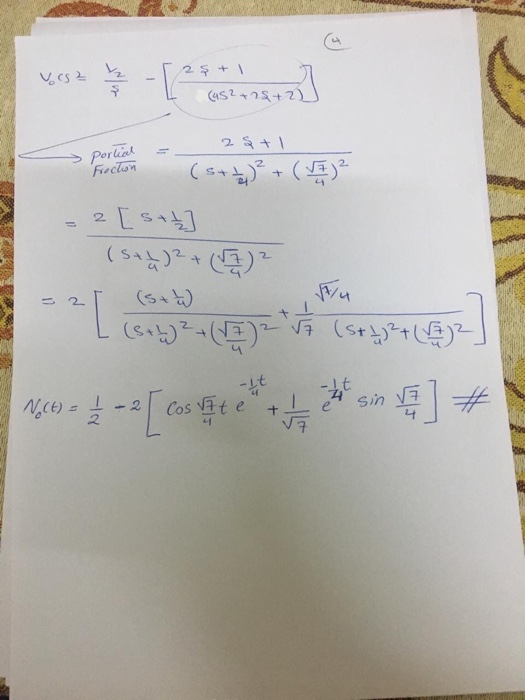
Homework Answers
C. Step response of a system in MATLAB
MATLAB code
numerator = [1]
denominator = [4 2 2]
system = tf(numerator,denominator)
step(system)
Explanation of program
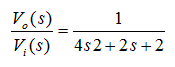
The transfer function given in your problem is shown above.
since the numerator is 1, we have used the following command to input the numerator
numerator = [1]
since the denominator is 4s2 + 2s +2, take the coefficients of equation which is [4 2 2].
denominator = [4 2 2]
Now we have to convert the numerator and denominator to transfer function. For that we are using the command: tf()
system = tf(numerator,denominator)
The command used for obtaining step response and step response plot is : step()
step(system)
D. Plot of step response
The command step(system) also plots the
response. The response is attached below.
Derive separate formulas for and using the equation above then calculate and to have (Peak Time)...
 Derive separate formulas for and
using the equation above then calculate and to
have (Peak Time) = 0.2 seconds
and (Overshoot) OS = 15%.
S2+ S* We were unable to transcribe this imageWe were unable to transcribe this imageWe were unable to transcribe this imageWe were unable to transcribe this imageWe were unable to transcribe this image
Derive separate formulas for and
using the equation above then calculate and to
have (Peak Time) = 0.2 seconds
and (Overshoot) OS = 15%.
S2+ S* We were unable to transcribe this imageWe were unable to transcribe this imageWe were unable to transcribe this imageWe were unable to transcribe this imageWe were unable to transcribe this image
How many distinct derivations of bcde are possible using S BCDE B b C c D...
 How many distinct derivations of bcde are possible using
S BCDE
B b
C c
D d
E e
We were unable to transcribe this imageWe were unable to transcribe this imageWe were unable to transcribe this imageWe were unable to transcribe this imageWe were unable to transcribe this image
How many distinct derivations of bcde are possible using
S BCDE
B b
C c
D d
E e
We were unable to transcribe this imageWe were unable to transcribe this imageWe were unable to transcribe this imageWe were unable to transcribe this imageWe were unable to transcribe this image
' 1. Review Question a) Name three applications for feedback control systems. b) Functionally, ho...
 ' 1. Review Question a) Name three applications for feedback control systems. b) Functionally, how do closed-loop systems differ from open-loop systems? c) Name the three major design criteria for control systems. d) Name the performance specification for first-order systems. e) Briefly describe how the zeros of the open-loop system affect the root locus and the transient response. What does the Routh-Hurwitz criterion tell us? f) 2. Given the electric network shown in Figure. a) Write the differential equation for...
Find the inverse (unilateral) Laplace transforms of the following functions: (a) (b) (c) (d) (e) (f)...
 Find the inverse (unilateral) Laplace transforms of the
following functions:
(a)
(b)
(c)
(d)
(e)
(f)
(g)
(h)
(i)
We were unable to transcribe this imageWe were unable to transcribe this imageWe were unable to transcribe this imageWe were unable to transcribe this imageWe were unable to transcribe this imageWe were unable to transcribe this imageWe were unable to transcribe this imageWe were unable to transcribe this imageWe were unable to transcribe this image
Find the inverse (unilateral) Laplace transforms of the
following functions:
(a)
(b)
(c)
(d)
(e)
(f)
(g)
(h)
(i)
We were unable to transcribe this imageWe were unable to transcribe this imageWe were unable to transcribe this imageWe were unable to transcribe this imageWe were unable to transcribe this imageWe were unable to transcribe this imageWe were unable to transcribe this imageWe were unable to transcribe this imageWe were unable to transcribe this image
Find the indefinite integrals for the following: a.) b.) c.) d.) (the exponent is ) Please...
 Find the indefinite integrals for the following:
a.)
b.)
c.)
d.)
(the exponent is
)
Please show work, thanks!
We were unable to transcribe this imageWe were unable to transcribe this imageWe were unable to transcribe this imageWe were unable to transcribe this imageWe were unable to transcribe this image
Find the indefinite integrals for the following:
a.)
b.)
c.)
d.)
(the exponent is
)
Please show work, thanks!
We were unable to transcribe this imageWe were unable to transcribe this imageWe were unable to transcribe this imageWe were unable to transcribe this imageWe were unable to transcribe this image
(19) i(t) By using the time-domain technique, find in the electric circuit shown in Figure P.6...
 (19) i(t) By using the time-domain technique, find in the electric circuit shown in Figure P.6 when vs(t) is defined by Figure 2.19 We were unable to transcribe this imageWe were unable to transcribe this image
What is the ΔH for the reaction H + I ➞ 2 HI ? And is...
 What is the ΔH
for the reaction H
+ I
➞ 2 HI ? And is the reaction exothermic or endothermic?
CH10: Q07 Homework Important Answered What is the AHrxn for the reaction H2 + 12 + 2 HI ? And is the reaction exothermic or enothermic? O A 69 kcal/mol, endothermic 242 kcal/mol, enothermic -2 kcal/mol, exothermic O D 69 kcal/mol, exothermic E -2 kcal/mol, endothermic F 242 kcal/mol, exothermic Answered Change your responses to resubmit We were unable...
What is the ΔH
for the reaction H
+ I
➞ 2 HI ? And is the reaction exothermic or endothermic?
CH10: Q07 Homework Important Answered What is the AHrxn for the reaction H2 + 12 + 2 HI ? And is the reaction exothermic or enothermic? O A 69 kcal/mol, endothermic 242 kcal/mol, enothermic -2 kcal/mol, exothermic O D 69 kcal/mol, exothermic E -2 kcal/mol, endothermic F 242 kcal/mol, exothermic Answered Change your responses to resubmit We were unable...
Help with part B, please! I have worked part a (answer below) and drew Mohr's circle,...
 Help with part B, please!
I have worked part a (answer below) and drew Mohr's circle, but
I simply do not understand "b" at all. I know what hydrostatic
pressure is but I just do not understand what is asking or even how
to implement. Thanks!
Problem:
A stress element in plane stress encounters x = 20
MPa, y =
-10 MPa, and xy = 13
MPa.
(a) Determine the three principal stresses and maximum shear
stress.
( My answer:...
Help with part B, please!
I have worked part a (answer below) and drew Mohr's circle, but
I simply do not understand "b" at all. I know what hydrostatic
pressure is but I just do not understand what is asking or even how
to implement. Thanks!
Problem:
A stress element in plane stress encounters x = 20
MPa, y =
-10 MPa, and xy = 13
MPa.
(a) Determine the three principal stresses and maximum shear
stress.
( My answer:...
***PLEASE NOTE: I have already calculated the potential and need help with Electric Field and induced...
 ***PLEASE NOTE: I have already calculated the potential and need
help with Electric Field and induced charge at the boundaries for
this problem***
An infinitely long rectangular metal pipe (sides and ) is grounded, but
one end, at x = 0, is maintained at a specified potential , as
indicated in Fig. 3.22. What is the ELECTRIC FIELD and INDUCED
CHARGE on all boundaries? I have already worked you the potential,
and got:
We were unable to transcribe this imageWe...
***PLEASE NOTE: I have already calculated the potential and need
help with Electric Field and induced charge at the boundaries for
this problem***
An infinitely long rectangular metal pipe (sides and ) is grounded, but
one end, at x = 0, is maintained at a specified potential , as
indicated in Fig. 3.22. What is the ELECTRIC FIELD and INDUCED
CHARGE on all boundaries? I have already worked you the potential,
and got:
We were unable to transcribe this imageWe...
draw the vector d=a-b? this is what i put but its wrong :( We were unable...
 draw the vector d=a-b? this is
what i put but its wrong :(
We were unable to transcribe this imageWe were unable to transcribe this image
draw the vector d=a-b? this is
what i put but its wrong :(
We were unable to transcribe this imageWe were unable to transcribe this image
 Derive separate formulas for and
using the equation above then calculate and to
have (Peak Time) = 0.2 seconds
and (Overshoot) OS = 15%.
S2+ S* We were unable to transcribe this imageWe were unable to transcribe this imageWe were unable to transcribe this imageWe were unable to transcribe this imageWe were unable to transcribe this image
Derive separate formulas for and
using the equation above then calculate and to
have (Peak Time) = 0.2 seconds
and (Overshoot) OS = 15%.
S2+ S* We were unable to transcribe this imageWe were unable to transcribe this imageWe were unable to transcribe this imageWe were unable to transcribe this imageWe were unable to transcribe this image
 How many distinct derivations of bcde are possible using
S BCDE
B b
C c
D d
E e
We were unable to transcribe this imageWe were unable to transcribe this imageWe were unable to transcribe this imageWe were unable to transcribe this imageWe were unable to transcribe this image
How many distinct derivations of bcde are possible using
S BCDE
B b
C c
D d
E e
We were unable to transcribe this imageWe were unable to transcribe this imageWe were unable to transcribe this imageWe were unable to transcribe this imageWe were unable to transcribe this image
 ' 1. Review Question a) Name three applications for feedback control systems. b) Functionally, how do closed-loop systems differ from open-loop systems? c) Name the three major design criteria for control systems. d) Name the performance specification for first-order systems. e) Briefly describe how the zeros of the open-loop system affect the root locus and the transient response. What does the Routh-Hurwitz criterion tell us? f) 2. Given the electric network shown in Figure. a) Write the differential equation for...
 Find the inverse (unilateral) Laplace transforms of the
following functions:
(a)
(b)
(c)
(d)
(e)
(f)
(g)
(h)
(i)
We were unable to transcribe this imageWe were unable to transcribe this imageWe were unable to transcribe this imageWe were unable to transcribe this imageWe were unable to transcribe this imageWe were unable to transcribe this imageWe were unable to transcribe this imageWe were unable to transcribe this imageWe were unable to transcribe this image
Find the inverse (unilateral) Laplace transforms of the
following functions:
(a)
(b)
(c)
(d)
(e)
(f)
(g)
(h)
(i)
We were unable to transcribe this imageWe were unable to transcribe this imageWe were unable to transcribe this imageWe were unable to transcribe this imageWe were unable to transcribe this imageWe were unable to transcribe this imageWe were unable to transcribe this imageWe were unable to transcribe this imageWe were unable to transcribe this image
 Find the indefinite integrals for the following:
a.)
b.)
c.)
d.)
(the exponent is
)
Please show work, thanks!
We were unable to transcribe this imageWe were unable to transcribe this imageWe were unable to transcribe this imageWe were unable to transcribe this imageWe were unable to transcribe this image
Find the indefinite integrals for the following:
a.)
b.)
c.)
d.)
(the exponent is
)
Please show work, thanks!
We were unable to transcribe this imageWe were unable to transcribe this imageWe were unable to transcribe this imageWe were unable to transcribe this imageWe were unable to transcribe this image
 (19) i(t) By using the time-domain technique, find in the electric circuit shown in Figure P.6 when vs(t) is defined by Figure 2.19 We were unable to transcribe this imageWe were unable to transcribe this image
 What is the ΔH
for the reaction H
+ I
➞ 2 HI ? And is the reaction exothermic or endothermic?
CH10: Q07 Homework Important Answered What is the AHrxn for the reaction H2 + 12 + 2 HI ? And is the reaction exothermic or enothermic? O A 69 kcal/mol, endothermic 242 kcal/mol, enothermic -2 kcal/mol, exothermic O D 69 kcal/mol, exothermic E -2 kcal/mol, endothermic F 242 kcal/mol, exothermic Answered Change your responses to resubmit We were unable...
What is the ΔH
for the reaction H
+ I
➞ 2 HI ? And is the reaction exothermic or endothermic?
CH10: Q07 Homework Important Answered What is the AHrxn for the reaction H2 + 12 + 2 HI ? And is the reaction exothermic or enothermic? O A 69 kcal/mol, endothermic 242 kcal/mol, enothermic -2 kcal/mol, exothermic O D 69 kcal/mol, exothermic E -2 kcal/mol, endothermic F 242 kcal/mol, exothermic Answered Change your responses to resubmit We were unable...
 Help with part B, please!
I have worked part a (answer below) and drew Mohr's circle, but
I simply do not understand "b" at all. I know what hydrostatic
pressure is but I just do not understand what is asking or even how
to implement. Thanks!
Problem:
A stress element in plane stress encounters x = 20
MPa, y =
-10 MPa, and xy = 13
MPa.
(a) Determine the three principal stresses and maximum shear
stress.
( My answer:...
Help with part B, please!
I have worked part a (answer below) and drew Mohr's circle, but
I simply do not understand "b" at all. I know what hydrostatic
pressure is but I just do not understand what is asking or even how
to implement. Thanks!
Problem:
A stress element in plane stress encounters x = 20
MPa, y =
-10 MPa, and xy = 13
MPa.
(a) Determine the three principal stresses and maximum shear
stress.
( My answer:...
 ***PLEASE NOTE: I have already calculated the potential and need
help with Electric Field and induced charge at the boundaries for
this problem***
An infinitely long rectangular metal pipe (sides and ) is grounded, but
one end, at x = 0, is maintained at a specified potential , as
indicated in Fig. 3.22. What is the ELECTRIC FIELD and INDUCED
CHARGE on all boundaries? I have already worked you the potential,
and got:
We were unable to transcribe this imageWe...
***PLEASE NOTE: I have already calculated the potential and need
help with Electric Field and induced charge at the boundaries for
this problem***
An infinitely long rectangular metal pipe (sides and ) is grounded, but
one end, at x = 0, is maintained at a specified potential , as
indicated in Fig. 3.22. What is the ELECTRIC FIELD and INDUCED
CHARGE on all boundaries? I have already worked you the potential,
and got:
We were unable to transcribe this imageWe...
 draw the vector d=a-b? this is
what i put but its wrong :(
We were unable to transcribe this imageWe were unable to transcribe this image
draw the vector d=a-b? this is
what i put but its wrong :(
We were unable to transcribe this imageWe were unable to transcribe this image
Most questions answered within 3 hours.
-
Where is the error in this code sequence?
String s1 = "Hello";
String s2 = "ello";...
asked 11 months ago -
Financial data for Joel de Paris, Inc., for last year
follow:
Joel de Paris, Inc.
Balance...
asked 11 months ago -
Consider this reaction:
Al2(SO4)3 (aq)+ BaCl3
(aq) Al2Cl6 (aq)- +
3BaSO4(s) . What is the...
asked 11 months ago -
Suppose that Savneet is considering increasing her
recent random sample from 20 car rentals to 40...
asked 11 months ago -
Trucks arrive at an unloading terminal at an average rate of 120
per hour.
Trucks arrive...
asked 11 months ago -
Why are methanol and ethanol completely soluble in water while
octanol is not very little soluble....
asked 11 months ago -
A facilities manager at a university reads in a research report
that the mean amount of...
asked 11 months ago -
When the CuSO4 is rehydrated by adding water to the anhydrous
compound, is this an endothermic...
asked 11 months ago -
A ray of sunlight is passing from diamond into crown glass; the
angle of incidence is...
asked 11 months ago -
A block of mass 0.249 kg is placed on top of a light, vertical
spring of...
asked 11 months ago -
how do the kidneys compensate in the presences of acidosis
a) trigger hyperventilate
b) reserve acid...
asked 11 months ago -
Question 501 pts
The rental rate of capital to the firm increases. Which of the
following...
asked 11 months ago