***PLEASE NOTE: I have already calculated the potential and need help with Electric Field and induced charge at the boundaries for this problem***
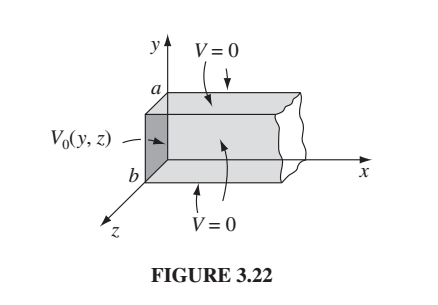
An infinitely long rectangular metal pipe (sides  and
and  ) is grounded, but
one end, at x = 0, is maintained at a specified potential
) is grounded, but
one end, at x = 0, is maintained at a specified potential  , as
indicated in Fig. 3.22. What is the ELECTRIC FIELD and INDUCED
CHARGE on all boundaries? I have already worked you the potential,
and got:
, as
indicated in Fig. 3.22. What is the ELECTRIC FIELD and INDUCED
CHARGE on all boundaries? I have already worked you the potential,
and got: 
Homework Answers
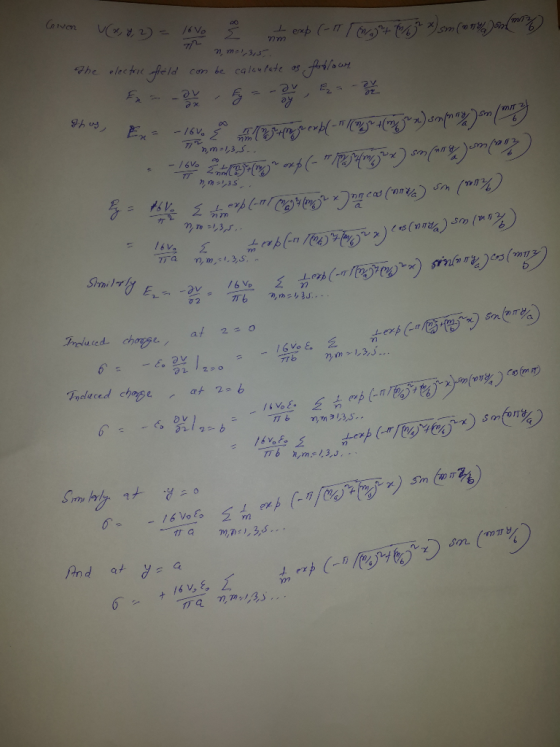
I have one point more, in the solution, actually the normal on
the surfaces at y = 0 or z = 0 are directed along negative y or
negative z. Therefore, the sign of surface charge density obtained
in the solution in that should be positive perhaps as well.
Add Answer to:
***PLEASE NOTE: I have already calculated the potential and need
help with Electric Field and induced...
Which of the following is true about the electric field from infinitely long, charged wire: a)...
 Which of the following is true about the electric field from infinitely long, charged wire: a) The vectors of the net electric field are perpendicular to the wire. b) The net electric field is constant at any distance from the wire. c) The vectors if the net electric field are parallel to the wire. d) The net electric field is the largest at the center of the wire. We were unable to transcribe this imageCorrect expression for the magnitude of...
Hi I need help with question 3 shown below. Thank you This problem references problem 2,...
 Hi I need help with question 3 shown below. Thank you
This problem references problem 2, which I have already
completed
3) The p-n junction of problem 2 has a cross sectional area of 103 cm2. Calculate: a) the total depletion zone width, b)n-side depletion zone width, c) p-side depletion zone width, d) total charge on the n side, e) total charge on the p side and f) the peak electric field magnitude. g) Sketch εχ vs. x and the...
Hi I need help with question 3 shown below. Thank you
This problem references problem 2, which I have already
completed
3) The p-n junction of problem 2 has a cross sectional area of 103 cm2. Calculate: a) the total depletion zone width, b)n-side depletion zone width, c) p-side depletion zone width, d) total charge on the n side, e) total charge on the p side and f) the peak electric field magnitude. g) Sketch εχ vs. x and the...
a) An electron is traveling through a uniform electric field. The field is constant and given...
 a) An electron is traveling through a uniform electric field.
The field is constant and given by
At t=0 , the electron is at the origin and traveling in the x
direction with a speed of 1.40 m/s .
What is its position 1.70 s later?
x= _____________m
y=_____________m
b) An electron moves in a circle of radius r around a very long
uniformly charged wire in a vacuum chamber, as shown in the
figure.(Figure 1) The charge density on...
a) An electron is traveling through a uniform electric field.
The field is constant and given by
At t=0 , the electron is at the origin and traveling in the x
direction with a speed of 1.40 m/s .
What is its position 1.70 s later?
x= _____________m
y=_____________m
b) An electron moves in a circle of radius r around a very long
uniformly charged wire in a vacuum chamber, as shown in the
figure.(Figure 1) The charge density on...
In a cubical volume, 0.70 m on a side, the electric field is where E0=0.125N/C and...
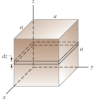 In a cubical volume, 0.70 m on a side, the electric field is
where E0=0.125N/C and a=0.70m.
The cube has its sides parallel to the coordinate axes, see the
figure. Determine the net charge within the cube.
CI dz We were unable to transcribe this image
In a cubical volume, 0.70 m on a side, the electric field is
where E0=0.125N/C and a=0.70m.
The cube has its sides parallel to the coordinate axes, see the
figure. Determine the net charge within the cube.
CI dz We were unable to transcribe this image
I am trying to give the magnitude and direction of the electric field produced at point...
 I am trying to give the magnitude and direction of the
electric field produced at point A. However that angle seems small.
Where did I go wrong?
We were unable to transcribe this image2 S2
I am trying to give the magnitude and direction of the
electric field produced at point A. However that angle seems small.
Where did I go wrong?
We were unable to transcribe this image2 S2
please I really need the solution to the electric field vector and not the electric potential....
 please I really need the solution to the electric
field vector and not the electric potential. thanks
the dot is at the center of the equilateral
triangle
yes, is a centroid
s shwn in tfisure belforn an esmilaten iangle with4.mg sides whatis the eucic Poted ndicated unth the dot and the elucic ald vechw -Inc Inc
please I really need the solution to the electric
field vector and not the electric potential. thanks
the dot is at the center of the equilateral
triangle
yes, is a centroid
s shwn in tfisure belforn an esmilaten iangle with4.mg sides whatis the eucic Poted ndicated unth the dot and the elucic ald vechw -Inc Inc
I need the answers to these ten questions. I have attached them below. Please answer them...
 I need the answers to these ten questions. I have attached them
below. Please answer them all. Many many thanks in advance!!
When a torch is brought 2 times closer, how many times brighter will it appear? O 16 A diffraction grating that contains 650472 lines/m is illuminated by monochromatic light (λ-632.8 nm) from a helium-neon laser directed perpendicular to the surface of the grating. What is the angle for the second order maxima to occur? 24° O 45 48...
I need the answers to these ten questions. I have attached them
below. Please answer them all. Many many thanks in advance!!
When a torch is brought 2 times closer, how many times brighter will it appear? O 16 A diffraction grating that contains 650472 lines/m is illuminated by monochromatic light (λ-632.8 nm) from a helium-neon laser directed perpendicular to the surface of the grating. What is the angle for the second order maxima to occur? 24° O 45 48...
Problem: Determine the field from the potential and show that the result agrees with what you obt...
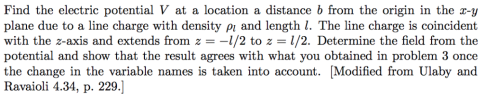 Problem: Determine the field from the potential
and show that the result agrees with what you obtained in
problem 3 once the change in the variable names is taken into
account.
Answer for problem 3:
We were unable to transcribe this imageThe assumption made here is for θ =-, it is possible only when is very large, that is infinity. Hence, it is proved that the expression for the electric filed, E at any point P due to infinitely long...
Problem: Determine the field from the potential
and show that the result agrees with what you obtained in
problem 3 once the change in the variable names is taken into
account.
Answer for problem 3:
We were unable to transcribe this imageThe assumption made here is for θ =-, it is possible only when is very large, that is infinity. Hence, it is proved that the expression for the electric filed, E at any point P due to infinitely long...
3.1 Pre-lab In the lab on electric potential and electric field lines, you noted that charged...
 3.1 Pre-lab In the lab on electric potential and electric field lines, you noted that charged par- ticles produce electric fields and these electric fields, in turn, act on charged par- ticles. However, you then proceeded to produce an electric field geometry using conductors held at a particular electric potential. What happened to the electric charges? Electric charge and electric potential are closely related to each other. Putting charge on a conductor raises its electric potential. It is usually much...
Help with part B, please! I have worked part a (answer below) and drew Mohr's circle,...
 Help with part B, please!
I have worked part a (answer below) and drew Mohr's circle, but
I simply do not understand "b" at all. I know what hydrostatic
pressure is but I just do not understand what is asking or even how
to implement. Thanks!
Problem:
A stress element in plane stress encounters x = 20
MPa, y =
-10 MPa, and xy = 13
MPa.
(a) Determine the three principal stresses and maximum shear
stress.
( My answer:...
Help with part B, please!
I have worked part a (answer below) and drew Mohr's circle, but
I simply do not understand "b" at all. I know what hydrostatic
pressure is but I just do not understand what is asking or even how
to implement. Thanks!
Problem:
A stress element in plane stress encounters x = 20
MPa, y =
-10 MPa, and xy = 13
MPa.
(a) Determine the three principal stresses and maximum shear
stress.
( My answer:...
 Which of the following is true about the electric field from infinitely long, charged wire: a) The vectors of the net electric field are perpendicular to the wire. b) The net electric field is constant at any distance from the wire. c) The vectors if the net electric field are parallel to the wire. d) The net electric field is the largest at the center of the wire. We were unable to transcribe this imageCorrect expression for the magnitude of...
 Hi I need help with question 3 shown below. Thank you
This problem references problem 2, which I have already
completed
3) The p-n junction of problem 2 has a cross sectional area of 103 cm2. Calculate: a) the total depletion zone width, b)n-side depletion zone width, c) p-side depletion zone width, d) total charge on the n side, e) total charge on the p side and f) the peak electric field magnitude. g) Sketch εχ vs. x and the...
Hi I need help with question 3 shown below. Thank you
This problem references problem 2, which I have already
completed
3) The p-n junction of problem 2 has a cross sectional area of 103 cm2. Calculate: a) the total depletion zone width, b)n-side depletion zone width, c) p-side depletion zone width, d) total charge on the n side, e) total charge on the p side and f) the peak electric field magnitude. g) Sketch εχ vs. x and the...
 a) An electron is traveling through a uniform electric field.
The field is constant and given by
At t=0 , the electron is at the origin and traveling in the x
direction with a speed of 1.40 m/s .
What is its position 1.70 s later?
x= _____________m
y=_____________m
b) An electron moves in a circle of radius r around a very long
uniformly charged wire in a vacuum chamber, as shown in the
figure.(Figure 1) The charge density on...
a) An electron is traveling through a uniform electric field.
The field is constant and given by
At t=0 , the electron is at the origin and traveling in the x
direction with a speed of 1.40 m/s .
What is its position 1.70 s later?
x= _____________m
y=_____________m
b) An electron moves in a circle of radius r around a very long
uniformly charged wire in a vacuum chamber, as shown in the
figure.(Figure 1) The charge density on...
 In a cubical volume, 0.70 m on a side, the electric field is
where E0=0.125N/C and a=0.70m.
The cube has its sides parallel to the coordinate axes, see the
figure. Determine the net charge within the cube.
CI dz We were unable to transcribe this image
In a cubical volume, 0.70 m on a side, the electric field is
where E0=0.125N/C and a=0.70m.
The cube has its sides parallel to the coordinate axes, see the
figure. Determine the net charge within the cube.
CI dz We were unable to transcribe this image
 I am trying to give the magnitude and direction of the
electric field produced at point A. However that angle seems small.
Where did I go wrong?
We were unable to transcribe this image2 S2
I am trying to give the magnitude and direction of the
electric field produced at point A. However that angle seems small.
Where did I go wrong?
We were unable to transcribe this image2 S2
 please I really need the solution to the electric
field vector and not the electric potential. thanks
the dot is at the center of the equilateral
triangle
yes, is a centroid
s shwn in tfisure belforn an esmilaten iangle with4.mg sides whatis the eucic Poted ndicated unth the dot and the elucic ald vechw -Inc Inc
please I really need the solution to the electric
field vector and not the electric potential. thanks
the dot is at the center of the equilateral
triangle
yes, is a centroid
s shwn in tfisure belforn an esmilaten iangle with4.mg sides whatis the eucic Poted ndicated unth the dot and the elucic ald vechw -Inc Inc
 I need the answers to these ten questions. I have attached them
below. Please answer them all. Many many thanks in advance!!
When a torch is brought 2 times closer, how many times brighter will it appear? O 16 A diffraction grating that contains 650472 lines/m is illuminated by monochromatic light (λ-632.8 nm) from a helium-neon laser directed perpendicular to the surface of the grating. What is the angle for the second order maxima to occur? 24° O 45 48...
I need the answers to these ten questions. I have attached them
below. Please answer them all. Many many thanks in advance!!
When a torch is brought 2 times closer, how many times brighter will it appear? O 16 A diffraction grating that contains 650472 lines/m is illuminated by monochromatic light (λ-632.8 nm) from a helium-neon laser directed perpendicular to the surface of the grating. What is the angle for the second order maxima to occur? 24° O 45 48...
 Problem: Determine the field from the potential
and show that the result agrees with what you obtained in
problem 3 once the change in the variable names is taken into
account.
Answer for problem 3:
We were unable to transcribe this imageThe assumption made here is for θ =-, it is possible only when is very large, that is infinity. Hence, it is proved that the expression for the electric filed, E at any point P due to infinitely long...
Problem: Determine the field from the potential
and show that the result agrees with what you obtained in
problem 3 once the change in the variable names is taken into
account.
Answer for problem 3:
We were unable to transcribe this imageThe assumption made here is for θ =-, it is possible only when is very large, that is infinity. Hence, it is proved that the expression for the electric filed, E at any point P due to infinitely long...
 3.1 Pre-lab In the lab on electric potential and electric field lines, you noted that charged par- ticles produce electric fields and these electric fields, in turn, act on charged par- ticles. However, you then proceeded to produce an electric field geometry using conductors held at a particular electric potential. What happened to the electric charges? Electric charge and electric potential are closely related to each other. Putting charge on a conductor raises its electric potential. It is usually much...
 Help with part B, please!
I have worked part a (answer below) and drew Mohr's circle, but
I simply do not understand "b" at all. I know what hydrostatic
pressure is but I just do not understand what is asking or even how
to implement. Thanks!
Problem:
A stress element in plane stress encounters x = 20
MPa, y =
-10 MPa, and xy = 13
MPa.
(a) Determine the three principal stresses and maximum shear
stress.
( My answer:...
Help with part B, please!
I have worked part a (answer below) and drew Mohr's circle, but
I simply do not understand "b" at all. I know what hydrostatic
pressure is but I just do not understand what is asking or even how
to implement. Thanks!
Problem:
A stress element in plane stress encounters x = 20
MPa, y =
-10 MPa, and xy = 13
MPa.
(a) Determine the three principal stresses and maximum shear
stress.
( My answer:...
Most questions answered within 3 hours.
-
Where is the error in this code sequence?
String s1 = "Hello";
String s2 = "ello";...
asked 10 months ago -
Financial data for Joel de Paris, Inc., for last year
follow:
Joel de Paris, Inc.
Balance...
asked 10 months ago -
Consider this reaction:
Al2(SO4)3 (aq)+ BaCl3
(aq) Al2Cl6 (aq)- +
3BaSO4(s) . What is the...
asked 10 months ago -
Suppose that Savneet is considering increasing her
recent random sample from 20 car rentals to 40...
asked 10 months ago -
Trucks arrive at an unloading terminal at an average rate of 120
per hour.
Trucks arrive...
asked 10 months ago -
Why are methanol and ethanol completely soluble in water while
octanol is not very little soluble....
asked 10 months ago -
A facilities manager at a university reads in a research report
that the mean amount of...
asked 10 months ago -
When the CuSO4 is rehydrated by adding water to the anhydrous
compound, is this an endothermic...
asked 10 months ago -
A ray of sunlight is passing from diamond into crown glass; the
angle of incidence is...
asked 10 months ago -
A block of mass 0.249 kg is placed on top of a light, vertical
spring of...
asked 10 months ago -
how do the kidneys compensate in the presences of acidosis
a) trigger hyperventilate
b) reserve acid...
asked 10 months ago -
Question 501 pts
The rental rate of capital to the firm increases. Which of the
following...
asked 10 months ago