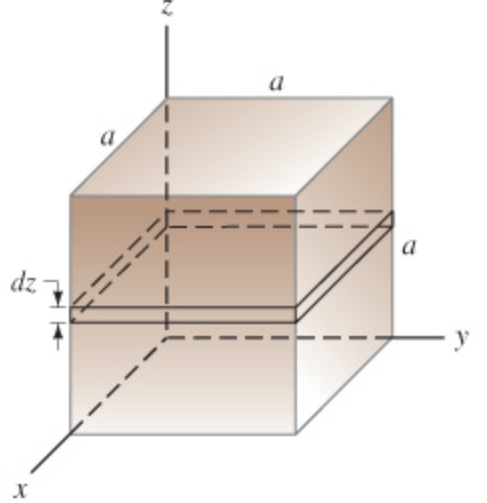
In a cubical volume, 0.70 m on a side, the electric field is where E0=0.125N/C and a=0.70m.

The cube has its sides parallel to the coordinate axes, see the figure. Determine the net charge within the cube.
Homework Answers
side of the cubical volume = 0.70 m
a = 0.70 m
E0= 0.125 N/C
= 0.125 ( 1 + 0.70/0.70 ) i + 0.125 ( 0.70/0.70 )j
= 0.125 (2) i + 0.125 j
= 0.125( 2i + j)
for two opposite sides of the cube
= 0.125(2i+j)
therefore E total = 2* 0.125(2i+j)
jk
= 0.125(0.70/0.70)j
= 0.125 j
jk
takes place on two sides so it is equal to = 2*0.125 j
ki
= 0.125 ( 1+ 0.70/0.70)i
ki=
0.125(2i)
this takes place on two sides therefore
ki = 2*0.125 *2i
so the net field= 2*0.125 *(2i +j) + 2*0.125 *(j) + 2*0.125 *(2i)
= 0.250 (2i + j+ j + 2i)
= 0.250 ( 4i + 2j )
=0.500(2i+ j)
Add Answer to:
In a cubical volume, 0.70 m on a side, the electric field is
where E0=0.125N/C and...
1) A point charge of 9.40 nC is located at the origin and a second charge...
 1) A point charge of 9.40 nC is located at the origin and a
second charge of -4.20 nC is located on the x axis at x=3.75cm.
a) Calculate the electric flux through a sphere centered at the
origin with radius 1.20 m .
b) Repeat the calculation for a sphere of radius 2.70 m .
2) In a cubical volume, 0.70 m on a side, the electric field
is
where E0=0.125N/C and a=0.70m. The cube has its sides
parallel...
1) A point charge of 9.40 nC is located at the origin and a
second charge of -4.20 nC is located on the x axis at x=3.75cm.
a) Calculate the electric flux through a sphere centered at the
origin with radius 1.20 m .
b) Repeat the calculation for a sphere of radius 2.70 m .
2) In a cubical volume, 0.70 m on a side, the electric field
is
where E0=0.125N/C and a=0.70m. The cube has its sides
parallel...
Flux through a cube: The electric field, E, in a cube of side a 0.70 m...
 Flux through a cube: The electric field, E, in a cube of side a 0.70 m is given by where Eo is a scalar with valueE-0.125 N/C. The sides of the cube lie along the z, y, and z axes as shown in the figure below. Determine the net charge Qend in nanocoulombs (nC), enclosed by cube. DC
An imaginary cubical surface of side L has its edges parallel to the x-, y- and...
An imaginary cubical surface of side L has its edges parallel to the x-, y- and z-axes, one corner at the point x = 0,y = 0, z = 0 and the opposite corner at the point x=L, y=L, z=L. The cube is in a region of uniform electric field E⃗ =E1i^+E2j^, where E1 and E2 are positive constants. Calculate the electric flux through the entire cubical surface. Face the normal points out of the cube. Express your answer in...
***PLEASE NOTE: I have already calculated the potential and need help with Electric Field and induced...
 ***PLEASE NOTE: I have already calculated the potential and need
help with Electric Field and induced charge at the boundaries for
this problem***
An infinitely long rectangular metal pipe (sides and ) is grounded, but
one end, at x = 0, is maintained at a specified potential , as
indicated in Fig. 3.22. What is the ELECTRIC FIELD and INDUCED
CHARGE on all boundaries? I have already worked you the potential,
and got:
We were unable to transcribe this imageWe...
***PLEASE NOTE: I have already calculated the potential and need
help with Electric Field and induced charge at the boundaries for
this problem***
An infinitely long rectangular metal pipe (sides and ) is grounded, but
one end, at x = 0, is maintained at a specified potential , as
indicated in Fig. 3.22. What is the ELECTRIC FIELD and INDUCED
CHARGE on all boundaries? I have already worked you the potential,
and got:
We were unable to transcribe this imageWe...
A cubic box of side a = 0.819 m is placed so that its edges are...
 A cubic box of side a = 0.819 m is placed so that its edges are
parallel to the coordinate axes, as shown in the figure. There is
NO net electric charge inside the box, but the space in and around
the box is filled with a nonuniform electric field of the following
form: E(x,y,z) = c1z^2i + c2xyj + c3x^2k, where c1 = 4.16 N/(Cm^2),
c2 =
3.62 N/(Cm^2), c3 = 5.48 N/(Cm^2), are constants. What is the
electric...
A cubic box of side a = 0.819 m is placed so that its edges are
parallel to the coordinate axes, as shown in the figure. There is
NO net electric charge inside the box, but the space in and around
the box is filled with a nonuniform electric field of the following
form: E(x,y,z) = c1z^2i + c2xyj + c3x^2k, where c1 = 4.16 N/(Cm^2),
c2 =
3.62 N/(Cm^2), c3 = 5.48 N/(Cm^2), are constants. What is the
electric...
Which of the following is true about the electric field from infinitely long, charged wire: a)...
 Which of the following is true about the electric field from infinitely long, charged wire: a) The vectors of the net electric field are perpendicular to the wire. b) The net electric field is constant at any distance from the wire. c) The vectors if the net electric field are parallel to the wire. d) The net electric field is the largest at the center of the wire. We were unable to transcribe this imageCorrect expression for the magnitude of...
A cube of side L-3.2 m lies in a region where the electric field is given...
 A cube of side L-3.2 m lies in a region where the electric field is given by E-2 7+5.4)i -4.0k N/C. We wish to find the net electric flux through the cube by first calculating the flux through each of (a) What is the flux through the left face of the cube? N-m2/C (b) What is the flux through the right face of the cube? N m2/c (c) What is the flux through the top face of the cube? (d)...
A proton of mass m and charge q is in both a uniform electric field, and...
A proton of mass m and charge q is in both a uniform electric field, and a uniform magnetic field . Write down the three Cartesian components of the Lorentz force law and solve for the motion of the proton We were unable to transcribe this imageWe were unable to transcribe this image
 1) A point charge of 9.40 nC is located at the origin and a
second charge of -4.20 nC is located on the x axis at x=3.75cm.
a) Calculate the electric flux through a sphere centered at the
origin with radius 1.20 m .
b) Repeat the calculation for a sphere of radius 2.70 m .
2) In a cubical volume, 0.70 m on a side, the electric field
is
where E0=0.125N/C and a=0.70m. The cube has its sides
parallel...
1) A point charge of 9.40 nC is located at the origin and a
second charge of -4.20 nC is located on the x axis at x=3.75cm.
a) Calculate the electric flux through a sphere centered at the
origin with radius 1.20 m .
b) Repeat the calculation for a sphere of radius 2.70 m .
2) In a cubical volume, 0.70 m on a side, the electric field
is
where E0=0.125N/C and a=0.70m. The cube has its sides
parallel...
 Flux through a cube: The electric field, E, in a cube of side a 0.70 m is given by where Eo is a scalar with valueE-0.125 N/C. The sides of the cube lie along the z, y, and z axes as shown in the figure below. Determine the net charge Qend in nanocoulombs (nC), enclosed by cube. DC
 ***PLEASE NOTE: I have already calculated the potential and need
help with Electric Field and induced charge at the boundaries for
this problem***
An infinitely long rectangular metal pipe (sides and ) is grounded, but
one end, at x = 0, is maintained at a specified potential , as
indicated in Fig. 3.22. What is the ELECTRIC FIELD and INDUCED
CHARGE on all boundaries? I have already worked you the potential,
and got:
We were unable to transcribe this imageWe...
***PLEASE NOTE: I have already calculated the potential and need
help with Electric Field and induced charge at the boundaries for
this problem***
An infinitely long rectangular metal pipe (sides and ) is grounded, but
one end, at x = 0, is maintained at a specified potential , as
indicated in Fig. 3.22. What is the ELECTRIC FIELD and INDUCED
CHARGE on all boundaries? I have already worked you the potential,
and got:
We were unable to transcribe this imageWe...
 A cubic box of side a = 0.819 m is placed so that its edges are
parallel to the coordinate axes, as shown in the figure. There is
NO net electric charge inside the box, but the space in and around
the box is filled with a nonuniform electric field of the following
form: E(x,y,z) = c1z^2i + c2xyj + c3x^2k, where c1 = 4.16 N/(Cm^2),
c2 =
3.62 N/(Cm^2), c3 = 5.48 N/(Cm^2), are constants. What is the
electric...
A cubic box of side a = 0.819 m is placed so that its edges are
parallel to the coordinate axes, as shown in the figure. There is
NO net electric charge inside the box, but the space in and around
the box is filled with a nonuniform electric field of the following
form: E(x,y,z) = c1z^2i + c2xyj + c3x^2k, where c1 = 4.16 N/(Cm^2),
c2 =
3.62 N/(Cm^2), c3 = 5.48 N/(Cm^2), are constants. What is the
electric...
 Which of the following is true about the electric field from infinitely long, charged wire: a) The vectors of the net electric field are perpendicular to the wire. b) The net electric field is constant at any distance from the wire. c) The vectors if the net electric field are parallel to the wire. d) The net electric field is the largest at the center of the wire. We were unable to transcribe this imageCorrect expression for the magnitude of...
 A cube of side L-3.2 m lies in a region where the electric field is given by E-2 7+5.4)i -4.0k N/C. We wish to find the net electric flux through the cube by first calculating the flux through each of (a) What is the flux through the left face of the cube? N-m2/C (b) What is the flux through the right face of the cube? N m2/c (c) What is the flux through the top face of the cube? (d)...
Most questions answered within 3 hours.
-
Where is the error in this code sequence?
String s1 = "Hello";
String s2 = "ello";...
asked 10 months ago -
Financial data for Joel de Paris, Inc., for last year
follow:
Joel de Paris, Inc.
Balance...
asked 10 months ago -
Consider this reaction:
Al2(SO4)3 (aq)+ BaCl3
(aq) Al2Cl6 (aq)- +
3BaSO4(s) . What is the...
asked 10 months ago -
Suppose that Savneet is considering increasing her
recent random sample from 20 car rentals to 40...
asked 10 months ago -
Trucks arrive at an unloading terminal at an average rate of 120
per hour.
Trucks arrive...
asked 10 months ago -
Why are methanol and ethanol completely soluble in water while
octanol is not very little soluble....
asked 10 months ago -
A facilities manager at a university reads in a research report
that the mean amount of...
asked 10 months ago -
When the CuSO4 is rehydrated by adding water to the anhydrous
compound, is this an endothermic...
asked 10 months ago -
A ray of sunlight is passing from diamond into crown glass; the
angle of incidence is...
asked 10 months ago -
A block of mass 0.249 kg is placed on top of a light, vertical
spring of...
asked 10 months ago -
how do the kidneys compensate in the presences of acidosis
a) trigger hyperventilate
b) reserve acid...
asked 10 months ago -
Question 501 pts
The rental rate of capital to the firm increases. Which of the
following...
asked 10 months ago