A proton of mass m and charge q is in both a uniform electric
field,
and a uniform magnetic field
. Write down the three Cartesian components of the Lorentz force
law and solve for the motion of the proton
Homework Answers

Add Answer to:
A proton of mass m and charge q is in both a uniform electric field, and...
2.53A charged particle of mass m and positive charge q moves in uniform electric and magnetic...
 2.53A charged particle of mass m and positive charge q moves in uniform electric and magnetic fields. E and B, both pointing in the z direction. The net force on the particle is F = q (E + v x B). Write down the equation of motion for the particle and resolve it into its three components. Solve the equations and describe the particle's motion.
Question 2 Write down the equations of motion of a bead on a wheel: (a) from...
 Question 2
Write down the equations of motion of a bead on a wheel:
(a) from the frame of the wheel
(b) from the frame of the ground
(c) Write the equations of motion of a charged particle q in a
static electric field that is orthogonal to a magnetic field.
Recall: F = q(E + V x B) Lorentz force law. Hint: mimic the
derivation for a charged particle in a magnetic field. You should
get x'' = -2x...
Question 2
Write down the equations of motion of a bead on a wheel:
(a) from the frame of the wheel
(b) from the frame of the ground
(c) Write the equations of motion of a charged particle q in a
static electric field that is orthogonal to a magnetic field.
Recall: F = q(E + V x B) Lorentz force law. Hint: mimic the
derivation for a charged particle in a magnetic field. You should
get x'' = -2x...
Question 2 Write down the equations of motion of a bead on a wheel: (a) from...
 Question 2
Write down the equations of motion of a bead on a wheel:
(a) from the frame of the wheel
(b) from the frame of the ground
(c) Write the equations of motion of a charged particle q in a
static electric field that is orthogonal to a magnetic field.
Recall: F = q(E + V x B) Lorentz force law. Hint: mimic the
derivation for a charged particle in a magnetic field. You should
get x'' = -2x...
Question 2
Write down the equations of motion of a bead on a wheel:
(a) from the frame of the wheel
(b) from the frame of the ground
(c) Write the equations of motion of a charged particle q in a
static electric field that is orthogonal to a magnetic field.
Recall: F = q(E + V x B) Lorentz force law. Hint: mimic the
derivation for a charged particle in a magnetic field. You should
get x'' = -2x...
Consider the motion of particle mass m and charge q in an electromagnetic field with electric...
Consider the motion of particle mass m and charge q in an electromagnetic field with electric field vector is E and the magnetic field vector is B. The force acting on the particle is given by the Lorentz equation F = qE + qv x B (assuming non-relativistic case, v<) ( a) If there is no electric field and the particle enters the magnetic field in a direction perpendicular to the lines of magnetic flux, show that the trajectory is...
home / study / science / physics / physics questions and answers / question 2 write...
 home / study / science / physics / physics questions and answers
/ question 2 write down the equations of motion of a bead on a
wheel: (a) from the frame of the ...
Question: Question 2 Write down the equations of motion
of a bead on a wheel: (a) from the frame of the whe...
Question 2
Write down the equations of motion of a bead on a wheel:
(a) from the frame of the wheel
(b) from the...
home / study / science / physics / physics questions and answers
/ question 2 write down the equations of motion of a bead on a
wheel: (a) from the frame of the ...
Question: Question 2 Write down the equations of motion
of a bead on a wheel: (a) from the frame of the whe...
Question 2
Write down the equations of motion of a bead on a wheel:
(a) from the frame of the wheel
(b) from the...
Example 2 A proton is released from rest at point A in a uniform electric field...
 Example 2 A proton is released from rest at point A in a uniform electric field that has a magnitude of 8.0 × 10⁴ V/m. The proton undergoes a displacement of magnitude d- 0.50 m to point B in the direction of the electric field. Find the speed of the proton after completing the displacement We were unable to transcribe this image
A charged particle of mass m and positive charge q moves in uniform electric and magnetic...
A charged particle of mass m and positive charge q moves in uniform electric and magnetic fields, E pointing in the y direction and B in the z direction. suppose the particle is initially at the origin and is given a kick at time t=0 along the x axis with vx = vxo (positive or negative). a) Write down the equation of motion for the particle and resolve it into its three components. show that the motion remains in the...
A particle with charge q exists in a region with a uniform electric field Ē =...
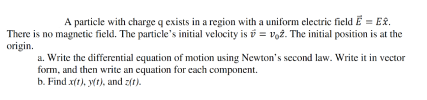 A particle with charge q exists in a region with a uniform electric field Ē = Eî. There is no magnetic field. The particle’s initial velocity is ū = voĉ. The initial position is at the origin. a. Write the differential equation of motion using Newton's second law. Write it in vector form, and then write an equation for each component. b. Find x(t), y(t), and z(t).
A Cycloidal Path A particle with mass m and positive charge q starts from rest at the origin as s...
 Please help, I am
struggling!
A Cycloidal Path A particle with mass m and positive charge q starts from rest at the origin as shown in the figure below. There is a uniform electric field = Eo? and a uniform magnetic field B = BoZ The path of the charged sketched below is a cycloid whose radius of curvature at the top points is twice the y-coordinate at that level. This path is exactly the same as the path of...
Please help, I am
struggling!
A Cycloidal Path A particle with mass m and positive charge q starts from rest at the origin as shown in the figure below. There is a uniform electric field = Eo? and a uniform magnetic field B = BoZ The path of the charged sketched below is a cycloid whose radius of curvature at the top points is twice the y-coordinate at that level. This path is exactly the same as the path of...
X nt PROBLEMS ABOUT MAGNETIC FORCES P4) A region contains both uniform electric field E(S.2-4j+2k) x 103 V/m and magnet...
 X nt PROBLEMS ABOUT MAGNETIC FORCES P4) A region contains both uniform electric field E(S.2-4j+2k) x 103 V/m and magnetic field B = Bi+B. When a proton q 16X 10-c is inserted (6+3-5)x 10 m/s, it is found that the net force on the proton is Prepared by Asist Prof Dr. I.Sakalli P1) A wire carries a steady current of 0.6A. A straight section of ie the region with a constant velocity follows F(29.121 424j + 10.4 ) x 10-16N...
 2.53A charged particle of mass m and positive charge q moves in uniform electric and magnetic fields. E and B, both pointing in the z direction. The net force on the particle is F = q (E + v x B). Write down the equation of motion for the particle and resolve it into its three components. Solve the equations and describe the particle's motion.
 Question 2
Write down the equations of motion of a bead on a wheel:
(a) from the frame of the wheel
(b) from the frame of the ground
(c) Write the equations of motion of a charged particle q in a
static electric field that is orthogonal to a magnetic field.
Recall: F = q(E + V x B) Lorentz force law. Hint: mimic the
derivation for a charged particle in a magnetic field. You should
get x'' = -2x...
Question 2
Write down the equations of motion of a bead on a wheel:
(a) from the frame of the wheel
(b) from the frame of the ground
(c) Write the equations of motion of a charged particle q in a
static electric field that is orthogonal to a magnetic field.
Recall: F = q(E + V x B) Lorentz force law. Hint: mimic the
derivation for a charged particle in a magnetic field. You should
get x'' = -2x...
 Question 2
Write down the equations of motion of a bead on a wheel:
(a) from the frame of the wheel
(b) from the frame of the ground
(c) Write the equations of motion of a charged particle q in a
static electric field that is orthogonal to a magnetic field.
Recall: F = q(E + V x B) Lorentz force law. Hint: mimic the
derivation for a charged particle in a magnetic field. You should
get x'' = -2x...
Question 2
Write down the equations of motion of a bead on a wheel:
(a) from the frame of the wheel
(b) from the frame of the ground
(c) Write the equations of motion of a charged particle q in a
static electric field that is orthogonal to a magnetic field.
Recall: F = q(E + V x B) Lorentz force law. Hint: mimic the
derivation for a charged particle in a magnetic field. You should
get x'' = -2x...
 home / study / science / physics / physics questions and answers
/ question 2 write down the equations of motion of a bead on a
wheel: (a) from the frame of the ...
Question: Question 2 Write down the equations of motion
of a bead on a wheel: (a) from the frame of the whe...
Question 2
Write down the equations of motion of a bead on a wheel:
(a) from the frame of the wheel
(b) from the...
home / study / science / physics / physics questions and answers
/ question 2 write down the equations of motion of a bead on a
wheel: (a) from the frame of the ...
Question: Question 2 Write down the equations of motion
of a bead on a wheel: (a) from the frame of the whe...
Question 2
Write down the equations of motion of a bead on a wheel:
(a) from the frame of the wheel
(b) from the...
 Example 2 A proton is released from rest at point A in a uniform electric field that has a magnitude of 8.0 × 10⁴ V/m. The proton undergoes a displacement of magnitude d- 0.50 m to point B in the direction of the electric field. Find the speed of the proton after completing the displacement We were unable to transcribe this image
 A particle with charge q exists in a region with a uniform electric field Ē = Eî. There is no magnetic field. The particle’s initial velocity is ū = voĉ. The initial position is at the origin. a. Write the differential equation of motion using Newton's second law. Write it in vector form, and then write an equation for each component. b. Find x(t), y(t), and z(t).
 Please help, I am
struggling!
A Cycloidal Path A particle with mass m and positive charge q starts from rest at the origin as shown in the figure below. There is a uniform electric field = Eo? and a uniform magnetic field B = BoZ The path of the charged sketched below is a cycloid whose radius of curvature at the top points is twice the y-coordinate at that level. This path is exactly the same as the path of...
Please help, I am
struggling!
A Cycloidal Path A particle with mass m and positive charge q starts from rest at the origin as shown in the figure below. There is a uniform electric field = Eo? and a uniform magnetic field B = BoZ The path of the charged sketched below is a cycloid whose radius of curvature at the top points is twice the y-coordinate at that level. This path is exactly the same as the path of...
 X nt PROBLEMS ABOUT MAGNETIC FORCES P4) A region contains both uniform electric field E(S.2-4j+2k) x 103 V/m and magnetic field B = Bi+B. When a proton q 16X 10-c is inserted (6+3-5)x 10 m/s, it is found that the net force on the proton is Prepared by Asist Prof Dr. I.Sakalli P1) A wire carries a steady current of 0.6A. A straight section of ie the region with a constant velocity follows F(29.121 424j + 10.4 ) x 10-16N...
Most questions answered within 3 hours.
-
Where is the error in this code sequence?
String s1 = "Hello";
String s2 = "ello";...
asked 11 months ago -
Financial data for Joel de Paris, Inc., for last year
follow:
Joel de Paris, Inc.
Balance...
asked 11 months ago -
Consider this reaction:
Al2(SO4)3 (aq)+ BaCl3
(aq) Al2Cl6 (aq)- +
3BaSO4(s) . What is the...
asked 11 months ago -
Suppose that Savneet is considering increasing her
recent random sample from 20 car rentals to 40...
asked 11 months ago -
Trucks arrive at an unloading terminal at an average rate of 120
per hour.
Trucks arrive...
asked 11 months ago -
Why are methanol and ethanol completely soluble in water while
octanol is not very little soluble....
asked 11 months ago -
A facilities manager at a university reads in a research report
that the mean amount of...
asked 11 months ago -
When the CuSO4 is rehydrated by adding water to the anhydrous
compound, is this an endothermic...
asked 11 months ago -
A ray of sunlight is passing from diamond into crown glass; the
angle of incidence is...
asked 11 months ago -
A block of mass 0.249 kg is placed on top of a light, vertical
spring of...
asked 11 months ago -
how do the kidneys compensate in the presences of acidosis
a) trigger hyperventilate
b) reserve acid...
asked 11 months ago -
Question 501 pts
The rental rate of capital to the firm increases. Which of the
following...
asked 11 months ago