home / study / science / physics / physics questions and answers / question 2 write down the equations of motion of a bead on a wheel: (a) from the frame of the ...
Question: Question 2 Write down the equations of motion of a bead on a wheel: (a) from the frame of the whe...
Question 2
Write down the equations of motion of a bead on a wheel:
(a) from the frame of the wheel
(b) from the frame of the ground

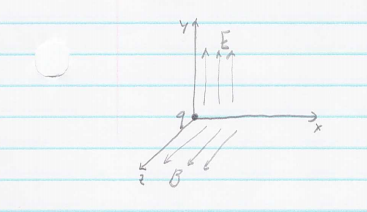
(c) Write the equations of motion of a charged particle q in a
static electric field that is orthogonal to a magnetic field.
Recall: F = q(E + V x B) Lorentz force law. Hint: mimic the
derivation for a charged particle in a magnetic field. You should
get x'' = - 2x
+
2(E/B)t which has the solution x(t) =
A1cost
+ A2sint
+ (E/B)t
2x
+
2(E/B)t which has the solution x(t) =
A1cost
+ A2sint
+ (E/B)t
Homework Answers

Add Answer to:
home / study / science / physics / physics questions and answers
/ question 2 write...
Question 2 Write down the equations of motion of a bead on a wheel: (a) from...
 Question 2
Write down the equations of motion of a bead on a wheel:
(a) from the frame of the wheel
(b) from the frame of the ground
(c) Write the equations of motion of a charged particle q in a
static electric field that is orthogonal to a magnetic field.
Recall: F = q(E + V x B) Lorentz force law. Hint: mimic the
derivation for a charged particle in a magnetic field. You should
get x'' = -2x...
Question 2
Write down the equations of motion of a bead on a wheel:
(a) from the frame of the wheel
(b) from the frame of the ground
(c) Write the equations of motion of a charged particle q in a
static electric field that is orthogonal to a magnetic field.
Recall: F = q(E + V x B) Lorentz force law. Hint: mimic the
derivation for a charged particle in a magnetic field. You should
get x'' = -2x...
Question 2 Write down the equations of motion of a bead on a wheel: (a) from...
 Question 2
Write down the equations of motion of a bead on a wheel:
(a) from the frame of the wheel
(b) from the frame of the ground
(c) Write the equations of motion of a charged particle q in a
static electric field that is orthogonal to a magnetic field.
Recall: F = q(E + V x B) Lorentz force law. Hint: mimic the
derivation for a charged particle in a magnetic field. You should
get x'' = -2x...
Question 2
Write down the equations of motion of a bead on a wheel:
(a) from the frame of the wheel
(b) from the frame of the ground
(c) Write the equations of motion of a charged particle q in a
static electric field that is orthogonal to a magnetic field.
Recall: F = q(E + V x B) Lorentz force law. Hint: mimic the
derivation for a charged particle in a magnetic field. You should
get x'' = -2x...
A proton of mass m and charge q is in both a uniform electric field, and...
A proton of mass m and charge q is in both a uniform electric field, and a uniform magnetic field . Write down the three Cartesian components of the Lorentz force law and solve for the motion of the proton We were unable to transcribe this imageWe were unable to transcribe this image
A bead of mass m slides frictionlessly on a circle of wire with radius R. The...
A bead of mass m slides frictionlessly on a circle of wire with radius R. The circle stands up in a vertical plane and rotates about the z-axis with constant angular velocity . Write down the Lagrangian. Find the equations of motion. For an angular velocity greater than some critical angular velocity , the bead will experience small oscillations about some stable equilibrium point . Find and (). We were unable to transcribe this imageWe were unable to transcribe this...
home / study / science / physics / physics questions and answers / 2. an object...
home / study / science / physics / physics questions and answers / 2. an object is attached to a vertical spring. you slowly release the object and allow it ... Your question has been answered Let us know if you got a helpful answer. Rate this answer Question: 2. An object is attached to a vertical spring. You slowly release the object and allow it to stre... 2. An object is attached to a vertical spring. You slowly release...
home / study / science / physics / physics questions and answers / a velocity selector...
home / study / science / physics / physics questions and answers / a velocity selector consists of electric and magnetic fields described by the expressions e ... Question: A velocity selector consists of electric and magnetic fields described by the expressions E with ... A velocity selector consists of electric and magnetic fields described by the expressions E with arrow = E k and B with arrow = B j, with B = 10.0 mT. Find the value of...
home / study / science / physics / physics questions and answers / a parallel plate...
home / study / science / physics / physics questions and answers / a parallel plate capacitor, with a plate area of 8.5 x10 (-4)m^2 and an air filled separation ... Question: A parallel plate capacitor, with a plate area of 8.5 x10 (-4)m^2 and an air filled separation of ... A parallel plate capacitor, with a plate area of 8.5 x10 (-4)m^2 and an air filled separation of 3 x 10 (-3)m, are charged by a 6 Volt battery....
Problem 23.29 (Multistep) An accelerated electron An electron is initially at rest. At time t1=0 it...
 Problem 23.29 (Multistep)
An accelerated electron
An electron is initially at rest. At time t1=0 it is accelerated
upward with an acceleration of a= 1 × 10¹⁹
m/s2 for a very short time (this large acceleration is
possible because the electron has a very small mass). We make
observations at location A, x= 16 meters from the electron
(see the figure).
Part 1
(a) At time t2= 1 ns (1 × 10⁻⁹ s), what is the magnitude
and direction of...
Problem 23.29 (Multistep)
An accelerated electron
An electron is initially at rest. At time t1=0 it is accelerated
upward with an acceleration of a= 1 × 10¹⁹
m/s2 for a very short time (this large acceleration is
possible because the electron has a very small mass). We make
observations at location A, x= 16 meters from the electron
(see the figure).
Part 1
(a) At time t2= 1 ns (1 × 10⁻⁹ s), what is the magnitude
and direction of...
Physics question help. Answer these 2 questions with correct units: What is the strength of the...
Physics question help. Answer these 2 questions with correct units: What is the strength of the electric field 4.4 cm from a small plastic bead that has been charged to -8.6 nC ? What is the direction of the electric field 4.4 cm from a small plastic bead that has been charged to -8.6 nC ? (away or toward the bead).
The behavior of a spin- particle in a uniform magnetic field in the z-direction, , with...
 The behavior of a spin-
particle in a uniform magnetic field in the z-direction,
, with the Hamiltonian
You found that the expectation value of the spin vector
undergoes Larmor precession about the z axis. In this sense, we can
view it as an analogue to a rotating coin, choosing the
eigenstate with eigenvalue
to represent heads and the eigenstate with eigenvalue
to represent tails. Under time-evolution in the magnetic field,
these eigenstates will “rotate” between each other.
(a) Suppose...
The behavior of a spin-
particle in a uniform magnetic field in the z-direction,
, with the Hamiltonian
You found that the expectation value of the spin vector
undergoes Larmor precession about the z axis. In this sense, we can
view it as an analogue to a rotating coin, choosing the
eigenstate with eigenvalue
to represent heads and the eigenstate with eigenvalue
to represent tails. Under time-evolution in the magnetic field,
these eigenstates will “rotate” between each other.
(a) Suppose...
 Question 2
Write down the equations of motion of a bead on a wheel:
(a) from the frame of the wheel
(b) from the frame of the ground
(c) Write the equations of motion of a charged particle q in a
static electric field that is orthogonal to a magnetic field.
Recall: F = q(E + V x B) Lorentz force law. Hint: mimic the
derivation for a charged particle in a magnetic field. You should
get x'' = -2x...
Question 2
Write down the equations of motion of a bead on a wheel:
(a) from the frame of the wheel
(b) from the frame of the ground
(c) Write the equations of motion of a charged particle q in a
static electric field that is orthogonal to a magnetic field.
Recall: F = q(E + V x B) Lorentz force law. Hint: mimic the
derivation for a charged particle in a magnetic field. You should
get x'' = -2x...
 Question 2
Write down the equations of motion of a bead on a wheel:
(a) from the frame of the wheel
(b) from the frame of the ground
(c) Write the equations of motion of a charged particle q in a
static electric field that is orthogonal to a magnetic field.
Recall: F = q(E + V x B) Lorentz force law. Hint: mimic the
derivation for a charged particle in a magnetic field. You should
get x'' = -2x...
Question 2
Write down the equations of motion of a bead on a wheel:
(a) from the frame of the wheel
(b) from the frame of the ground
(c) Write the equations of motion of a charged particle q in a
static electric field that is orthogonal to a magnetic field.
Recall: F = q(E + V x B) Lorentz force law. Hint: mimic the
derivation for a charged particle in a magnetic field. You should
get x'' = -2x...
 The behavior of a spin-
particle in a uniform magnetic field in the z-direction,
, with the Hamiltonian
You found that the expectation value of the spin vector
undergoes Larmor precession about the z axis. In this sense, we can
view it as an analogue to a rotating coin, choosing the
eigenstate with eigenvalue
to represent heads and the eigenstate with eigenvalue
to represent tails. Under time-evolution in the magnetic field,
these eigenstates will “rotate” between each other.
(a) Suppose...
The behavior of a spin-
particle in a uniform magnetic field in the z-direction,
, with the Hamiltonian
You found that the expectation value of the spin vector
undergoes Larmor precession about the z axis. In this sense, we can
view it as an analogue to a rotating coin, choosing the
eigenstate with eigenvalue
to represent heads and the eigenstate with eigenvalue
to represent tails. Under time-evolution in the magnetic field,
these eigenstates will “rotate” between each other.
(a) Suppose...
Most questions answered within 3 hours.
-
Where is the error in this code sequence?
String s1 = "Hello";
String s2 = "ello";...
asked 1 year ago -
Financial data for Joel de Paris, Inc., for last year
follow:
Joel de Paris, Inc.
Balance...
asked 1 year ago -
Consider this reaction:
Al2(SO4)3 (aq)+ BaCl3
(aq) Al2Cl6 (aq)- +
3BaSO4(s) . What is the...
asked 1 year ago -
Suppose that Savneet is considering increasing her
recent random sample from 20 car rentals to 40...
asked 1 year ago -
Trucks arrive at an unloading terminal at an average rate of 120
per hour.
Trucks arrive...
asked 1 year ago -
Why are methanol and ethanol completely soluble in water while
octanol is not very little soluble....
asked 1 year ago -
A facilities manager at a university reads in a research report
that the mean amount of...
asked 1 year ago -
When the CuSO4 is rehydrated by adding water to the anhydrous
compound, is this an endothermic...
asked 1 year ago -
A ray of sunlight is passing from diamond into crown glass; the
angle of incidence is...
asked 1 year ago -
A block of mass 0.249 kg is placed on top of a light, vertical
spring of...
asked 1 year ago -
how do the kidneys compensate in the presences of acidosis
a) trigger hyperventilate
b) reserve acid...
asked 1 year ago -
Question 501 pts
The rental rate of capital to the firm increases. Which of the
following...
asked 1 year ago