Two charged spheres on a frictionless horizontal surface are attached to opposite ends of a 750...
Two charged spheres on a frictionless horizontal surface are attached to opposite ends of a 750 N/m spring & are in static equilibrium. The 24 kg red sphere has more charge than the 9 kg green sphere. The total charge magnitude on the spheres is 59 μC & they have opposite polarity. As a result the spring is compressed 0.03 m & the centers of the spheres are 0.57 m apart. Determine the charge magnitude on each sphere.
Homework Answers
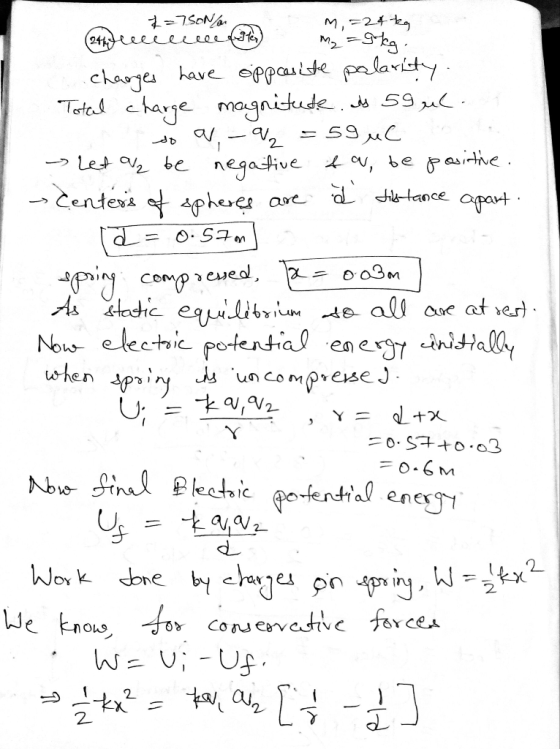
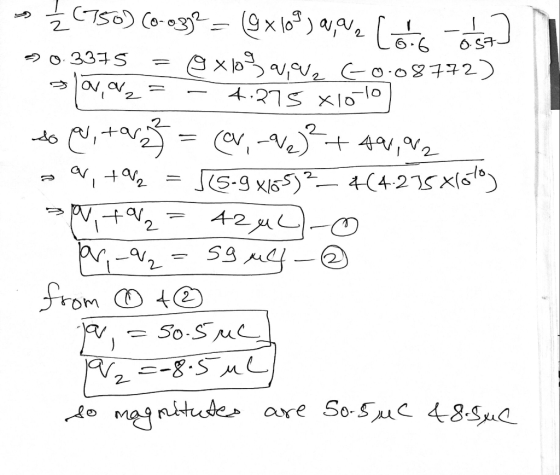
Here we apply work energy theorem and conservative force definition.
Add Answer to:
Two charged spheres on a frictionless horizontal surface are
attached to opposite ends of a 750...
A charged sphere in static equilibrium is resting on a horizontal surface. Directly above it is...
 A charged sphere in static
equilibrium is resting on a horizontal surface. Directly above it
is another charged sphere (also in static equilibrium) that is
hanging from a 2,250 N/m spring. The 2 kg red sphere has more
charge than the 3 kg green sphere. The total charge magnitude on
the spheres is 81 µC & they have opposite polarity. As a result
the normal force on the red sphere is 4 N & the centers of the
spheres are...
A charged sphere in static
equilibrium is resting on a horizontal surface. Directly above it
is another charged sphere (also in static equilibrium) that is
hanging from a 2,250 N/m spring. The 2 kg red sphere has more
charge than the 3 kg green sphere. The total charge magnitude on
the spheres is 81 µC & they have opposite polarity. As a result
the normal force on the red sphere is 4 N & the centers of the
spheres are...
A charged sphere in static equilibrium is resting on a horizontal surface. Directly above it is...
 A
charged sphere in static equilibrium is resting on a horizontal
surface. Directly above it is another charged sphere (also in
static equilibrium) that is hanging from a 12 N/m spring. The 34 kg
red sphere has more charge than the 1 kg green sphere. The total
charge magnitude on the spheres is 26 µC & they have the same
polarity. As a result the spring is stretched 0.25 m & the
centers of the spheres are 0.32 m apart....
A
charged sphere in static equilibrium is resting on a horizontal
surface. Directly above it is another charged sphere (also in
static equilibrium) that is hanging from a 12 N/m spring. The 34 kg
red sphere has more charge than the 1 kg green sphere. The total
charge magnitude on the spheres is 26 µC & they have the same
polarity. As a result the spring is stretched 0.25 m & the
centers of the spheres are 0.32 m apart....
A charged sphere in static equilibrium is resting on a horizontal surface. Directly above it is...
A charged sphere in static equilibrium is resting on a horizontal surface. Directly above it is another charged sphere (also in static equilibrium) that is hanging from a string. The 34 kg red sphere has more charge than the 31 kg green sphere. The total charge magnitude on the spheres is 65 µC & they have opposite polarity. As a result, the tension is 322 N & the centers of the spheres are 0.69 m apart. Determine the charge magnitude...
A charged sphere in static equilibrium is resting on a horizontal surface. Directly above it is...
 A charged sphere in static equilibrium is resting on a
horizontal surface. Directly above it is another charged sphere
(also in static equilibrium) that is hanging from a 9,000 N/m
spring. The 36 kg red sphere has more charge than the 49 kg green
sphere. The total charge magnitude on the spheres is 248 µC &
they have the same polarity. As a result the spring is stretched
0.02 m& the centers of the spheres are 0.66 m
apart. Determine...
A charged sphere in static equilibrium is resting on a
horizontal surface. Directly above it is another charged sphere
(also in static equilibrium) that is hanging from a 9,000 N/m
spring. The 36 kg red sphere has more charge than the 49 kg green
sphere. The total charge magnitude on the spheres is 248 µC &
they have the same polarity. As a result the spring is stretched
0.02 m& the centers of the spheres are 0.66 m
apart. Determine...
1. Two uniformly charged spheres are attached to frictionless pucks on an air table. The charge...
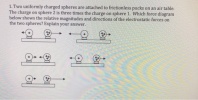 1. Two uniformly charged spheres are attached to frictionless pucks on an air table. The charge on sphere 2 is three times the charge on sphere 1. Which force diagram below shows the relative magnitudes and directions of the electrostatic forces on the two spheres? Explain your answer.
A block with mass 0.400 kg is on a horizontal frictionless surface and is attached to...
A block with mass 0.400 kg is on a horizontal frictionless surface and is attached to a horizontal compressed spring that has force constant k=200 N/m. The other end of the spring is attached to a wall. The block is released, and it moves back and forth on the end of the spring. During this motion the block has speed 3.00 m/s when the spring is stretched 0.160 m. (a) During the motion of the block, what is its maximum...
0.1m There are two charged spheres sitting on insulating bases on a frictionless surface. The -3...
 0.1m There are two charged spheres sitting on insulating bases on a frictionless surface. The -3 bases are identical and have a mass of 0.5x10 kg. The larger sphere has a mass of 2x10 x10 kg and a charge of+0.2 micro-coulombs. The smaller sphere has a mass of 1 kg and a charge of + 0.1 micro-coulombs. A) Draw a free body diagram of each sphere. Label each force and make certain that all force vectors are drawn to appropriate...
A positive charge q1 = 2.90 μc on a frictionless horizontal surface is attached to a...
 A positive charge q1 = 2.90 μc on a frictionless horizontal surface is attached to a spring of force constant k as in the figure shown below. when a charge of q2 =-9.100 μC is placed 9.50 cm away from the positive charge, the spring stretches by 5.00 mm, reducing the distance between charges to d = 9.00 cm. Find the value of k. The response you submitted has the wrong sign. N/m 1 42
A 4.86 kg block free to move on a horizontal, frictionless surface is attached to one...
A 4.86 kg block free to move on a horizontal, frictionless surface is attached to one end of a light horizontal spring. The other end of the spring is fixed. The spring is compressed 0.104 m from equilibrium and is then released. The speed of the block is 1.01 m/s when it passes the equilibrium position of the spring. The same experiment is now repeated with the frictionless surface replaced by a surface for which $\mu$k = 0.275. Determine the...
A mass of 9 kg is placed on a horizontal frictionless surface and attached to a...
A mass of 9 kg is placed on a horizontal frictionless surface and attached to a spring. The mass is compressed 0.69 meters on the spring from equilibrium and held still. It is then released and it travels across the horizontal surface, around a frictionless quarter circular ramp, and it is launched into the air vertically and reaches a maximum height of 6 meters above the ground. The same mass is then attached to the same spring and hung vertically...
 A charged sphere in static
equilibrium is resting on a horizontal surface. Directly above it
is another charged sphere (also in static equilibrium) that is
hanging from a 2,250 N/m spring. The 2 kg red sphere has more
charge than the 3 kg green sphere. The total charge magnitude on
the spheres is 81 µC & they have opposite polarity. As a result
the normal force on the red sphere is 4 N & the centers of the
spheres are...
A charged sphere in static
equilibrium is resting on a horizontal surface. Directly above it
is another charged sphere (also in static equilibrium) that is
hanging from a 2,250 N/m spring. The 2 kg red sphere has more
charge than the 3 kg green sphere. The total charge magnitude on
the spheres is 81 µC & they have opposite polarity. As a result
the normal force on the red sphere is 4 N & the centers of the
spheres are...
 A
charged sphere in static equilibrium is resting on a horizontal
surface. Directly above it is another charged sphere (also in
static equilibrium) that is hanging from a 12 N/m spring. The 34 kg
red sphere has more charge than the 1 kg green sphere. The total
charge magnitude on the spheres is 26 µC & they have the same
polarity. As a result the spring is stretched 0.25 m & the
centers of the spheres are 0.32 m apart....
A
charged sphere in static equilibrium is resting on a horizontal
surface. Directly above it is another charged sphere (also in
static equilibrium) that is hanging from a 12 N/m spring. The 34 kg
red sphere has more charge than the 1 kg green sphere. The total
charge magnitude on the spheres is 26 µC & they have the same
polarity. As a result the spring is stretched 0.25 m & the
centers of the spheres are 0.32 m apart....
 A charged sphere in static equilibrium is resting on a
horizontal surface. Directly above it is another charged sphere
(also in static equilibrium) that is hanging from a 9,000 N/m
spring. The 36 kg red sphere has more charge than the 49 kg green
sphere. The total charge magnitude on the spheres is 248 µC &
they have the same polarity. As a result the spring is stretched
0.02 m& the centers of the spheres are 0.66 m
apart. Determine...
A charged sphere in static equilibrium is resting on a
horizontal surface. Directly above it is another charged sphere
(also in static equilibrium) that is hanging from a 9,000 N/m
spring. The 36 kg red sphere has more charge than the 49 kg green
sphere. The total charge magnitude on the spheres is 248 µC &
they have the same polarity. As a result the spring is stretched
0.02 m& the centers of the spheres are 0.66 m
apart. Determine...
 1. Two uniformly charged spheres are attached to frictionless pucks on an air table. The charge on sphere 2 is three times the charge on sphere 1. Which force diagram below shows the relative magnitudes and directions of the electrostatic forces on the two spheres? Explain your answer.
 0.1m There are two charged spheres sitting on insulating bases on a frictionless surface. The -3 bases are identical and have a mass of 0.5x10 kg. The larger sphere has a mass of 2x10 x10 kg and a charge of+0.2 micro-coulombs. The smaller sphere has a mass of 1 kg and a charge of + 0.1 micro-coulombs. A) Draw a free body diagram of each sphere. Label each force and make certain that all force vectors are drawn to appropriate...
 A positive charge q1 = 2.90 μc on a frictionless horizontal surface is attached to a spring of force constant k as in the figure shown below. when a charge of q2 =-9.100 μC is placed 9.50 cm away from the positive charge, the spring stretches by 5.00 mm, reducing the distance between charges to d = 9.00 cm. Find the value of k. The response you submitted has the wrong sign. N/m 1 42
Most questions answered within 3 hours.
-
Where is the error in this code sequence?
String s1 = "Hello";
String s2 = "ello";...
asked 10 months ago -
Financial data for Joel de Paris, Inc., for last year
follow:
Joel de Paris, Inc.
Balance...
asked 10 months ago -
Consider this reaction:
Al2(SO4)3 (aq)+ BaCl3
(aq) Al2Cl6 (aq)- +
3BaSO4(s) . What is the...
asked 10 months ago -
Suppose that Savneet is considering increasing her
recent random sample from 20 car rentals to 40...
asked 10 months ago -
Trucks arrive at an unloading terminal at an average rate of 120
per hour.
Trucks arrive...
asked 10 months ago -
Why are methanol and ethanol completely soluble in water while
octanol is not very little soluble....
asked 10 months ago -
A facilities manager at a university reads in a research report
that the mean amount of...
asked 10 months ago -
When the CuSO4 is rehydrated by adding water to the anhydrous
compound, is this an endothermic...
asked 10 months ago -
A ray of sunlight is passing from diamond into crown glass; the
angle of incidence is...
asked 10 months ago -
A block of mass 0.249 kg is placed on top of a light, vertical
spring of...
asked 10 months ago -
how do the kidneys compensate in the presences of acidosis
a) trigger hyperventilate
b) reserve acid...
asked 10 months ago -
Question 501 pts
The rental rate of capital to the firm increases. Which of the
following...
asked 10 months ago