
Homework Answers
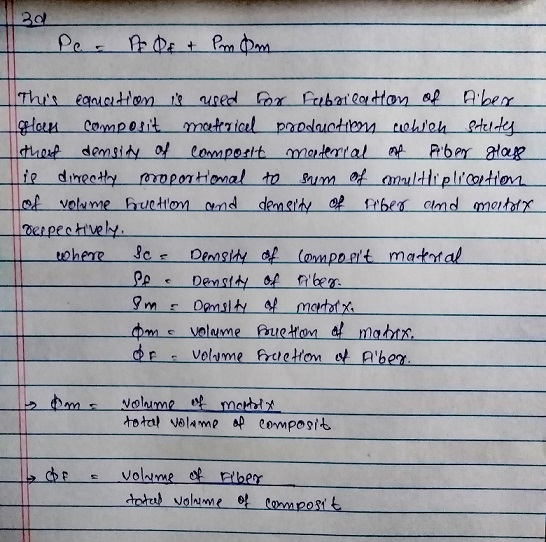
Ans 3a
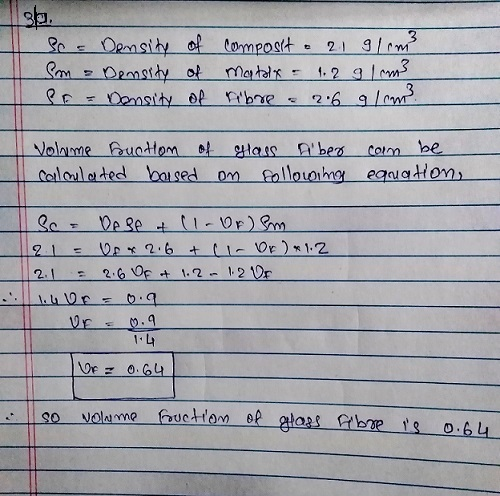
Ans 3b
Add Answer to:
3a. Give the name and significance of the equation below and define all the terms used....
Q3: According to your textbook, what is the coefficient of viscosity for water at 100°C? Give...
Q3: According to your textbook, what is the coefficient of viscosity for water at 100°C? Give your answer in terms of Pa·s. Q4: A tensile test uses a test specimen that has a gage length of 50 mm and an area = 211 mm2. During the test, the specimen yields under a load of 95,191 N. The corresponding gage length = 50.24 mm - this is at the 0.2 percent yield point. The maximum load of 160,342 N is reached...
You can choose between fibres with critical fibre lengths of 0.4, 0.8, or 1.2 mm, all...
 You can choose between fibres with critical fibre lengths of 0.4, 0.8, or 1.2 mm, all of which have the same strength and stiffness. Which fibre should you choose to achieve the strongest and stiffest composite? Explain your choice. (4 marks) 15.) designing a composite using short glass fibres and an epoxy resin. You are Page 4 of 11 Mid-year Examinations, 2018 PROD111-18S1 (C) 16.) Define specific heat and thermal conductivity. Why are those two properties important for the perception...
Ur thhe spécific for shear, u, and the specific heat of the material. Hence, temperature risc ene...
 ur thhe spécific for shear, u, and the specific heat of the material. Hence, temperature risc ene machining materials with high strengt cates. The temperature rise at the tool-chip interface is, of course, also a fiu cocfficient of friction. Flank wear (see Section 8.3 and Fig. 8.20a) isction of source of heat, caused by rubbing of the tool on the machined surface. those of the workpiece. generated in the shear plane is a functioll UI material. Hence, temperature rise is...
 You can choose between fibres with critical fibre lengths of 0.4, 0.8, or 1.2 mm, all of which have the same strength and stiffness. Which fibre should you choose to achieve the strongest and stiffest composite? Explain your choice. (4 marks) 15.) designing a composite using short glass fibres and an epoxy resin. You are Page 4 of 11 Mid-year Examinations, 2018 PROD111-18S1 (C) 16.) Define specific heat and thermal conductivity. Why are those two properties important for the perception...
 ur thhe spécific for shear, u, and the specific heat of the material. Hence, temperature risc ene machining materials with high strengt cates. The temperature rise at the tool-chip interface is, of course, also a fiu cocfficient of friction. Flank wear (see Section 8.3 and Fig. 8.20a) isction of source of heat, caused by rubbing of the tool on the machined surface. those of the workpiece. generated in the shear plane is a functioll UI material. Hence, temperature rise is...
Most questions answered within 3 hours.
-
Where is the error in this code sequence?
String s1 = "Hello";
String s2 = "ello";...
asked 11 months ago -
Financial data for Joel de Paris, Inc., for last year
follow:
Joel de Paris, Inc.
Balance...
asked 11 months ago -
Consider this reaction:
Al2(SO4)3 (aq)+ BaCl3
(aq) Al2Cl6 (aq)- +
3BaSO4(s) . What is the...
asked 11 months ago -
Suppose that Savneet is considering increasing her
recent random sample from 20 car rentals to 40...
asked 11 months ago -
Trucks arrive at an unloading terminal at an average rate of 120
per hour.
Trucks arrive...
asked 11 months ago -
Why are methanol and ethanol completely soluble in water while
octanol is not very little soluble....
asked 11 months ago -
A facilities manager at a university reads in a research report
that the mean amount of...
asked 11 months ago -
When the CuSO4 is rehydrated by adding water to the anhydrous
compound, is this an endothermic...
asked 11 months ago -
A ray of sunlight is passing from diamond into crown glass; the
angle of incidence is...
asked 11 months ago -
A block of mass 0.249 kg is placed on top of a light, vertical
spring of...
asked 11 months ago -
how do the kidneys compensate in the presences of acidosis
a) trigger hyperventilate
b) reserve acid...
asked 11 months ago -
Question 501 pts
The rental rate of capital to the firm increases. Which of the
following...
asked 11 months ago