
Homework Answers
![At equilibrium :- concentration of [D] given = 8.4 m. Thus, at my time t, equilibrium is achieved. The concentration of CO] i](http://img.homeworklib.com/questions/16804070-af82-11ea-a074-8354a5c79369.png?x-oss-process=image/resize,w_560)
![for the given imaginary reaction :- Keq = [C] [D] 3 [n] 4 [B]2 Putting value of concentrations of A, B, C $ $ after equilibr](http://img.homeworklib.com/questions/1711c520-af82-11ea-877a-0fa983de410e.png?x-oss-process=image/resize,w_560)
Add Answer to:
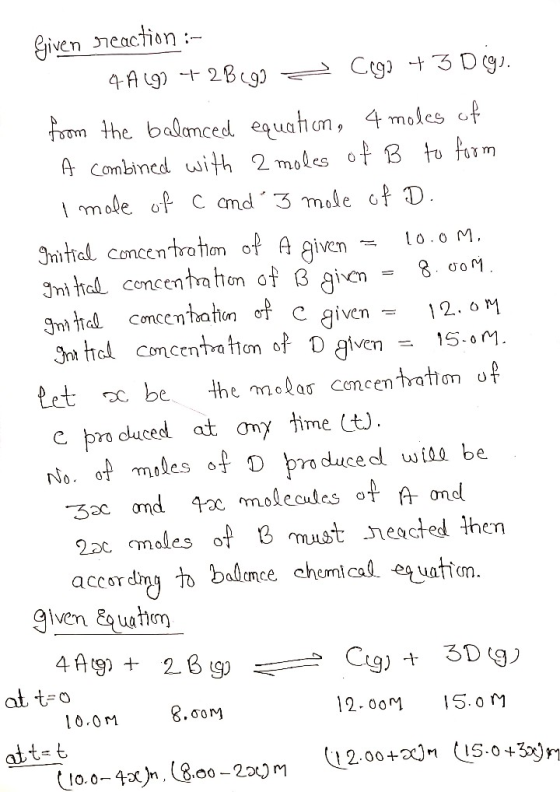
7. Consider the reaction: 4A(g) + 2B(g) + C(g) + 3D(g) The reaction is prepared by...
Consider the reaction: AC(g)+2B(g) ↔ AB2 (g) + C(g) ΔH=+56.9kJ The system is sitting at equilibrium. Describe...
Consider the reaction: AC(g)+2B(g) ↔ AB2 (g) + C(g) ΔH=+56.9kJ The system is sitting at equilibrium. Describe what will happen when each of the following stresses are applied. A)The K for the reaction will lower. B)The K for the reaction will get larger. C)The K for the reaction will not change. 1)B is selectively removed from the reaction vessel. A)The K for the reaction will lower. B)The K for the reaction will get larger. C)The K for the reaction will not...
Consider the following reaction 2 H2S(g) ⇌ 2 H2(g) + S2(g) with Kc = 1.67 ×10⁻⁷...
Consider the following reaction 2 H2S(g) ⇌ 2 H2(g) + S2(g) with Kc = 1.67 ×10⁻⁷ If a vessel initially contains 0.050 M H2S(g), what will be the concentration of H2(g) once equilibrium is achieved? A. 0.049 M B. 9.4 ×10⁻⁴ M C. 0.050 M D. 4.7 ×10⁻⁴ M
Consider the following generic reaction: A+2B→C+3D, with ΔH = 111 kJ . Determine the value of...
Consider the following generic reaction: A+2B→C+3D, with ΔH = 111 kJ . Determine the value of ΔH for each of the following related reactions. A. 3A+6B→3C+9D B. C+3D→A+2B C. 1/2C+3/2D→1/2A+B
Consider the following equilibrium. A+2B⇌C+3D If the change in concentration for C is 0.760 M, what...
Consider the following equilibrium. A+2B⇌C+3D If the change in concentration for C is 0.760 M, what will be the corresponding change in concentration (in units of molarity) for D? Round the answer to three significant figures.
Consider the reaction A(g) + 2B(g) ⇌ C(g) at 25 °C. The initial pressures of all...
Consider the reaction A(g) + 2B(g) ⇌ C(g) at 25 °C. The initial pressures of all the gases are 0.100 atm. Once equilibrium has been established, it is found that Pc = 0.140 atm. What is Kp for this reaction at 25 °C. Please explain and/or show the steps.
Consider the following hypothetical reaction: A (g) + 2 B (g) ⇌ 2 C (g) If...
Consider the following hypothetical reaction: A (g) + 2 B (g) ⇌ 2 C (g) If the reaction is at equilibrium and the concentrations of the species at equilibrium are [A] = 0.0752 M, [B] = 0.0834 M, and [C] = 0.0699 M, what is the value of the equilibrium constant (Kc) for the reaction under these conditions?
A particular reaction is represented as A(g) ↔ 2B(g) + C(g). Initially, the concentration of A...
A particular reaction is represented as A(g) ↔ 2B(g) + C(g). Initially, the concentration of A was 1.5 M. The reaction was allowed to reach equilibrium and the concentration of product C was found to be 0.45 M. What is the value of the equilibrium constant?
Consider the following reactions: B(g ) → A(g) ΔH = 27.9 kJ and C(g) → 2B...
Consider the following reactions: B(g ) → A(g) ΔH = 27.9 kJ and C(g) → 2B (g) ΔH = -18.0 kJ A. Calculate ΔH for the reaction 4A(g) →4 B(g) B. Using the two equations given Show how you would arrange the reactions so they add up to the equation 2A (g) → C (g), and then calculate ΔH for 2A (g) → C (g)
Consider the system at 25.0°C A(g) + 2B(g) + C(g) 2D(g) At time zero, only A,...
 Consider the system at 25.0°C A(g) + 2B(g) + C(g) 2D(g) At time zero, only A, B and C are present in a sealed container. The reaction reaches equilibrium 10 minutes after the reaction is initiated. The partial pressures of A, B, C and D are written as Pa, PB, Pc and PD. Pc at 10 min is Pc at 9 min. v Po at 11 min is Po at 12 min. Select Greater than More information required Equal to...
Consider the reaction for the decomposition of hydrogen disulfide: 2H2S(g)⇌2H2(g)+S2(g), Kc = 1.67×10⁻⁷ at 800∘C A...
Consider the reaction for the decomposition of hydrogen disulfide: 2H2S(g)⇌2H2(g)+S2(g), Kc = 1.67×10⁻⁷ at 800∘C A 0.500 L reaction vessel initially contains 0.175 mol of H2S and 6.25×10⁻² mol of H2 at 800∘C. Find the equilibrium concentration of [S2].
 Consider the system at 25.0°C A(g) + 2B(g) + C(g) 2D(g) At time zero, only A, B and C are present in a sealed container. The reaction reaches equilibrium 10 minutes after the reaction is initiated. The partial pressures of A, B, C and D are written as Pa, PB, Pc and PD. Pc at 10 min is Pc at 9 min. v Po at 11 min is Po at 12 min. Select Greater than More information required Equal to...
Most questions answered within 3 hours.
-
Where is the error in this code sequence?
String s1 = "Hello";
String s2 = "ello";...
asked 10 months ago -
Financial data for Joel de Paris, Inc., for last year
follow:
Joel de Paris, Inc.
Balance...
asked 10 months ago -
Consider this reaction:
Al2(SO4)3 (aq)+ BaCl3
(aq) Al2Cl6 (aq)- +
3BaSO4(s) . What is the...
asked 10 months ago -
Suppose that Savneet is considering increasing her
recent random sample from 20 car rentals to 40...
asked 10 months ago -
Trucks arrive at an unloading terminal at an average rate of 120
per hour.
Trucks arrive...
asked 10 months ago -
Why are methanol and ethanol completely soluble in water while
octanol is not very little soluble....
asked 10 months ago -
A facilities manager at a university reads in a research report
that the mean amount of...
asked 10 months ago -
When the CuSO4 is rehydrated by adding water to the anhydrous
compound, is this an endothermic...
asked 10 months ago -
A ray of sunlight is passing from diamond into crown glass; the
angle of incidence is...
asked 10 months ago -
A block of mass 0.249 kg is placed on top of a light, vertical
spring of...
asked 10 months ago -
how do the kidneys compensate in the presences of acidosis
a) trigger hyperventilate
b) reserve acid...
asked 10 months ago -
Question 501 pts
The rental rate of capital to the firm increases. Which of the
following...
asked 10 months ago