
Homework Answers
F = ma
For constant force,
Acceleration is inversely proportional to mass,
So acceleration of mass M is twice as that of 2M
Using 2md equation of motion
d = 0.5 at^2
For same value of time, distance is directly proportional to Acceleration produced
dM = 2 d2M ... (i)
Also, dM + d2M = 6
From (i)
3 d2M = 6
d2M = 2 m
Ordinate of this point becomes = (-3+2) = - 1 m
Option (3) is correct.
======
Comment in case any doubt.. Goodluck
Add Answer to:
A large skinny guy with mass 2M and a smaller guy with mass M are holding...
You are standing on a large sheet of frictionless ice and are holding a large rock....
You are standing on a large sheet of frictionless ice and are holding a large rock. In order to get off the ice, you throw the rock so it has velocity relative to the earth of 12.4 m/s at an angle of 34.0 ? above the horizontal. If your mass is 74.0 kg and the rock's mass is 14.7 kg , what is your speed after you throw the rock?
A guy of mass m is wakeboarding behind a boat with mass mp. The cord that is being used to tow hi...
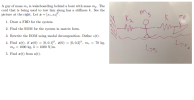 A guy of mass m is wakeboarding behind a boat with mass mp. The cord that is being used to tow him along has a stiffness k. See the picture at the right. Let z = [z1,T2P. 1. Draw a FBD for the system. 2. Find the EOM for the system in matrix form 3. Rewrite the EOM using modal decomposition. Define s(t) 4. Find 8(t), if x(0) [0, 0.1]T, ż(0) = [0, 0.2]T, m, = 70 kg, mp 1000...
Q16:- A small cbject of mass m is suspended from a sting of length 2m. The...
 Q16:- A small cbject of mass m is suspended from a sting of length 2m. The object revolves with constant speed v in a horizontal circle of radius r When 4, The speed of the object in ms-1 (A) 4.60 (B) 5.32 (C)5.95 (D) 2.66 (E) 3.76 17If it takes 4.00 J of work to stretch a Hooke's-law spring 10.0 cm from its unstressed ength, determise the extra work required to stretch it an additional 4.0 cm. (A)6, 24) (B)7....
(7 points) A package of mass 2m is released from rest at a warehouse loading dock...
 (7 points) A package of mass 2m is released from rest at a warehouse loading dock at height h and slides down a frictionless chute. Unfortunately, the previous package (of mass m) was not removed, from the bottom of the chute. a) (1 point) What is the potential energy of the package (of mass 2m) at the top of the chute (relative to the dashed line)? 2m b) (I point) What is the speed V of the package of mass...
A figure skater is spinning on frictionless ice. Treat the figure skater as a sphere with...
A figure skater is spinning on frictionless ice. Treat the figure skater as a sphere with radius R=.4m and mass M=60kg. The skater is holding onto a massless string attached to a weighted ball of m=10kg. The skater is initially spinning at an angular speed w0 of 2pi radians per second (1 rev/s) with a sting radius of r=1m. Moment of inertia for a sphere is I=(2/5)MR^2. 1.) What is the initial total rotational inertia of the skater and ball?...
? 2M 3.M An object of mass 3M, moving in the +x direction at speed Do,...
 ? 2M 3.M An object of mass 3M, moving in the +x direction at speed Do, breaks into two pieces of mass M and 2M as shown in the figure If 0, = 66.0 and 02 = 23.0", determine the final velocities 1, and v, of the resulting pieces in terms of . DI DO Do
(20%) Problem 5: Consider a large crane holding a car of mass M = 1100 kg...
 (20%) Problem 5: Consider a large crane holding a car of mass M = 1100 kg as shown in the figure. The cable is L=9.8 m long and has a density of g = 1.1 kg/m. It is a very breezy day and the cable starts to vibrate in the wind. 33% Part (a) Give an expression for the fundamental frequency of the cable's vibration. Grade Summary Deductions 0% Potential 100% 1 f 2LV ? р Mg PL VI Submissions...
A block of mass 2m is intially at rest on a rough inclined plane where ?...
 A block of mass 2m is intially at rest on a rough inclined plane
where ? < 30 and is connected to an object with mass m as shown.
the rope may be considerd massless, and the pulley may be considerd
frictionless . the cofficient of static friction between the block
and the plabe is us and the cofficient of kinetic
friction between the block and the plane is uk.
1. What is the magnitude of the static frictional force...
A block of mass 2m is intially at rest on a rough inclined plane
where ? < 30 and is connected to an object with mass m as shown.
the rope may be considerd massless, and the pulley may be considerd
frictionless . the cofficient of static friction between the block
and the plabe is us and the cofficient of kinetic
friction between the block and the plane is uk.
1. What is the magnitude of the static frictional force...
ELECTRODYNAMICS (SEE CONSERVATION LAWS AND RELATIVITY CHAPTERS IN GRIFFITHS). 9- A large ball with mass M...
 ELECTRODYNAMICS (SEE CONSERVATION LAWS AND RELATIVITY
CHAPTERS IN GRIFFITHS).
9- A large ball with mass M is originally at rest. To set the ball in motion we make smaller balls inellastical collide with the M ball. The smaller balls stick in M. There's a point in which we have thrown n smaller balls. Thus, the Mass of the bigger ball is now Mn, having velocity vn. vww 1, Derive a formula for the 4 vector momentum. (hint: conservation laws) 2...
ELECTRODYNAMICS (SEE CONSERVATION LAWS AND RELATIVITY
CHAPTERS IN GRIFFITHS).
9- A large ball with mass M is originally at rest. To set the ball in motion we make smaller balls inellastical collide with the M ball. The smaller balls stick in M. There's a point in which we have thrown n smaller balls. Thus, the Mass of the bigger ball is now Mn, having velocity vn. vww 1, Derive a formula for the 4 vector momentum. (hint: conservation laws) 2...
(Figure 1)Block 1. of mass m = 0.700 kg. is connected over an ideal (massless and frictionless) pulley to block 2 of mass m2
 (Figure 1)Block 1. of mass m = 0.700 kg. is connected over an ideal (massless and frictionless) pulley to block 2 of mass m2, as shown For an angle of θ =30.0° and a coefficient of kinetic friction between block 2 and the plane of a = 0.350, an acceleration of magnitude α = 0 200 m/s2 is observed for block 2.
 A guy of mass m is wakeboarding behind a boat with mass mp. The cord that is being used to tow him along has a stiffness k. See the picture at the right. Let z = [z1,T2P. 1. Draw a FBD for the system. 2. Find the EOM for the system in matrix form 3. Rewrite the EOM using modal decomposition. Define s(t) 4. Find 8(t), if x(0) [0, 0.1]T, ż(0) = [0, 0.2]T, m, = 70 kg, mp 1000...
 Q16:- A small cbject of mass m is suspended from a sting of length 2m. The object revolves with constant speed v in a horizontal circle of radius r When 4, The speed of the object in ms-1 (A) 4.60 (B) 5.32 (C)5.95 (D) 2.66 (E) 3.76 17If it takes 4.00 J of work to stretch a Hooke's-law spring 10.0 cm from its unstressed ength, determise the extra work required to stretch it an additional 4.0 cm. (A)6, 24) (B)7....
 (7 points) A package of mass 2m is released from rest at a warehouse loading dock at height h and slides down a frictionless chute. Unfortunately, the previous package (of mass m) was not removed, from the bottom of the chute. a) (1 point) What is the potential energy of the package (of mass 2m) at the top of the chute (relative to the dashed line)? 2m b) (I point) What is the speed V of the package of mass...
 ? 2M 3.M An object of mass 3M, moving in the +x direction at speed Do, breaks into two pieces of mass M and 2M as shown in the figure If 0, = 66.0 and 02 = 23.0", determine the final velocities 1, and v, of the resulting pieces in terms of . DI DO Do
 (20%) Problem 5: Consider a large crane holding a car of mass M = 1100 kg as shown in the figure. The cable is L=9.8 m long and has a density of g = 1.1 kg/m. It is a very breezy day and the cable starts to vibrate in the wind. 33% Part (a) Give an expression for the fundamental frequency of the cable's vibration. Grade Summary Deductions 0% Potential 100% 1 f 2LV ? р Mg PL VI Submissions...
 A block of mass 2m is intially at rest on a rough inclined plane
where ? < 30 and is connected to an object with mass m as shown.
the rope may be considerd massless, and the pulley may be considerd
frictionless . the cofficient of static friction between the block
and the plabe is us and the cofficient of kinetic
friction between the block and the plane is uk.
1. What is the magnitude of the static frictional force...
A block of mass 2m is intially at rest on a rough inclined plane
where ? < 30 and is connected to an object with mass m as shown.
the rope may be considerd massless, and the pulley may be considerd
frictionless . the cofficient of static friction between the block
and the plabe is us and the cofficient of kinetic
friction between the block and the plane is uk.
1. What is the magnitude of the static frictional force...
 ELECTRODYNAMICS (SEE CONSERVATION LAWS AND RELATIVITY
CHAPTERS IN GRIFFITHS).
9- A large ball with mass M is originally at rest. To set the ball in motion we make smaller balls inellastical collide with the M ball. The smaller balls stick in M. There's a point in which we have thrown n smaller balls. Thus, the Mass of the bigger ball is now Mn, having velocity vn. vww 1, Derive a formula for the 4 vector momentum. (hint: conservation laws) 2...
ELECTRODYNAMICS (SEE CONSERVATION LAWS AND RELATIVITY
CHAPTERS IN GRIFFITHS).
9- A large ball with mass M is originally at rest. To set the ball in motion we make smaller balls inellastical collide with the M ball. The smaller balls stick in M. There's a point in which we have thrown n smaller balls. Thus, the Mass of the bigger ball is now Mn, having velocity vn. vww 1, Derive a formula for the 4 vector momentum. (hint: conservation laws) 2...
Most questions answered within 3 hours.
-
Where is the error in this code sequence?
String s1 = "Hello";
String s2 = "ello";...
asked 10 months ago -
Financial data for Joel de Paris, Inc., for last year
follow:
Joel de Paris, Inc.
Balance...
asked 10 months ago -
Consider this reaction:
Al2(SO4)3 (aq)+ BaCl3
(aq) Al2Cl6 (aq)- +
3BaSO4(s) . What is the...
asked 10 months ago -
Suppose that Savneet is considering increasing her
recent random sample from 20 car rentals to 40...
asked 10 months ago -
Trucks arrive at an unloading terminal at an average rate of 120
per hour.
Trucks arrive...
asked 10 months ago -
Why are methanol and ethanol completely soluble in water while
octanol is not very little soluble....
asked 10 months ago -
A facilities manager at a university reads in a research report
that the mean amount of...
asked 10 months ago -
When the CuSO4 is rehydrated by adding water to the anhydrous
compound, is this an endothermic...
asked 10 months ago -
A ray of sunlight is passing from diamond into crown glass; the
angle of incidence is...
asked 10 months ago -
A block of mass 0.249 kg is placed on top of a light, vertical
spring of...
asked 10 months ago -
how do the kidneys compensate in the presences of acidosis
a) trigger hyperventilate
b) reserve acid...
asked 10 months ago -
Question 501 pts
The rental rate of capital to the firm increases. Which of the
following...
asked 10 months ago