
Homework Answers
So to accomplish this task we can follow below algorithm :
- sort the skies_list
- get the max height from the person_list
- get the index of the min abs_diff of skies_list values with this max_height of person
- assign the value at this index as max_skie_height.
- create a new list with skie_heights <= max_skie_height.
- if there are not sufficient skies with height <= max_skie_height then we have to include the skies with height more than the max_skie_height until the length of new list is equal to the person list.
- then sort both the lists , person and new_skies in descending order.
- generate a new list with abs difference values of person and new_skies at ith index.
- return the sum of this list.
the code for the same is attached below :
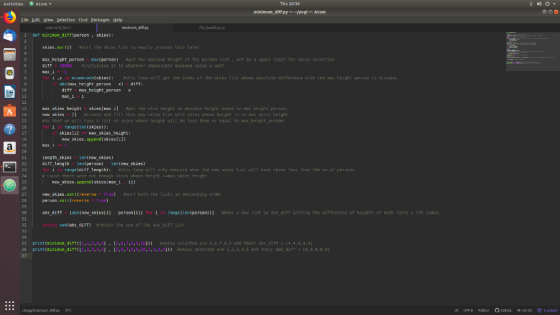
 text
code :
text
code :
def minimum_diff(person , skies):
skies.sort() #sort the skies list to easily process this later
max_height_person =
max(person) #get the maximum height of the person list
, act as a upper limit for skies selection .
diff = 10000 #initialise it to
whatever impossible maximum value u want.
max_i = -1
for i ,x in enumerate(skies):
#this loop will get the index of the skies list whose absolute
difference with the max_height_person is minimum.
if abs(max_height_person
- x) < diff:
diff = max_height_person - x
max_i = i
max_skies_height =
skies[max_i] #get the skie height as maximum height
based on max_height_person.
new_skies = [] #create and fill this
new skies list with skies whose height is <=
max_skies_height.
#So that we will have a list of skies whose
height will be less than or eqaul to max_height_person.
for i in range(len(skies)):
if skies[i] <=
max_skies_height:
new_skies.append(skies[i])
max_i += 1
length_skies = len(new_skies)
diff_length = len(person) - len(new_skies)
for i in range(diff_length): #this
loop will only execute when the new_skies list will have skies less
than the no of persons
# cause there were not enough skies whose height
<=max_skies_height
new_skies.append(skies[max_i + i])
new_skies.sort(reverse =
True) #sort both the lists in descending order
person.sort(reverse = True)
abs_diff = [abs(new_skies[i] - person[i]) for i in range(len(person))] #make a new list as abs_diff getting the difference of heights of both lists's ith index.
return sum(abs_diff) #return the sum of ths abs_diff list.
print(minimum_diff([1,2,3,4,5] ,
[5,8,7,6,9,10])) #skies selected are 5,6,7,8,9 and
their abs_diff = [4,4,4,4,4]
print(minimum_diff([1,2,3,4,5] , [5,8,7,6,9,10,1,2,3,4])) #skies
selected are 1,2,3,4,5 and their abs_diff =
[0,0,0,0,0]
Add Answer to:
3. Skiers go fastest with skis whose length is about their height. Your team consists ofn...
Most questions answered within 3 hours.
-
Where is the error in this code sequence?
String s1 = "Hello";
String s2 = "ello";...
asked 10 months ago -
Financial data for Joel de Paris, Inc., for last year
follow:
Joel de Paris, Inc.
Balance...
asked 10 months ago -
Consider this reaction:
Al2(SO4)3 (aq)+ BaCl3
(aq) Al2Cl6 (aq)- +
3BaSO4(s) . What is the...
asked 10 months ago -
Suppose that Savneet is considering increasing her
recent random sample from 20 car rentals to 40...
asked 10 months ago -
Trucks arrive at an unloading terminal at an average rate of 120
per hour.
Trucks arrive...
asked 10 months ago -
Why are methanol and ethanol completely soluble in water while
octanol is not very little soluble....
asked 10 months ago -
A facilities manager at a university reads in a research report
that the mean amount of...
asked 10 months ago -
When the CuSO4 is rehydrated by adding water to the anhydrous
compound, is this an endothermic...
asked 10 months ago -
A ray of sunlight is passing from diamond into crown glass; the
angle of incidence is...
asked 10 months ago -
A block of mass 0.249 kg is placed on top of a light, vertical
spring of...
asked 10 months ago -
how do the kidneys compensate in the presences of acidosis
a) trigger hyperventilate
b) reserve acid...
asked 10 months ago -
Question 501 pts
The rental rate of capital to the firm increases. Which of the
following...
asked 10 months ago