
Homework Answers

Add Answer to:
2. (3 pt) Select the compound that best fits the below data. The two numbered fragments...
3. Below are the MS and IR spectra of Compound A. a. Determine its structure. b....
 3. Below are the MS and IR spectra of Compound A. a. Determine its structure. b. Identify pertinent peaks on the IR. Relative Intensity 25 50 75 125 150 175 100 m/z
110 2. (1 points) The mass spectrum of 2-methyl-3-pentanol is shown below. Identify the fragments. 100- MS-NU-5456...
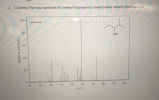 110 2. (1 points) The mass spectrum of 2-methyl-3-pentanol is shown below. Identify the fragments. 100- MS-NU-5456 Relative Intensity 0- t THAT it 20 TH 40 E 60 TITTTTTTTT 100 50 70 m/z
Use the mass spectrum to answer the questions below Does the compound contain chlorine or bromine...
 Use the mass spectrum to answer the questions below
Does the compound contain chlorine or bromine or neither?
Explain.
Give the m/z value for the molecular ion peak.
Give the m/z value for the base peak.
The base peak is a common fragment – what is the most likely
chemical formula for the base peak?
Does the compound contain chlorine or bromine or neither?
Explain.
Give the m/z value for the molecular ion peak.
Give the m/z value for the...
Use the mass spectrum to answer the questions below
Does the compound contain chlorine or bromine or neither?
Explain.
Give the m/z value for the molecular ion peak.
Give the m/z value for the base peak.
The base peak is a common fragment – what is the most likely
chemical formula for the base peak?
Does the compound contain chlorine or bromine or neither?
Explain.
Give the m/z value for the molecular ion peak.
Give the m/z value for the...
Use the data below from an electron impact mass spectrum of a pure compound to deduce...
Use the data below from an electron impact mass spectrum of a pure compound to deduce its structure. Draw your structure. PART 1: m/z relative intensity 52 31 50 100 15 2 PART 2: m/z Relative intensity 17 1.6 16 100 15 89 14 20 13 11
"Label the parent, base, and four daughter ions. Identify the potential lost fragments of at least...
 "Label the parent, base, and four daughter ions. Identify the
potential lost fragments of at least two fragmentations."
Please draw arrows to where the daughter ions are. Thanks!
Label the parent and four daughter ions. Identify the potential lost fragments of at least two fragmentations. bromine 100 - MS2016-05353CMP base Relative Intensity - Bromine 20 - CH₂ CH3 Ontmoet Hom e Parent 50 25 75 125 150 100 m/z
"Label the parent, base, and four daughter ions. Identify the
potential lost fragments of at least two fragmentations."
Please draw arrows to where the daughter ions are. Thanks!
Label the parent and four daughter ions. Identify the potential lost fragments of at least two fragmentations. bromine 100 - MS2016-05353CMP base Relative Intensity - Bromine 20 - CH₂ CH3 Ontmoet Hom e Parent 50 25 75 125 150 100 m/z
5. Given the spectral data below, provide a structure. Note you must assign all of the...
 5. Given the spectral data below, provide a structure. Note you must assign all of the signals in the spectrum below to receive full credit. Also assign any key signals in the IR or MS that assisted you in deriving your answer. (6 pts.) 6H, 3H,d 2Hd 1H, sextet 1Hm PPM Relative Intensity M+ = 164 50 75 125 150 100 m/z
15. The mass spectrum of a compound appears below. The molecular ion, M+1, and M+2 peaks...
 15. The mass spectrum of a compound appears below. The molecular ion, M+1, and M+2 peaks have intensities of 100, 6.8, and 31.8 respectively. Use the information provided to determine the formula of the compound 100 MS-NW-5495 80 60 40 20 шшшl 110 10 20 30 40 50 60 70 80 90 100 m/z Relative Intensity
15. The mass spectrum of a compound appears below. The molecular ion, M+1, and M+2 peaks have intensities of 100, 6.8, and 31.8 respectively....
15. The mass spectrum of a compound appears below. The molecular ion, M+1, and M+2 peaks have intensities of 100, 6.8, and 31.8 respectively. Use the information provided to determine the formula of the compound 100 MS-NW-5495 80 60 40 20 шшшl 110 10 20 30 40 50 60 70 80 90 100 m/z Relative Intensity
15. The mass spectrum of a compound appears below. The molecular ion, M+1, and M+2 peaks have intensities of 100, 6.8, and 31.8 respectively....
Which mechanism best fits the data? Consider the following reaction. 5A+B+3C5D E The following data was...
 Which mechanism best fits the data?
Consider the following reaction. 5A+B+3C5D E The following data was collected on the reaction. Alo [B)o 0.48 0.48 0.96 0.48 Trial 0.3 0.6 0.3 0.30 Clo Rate (M/s) 0.3 0.3 0.3 0.6 8.396 8.396 16.792 16.792 2 4. Two mechanisms are proposed: Mechanism 1: A + B D +Z Mechanism 2: Select an answer Mechanism 1 Mechanism 2 x-A-C Which mechanism best fits the data? Select an answer
Which mechanism best fits the data?
Consider the following reaction. 5A+B+3C5D E The following data was collected on the reaction. Alo [B)o 0.48 0.48 0.96 0.48 Trial 0.3 0.6 0.3 0.30 Clo Rate (M/s) 0.3 0.3 0.3 0.6 8.396 8.396 16.792 16.792 2 4. Two mechanisms are proposed: Mechanism 1: A + B D +Z Mechanism 2: Select an answer Mechanism 1 Mechanism 2 x-A-C Which mechanism best fits the data? Select an answer
5. Given the spectral data below, provide a structure. Note you must assign all of the...
 5. Given the spectral data below, provide a structure. Note you must assign all of the signals in the spectrum below to receive full credit. Also assign any key signals in the IR or MS that assisted you in deriving your answer. (6 pts.) 6H, d 3H, d 2H, d 1H, sextet 1Hm Relative Intensity M+ = 164 50 75 125 150 100 m/z 2000 Wavnumber icm-1)
8. Use the spectral data below to propose structure(s) for the compound labeled Y, which can...
 8. Use the spectral data below to propose structure(s) for the compound labeled Y, which can be identified from the MS, IR, spectra presented below. (2 pts) a) Determine the molecular formula (MF = C.H. e) from the molecular ion on the MS using the Rule 13 where (MW/13) En+r. Since the M+2 peak is approximately 1/3 of the intensity of the molecular peak, this is an indication that the compound contain a cl _atom. Make the necessary substitution for...
 3. Below are the MS and IR spectra of Compound A. a. Determine its structure. b. Identify pertinent peaks on the IR. Relative Intensity 25 50 75 125 150 175 100 m/z
 110 2. (1 points) The mass spectrum of 2-methyl-3-pentanol is shown below. Identify the fragments. 100- MS-NU-5456 Relative Intensity 0- t THAT it 20 TH 40 E 60 TITTTTTTTT 100 50 70 m/z
 Use the mass spectrum to answer the questions below
Does the compound contain chlorine or bromine or neither?
Explain.
Give the m/z value for the molecular ion peak.
Give the m/z value for the base peak.
The base peak is a common fragment – what is the most likely
chemical formula for the base peak?
Does the compound contain chlorine or bromine or neither?
Explain.
Give the m/z value for the molecular ion peak.
Give the m/z value for the...
Use the mass spectrum to answer the questions below
Does the compound contain chlorine or bromine or neither?
Explain.
Give the m/z value for the molecular ion peak.
Give the m/z value for the base peak.
The base peak is a common fragment – what is the most likely
chemical formula for the base peak?
Does the compound contain chlorine or bromine or neither?
Explain.
Give the m/z value for the molecular ion peak.
Give the m/z value for the...
 "Label the parent, base, and four daughter ions. Identify the
potential lost fragments of at least two fragmentations."
Please draw arrows to where the daughter ions are. Thanks!
Label the parent and four daughter ions. Identify the potential lost fragments of at least two fragmentations. bromine 100 - MS2016-05353CMP base Relative Intensity - Bromine 20 - CH₂ CH3 Ontmoet Hom e Parent 50 25 75 125 150 100 m/z
"Label the parent, base, and four daughter ions. Identify the
potential lost fragments of at least two fragmentations."
Please draw arrows to where the daughter ions are. Thanks!
Label the parent and four daughter ions. Identify the potential lost fragments of at least two fragmentations. bromine 100 - MS2016-05353CMP base Relative Intensity - Bromine 20 - CH₂ CH3 Ontmoet Hom e Parent 50 25 75 125 150 100 m/z
 5. Given the spectral data below, provide a structure. Note you must assign all of the signals in the spectrum below to receive full credit. Also assign any key signals in the IR or MS that assisted you in deriving your answer. (6 pts.) 6H, 3H,d 2Hd 1H, sextet 1Hm PPM Relative Intensity M+ = 164 50 75 125 150 100 m/z
 15. The mass spectrum of a compound appears below. The molecular ion, M+1, and M+2 peaks have intensities of 100, 6.8, and 31.8 respectively. Use the information provided to determine the formula of the compound 100 MS-NW-5495 80 60 40 20 шшшl 110 10 20 30 40 50 60 70 80 90 100 m/z Relative Intensity
15. The mass spectrum of a compound appears below. The molecular ion, M+1, and M+2 peaks have intensities of 100, 6.8, and 31.8 respectively....
15. The mass spectrum of a compound appears below. The molecular ion, M+1, and M+2 peaks have intensities of 100, 6.8, and 31.8 respectively. Use the information provided to determine the formula of the compound 100 MS-NW-5495 80 60 40 20 шшшl 110 10 20 30 40 50 60 70 80 90 100 m/z Relative Intensity
15. The mass spectrum of a compound appears below. The molecular ion, M+1, and M+2 peaks have intensities of 100, 6.8, and 31.8 respectively....
 Which mechanism best fits the data?
Consider the following reaction. 5A+B+3C5D E The following data was collected on the reaction. Alo [B)o 0.48 0.48 0.96 0.48 Trial 0.3 0.6 0.3 0.30 Clo Rate (M/s) 0.3 0.3 0.3 0.6 8.396 8.396 16.792 16.792 2 4. Two mechanisms are proposed: Mechanism 1: A + B D +Z Mechanism 2: Select an answer Mechanism 1 Mechanism 2 x-A-C Which mechanism best fits the data? Select an answer
Which mechanism best fits the data?
Consider the following reaction. 5A+B+3C5D E The following data was collected on the reaction. Alo [B)o 0.48 0.48 0.96 0.48 Trial 0.3 0.6 0.3 0.30 Clo Rate (M/s) 0.3 0.3 0.3 0.6 8.396 8.396 16.792 16.792 2 4. Two mechanisms are proposed: Mechanism 1: A + B D +Z Mechanism 2: Select an answer Mechanism 1 Mechanism 2 x-A-C Which mechanism best fits the data? Select an answer
 5. Given the spectral data below, provide a structure. Note you must assign all of the signals in the spectrum below to receive full credit. Also assign any key signals in the IR or MS that assisted you in deriving your answer. (6 pts.) 6H, d 3H, d 2H, d 1H, sextet 1Hm Relative Intensity M+ = 164 50 75 125 150 100 m/z 2000 Wavnumber icm-1)
 8. Use the spectral data below to propose structure(s) for the compound labeled Y, which can be identified from the MS, IR, spectra presented below. (2 pts) a) Determine the molecular formula (MF = C.H. e) from the molecular ion on the MS using the Rule 13 where (MW/13) En+r. Since the M+2 peak is approximately 1/3 of the intensity of the molecular peak, this is an indication that the compound contain a cl _atom. Make the necessary substitution for...
Most questions answered within 3 hours.
-
Where is the error in this code sequence?
String s1 = "Hello";
String s2 = "ello";...
asked 10 months ago -
Financial data for Joel de Paris, Inc., for last year
follow:
Joel de Paris, Inc.
Balance...
asked 10 months ago -
Consider this reaction:
Al2(SO4)3 (aq)+ BaCl3
(aq) Al2Cl6 (aq)- +
3BaSO4(s) . What is the...
asked 10 months ago -
Suppose that Savneet is considering increasing her
recent random sample from 20 car rentals to 40...
asked 10 months ago -
Trucks arrive at an unloading terminal at an average rate of 120
per hour.
Trucks arrive...
asked 10 months ago -
Why are methanol and ethanol completely soluble in water while
octanol is not very little soluble....
asked 10 months ago -
A facilities manager at a university reads in a research report
that the mean amount of...
asked 10 months ago -
When the CuSO4 is rehydrated by adding water to the anhydrous
compound, is this an endothermic...
asked 10 months ago -
A ray of sunlight is passing from diamond into crown glass; the
angle of incidence is...
asked 10 months ago -
A block of mass 0.249 kg is placed on top of a light, vertical
spring of...
asked 10 months ago -
how do the kidneys compensate in the presences of acidosis
a) trigger hyperventilate
b) reserve acid...
asked 10 months ago -
Question 501 pts
The rental rate of capital to the firm increases. Which of the
following...
asked 10 months ago