
Homework Answers
Add Answer to:
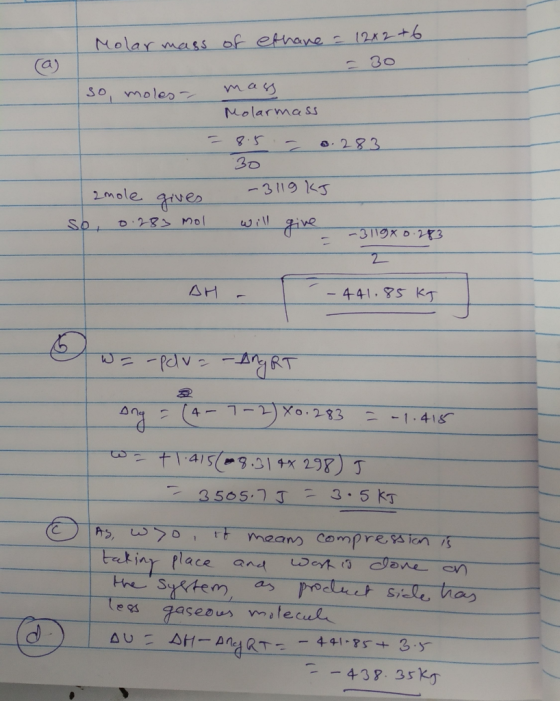
For the following reaction: 2 CH. (g) + 702(g) → 4 CO2 (g) + 6H20 (1)...
1. Given AH (CO2(g)) - -393.5 kJ/mole, AH (CH2(g)) = -146.4 kJ/mole HO )) - -241.8/mote...
 1. Given AH (CO2(g)) - -393.5 kJ/mole, AH (CH2(g)) = -146.4 kJ/mole HO )) - -241.8/mote and AH (a) (10 points) How much heat is evolved if 36.0 g CsHis undergoes combustion at constant pressure? (b) (10 points) What volume of O2(g) is required in the combustion at 25°C and 1.00 atm if 9,818 kJ are evolved?
Consider the following reaction: C(s, diamond) + O2(g) - CO2(g) substance AHF (kJ/mol) C(s, diamond) 2.0...
 Consider the following reaction: C(s, diamond) + O2(g) - CO2(g) substance AHF (kJ/mol) C(s, diamond) 2.0 CO2(g) -393.5 H20(1) -286.0 02(9) 0.0 How much heat is evolved when 1.201x101 g of C(s, diamond) is burned in excess oxygen. Answer to 4 sig figs. Assume standard conditions. Note that, by convention, a decrease in enthalpy of the system will result in a positive quantity of heat being evolved. Submit Answer Incorrect. Tries 7/99 Previous Tries How much heat is evolved when...
1.(3pts) Use the following data to determine the AH.. of 2 CH109) + 13 O2(g) ---> 8 CO2(g) + 10 H2O(1) Data: Sub...
 1.(3pts) Use the following data to determine the AH.. of 2 CH109) + 13 O2(g) ---> 8 CO2(g) + 10 H2O(1) Data: Substance AH(kJ/mol) Substance AH(kJ/mol CzH.(g) CH2OH() C4H10g) CH2(1) H2O(g) CO(g) O2(g) -239.0 -126.15 -156.4 -241.82 -110.53 C:H:(8) CH,OH(g) CsH (8) CH (1) H.O(1) CO2 N (8) -104.0 -2010 -146.44 + 12.0 -285.83 -393.51 0 2.(2pts) If you are given 158,0 g 0_(g) and a sufficient amount of the other reactant, calculate the heat associated with reaction in problem...
i need help on #1 c and d A degreasing agent, tetrachloroethylene, is produced in the reaction CH (g) + 4 HCl(g) +20...
 i need help on #1 c and d
A degreasing agent, tetrachloroethylene, is produced in the reaction CH (g) + 4 HCl(g) +20 (g) → C Cl.(l) + 4H2O(1) rk/mol): 52.26 -9231 0 a) determine AH"for CCl4(1) AHºrn = - 878.5 kJ - 285.8 a) AHⓇ for CC.(I) = -52.28 kJ b) How much heat (kJ) would be eve amounts of HCl and O:)? much heat (kJ) would be evolved when 7.5 kg of C2H4(g) reacts completely (with stoichiometric b)...
i need help on #1 c and d
A degreasing agent, tetrachloroethylene, is produced in the reaction CH (g) + 4 HCl(g) +20 (g) → C Cl.(l) + 4H2O(1) rk/mol): 52.26 -9231 0 a) determine AH"for CCl4(1) AHºrn = - 878.5 kJ - 285.8 a) AHⓇ for CC.(I) = -52.28 kJ b) How much heat (kJ) would be eve amounts of HCl and O:)? much heat (kJ) would be evolved when 7.5 kg of C2H4(g) reacts completely (with stoichiometric b)...
1. A degreasing agent, tetrachloroethylene, is produced in the reaction CH4(g) +4 HCl(g) +2 02(g) →...
 1. A degreasing agent, tetrachloroethylene, is produced in the reaction CH4(g) +4 HCl(g) +2 02(g) → C2C14(1) + 4H2O(1) AH° (kJ/mol): 52.26 -92.31 - 285.8 a) determine AH°for CCl4(1) AH' - 878.5 kJ a) AH° for C,CL(1) = b) How much heat (kJ) would be evolved when 7.5 kg of CH4(g) reacts completely (with stoichiometric amounts of HCl and O2)? b) heat, do = c) Using the equation for work done by/on the system; w=-P AV, calculate the amount of...
Please show work and explain ts19) For the reaction, C, H12(g) + 802(g)5 CO2(g) +6H20), AU-3524...
 Please show work and
explain
ts19) For the reaction, C, H12(g) + 802(g)5 CO2(g) +6H20), AU-3524 kJ at 75°C. What is AH for the reaction? 244-3512 kJ -3518 kJ -3530 kJ -3536 kJ Point out of a
Please show work and
explain
ts19) For the reaction, C, H12(g) + 802(g)5 CO2(g) +6H20), AU-3524 kJ at 75°C. What is AH for the reaction? 244-3512 kJ -3518 kJ -3530 kJ -3536 kJ Point out of a
The combustion reaction for octane burning in oxygen is: 2 C8H18 (1) + 25 O2(g) → 16 CO2(g) +18 H20() AH = -10869 kJ ....
 The combustion reaction for octane burning in oxygen is: 2 C8H18 (1) + 25 O2(g) → 16 CO2(g) +18 H20() AH = -10869 kJ . Suppose an oxygen bomb calorimeter is loaded with oxygen gas and excess octane. The oxygen gas has a volume of 480.0 mL, pressure of 6.35 atm, and an initial temperature of 22.1 °C. The calorimeter has a heat capacity of 1.75 kJ/ °C. Assuming the oxygen reacts completely, what is the final temperature of the...
1.(3pts) Use the following data to determine the AHıxn of 2 C3H12O(l) + 15 O2(g) ---->...
 1.(3pts) Use the following data to determine the AHıxn of 2 C3H12O(l) + 15 O2(g) ----> 10 CO2(g) + 12 H2O(1) Substance AH(kJ/mol) Substance AH(kJ/mol) Data: CzH.(g) CH,OH(1) C.H.0(1) C6H40(1) H2O(g) CO(g) O2(g) 20.9 -239.0 -277.0 -316.0 -241.82 -110.53 C3H2(g) CHOH(9) CH 20(1) CH;60(1) H2O(1) -104.0 -201.0 -298.6 -340.0 -285.83 -393.51 CO2 N (8) 2.(2pts) If you are given 148,0 g O2(g) and a sufficient amount of the other reactant, calculate the heat associated with reaction in problem 1 and...
Heat Evolved During Combustion Consider the following reaction: 2 CO(g) + O2(g) 2 CO2(9) Use standard heats of formatio...
 Heat Evolved During Combustion Consider the following reaction: 2 CO(g) + O2(g) 2 CO2(9) Use standard heats of formation from Zumdahl 'Chemical Principles' 8th ed. Appendix Four pp A19 - A21. How much heat is evolved when 1.071x101 moles of CO(9) is burned in excess oxygen. Answer to 4 sig figs. 1pts Submit Answer Tries 0/5 How much heat is evolved when 1.681x10² g of CO(g) is burned in excess oxygen. Answer to 4 sig figs. 1pts Submit Answer Tries...
The balanced combustion reaction for CH is 2CH.(1) + 15 02(g) — 12 CO2(g) + 6H2O(l)...
 The balanced combustion reaction for CH is 2CH.(1) + 15 02(g) — 12 CO2(g) + 6H2O(l) + 6542 kJ If 6.600 g CH, is burned and the heat produced from the burning is added to 5691 g of water at 21 °C, what is the final temperature of the water?
 1. Given AH (CO2(g)) - -393.5 kJ/mole, AH (CH2(g)) = -146.4 kJ/mole HO )) - -241.8/mote and AH (a) (10 points) How much heat is evolved if 36.0 g CsHis undergoes combustion at constant pressure? (b) (10 points) What volume of O2(g) is required in the combustion at 25°C and 1.00 atm if 9,818 kJ are evolved?
 Consider the following reaction: C(s, diamond) + O2(g) - CO2(g) substance AHF (kJ/mol) C(s, diamond) 2.0 CO2(g) -393.5 H20(1) -286.0 02(9) 0.0 How much heat is evolved when 1.201x101 g of C(s, diamond) is burned in excess oxygen. Answer to 4 sig figs. Assume standard conditions. Note that, by convention, a decrease in enthalpy of the system will result in a positive quantity of heat being evolved. Submit Answer Incorrect. Tries 7/99 Previous Tries How much heat is evolved when...
 1.(3pts) Use the following data to determine the AH.. of 2 CH109) + 13 O2(g) ---> 8 CO2(g) + 10 H2O(1) Data: Substance AH(kJ/mol) Substance AH(kJ/mol CzH.(g) CH2OH() C4H10g) CH2(1) H2O(g) CO(g) O2(g) -239.0 -126.15 -156.4 -241.82 -110.53 C:H:(8) CH,OH(g) CsH (8) CH (1) H.O(1) CO2 N (8) -104.0 -2010 -146.44 + 12.0 -285.83 -393.51 0 2.(2pts) If you are given 158,0 g 0_(g) and a sufficient amount of the other reactant, calculate the heat associated with reaction in problem...
 i need help on #1 c and d
A degreasing agent, tetrachloroethylene, is produced in the reaction CH (g) + 4 HCl(g) +20 (g) → C Cl.(l) + 4H2O(1) rk/mol): 52.26 -9231 0 a) determine AH"for CCl4(1) AHºrn = - 878.5 kJ - 285.8 a) AHⓇ for CC.(I) = -52.28 kJ b) How much heat (kJ) would be eve amounts of HCl and O:)? much heat (kJ) would be evolved when 7.5 kg of C2H4(g) reacts completely (with stoichiometric b)...
i need help on #1 c and d
A degreasing agent, tetrachloroethylene, is produced in the reaction CH (g) + 4 HCl(g) +20 (g) → C Cl.(l) + 4H2O(1) rk/mol): 52.26 -9231 0 a) determine AH"for CCl4(1) AHºrn = - 878.5 kJ - 285.8 a) AHⓇ for CC.(I) = -52.28 kJ b) How much heat (kJ) would be eve amounts of HCl and O:)? much heat (kJ) would be evolved when 7.5 kg of C2H4(g) reacts completely (with stoichiometric b)...
 1. A degreasing agent, tetrachloroethylene, is produced in the reaction CH4(g) +4 HCl(g) +2 02(g) → C2C14(1) + 4H2O(1) AH° (kJ/mol): 52.26 -92.31 - 285.8 a) determine AH°for CCl4(1) AH' - 878.5 kJ a) AH° for C,CL(1) = b) How much heat (kJ) would be evolved when 7.5 kg of CH4(g) reacts completely (with stoichiometric amounts of HCl and O2)? b) heat, do = c) Using the equation for work done by/on the system; w=-P AV, calculate the amount of...
 Please show work and
explain
ts19) For the reaction, C, H12(g) + 802(g)5 CO2(g) +6H20), AU-3524 kJ at 75°C. What is AH for the reaction? 244-3512 kJ -3518 kJ -3530 kJ -3536 kJ Point out of a
Please show work and
explain
ts19) For the reaction, C, H12(g) + 802(g)5 CO2(g) +6H20), AU-3524 kJ at 75°C. What is AH for the reaction? 244-3512 kJ -3518 kJ -3530 kJ -3536 kJ Point out of a
 The combustion reaction for octane burning in oxygen is: 2 C8H18 (1) + 25 O2(g) → 16 CO2(g) +18 H20() AH = -10869 kJ . Suppose an oxygen bomb calorimeter is loaded with oxygen gas and excess octane. The oxygen gas has a volume of 480.0 mL, pressure of 6.35 atm, and an initial temperature of 22.1 °C. The calorimeter has a heat capacity of 1.75 kJ/ °C. Assuming the oxygen reacts completely, what is the final temperature of the...
 1.(3pts) Use the following data to determine the AHıxn of 2 C3H12O(l) + 15 O2(g) ----> 10 CO2(g) + 12 H2O(1) Substance AH(kJ/mol) Substance AH(kJ/mol) Data: CzH.(g) CH,OH(1) C.H.0(1) C6H40(1) H2O(g) CO(g) O2(g) 20.9 -239.0 -277.0 -316.0 -241.82 -110.53 C3H2(g) CHOH(9) CH 20(1) CH;60(1) H2O(1) -104.0 -201.0 -298.6 -340.0 -285.83 -393.51 CO2 N (8) 2.(2pts) If you are given 148,0 g O2(g) and a sufficient amount of the other reactant, calculate the heat associated with reaction in problem 1 and...
 Heat Evolved During Combustion Consider the following reaction: 2 CO(g) + O2(g) 2 CO2(9) Use standard heats of formation from Zumdahl 'Chemical Principles' 8th ed. Appendix Four pp A19 - A21. How much heat is evolved when 1.071x101 moles of CO(9) is burned in excess oxygen. Answer to 4 sig figs. 1pts Submit Answer Tries 0/5 How much heat is evolved when 1.681x10² g of CO(g) is burned in excess oxygen. Answer to 4 sig figs. 1pts Submit Answer Tries...
 The balanced combustion reaction for CH is 2CH.(1) + 15 02(g) — 12 CO2(g) + 6H2O(l) + 6542 kJ If 6.600 g CH, is burned and the heat produced from the burning is added to 5691 g of water at 21 °C, what is the final temperature of the water?
Most questions answered within 3 hours.
-
Where is the error in this code sequence?
String s1 = "Hello";
String s2 = "ello";...
asked 11 months ago -
Financial data for Joel de Paris, Inc., for last year
follow:
Joel de Paris, Inc.
Balance...
asked 11 months ago -
Consider this reaction:
Al2(SO4)3 (aq)+ BaCl3
(aq) Al2Cl6 (aq)- +
3BaSO4(s) . What is the...
asked 11 months ago -
Suppose that Savneet is considering increasing her
recent random sample from 20 car rentals to 40...
asked 11 months ago -
Trucks arrive at an unloading terminal at an average rate of 120
per hour.
Trucks arrive...
asked 11 months ago -
Why are methanol and ethanol completely soluble in water while
octanol is not very little soluble....
asked 11 months ago -
A facilities manager at a university reads in a research report
that the mean amount of...
asked 11 months ago -
When the CuSO4 is rehydrated by adding water to the anhydrous
compound, is this an endothermic...
asked 11 months ago -
A ray of sunlight is passing from diamond into crown glass; the
angle of incidence is...
asked 11 months ago -
A block of mass 0.249 kg is placed on top of a light, vertical
spring of...
asked 11 months ago -
how do the kidneys compensate in the presences of acidosis
a) trigger hyperventilate
b) reserve acid...
asked 11 months ago -
Question 501 pts
The rental rate of capital to the firm increases. Which of the
following...
asked 11 months ago