
Homework Answers
Add Answer to:
1. Given AH (CO2(g)) - -393.5 kJ/mole, AH (CH2(g)) = -146.4 kJ/mole HO )) - -241.8/mote...
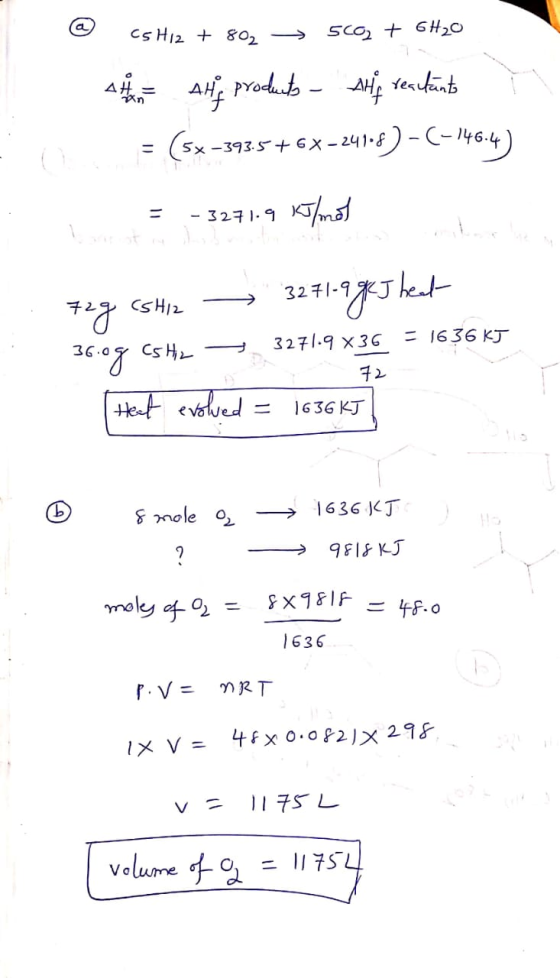
O98% |T-Mobile Wi-Fi 6:00 PM Name art Given AH (C0(g)-393.5 mole, A (CsHg)146.4 kJmole OHO)2418kmole and...
 O98% |T-Mobile Wi-Fi 6:00 PM Name art Given AH (C0(g)-393.5 mole, A (CsHg)146.4 kJmole OHO)2418kmole and 10poin How much heat is evolved if 36.0 g Clto undergoes combustion an (a) constant pressure? (10 points) What volume of O:(g) is required in the combustion at 25°C and 1.00 atm if 9,818 kJ are evolved?
. For the reaction C(s)+O2(g) CO2(g), AH = -393.5 kJ/mol. What is the amount of heat...
 . For the reaction C(s)+O2(g) CO2(g), AH = -393.5 kJ/mol. What is the amount of heat (in kJ) produced during the combustion of 34.56 g of coal (pure carbon)? pec To abiod to yedmun Decide whether each of these reactinns is exothorm
Given the following equations and AH' values: C(s) + O2(g) + CO2(g) AH = -393.5 kJ...
 Given the following equations and AH' values: C(s) + O2(g) + CO2(g) AH = -393.5 kJ H2(g) + 1/2O2(g) - H20 (1) AH = -285.8 kJ 2C2H2 (8) + 5O2(g) + 4CO2(g) + 2H20 (1) AH'= -2598 kJ Determine the heat of reaction (in kJ) at 298 K for the reaction: 2C(s) + H2(8) C2H2 (8) 0-136.8 0-219.8 0-109.9 O-167.1 +226.2
C(s) + O2(g) + CO2(g) AH° = -393.5 kJ (5 pts) Given the following enthalpy values...
 C(s) + O2(g) + CO2(g) AH° = -393.5 kJ (5 pts) Given the following enthalpy values for reactions at 25°C, what is AH at 25°C for the following reaction: C3H3(g) + 502(g) + 4H2O(g) + 3CO2(g) AH = -2043 kJ 3C(s) + 4 H2(g) → C3H8 (g) 2H2(g) + O2(g) + 2H2O(g) AH° = -483.6 kJ
The combustion of lauric acid is given by the following thermochemcial equation: CH3(CH2)10COOH(s) + 18 O2(g)...
 The combustion of lauric acid is given by the following
thermochemcial equation: CH3(CH2)10COOH(s) + 18 O2(g) → 12 H2O(l) +
12 CO2(g) Hcomb is −7377 kJ mol−1 Using the heats of formation
for CO2(g) and H2O(l) calculate the heat of formation (△fH) of
lauric acid. △fH△ CO2(g) = −393.5 kJ mol−1 fH
H2O(l)= −285.8 kJ mol−1
19. The combustion of lauric acid is given by the following thermochemcial equation: CH3(CH2)10COOH(s) + 18 O2(g) → 12 H2O(l) + 12 CO2(g) AH...
The combustion of lauric acid is given by the following
thermochemcial equation: CH3(CH2)10COOH(s) + 18 O2(g) → 12 H2O(l) +
12 CO2(g) Hcomb is −7377 kJ mol−1 Using the heats of formation
for CO2(g) and H2O(l) calculate the heat of formation (△fH) of
lauric acid. △fH△ CO2(g) = −393.5 kJ mol−1 fH
H2O(l)= −285.8 kJ mol−1
19. The combustion of lauric acid is given by the following thermochemcial equation: CH3(CH2)10COOH(s) + 18 O2(g) → 12 H2O(l) + 12 CO2(g) AH...
The standard enthalpy change for the combustion of 1 mole of propane is -2043.0 kJ. CzH3(g)...
 The standard enthalpy change for the combustion of 1 mole of propane is -2043.0 kJ. CzH3(g) + 5 O2(g) + 3 CO2(g) + 4H2O(g) Calculate 4, Hº for propane based on the following standard molar enthalpies of formation. molecule CO2(g) H2O(g) 4,Hº (kJ/mol-rxn) -393.5 -241.8
en 18 What is AH of the following reaction? CO2(g) + 2CH2(g) → C3H5(g) + O2(g) Substance AH,(kJ/mol) CO2(g) -393.5...
 en 18 What is AH of the following reaction? CO2(g) + 2CH2(g) → C3H5(g) + O2(g) Substance AH,(kJ/mol) CO2(g) -393.5 out of -74.9 CH4(g) CH3(g) -104.7 Select one: a. -573.1 kJ O b. 348.4 kJ O a. 438.6 kJ O d. -648.0 kJ -348.4 kJ
Please explain Data: C(graphite) + O2(g) => CO2(g) AH = -393.5 kJ H2(g) + 1/2O2(g) =>...
 Please explain
Data: C(graphite) + O2(g) => CO2(g) AH = -393.5 kJ H2(g) + 1/2O2(g) => H2O(1) AH = -285.8 kJ CH3OH(1) + 3/202(9) A CO2(g) + 2H20(1) AH = -726.4 kJ Using the data above, calculate the enthalpy change for the reaction below. Reaction: C(graphite) + 2H2(g) + 1/2O2(g) => CH3OH(1) A. +238.7 kJ B.-238.7 kJ C. +548.3 kJ D.-548.3 kJ E. +904.5 kJ
Please explain
Data: C(graphite) + O2(g) => CO2(g) AH = -393.5 kJ H2(g) + 1/2O2(g) => H2O(1) AH = -285.8 kJ CH3OH(1) + 3/202(9) A CO2(g) + 2H20(1) AH = -726.4 kJ Using the data above, calculate the enthalpy change for the reaction below. Reaction: C(graphite) + 2H2(g) + 1/2O2(g) => CH3OH(1) A. +238.7 kJ B.-238.7 kJ C. +548.3 kJ D.-548.3 kJ E. +904.5 kJ
The combustion reaction for octane burning in oxygen is: 2 C8H18 (1) + 25 O2(g) → 16 CO2(g) +18 H20() AH = -10869 kJ ....
 The combustion reaction for octane burning in oxygen is: 2 C8H18 (1) + 25 O2(g) → 16 CO2(g) +18 H20() AH = -10869 kJ . Suppose an oxygen bomb calorimeter is loaded with oxygen gas and excess octane. The oxygen gas has a volume of 480.0 mL, pressure of 6.35 atm, and an initial temperature of 22.1 °C. The calorimeter has a heat capacity of 1.75 kJ/ °C. Assuming the oxygen reacts completely, what is the final temperature of the...
7. Consider the following data: C2H6(g) -84.7 32.9 H2O(l) 285.9 -237.2 CO2(g) -393.5 -394.4 Ho kl...
 do
part f
7. Consider the following data: C2H6(g) -84.7 32.9 H2O(l) 285.9 -237.2 CO2(g) -393.5 -394.4 Ho kl/mole) a) Calculate the entropy change for the combustion of 1.0 mole of C,H,(g) at 25°C. b) Are the products more or less ordered than the reactants at 25 c) Is the reaction spontaneous at 25°C? d) Wh at is the maximum amount of useful work which can be obtained from the process at 25°C? e) If the process is carried out...
do
part f
7. Consider the following data: C2H6(g) -84.7 32.9 H2O(l) 285.9 -237.2 CO2(g) -393.5 -394.4 Ho kl/mole) a) Calculate the entropy change for the combustion of 1.0 mole of C,H,(g) at 25°C. b) Are the products more or less ordered than the reactants at 25 c) Is the reaction spontaneous at 25°C? d) Wh at is the maximum amount of useful work which can be obtained from the process at 25°C? e) If the process is carried out...
 O98% |T-Mobile Wi-Fi 6:00 PM Name art Given AH (C0(g)-393.5 mole, A (CsHg)146.4 kJmole OHO)2418kmole and 10poin How much heat is evolved if 36.0 g Clto undergoes combustion an (a) constant pressure? (10 points) What volume of O:(g) is required in the combustion at 25°C and 1.00 atm if 9,818 kJ are evolved?
 . For the reaction C(s)+O2(g) CO2(g), AH = -393.5 kJ/mol. What is the amount of heat (in kJ) produced during the combustion of 34.56 g of coal (pure carbon)? pec To abiod to yedmun Decide whether each of these reactinns is exothorm
 Given the following equations and AH' values: C(s) + O2(g) + CO2(g) AH = -393.5 kJ H2(g) + 1/2O2(g) - H20 (1) AH = -285.8 kJ 2C2H2 (8) + 5O2(g) + 4CO2(g) + 2H20 (1) AH'= -2598 kJ Determine the heat of reaction (in kJ) at 298 K for the reaction: 2C(s) + H2(8) C2H2 (8) 0-136.8 0-219.8 0-109.9 O-167.1 +226.2
 C(s) + O2(g) + CO2(g) AH° = -393.5 kJ (5 pts) Given the following enthalpy values for reactions at 25°C, what is AH at 25°C for the following reaction: C3H3(g) + 502(g) + 4H2O(g) + 3CO2(g) AH = -2043 kJ 3C(s) + 4 H2(g) → C3H8 (g) 2H2(g) + O2(g) + 2H2O(g) AH° = -483.6 kJ
 The combustion of lauric acid is given by the following
thermochemcial equation: CH3(CH2)10COOH(s) + 18 O2(g) → 12 H2O(l) +
12 CO2(g) Hcomb is −7377 kJ mol−1 Using the heats of formation
for CO2(g) and H2O(l) calculate the heat of formation (△fH) of
lauric acid. △fH△ CO2(g) = −393.5 kJ mol−1 fH
H2O(l)= −285.8 kJ mol−1
19. The combustion of lauric acid is given by the following thermochemcial equation: CH3(CH2)10COOH(s) + 18 O2(g) → 12 H2O(l) + 12 CO2(g) AH...
The combustion of lauric acid is given by the following
thermochemcial equation: CH3(CH2)10COOH(s) + 18 O2(g) → 12 H2O(l) +
12 CO2(g) Hcomb is −7377 kJ mol−1 Using the heats of formation
for CO2(g) and H2O(l) calculate the heat of formation (△fH) of
lauric acid. △fH△ CO2(g) = −393.5 kJ mol−1 fH
H2O(l)= −285.8 kJ mol−1
19. The combustion of lauric acid is given by the following thermochemcial equation: CH3(CH2)10COOH(s) + 18 O2(g) → 12 H2O(l) + 12 CO2(g) AH...
 The standard enthalpy change for the combustion of 1 mole of propane is -2043.0 kJ. CzH3(g) + 5 O2(g) + 3 CO2(g) + 4H2O(g) Calculate 4, Hº for propane based on the following standard molar enthalpies of formation. molecule CO2(g) H2O(g) 4,Hº (kJ/mol-rxn) -393.5 -241.8
 en 18 What is AH of the following reaction? CO2(g) + 2CH2(g) → C3H5(g) + O2(g) Substance AH,(kJ/mol) CO2(g) -393.5 out of -74.9 CH4(g) CH3(g) -104.7 Select one: a. -573.1 kJ O b. 348.4 kJ O a. 438.6 kJ O d. -648.0 kJ -348.4 kJ
 Please explain
Data: C(graphite) + O2(g) => CO2(g) AH = -393.5 kJ H2(g) + 1/2O2(g) => H2O(1) AH = -285.8 kJ CH3OH(1) + 3/202(9) A CO2(g) + 2H20(1) AH = -726.4 kJ Using the data above, calculate the enthalpy change for the reaction below. Reaction: C(graphite) + 2H2(g) + 1/2O2(g) => CH3OH(1) A. +238.7 kJ B.-238.7 kJ C. +548.3 kJ D.-548.3 kJ E. +904.5 kJ
Please explain
Data: C(graphite) + O2(g) => CO2(g) AH = -393.5 kJ H2(g) + 1/2O2(g) => H2O(1) AH = -285.8 kJ CH3OH(1) + 3/202(9) A CO2(g) + 2H20(1) AH = -726.4 kJ Using the data above, calculate the enthalpy change for the reaction below. Reaction: C(graphite) + 2H2(g) + 1/2O2(g) => CH3OH(1) A. +238.7 kJ B.-238.7 kJ C. +548.3 kJ D.-548.3 kJ E. +904.5 kJ
 The combustion reaction for octane burning in oxygen is: 2 C8H18 (1) + 25 O2(g) → 16 CO2(g) +18 H20() AH = -10869 kJ . Suppose an oxygen bomb calorimeter is loaded with oxygen gas and excess octane. The oxygen gas has a volume of 480.0 mL, pressure of 6.35 atm, and an initial temperature of 22.1 °C. The calorimeter has a heat capacity of 1.75 kJ/ °C. Assuming the oxygen reacts completely, what is the final temperature of the...
 do
part f
7. Consider the following data: C2H6(g) -84.7 32.9 H2O(l) 285.9 -237.2 CO2(g) -393.5 -394.4 Ho kl/mole) a) Calculate the entropy change for the combustion of 1.0 mole of C,H,(g) at 25°C. b) Are the products more or less ordered than the reactants at 25 c) Is the reaction spontaneous at 25°C? d) Wh at is the maximum amount of useful work which can be obtained from the process at 25°C? e) If the process is carried out...
do
part f
7. Consider the following data: C2H6(g) -84.7 32.9 H2O(l) 285.9 -237.2 CO2(g) -393.5 -394.4 Ho kl/mole) a) Calculate the entropy change for the combustion of 1.0 mole of C,H,(g) at 25°C. b) Are the products more or less ordered than the reactants at 25 c) Is the reaction spontaneous at 25°C? d) Wh at is the maximum amount of useful work which can be obtained from the process at 25°C? e) If the process is carried out...
Most questions answered within 3 hours.
-
Where is the error in this code sequence?
String s1 = "Hello";
String s2 = "ello";...
asked 11 months ago -
Financial data for Joel de Paris, Inc., for last year
follow:
Joel de Paris, Inc.
Balance...
asked 11 months ago -
Consider this reaction:
Al2(SO4)3 (aq)+ BaCl3
(aq) Al2Cl6 (aq)- +
3BaSO4(s) . What is the...
asked 11 months ago -
Suppose that Savneet is considering increasing her
recent random sample from 20 car rentals to 40...
asked 11 months ago -
Trucks arrive at an unloading terminal at an average rate of 120
per hour.
Trucks arrive...
asked 11 months ago -
Why are methanol and ethanol completely soluble in water while
octanol is not very little soluble....
asked 11 months ago -
A facilities manager at a university reads in a research report
that the mean amount of...
asked 11 months ago -
When the CuSO4 is rehydrated by adding water to the anhydrous
compound, is this an endothermic...
asked 11 months ago -
A ray of sunlight is passing from diamond into crown glass; the
angle of incidence is...
asked 11 months ago -
A block of mass 0.249 kg is placed on top of a light, vertical
spring of...
asked 11 months ago -
how do the kidneys compensate in the presences of acidosis
a) trigger hyperventilate
b) reserve acid...
asked 11 months ago -
Question 501 pts
The rental rate of capital to the firm increases. Which of the
following...
asked 11 months ago