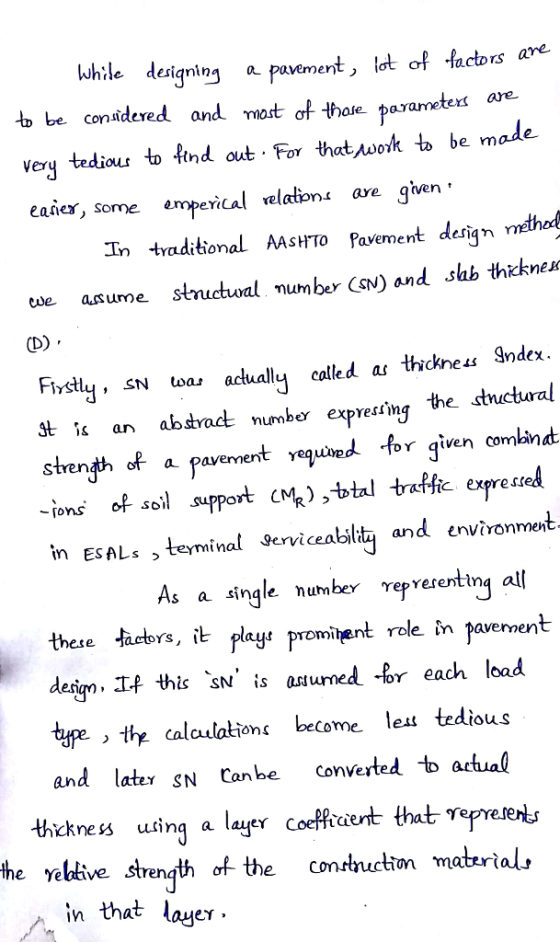
Why do we make an assumption of the structural number (SN) and slab thickness (D) "first"...
Why do we make an assumption of the structural number (SN) and slab thickness (D) "first" when using traditional AASHTO Pavement Design method?
Homework Answers

Add Answer to:
Why do we make an assumption of the structural number (SN) and
slab thickness (D) "first"...
7. Use the AASHTO design method to determine the thickness of full depth AC pavement given the following informatio...
 7. Use the AASHTO design method to determine the thickness of full depth AC pavement given the following information: subgrade resilient modulus is 10,000 psi; AC layer coefficient is 0.42; total ESAL on the design lane is 5x10°; reliability level is 95%; overall standard deviation is 0.40; initial serviceability index is 4.5; terminal serviceability index is 2.5; drainage coefficients for aggregate layers is 0.85. Show your work on the figure below 50 Design Serviceability Low APS 10 99.9 e 40...
4) For a design structural number, SN 5.0. selected. The base material has to be at...
 4) For a design structural number, SN 5.0. selected. The base material has to be at least 6 inches thick as set by policy (A2 0.14). What thickness should be used for the subbase (A3-0.10) to ensure the pavement design meets the required structural number. A 4 inch ACC pavement (A1 0.44) has been
this is the first part. A proposed reconstruction of a thickness and chara existing pavement consists...
 this is the first part.
A proposed reconstruction of a thickness and chara existing pavement consists Florida State Rcad is being planned. The current pavenmenst acteristics of the foundation layers are shown in the attached boring log The o sphalt layer, a sandy-limerock hase, and a sandy subhase. The r f an a seds of organic scils and peat. This pavement was constructed many years ago on pure experience. MODULE I: AASHTO APPROACH New information is now available on traffic...
this is the first part.
A proposed reconstruction of a thickness and chara existing pavement consists Florida State Rcad is being planned. The current pavenmenst acteristics of the foundation layers are shown in the attached boring log The o sphalt layer, a sandy-limerock hase, and a sandy subhase. The r f an a seds of organic scils and peat. This pavement was constructed many years ago on pure experience. MODULE I: AASHTO APPROACH New information is now available on traffic...
In this class, we will often make the assumption that there is a constant charge distribution,...
In this class, we will often make the assumption that there is a constant charge distribution, λλ (that is λλ is just equal to a constant number rather than depending on position). When is a constant λλ an appropriate assumption to make? Check all that apply, that is: Select all that are True. When using an insulator that is evenly charged When using a conductor with a charge applied to one end of it When using a conductor that is...
Why do we perform a structural comparison of various pesticides using FTIR-ATR prior to analysis.
Why do we perform a structural comparison of various pesticides using FTIR-ATR prior to analysis.
(3 points) Why do we prefer the binary number system for digital design? 5.
 (3 points) Why do we prefer the binary number system for digital design? 5.
What is the minimum number of samples that could make a standard line on the calibration curve and why do we use many sa...
What is the minimum number of samples that could make a standard line on the calibration curve and why do we use many samples
Q1. A continuous one-way slab is subjected to Gu(including self-weight) - 7.0 kN/m' Q-4.5 kN/m2. At the exterior ends, the slab is cast monolithically with the edge beams. Assume C30/37 concrete,...
 Q1. A continuous one-way slab is subjected to Gu(including self-weight) - 7.0 kN/m' Q-4.5 kN/m2. At the exterior ends, the slab is cast monolithically with the edge beams. Assume C30/37 concrete, grade 500 steel, and 25-mm cover to bars. Size of each beam is 350mm x 450mm, size of each column is 400mm x 400mm. (a) Determine the slab thickness. (b) Check whether the design shears and moments at critical sections (e.g. at mid- spans and supports) can be determined...
Why do we often use chain-weighting in place of traditional methods of calculating real GDP? Select...
Why do we often use chain-weighting in place of traditional methods of calculating real GDP? Select one: a. We think that items might change over time, which makes their price comparison less meaningful. b. Because we are interested in comparing the welfare of individuals over time, not simply the amount of money that they have. c. Because imports caused biases in GNP, which caused economists to make the switch. d. Computers have allowed us to use more complex algorithms to...
please do both d and e We also showed that power consumption can be reduced by...
 please do both d and e
We also showed that power consumption can be reduced by introducing an active component, such as a bipolar transistor, into the circuit. The model for such a circuit is shown below: 400TB l0V RE VL 2 I5 points] When using the node method to solve this problem, we end up with 2 unknown voltages, Vs and Vi. Explain why. d. (10 points] Repeat parts b. and c. to determine R1 and R2 for the...
please do both d and e
We also showed that power consumption can be reduced by introducing an active component, such as a bipolar transistor, into the circuit. The model for such a circuit is shown below: 400TB l0V RE VL 2 I5 points] When using the node method to solve this problem, we end up with 2 unknown voltages, Vs and Vi. Explain why. d. (10 points] Repeat parts b. and c. to determine R1 and R2 for the...
 7. Use the AASHTO design method to determine the thickness of full depth AC pavement given the following information: subgrade resilient modulus is 10,000 psi; AC layer coefficient is 0.42; total ESAL on the design lane is 5x10°; reliability level is 95%; overall standard deviation is 0.40; initial serviceability index is 4.5; terminal serviceability index is 2.5; drainage coefficients for aggregate layers is 0.85. Show your work on the figure below 50 Design Serviceability Low APS 10 99.9 e 40...
 4) For a design structural number, SN 5.0. selected. The base material has to be at least 6 inches thick as set by policy (A2 0.14). What thickness should be used for the subbase (A3-0.10) to ensure the pavement design meets the required structural number. A 4 inch ACC pavement (A1 0.44) has been
 this is the first part.
A proposed reconstruction of a thickness and chara existing pavement consists Florida State Rcad is being planned. The current pavenmenst acteristics of the foundation layers are shown in the attached boring log The o sphalt layer, a sandy-limerock hase, and a sandy subhase. The r f an a seds of organic scils and peat. This pavement was constructed many years ago on pure experience. MODULE I: AASHTO APPROACH New information is now available on traffic...
this is the first part.
A proposed reconstruction of a thickness and chara existing pavement consists Florida State Rcad is being planned. The current pavenmenst acteristics of the foundation layers are shown in the attached boring log The o sphalt layer, a sandy-limerock hase, and a sandy subhase. The r f an a seds of organic scils and peat. This pavement was constructed many years ago on pure experience. MODULE I: AASHTO APPROACH New information is now available on traffic...
 (3 points) Why do we prefer the binary number system for digital design? 5.
 Q1. A continuous one-way slab is subjected to Gu(including self-weight) - 7.0 kN/m' Q-4.5 kN/m2. At the exterior ends, the slab is cast monolithically with the edge beams. Assume C30/37 concrete, grade 500 steel, and 25-mm cover to bars. Size of each beam is 350mm x 450mm, size of each column is 400mm x 400mm. (a) Determine the slab thickness. (b) Check whether the design shears and moments at critical sections (e.g. at mid- spans and supports) can be determined...
 please do both d and e
We also showed that power consumption can be reduced by introducing an active component, such as a bipolar transistor, into the circuit. The model for such a circuit is shown below: 400TB l0V RE VL 2 I5 points] When using the node method to solve this problem, we end up with 2 unknown voltages, Vs and Vi. Explain why. d. (10 points] Repeat parts b. and c. to determine R1 and R2 for the...
please do both d and e
We also showed that power consumption can be reduced by introducing an active component, such as a bipolar transistor, into the circuit. The model for such a circuit is shown below: 400TB l0V RE VL 2 I5 points] When using the node method to solve this problem, we end up with 2 unknown voltages, Vs and Vi. Explain why. d. (10 points] Repeat parts b. and c. to determine R1 and R2 for the...
Most questions answered within 3 hours.
-
Where is the error in this code sequence?
String s1 = "Hello";
String s2 = "ello";...
asked 10 months ago -
Financial data for Joel de Paris, Inc., for last year
follow:
Joel de Paris, Inc.
Balance...
asked 10 months ago -
Consider this reaction:
Al2(SO4)3 (aq)+ BaCl3
(aq) Al2Cl6 (aq)- +
3BaSO4(s) . What is the...
asked 10 months ago -
Suppose that Savneet is considering increasing her
recent random sample from 20 car rentals to 40...
asked 10 months ago -
Trucks arrive at an unloading terminal at an average rate of 120
per hour.
Trucks arrive...
asked 10 months ago -
Why are methanol and ethanol completely soluble in water while
octanol is not very little soluble....
asked 10 months ago -
A facilities manager at a university reads in a research report
that the mean amount of...
asked 10 months ago -
When the CuSO4 is rehydrated by adding water to the anhydrous
compound, is this an endothermic...
asked 10 months ago -
A ray of sunlight is passing from diamond into crown glass; the
angle of incidence is...
asked 10 months ago -
A block of mass 0.249 kg is placed on top of a light, vertical
spring of...
asked 10 months ago -
how do the kidneys compensate in the presences of acidosis
a) trigger hyperventilate
b) reserve acid...
asked 10 months ago -
Question 501 pts
The rental rate of capital to the firm increases. Which of the
following...
asked 10 months ago