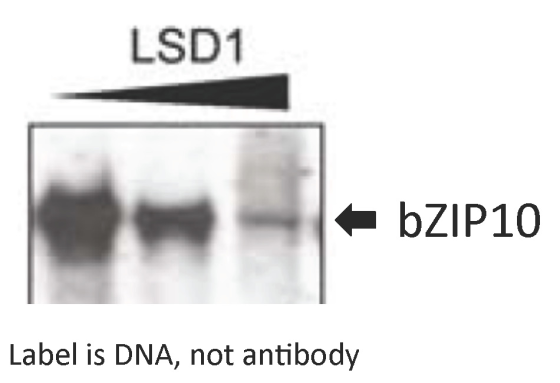
Increasing amounts of Lsd (LSD1 wedge) were added to tubes that contained equal amounts of bZIP10. The resulting complexes were run on a non-denaturing gel to preserve protein interactions. The gel above is a different type of technique than those we have talked about. Instead of visualizing the protein with a labeled antibody, the protein is visualized due to its interaction with labeled DNA. Thus, you can see the position of bZIP10:Lsd complex because it binds to the DNA, but you are actually seeing the DNA.
1) What does the data show?
As more Lsd was added, the amount of bZIP10 binding to DNA was increased
As more Lsd was added, the amount of bZIP10 binding to DNA stayed the same
As more Lsd was added, the amount of bZIP10 binding to DNA was reduced
2) How could this data be interpreted?
Lsd does not affect bZIP10 binding to DNA
Lsd enhances bZIP10 binding to DNA
Lsd decreases bZIP10 binding to DNA
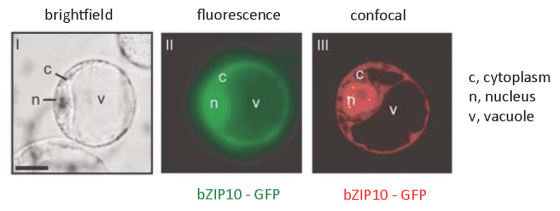
The figure above shows three different images of an undiseased normal plant cell (remember from your general biology that plant cells have vacuoles). Images II and III are fluorescence images of bZIP10 that is tagged with GFP, in image II it is false colored green and in III it is false colored red. Images I and II are the same cell viewed differently. Image III is a different cell to I and II.
3) Where is bZIP10 normally found in undiseased plants?
Cytoplasm
Nucleus and cytoplasm
Nucleus
Homework Answers
1. The reduction in the intensity of the band shows that: As more Lsd was added, the amount of bZIP10 binding to DNA was reduced.
2. What can be interpreted from this is that, : Lsd decreases bZIP10 binding to DNA
3. Nucleus and Cytoplasm
All the Best :)
Add Answer to:
Increasing amounts of Lsd (LSD1 wedge) were added to tubes that
contained equal amounts of bZIP10....
2. Match the phase to the description. NOTE: this question might look a little different on...
 2. Match the phase to the description. NOTE: this question might look a little different on the Moodle activity. Read carefully. Phase Hanne Description of Events in the Life of a Cell • Anaphase of muitosis A. The combined phases of GI/Go+S+G2 • Gl phase • G2 phase B. The cell is metabolically active; the cell duplicates argumelles and cytosolie components; the cell size starts to increase the cell makes proteins which will soon be used in DNA synthesis C....
1. Fill out the following table by indicating which general technique (light microscopy (LM) or electron...
 1. Fill out the following table by indicating which general technique (light microscopy (LM) or electron microscopy (EM]) could be used to observe each structure or phenomenon. Put "no" in the box if the technique could not be used. If light microscopy can be used, name one technique (bright-field, phase-contrast, fluorescence, etc.) that you think would be effective. You will find some useful information in Appendix 1 of this manual and Chapter 18 of your textbook. Structure or phenomenon Could...
10. Write a one-page summary of the attached paper? INTRODUCTION Many problems can develop in activated...
10. Write a one-page summary of the attached paper? INTRODUCTION Many problems can develop in activated sludge operation that adversely affect effluent quality with origins in the engineering, hydraulic and microbiological components of the process. The real "heart" of the activated sludge system is the development and maintenance of a mixed microbial culture (activated sludge) that treats wastewater and which can be managed. One definition of a wastewater treatment plant operator is a "bug farmer", one who controls the aeration...
 2. Match the phase to the description. NOTE: this question might look a little different on the Moodle activity. Read carefully. Phase Hanne Description of Events in the Life of a Cell • Anaphase of muitosis A. The combined phases of GI/Go+S+G2 • Gl phase • G2 phase B. The cell is metabolically active; the cell duplicates argumelles and cytosolie components; the cell size starts to increase the cell makes proteins which will soon be used in DNA synthesis C....
 1. Fill out the following table by indicating which general technique (light microscopy (LM) or electron microscopy (EM]) could be used to observe each structure or phenomenon. Put "no" in the box if the technique could not be used. If light microscopy can be used, name one technique (bright-field, phase-contrast, fluorescence, etc.) that you think would be effective. You will find some useful information in Appendix 1 of this manual and Chapter 18 of your textbook. Structure or phenomenon Could...
Most questions answered within 3 hours.
-
Where is the error in this code sequence?
String s1 = "Hello";
String s2 = "ello";...
asked 10 months ago -
Financial data for Joel de Paris, Inc., for last year
follow:
Joel de Paris, Inc.
Balance...
asked 10 months ago -
Consider this reaction:
Al2(SO4)3 (aq)+ BaCl3
(aq) Al2Cl6 (aq)- +
3BaSO4(s) . What is the...
asked 10 months ago -
Suppose that Savneet is considering increasing her
recent random sample from 20 car rentals to 40...
asked 10 months ago -
Trucks arrive at an unloading terminal at an average rate of 120
per hour.
Trucks arrive...
asked 10 months ago -
Why are methanol and ethanol completely soluble in water while
octanol is not very little soluble....
asked 10 months ago -
A facilities manager at a university reads in a research report
that the mean amount of...
asked 10 months ago -
When the CuSO4 is rehydrated by adding water to the anhydrous
compound, is this an endothermic...
asked 10 months ago -
A ray of sunlight is passing from diamond into crown glass; the
angle of incidence is...
asked 10 months ago -
A block of mass 0.249 kg is placed on top of a light, vertical
spring of...
asked 10 months ago -
how do the kidneys compensate in the presences of acidosis
a) trigger hyperventilate
b) reserve acid...
asked 10 months ago -
Question 501 pts
The rental rate of capital to the firm increases. Which of the
following...
asked 10 months ago