
Homework Answers
1. Emitter resistance RE reduce the gain of the amplifier but when we connect emitter by pass capacitor CE parallel to the emitter resistance then the gain of the amplifier is increased. And also it provide the low reactance path to the AC signal. If we remove the emitter bypass capacitor then the extreme degradation is done and it reduce the gain of the amplifier. So it reduce the output voltage.
2. At mid band frequancy the voltage gain is constant. So the transistor parameters(h parameters) are effect the voltage gain at the mid band frequency.
Add Answer to:
If you remove the capacitor CE from across Rg in the Common Emitter amplifier, what should...
Calculate the voltage gain (Av) for the loaded Common Emitter Amplifier below: BAC 200 for all...
 Calculate the voltage gain (Av) for the loaded Common Emitter Amplifier below: BAC 200 for all transistors. Assume re 15 Q for the CE Amplifier. Ignore re' for the DP Amplifier Vcc 12 V, R1 56 K, R2 10 KQ, R4 22 KQ R3 5.6 KQ, RL 8 RE(CE) 628 0, RE(CC) 330 Rc 3.5 KQ, Enter your results. No units. SR3 R1 RC C3 Vcc C1 Beta Q2a HH Vin Beta Q1 Beta Q2b C4 R4 Vs R2 C2...
Question 26 Calculate the output power Pout (RL) for the unloaded Common Emitter Amplifier below BDC=200, BAC =...
 Question 26 Calculate the output power Pout (RL) for the unloaded Common Emitter Amplifier below BDC=200, BAC = 150, re 0.39 Vs- 538 mVpp, Vcc 15 V, R1=1 KQ, R2 = 330 2 RC= 1000, RE1= 8.20, RE2= 36 0, RL 0.19 KO Enter your results in mW. SR1 RL Vcc C1 Vin Beta Vs R2 RE1 RE2 C2 ww
Question 26 Calculate the output power Pout (RL) for the unloaded Common Emitter Amplifier below BDC=200, BAC = 150, re...
Question 26 Calculate the output power Pout (RL) for the unloaded Common Emitter Amplifier below BDC=200, BAC = 150, re 0.39 Vs- 538 mVpp, Vcc 15 V, R1=1 KQ, R2 = 330 2 RC= 1000, RE1= 8.20, RE2= 36 0, RL 0.19 KO Enter your results in mW. SR1 RL Vcc C1 Vin Beta Vs R2 RE1 RE2 C2 ww
Question 26 Calculate the output power Pout (RL) for the unloaded Common Emitter Amplifier below BDC=200, BAC = 150, re...
VCC 24V RC 6.8kQ 100kΩ C2 0 15UF 01 C1 15uF 2N3904 R2 RE CE Figure 1. Common-emitter transistor a...
 Please use Multisim with probes placed and labeled.
Thank you for your time!
VCC 24V RC 6.8kQ 100kΩ C2 0 15UF 01 C1 15uF 2N3904 R2 RE CE Figure 1. Common-emitter transistor amplifier 2. Use Multisim to build circuit and measure the DC bias value for the figure above. 3. Calculate the AC dynamic resistance, re, using the measured value of lE 4. Calculate the amp voltage gain for the bypassed emitter 5. Record measured and calculated results in table...
Please use Multisim with probes placed and labeled.
Thank you for your time!
VCC 24V RC 6.8kQ 100kΩ C2 0 15UF 01 C1 15uF 2N3904 R2 RE CE Figure 1. Common-emitter transistor amplifier 2. Use Multisim to build circuit and measure the DC bias value for the figure above. 3. Calculate the AC dynamic resistance, re, using the measured value of lE 4. Calculate the amp voltage gain for the bypassed emitter 5. Record measured and calculated results in table...
ee e A Quèstion 27 Calculate the minimum power rating (Po) for transistor in the loaded Common Emitter Amplifier be...
 ee e A Quèstion 27 Calculate the minimum power rating (Po) for transistor in the loaded Common Emitter Amplifier below Assume Boc- BAC= 149 , Use the exact method to calculate Ip. R1 680 R, R2 510 Q Voc 16 V RL 120 5.1 Q RE2 80 Q, Rc 85 RE1 Enter your results in mW SR1 RC C3 Vcc Vout C1 HI Beta Vin RL Vs RE1 RE2 C2 R2
ee e A Quèstion 27 Calculate the minimum power...
ee e A Quèstion 27 Calculate the minimum power rating (Po) for transistor in the loaded Common Emitter Amplifier below Assume Boc- BAC= 149 , Use the exact method to calculate Ip. R1 680 R, R2 510 Q Voc 16 V RL 120 5.1 Q RE2 80 Q, Rc 85 RE1 Enter your results in mW SR1 RC C3 Vcc Vout C1 HI Beta Vin RL Vs RE1 RE2 C2 R2
ee e A Quèstion 27 Calculate the minimum power...
I have constructed this NPN Common-Emitter circuit in multisim and am asked to "Perform AC Simula...
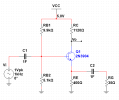 I have constructed this NPN Common-Emitter circuit in multisim
and am asked to "Perform AC Simulation to obtain
Av(gain), Ri, and Ro". How could I
do that? Please list out the steps/instructions to do so.
VCC 5.0V RB1 RC 1120Ω Vo C1 Q1 2N3904 1F Vi C2 1Vpk 1kHz 0° RB2 1F RE 400Ω RG 35Ω
VCC 5.0V RB1 RC 1120Ω Vo C1 Q1 2N3904 1F Vi C2 1Vpk 1kHz 0° RB2 1F RE 400Ω RG 35Ω
I have constructed this NPN Common-Emitter circuit in multisim
and am asked to "Perform AC Simulation to obtain
Av(gain), Ri, and Ro". How could I
do that? Please list out the steps/instructions to do so.
VCC 5.0V RB1 RC 1120Ω Vo C1 Q1 2N3904 1F Vi C2 1Vpk 1kHz 0° RB2 1F RE 400Ω RG 35Ω
VCC 5.0V RB1 RC 1120Ω Vo C1 Q1 2N3904 1F Vi C2 1Vpk 1kHz 0° RB2 1F RE 400Ω RG 35Ω
Do not answer it , if you do not know how to use pspice
 do not answer it , if you do not know how to use pspice
Vc 15Vdc R2 Rc 5k 150 C2 01 C1 RL 02N2222 Vin 50k R1 Re VAMP L-50mV FREQ 5000Hz Ce 10uF 1k 50 Figure 1: A Common-Emitter Amplifier Circuit Configuration 4. Refer to Fig. 1 in the handout; simulate the circuit in PSpice and obtain the input-output waveforms (to calculate the voltage gain) for a sinusoidal input with a magnitude of 10 mV and the frequencies...
do not answer it , if you do not know how to use pspice
Vc 15Vdc R2 Rc 5k 150 C2 01 C1 RL 02N2222 Vin 50k R1 Re VAMP L-50mV FREQ 5000Hz Ce 10uF 1k 50 Figure 1: A Common-Emitter Amplifier Circuit Configuration 4. Refer to Fig. 1 in the handout; simulate the circuit in PSpice and obtain the input-output waveforms (to calculate the voltage gain) for a sinusoidal input with a magnitude of 10 mV and the frequencies...
[1] The circuit diagram on the left below is a common emitter amplifier. It is the...
 [1] The circuit diagram on the left below is a common emitter amplifier. It is the full complement of components for this type of amplifier ready for AC analysis. This amplifier will be discussed in lecture prior to the lab exercises. However, with the circuit including only Rc. RE, Ri, and R2 as shown in the figure on the right, proceed with the design for a DC operating point of the common emitter amplifier. The following parameters are given: Vcc...
Calculate the power consumption from the DC power supply for our two transistor amplifier when there...
 Calculate the power consumption from the DC power supply for our
two transistor amplifier when there is no AC input signal.
R1 47k RC 2.74k Vout Cin Vin 220n RS 470 47micro 2N3904 8 Ohm SPKR R2 10k RE 1k RE' 820 5 1 47micro Common Emitter Stage Emitter Follower Stage
Calculate the power consumption from the DC power supply for our
two transistor amplifier when there is no AC input signal.
R1 47k RC 2.74k Vout Cin Vin 220n RS 470 47micro 2N3904 8 Ohm SPKR R2 10k RE 1k RE' 820 5 1 47micro Common Emitter Stage Emitter Follower Stage
2. For the common-emitter amplifier. B= 50. Vcc=12 a) Draw small signal circuit b) Find vout/vin...
 2. For the common-emitter amplifier. B= 50. Vcc=12 a) Draw small signal circuit b) Find vout/vin Find Zin and Zou Vcc R1 27k R2 2.2k Zout Zin Vo 4 C1 16 BIG Q1 NPN V1 C2 V R3 15k RE 1.2k BIG
Blackboard X A wOVIny T0anoer queauoTWaaveUnT0aUrie Question 24 Calculate the power gain (Ap) for the loaded Common...
 Blackboard X A wOVIny T0anoer queauoTWaaveUnT0aUrie Question 24 Calculate the power gain (Ap) for the loaded Common Emitter Amplifier below Assume BAC200, Assume re' 16 0 Vcc 15 V R1 66.4 KQ, R2 25.8 KO Rc 3.9 KQ RE1 3300, RE2 1.8 KO, RL 3.54 KO Enter your results. No units. SR1 RC C3 Vcc Vout Vin HH Beta RL Vs R2 RE1 RE2 C2 AMoving to another question will save this response. ww
Blackboard X A wOVIny T0anoer queauoTWaaveUnT0aUrie...
Blackboard X A wOVIny T0anoer queauoTWaaveUnT0aUrie Question 24 Calculate the power gain (Ap) for the loaded Common Emitter Amplifier below Assume BAC200, Assume re' 16 0 Vcc 15 V R1 66.4 KQ, R2 25.8 KO Rc 3.9 KQ RE1 3300, RE2 1.8 KO, RL 3.54 KO Enter your results. No units. SR1 RC C3 Vcc Vout Vin HH Beta RL Vs R2 RE1 RE2 C2 AMoving to another question will save this response. ww
Blackboard X A wOVIny T0anoer queauoTWaaveUnT0aUrie...
 Calculate the voltage gain (Av) for the loaded Common Emitter Amplifier below: BAC 200 for all transistors. Assume re 15 Q for the CE Amplifier. Ignore re' for the DP Amplifier Vcc 12 V, R1 56 K, R2 10 KQ, R4 22 KQ R3 5.6 KQ, RL 8 RE(CE) 628 0, RE(CC) 330 Rc 3.5 KQ, Enter your results. No units. SR3 R1 RC C3 Vcc C1 Beta Q2a HH Vin Beta Q1 Beta Q2b C4 R4 Vs R2 C2...
 Question 26 Calculate the output power Pout (RL) for the unloaded Common Emitter Amplifier below BDC=200, BAC = 150, re 0.39 Vs- 538 mVpp, Vcc 15 V, R1=1 KQ, R2 = 330 2 RC= 1000, RE1= 8.20, RE2= 36 0, RL 0.19 KO Enter your results in mW. SR1 RL Vcc C1 Vin Beta Vs R2 RE1 RE2 C2 ww
Question 26 Calculate the output power Pout (RL) for the unloaded Common Emitter Amplifier below BDC=200, BAC = 150, re...
Question 26 Calculate the output power Pout (RL) for the unloaded Common Emitter Amplifier below BDC=200, BAC = 150, re 0.39 Vs- 538 mVpp, Vcc 15 V, R1=1 KQ, R2 = 330 2 RC= 1000, RE1= 8.20, RE2= 36 0, RL 0.19 KO Enter your results in mW. SR1 RL Vcc C1 Vin Beta Vs R2 RE1 RE2 C2 ww
Question 26 Calculate the output power Pout (RL) for the unloaded Common Emitter Amplifier below BDC=200, BAC = 150, re...
 Please use Multisim with probes placed and labeled.
Thank you for your time!
VCC 24V RC 6.8kQ 100kΩ C2 0 15UF 01 C1 15uF 2N3904 R2 RE CE Figure 1. Common-emitter transistor amplifier 2. Use Multisim to build circuit and measure the DC bias value for the figure above. 3. Calculate the AC dynamic resistance, re, using the measured value of lE 4. Calculate the amp voltage gain for the bypassed emitter 5. Record measured and calculated results in table...
Please use Multisim with probes placed and labeled.
Thank you for your time!
VCC 24V RC 6.8kQ 100kΩ C2 0 15UF 01 C1 15uF 2N3904 R2 RE CE Figure 1. Common-emitter transistor amplifier 2. Use Multisim to build circuit and measure the DC bias value for the figure above. 3. Calculate the AC dynamic resistance, re, using the measured value of lE 4. Calculate the amp voltage gain for the bypassed emitter 5. Record measured and calculated results in table...
 ee e A Quèstion 27 Calculate the minimum power rating (Po) for transistor in the loaded Common Emitter Amplifier below Assume Boc- BAC= 149 , Use the exact method to calculate Ip. R1 680 R, R2 510 Q Voc 16 V RL 120 5.1 Q RE2 80 Q, Rc 85 RE1 Enter your results in mW SR1 RC C3 Vcc Vout C1 HI Beta Vin RL Vs RE1 RE2 C2 R2
ee e A Quèstion 27 Calculate the minimum power...
ee e A Quèstion 27 Calculate the minimum power rating (Po) for transistor in the loaded Common Emitter Amplifier below Assume Boc- BAC= 149 , Use the exact method to calculate Ip. R1 680 R, R2 510 Q Voc 16 V RL 120 5.1 Q RE2 80 Q, Rc 85 RE1 Enter your results in mW SR1 RC C3 Vcc Vout C1 HI Beta Vin RL Vs RE1 RE2 C2 R2
ee e A Quèstion 27 Calculate the minimum power...
 I have constructed this NPN Common-Emitter circuit in multisim
and am asked to "Perform AC Simulation to obtain
Av(gain), Ri, and Ro". How could I
do that? Please list out the steps/instructions to do so.
VCC 5.0V RB1 RC 1120Ω Vo C1 Q1 2N3904 1F Vi C2 1Vpk 1kHz 0° RB2 1F RE 400Ω RG 35Ω
VCC 5.0V RB1 RC 1120Ω Vo C1 Q1 2N3904 1F Vi C2 1Vpk 1kHz 0° RB2 1F RE 400Ω RG 35Ω
I have constructed this NPN Common-Emitter circuit in multisim
and am asked to "Perform AC Simulation to obtain
Av(gain), Ri, and Ro". How could I
do that? Please list out the steps/instructions to do so.
VCC 5.0V RB1 RC 1120Ω Vo C1 Q1 2N3904 1F Vi C2 1Vpk 1kHz 0° RB2 1F RE 400Ω RG 35Ω
VCC 5.0V RB1 RC 1120Ω Vo C1 Q1 2N3904 1F Vi C2 1Vpk 1kHz 0° RB2 1F RE 400Ω RG 35Ω
 do not answer it , if you do not know how to use pspice
Vc 15Vdc R2 Rc 5k 150 C2 01 C1 RL 02N2222 Vin 50k R1 Re VAMP L-50mV FREQ 5000Hz Ce 10uF 1k 50 Figure 1: A Common-Emitter Amplifier Circuit Configuration 4. Refer to Fig. 1 in the handout; simulate the circuit in PSpice and obtain the input-output waveforms (to calculate the voltage gain) for a sinusoidal input with a magnitude of 10 mV and the frequencies...
do not answer it , if you do not know how to use pspice
Vc 15Vdc R2 Rc 5k 150 C2 01 C1 RL 02N2222 Vin 50k R1 Re VAMP L-50mV FREQ 5000Hz Ce 10uF 1k 50 Figure 1: A Common-Emitter Amplifier Circuit Configuration 4. Refer to Fig. 1 in the handout; simulate the circuit in PSpice and obtain the input-output waveforms (to calculate the voltage gain) for a sinusoidal input with a magnitude of 10 mV and the frequencies...
 [1] The circuit diagram on the left below is a common emitter amplifier. It is the full complement of components for this type of amplifier ready for AC analysis. This amplifier will be discussed in lecture prior to the lab exercises. However, with the circuit including only Rc. RE, Ri, and R2 as shown in the figure on the right, proceed with the design for a DC operating point of the common emitter amplifier. The following parameters are given: Vcc...
 Calculate the power consumption from the DC power supply for our
two transistor amplifier when there is no AC input signal.
R1 47k RC 2.74k Vout Cin Vin 220n RS 470 47micro 2N3904 8 Ohm SPKR R2 10k RE 1k RE' 820 5 1 47micro Common Emitter Stage Emitter Follower Stage
Calculate the power consumption from the DC power supply for our
two transistor amplifier when there is no AC input signal.
R1 47k RC 2.74k Vout Cin Vin 220n RS 470 47micro 2N3904 8 Ohm SPKR R2 10k RE 1k RE' 820 5 1 47micro Common Emitter Stage Emitter Follower Stage
 2. For the common-emitter amplifier. B= 50. Vcc=12 a) Draw small signal circuit b) Find vout/vin Find Zin and Zou Vcc R1 27k R2 2.2k Zout Zin Vo 4 C1 16 BIG Q1 NPN V1 C2 V R3 15k RE 1.2k BIG
 Blackboard X A wOVIny T0anoer queauoTWaaveUnT0aUrie Question 24 Calculate the power gain (Ap) for the loaded Common Emitter Amplifier below Assume BAC200, Assume re' 16 0 Vcc 15 V R1 66.4 KQ, R2 25.8 KO Rc 3.9 KQ RE1 3300, RE2 1.8 KO, RL 3.54 KO Enter your results. No units. SR1 RC C3 Vcc Vout Vin HH Beta RL Vs R2 RE1 RE2 C2 AMoving to another question will save this response. ww
Blackboard X A wOVIny T0anoer queauoTWaaveUnT0aUrie...
Blackboard X A wOVIny T0anoer queauoTWaaveUnT0aUrie Question 24 Calculate the power gain (Ap) for the loaded Common Emitter Amplifier below Assume BAC200, Assume re' 16 0 Vcc 15 V R1 66.4 KQ, R2 25.8 KO Rc 3.9 KQ RE1 3300, RE2 1.8 KO, RL 3.54 KO Enter your results. No units. SR1 RC C3 Vcc Vout Vin HH Beta RL Vs R2 RE1 RE2 C2 AMoving to another question will save this response. ww
Blackboard X A wOVIny T0anoer queauoTWaaveUnT0aUrie...
Most questions answered within 3 hours.
-
Where is the error in this code sequence?
String s1 = "Hello";
String s2 = "ello";...
asked 10 months ago -
Financial data for Joel de Paris, Inc., for last year
follow:
Joel de Paris, Inc.
Balance...
asked 10 months ago -
Consider this reaction:
Al2(SO4)3 (aq)+ BaCl3
(aq) Al2Cl6 (aq)- +
3BaSO4(s) . What is the...
asked 10 months ago -
Suppose that Savneet is considering increasing her
recent random sample from 20 car rentals to 40...
asked 10 months ago -
Trucks arrive at an unloading terminal at an average rate of 120
per hour.
Trucks arrive...
asked 10 months ago -
Why are methanol and ethanol completely soluble in water while
octanol is not very little soluble....
asked 10 months ago -
A facilities manager at a university reads in a research report
that the mean amount of...
asked 10 months ago -
When the CuSO4 is rehydrated by adding water to the anhydrous
compound, is this an endothermic...
asked 10 months ago -
A ray of sunlight is passing from diamond into crown glass; the
angle of incidence is...
asked 10 months ago -
A block of mass 0.249 kg is placed on top of a light, vertical
spring of...
asked 10 months ago -
how do the kidneys compensate in the presences of acidosis
a) trigger hyperventilate
b) reserve acid...
asked 10 months ago -
Question 501 pts
The rental rate of capital to the firm increases. Which of the
following...
asked 10 months ago