
Homework Answers
![levite [ 28 29€ + eipts] S = ? as, F = -K gT luz fru energy, F = U-TS = -keł en Citė 2BE the BE) N, -2A E => SE (1) May (I l](http://img.homeworklib.com/questions/7b5c4960-b692-11ea-a48e-4b1613c901da.png?x-oss-process=image/resize,w_560)
Add Answer to:
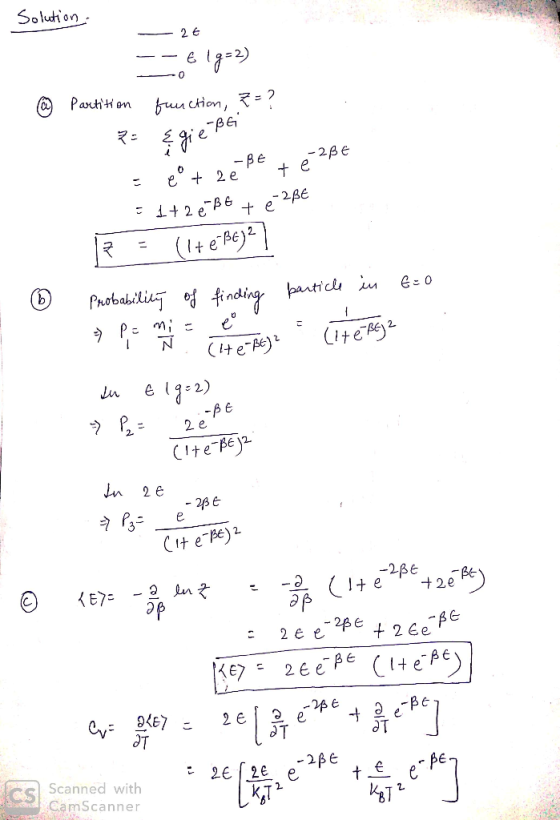
Q.7) Consider a systems of N>>1 identical, distinguishable and independent particles that can be placed in...
Consider a system of distinguishable particles having only three energy levels (0, 1 and 2) equally...
Consider a system of distinguishable particles having only three energy levels (0, 1 and 2) equally separated by an energy , delta e, which is equal to the value of kT at 25 K. Calculate at 25 K: (a) the ratios of populations n1/n0 and n2/n0 (b) the molecular partition function, q (c) the molar internal energy, E = U - U(0), in J/mol (d) the molar entropy, S, in J/(K mol) (e) the molar constant volume heat capacity, Cv,...
1. Consider a quantum system comprising three indistinguishable particles which can occupy only three individual-partic...
 1. Consider a quantum system comprising three indistinguishable particles which can occupy only three individual-particle energy levels, with energies ε,-0, ε,-2e and ε,-3. The system is in thermal equilibrium at temperature T. Suppose the particles are bosons with integer spin. i) How many states do you expect this system to have? Justify your answer [2 marks] (ii) Make a table showing, for each state of this system, the energy of the state, the number of particles (M, M,, N) with...
The system above has two distinguishable particles, each can be in either of two boxes. The...
 The system above has two distinguishable particles, each can be
in either of two boxes. The system is in thermal equilibrium with a
heat bath at temperature, T. The energy of the particle is zero
when it's in the left box, and it is
when it is in the right box. There is a correlation energy term
that increases the system energy by
if the particles are in the same box.
If the particles are indistinguishable how many microstates will...
The system above has two distinguishable particles, each can be
in either of two boxes. The system is in thermal equilibrium with a
heat bath at temperature, T. The energy of the particle is zero
when it's in the left box, and it is
when it is in the right box. There is a correlation energy term
that increases the system energy by
if the particles are in the same box.
If the particles are indistinguishable how many microstates will...
Question 9 Consider a quantum system comprising two indistinguishable particles which can occupy only three individual-particle...
 Question 9 Consider a quantum system comprising two indistinguishable particles which can occupy only three individual-particle energy levels, with energies 81 0, 82 2 and E3 38.The system is in thermal equilibrium at temperature T. (a) Suppose the particles which can occupy an energy level. are spinless, and there is no limit to the number of particles (i) How many states do you expect this system to have? Justify your answer (ii) Make a table showing, for each state of...
Problem 1. Consider a system of three identical particles. Each particle has 5 quantum states with...
 Problem 1. Consider a system of three identical particles. Each particle has 5 quantum states with energies 0, ε, 2E, 3E, 4E. For distinguishable particles, calculate the number of quantum states where (1) three particles are in the same single-particle state, (2) only two particles are in the same single-particle state, and (3) no two particles are in the same single-particle state. Problem 2. For fermions, (1) calculate the total number of quantum states, and (2) the number of states...
1 The Gibbs Paradox Consider N particles, each of mass m, in a 3-dimensional volume V at temperature T. Each particle i...
 1 The Gibbs Paradox Consider N particles, each of mass m, in a 3-dimensional volume V at temperature T. Each particle i has momentum pi. Assume that the particles are non-interacting (ideal gas) and distinguishable. a) (2P) Calculate the canonical partition function N P for the N-particle system. Make sure to work out the integral. b) (2P) Calculate the free energy F--kBTlnZ from the partition function Z. Is F an extensive quantity? c) (2P) Calculate the entropy S F/oT from...
(12%) Consider a system of non-interacting fermions in equilibrium with a heat bath at temperature T...
 (12%) Consider a system of non-interacting fermions in equilibrium with a heat bath at temperature T and a particle reservoir at chemical potential fl. Assume that we can neglect different spin orientations of the fermions. Each particle can be in one of three single-partiele states with energies 0, A and 2A. (a) Find the grand partition function of the system. (b) Find the mean number of particles and mean energy of the system. (C) Find the most probable microstate of...
5. Consider a quantum mechanical system made of N identical particles. There are total M possible...
 5. Consider a quantum mechanical system made of N identical particles. There are total M possible energy levels that each of these particles can occupy. (a) According to statistical thermodynamics, the probability that a particle occu- pies ith energy level with energy e; is proportional to e-Bes where B = r and T is the temperature. k is a universal constant called Boltzmann constant. What is the probability for a given particle to occupyith energy level? (b) On average, how...
trying for last time :( Can anyone please help and explain how to do this task...
 trying for last time :( Can anyone please help and explain how
to do this task ? Thank you
Q4 (QUANTUM IDEAL GASES) Is the statement "Given a two-spinless-fermion system, and two orbitals o labeled by quantum numbers a, b, the two-body wavefunction (1,2 represent the particle variables) V (1, 2) = 0a(1)$a (2) - 06(1)$6(2) +0a(1)º(2) - 06(1)$a(2) correctly describes a possible state of the system” true or false ? Explain your answer (0.5p). 4b) Consider a Fermi gas...
trying for last time :( Can anyone please help and explain how
to do this task ? Thank you
Q4 (QUANTUM IDEAL GASES) Is the statement "Given a two-spinless-fermion system, and two orbitals o labeled by quantum numbers a, b, the two-body wavefunction (1,2 represent the particle variables) V (1, 2) = 0a(1)$a (2) - 06(1)$6(2) +0a(1)º(2) - 06(1)$a(2) correctly describes a possible state of the system” true or false ? Explain your answer (0.5p). 4b) Consider a Fermi gas...
Question 14. Consider the following 3-state model: a system of 21 non-interacting particles that can occupy...
 Question 14. Consider the following 3-state model: a system of 21 non-interacting particles that can occupy one of three energy levels. This is analogous to electrons filling a number of orbitals. The energies associated with the states are E0, El and E2 respectively. Consider no external constraints on the system (i.e. thermal or pressure baths) and that the system is isolated a) What is the value of entropy change associated with the states of E0 = 21, El=E2=0. b) What...
 1. Consider a quantum system comprising three indistinguishable particles which can occupy only three individual-particle energy levels, with energies ε,-0, ε,-2e and ε,-3. The system is in thermal equilibrium at temperature T. Suppose the particles are bosons with integer spin. i) How many states do you expect this system to have? Justify your answer [2 marks] (ii) Make a table showing, for each state of this system, the energy of the state, the number of particles (M, M,, N) with...
 The system above has two distinguishable particles, each can be
in either of two boxes. The system is in thermal equilibrium with a
heat bath at temperature, T. The energy of the particle is zero
when it's in the left box, and it is
when it is in the right box. There is a correlation energy term
that increases the system energy by
if the particles are in the same box.
If the particles are indistinguishable how many microstates will...
The system above has two distinguishable particles, each can be
in either of two boxes. The system is in thermal equilibrium with a
heat bath at temperature, T. The energy of the particle is zero
when it's in the left box, and it is
when it is in the right box. There is a correlation energy term
that increases the system energy by
if the particles are in the same box.
If the particles are indistinguishable how many microstates will...
 Question 9 Consider a quantum system comprising two indistinguishable particles which can occupy only three individual-particle energy levels, with energies 81 0, 82 2 and E3 38.The system is in thermal equilibrium at temperature T. (a) Suppose the particles which can occupy an energy level. are spinless, and there is no limit to the number of particles (i) How many states do you expect this system to have? Justify your answer (ii) Make a table showing, for each state of...
 Problem 1. Consider a system of three identical particles. Each particle has 5 quantum states with energies 0, ε, 2E, 3E, 4E. For distinguishable particles, calculate the number of quantum states where (1) three particles are in the same single-particle state, (2) only two particles are in the same single-particle state, and (3) no two particles are in the same single-particle state. Problem 2. For fermions, (1) calculate the total number of quantum states, and (2) the number of states...
 1 The Gibbs Paradox Consider N particles, each of mass m, in a 3-dimensional volume V at temperature T. Each particle i has momentum pi. Assume that the particles are non-interacting (ideal gas) and distinguishable. a) (2P) Calculate the canonical partition function N P for the N-particle system. Make sure to work out the integral. b) (2P) Calculate the free energy F--kBTlnZ from the partition function Z. Is F an extensive quantity? c) (2P) Calculate the entropy S F/oT from...
 (12%) Consider a system of non-interacting fermions in equilibrium with a heat bath at temperature T and a particle reservoir at chemical potential fl. Assume that we can neglect different spin orientations of the fermions. Each particle can be in one of three single-partiele states with energies 0, A and 2A. (a) Find the grand partition function of the system. (b) Find the mean number of particles and mean energy of the system. (C) Find the most probable microstate of...
 5. Consider a quantum mechanical system made of N identical particles. There are total M possible energy levels that each of these particles can occupy. (a) According to statistical thermodynamics, the probability that a particle occu- pies ith energy level with energy e; is proportional to e-Bes where B = r and T is the temperature. k is a universal constant called Boltzmann constant. What is the probability for a given particle to occupyith energy level? (b) On average, how...
 trying for last time :( Can anyone please help and explain how
to do this task ? Thank you
Q4 (QUANTUM IDEAL GASES) Is the statement "Given a two-spinless-fermion system, and two orbitals o labeled by quantum numbers a, b, the two-body wavefunction (1,2 represent the particle variables) V (1, 2) = 0a(1)$a (2) - 06(1)$6(2) +0a(1)º(2) - 06(1)$a(2) correctly describes a possible state of the system” true or false ? Explain your answer (0.5p). 4b) Consider a Fermi gas...
trying for last time :( Can anyone please help and explain how
to do this task ? Thank you
Q4 (QUANTUM IDEAL GASES) Is the statement "Given a two-spinless-fermion system, and two orbitals o labeled by quantum numbers a, b, the two-body wavefunction (1,2 represent the particle variables) V (1, 2) = 0a(1)$a (2) - 06(1)$6(2) +0a(1)º(2) - 06(1)$a(2) correctly describes a possible state of the system” true or false ? Explain your answer (0.5p). 4b) Consider a Fermi gas...
 Question 14. Consider the following 3-state model: a system of 21 non-interacting particles that can occupy one of three energy levels. This is analogous to electrons filling a number of orbitals. The energies associated with the states are E0, El and E2 respectively. Consider no external constraints on the system (i.e. thermal or pressure baths) and that the system is isolated a) What is the value of entropy change associated with the states of E0 = 21, El=E2=0. b) What...
Most questions answered within 3 hours.
-
Where is the error in this code sequence?
String s1 = "Hello";
String s2 = "ello";...
asked 11 months ago -
Financial data for Joel de Paris, Inc., for last year
follow:
Joel de Paris, Inc.
Balance...
asked 11 months ago -
Consider this reaction:
Al2(SO4)3 (aq)+ BaCl3
(aq) Al2Cl6 (aq)- +
3BaSO4(s) . What is the...
asked 11 months ago -
Suppose that Savneet is considering increasing her
recent random sample from 20 car rentals to 40...
asked 11 months ago -
Trucks arrive at an unloading terminal at an average rate of 120
per hour.
Trucks arrive...
asked 11 months ago -
Why are methanol and ethanol completely soluble in water while
octanol is not very little soluble....
asked 11 months ago -
A facilities manager at a university reads in a research report
that the mean amount of...
asked 11 months ago -
When the CuSO4 is rehydrated by adding water to the anhydrous
compound, is this an endothermic...
asked 11 months ago -
A ray of sunlight is passing from diamond into crown glass; the
angle of incidence is...
asked 11 months ago -
A block of mass 0.249 kg is placed on top of a light, vertical
spring of...
asked 11 months ago -
how do the kidneys compensate in the presences of acidosis
a) trigger hyperventilate
b) reserve acid...
asked 11 months ago -
Question 501 pts
The rental rate of capital to the firm increases. Which of the
following...
asked 11 months ago