
Homework Answers

Add Answer to:
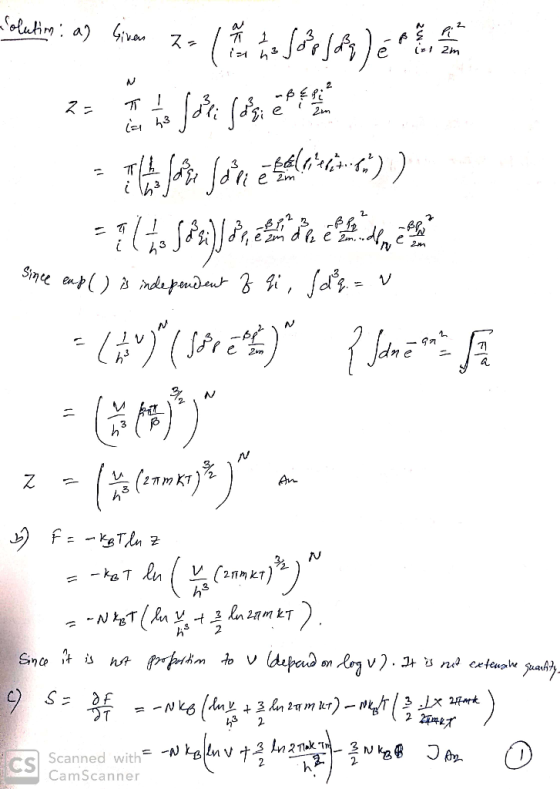
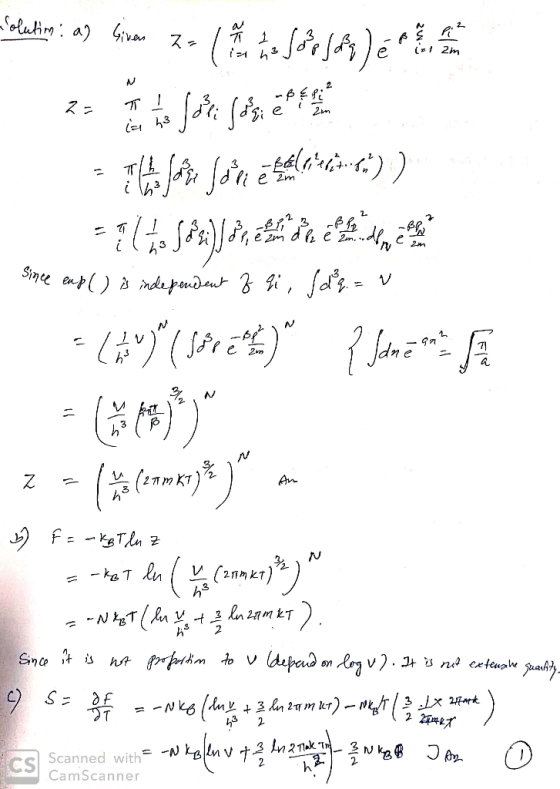
1 The Gibbs Paradox Consider N particles, each of mass m, in a 3-dimensional volume V at temperature T. Each particle i...
Pb2. Consider the case of a canonical ensemble of N gas particles confined to a t...
 Pb2. Consider the case of a canonical ensemble of N gas particles confined to a t rectangular parallelepiped of lengths: a, b, and c. The energy, which is the translational kinetic energy, is given by: o a where h is the Planck's constant, m the mass of the particle, and nx, ny ,nz are integer numbers running from 1 to +oo, (a) Calculate the canonical partition function, qi, for one particle by considering an integral approach for the calculation of...
1-r' Problem 16.12 (30 pts) This chapter examines the two-state system but consider instead the infinite-state...
 1-r' Problem 16.12 (30 pts) This chapter examines the two-state system but consider instead the infinite-state system consisting of N non-interacting particles. Each particle i can be in one of an infinite number of states designated by an integer, n; = 0,1,2, .... The energy of particle i is given by a = en; where e is a constant. Note: you may need the series sum Li-ori = a) If the particles are distinguishable, compute QIT,N) and A(T,N) for this...
Q.7) Consider a systems of N>>1 identical, distinguishable and independent particles that can be placed in...
 Q.7) Consider a systems of N>>1 identical, distinguishable and independent particles that can be placed in three energy levels of energies 0, E and 2€, respectively. Only the level of energy sis degenerate, of degeneracy g=2. This system is in equilibrium with a heat reservoir at temperature T. a) Obtain the partition function of the system. b) What is the probability of finding each particle in each energy level? c) Calculate the average energy <B>, the specific heat at constant...
1. N identical particles of mass m is confined to move only about a surface of...
1. N identical particles of mass m is confined to move only about a surface of area A, and thus can be considered as a “two-dimensional gas.” In the classical limit what is the single particle partition function of one of the particles in this ideal two-dimensional gas? What is the partition function of the N particle gas? What is the mean thermal energy of this gas, and what is the entropy of this gas?
Consider one dimensional lattice of N particles having a spin of 1 /2 with an associated magnetic...
 Consider one dimensional lattice of N particles having a spin of 1 /2 with an associated magnetic moment μ The spins are kept in a magnetic field with magnetic induction B along the z direction. The spin can point either up, t, or down, , relative to the z axis. The energy of particle with spin down is e B and that of particle with spin up is ε--B. We assume that the system is isolated from. its environment so...
Problem 3: (40 points) One-dimensional relativistic gas: Here we consider a non-interacting gas of N relativistic...
 Problem 3: (40 points) One-dimensional relativistic gas: Here we consider a non-interacting gas of N relativistic particles in one dimension. The gas is confined in a container of length L, i.e., the coordinate of each particle is limited to 0 <q < L. The energy of the ith particle is given by ε = c (a) Calculate the single particle partition function Z(T,L) for given energy E and particle number N. [12 points] (b) Calculate the average energy E and...
Consider a gas of N molecules of mass m, occupying a volume V at temperature T...
 Consider a gas of N molecules of mass m, occupying a volume V at temperature T and characterized by a fugacity f(T, V, N)--יג, where-2TmRT bound to a surface that has a total of No. The partition function of the bound gas molecules is Ž(T) At equilibrium, some of these molecules are a and only depends on T since gas molecules are bound to the surface. Using the grand canonical ensemble, find the ave to zero and the temperature is...
2. A system consists of N very weakly interacting particles at a temperature T high enough...
 2. A system consists of N very weakly interacting particles at a temperature T high enough that classical statistical mechanics is applicable. Each particle is fixed in space, has mass m, a. Calculate the heat capacity of this system of particles at this temperature in each of the i. The effective restoring force has magnitude κ x, where x is the displacement from and is free to perform one-dimensional oscillations about its equilibrium position. following cases: equilibrium. The effective restoring...
Question 1 A system of N identical non-interacting magnetic ions of spin Y%, has energy u...
 Question 1 A system of N identical non-interacting magnetic ions of spin Y%, has energy u tHo for each spin. μο is the magnetic moment in a crystal at absolute temperature T in a magnetic field B. For this system calculate: a) The partition function, Z. b) Free energy, F. c) The entropy. S d) The average energy, U e) The average magnetic moment, M
need help with thermodynamics A system consists of N weakly interacting particles, each of which can...
 need help with thermodynamics
A system consists of N weakly interacting particles, each of which can be in either of two states with respective energies e and 2. where e1 2 1. Without explicit calculation, make a qualitative plot of the mean energy U the entropy S of the system as a function of its temperature T. What is in the limit of very low and very high temperatures? What is S in the limit of very low and very...
need help with thermodynamics
A system consists of N weakly interacting particles, each of which can be in either of two states with respective energies e and 2. where e1 2 1. Without explicit calculation, make a qualitative plot of the mean energy U the entropy S of the system as a function of its temperature T. What is in the limit of very low and very high temperatures? What is S in the limit of very low and very...
 Pb2. Consider the case of a canonical ensemble of N gas particles confined to a t rectangular parallelepiped of lengths: a, b, and c. The energy, which is the translational kinetic energy, is given by: o a where h is the Planck's constant, m the mass of the particle, and nx, ny ,nz are integer numbers running from 1 to +oo, (a) Calculate the canonical partition function, qi, for one particle by considering an integral approach for the calculation of...
 1-r' Problem 16.12 (30 pts) This chapter examines the two-state system but consider instead the infinite-state system consisting of N non-interacting particles. Each particle i can be in one of an infinite number of states designated by an integer, n; = 0,1,2, .... The energy of particle i is given by a = en; where e is a constant. Note: you may need the series sum Li-ori = a) If the particles are distinguishable, compute QIT,N) and A(T,N) for this...
 Q.7) Consider a systems of N>>1 identical, distinguishable and independent particles that can be placed in three energy levels of energies 0, E and 2€, respectively. Only the level of energy sis degenerate, of degeneracy g=2. This system is in equilibrium with a heat reservoir at temperature T. a) Obtain the partition function of the system. b) What is the probability of finding each particle in each energy level? c) Calculate the average energy <B>, the specific heat at constant...
 Consider one dimensional lattice of N particles having a spin of 1 /2 with an associated magnetic moment μ The spins are kept in a magnetic field with magnetic induction B along the z direction. The spin can point either up, t, or down, , relative to the z axis. The energy of particle with spin down is e B and that of particle with spin up is ε--B. We assume that the system is isolated from. its environment so...
 Problem 3: (40 points) One-dimensional relativistic gas: Here we consider a non-interacting gas of N relativistic particles in one dimension. The gas is confined in a container of length L, i.e., the coordinate of each particle is limited to 0 <q < L. The energy of the ith particle is given by ε = c (a) Calculate the single particle partition function Z(T,L) for given energy E and particle number N. [12 points] (b) Calculate the average energy E and...
 Consider a gas of N molecules of mass m, occupying a volume V at temperature T and characterized by a fugacity f(T, V, N)--יג, where-2TmRT bound to a surface that has a total of No. The partition function of the bound gas molecules is Ž(T) At equilibrium, some of these molecules are a and only depends on T since gas molecules are bound to the surface. Using the grand canonical ensemble, find the ave to zero and the temperature is...
 2. A system consists of N very weakly interacting particles at a temperature T high enough that classical statistical mechanics is applicable. Each particle is fixed in space, has mass m, a. Calculate the heat capacity of this system of particles at this temperature in each of the i. The effective restoring force has magnitude κ x, where x is the displacement from and is free to perform one-dimensional oscillations about its equilibrium position. following cases: equilibrium. The effective restoring...
 Question 1 A system of N identical non-interacting magnetic ions of spin Y%, has energy u tHo for each spin. μο is the magnetic moment in a crystal at absolute temperature T in a magnetic field B. For this system calculate: a) The partition function, Z. b) Free energy, F. c) The entropy. S d) The average energy, U e) The average magnetic moment, M
 need help with thermodynamics
A system consists of N weakly interacting particles, each of which can be in either of two states with respective energies e and 2. where e1 2 1. Without explicit calculation, make a qualitative plot of the mean energy U the entropy S of the system as a function of its temperature T. What is in the limit of very low and very high temperatures? What is S in the limit of very low and very...
need help with thermodynamics
A system consists of N weakly interacting particles, each of which can be in either of two states with respective energies e and 2. where e1 2 1. Without explicit calculation, make a qualitative plot of the mean energy U the entropy S of the system as a function of its temperature T. What is in the limit of very low and very high temperatures? What is S in the limit of very low and very...
Most questions answered within 3 hours.
-
Where is the error in this code sequence?
String s1 = "Hello";
String s2 = "ello";...
asked 11 months ago -
Financial data for Joel de Paris, Inc., for last year
follow:
Joel de Paris, Inc.
Balance...
asked 11 months ago -
Consider this reaction:
Al2(SO4)3 (aq)+ BaCl3
(aq) Al2Cl6 (aq)- +
3BaSO4(s) . What is the...
asked 11 months ago -
Suppose that Savneet is considering increasing her
recent random sample from 20 car rentals to 40...
asked 11 months ago -
Trucks arrive at an unloading terminal at an average rate of 120
per hour.
Trucks arrive...
asked 11 months ago -
Why are methanol and ethanol completely soluble in water while
octanol is not very little soluble....
asked 11 months ago -
A facilities manager at a university reads in a research report
that the mean amount of...
asked 11 months ago -
When the CuSO4 is rehydrated by adding water to the anhydrous
compound, is this an endothermic...
asked 11 months ago -
A ray of sunlight is passing from diamond into crown glass; the
angle of incidence is...
asked 11 months ago -
A block of mass 0.249 kg is placed on top of a light, vertical
spring of...
asked 11 months ago -
how do the kidneys compensate in the presences of acidosis
a) trigger hyperventilate
b) reserve acid...
asked 11 months ago -
Question 501 pts
The rental rate of capital to the firm increases. Which of the
following...
asked 11 months ago