
Homework Answers
Rhombic form of sulfur is more stable than monoclinic forms at temperature below 95 DegC thus system would like to be in rhombic state at these temeprature levels.
So entropy change will be negative from rhombic to monoclinic form (because entropy increase only if the resultant form is more stable).
I hope it clarifies. if you have the Delta H and temeprature data then you can calulathe actual amount of entrop changed.
Add Answer to:
What is the entropy of change when sulfur transition from rhombic to monoclinic forms?
10. Elemental sulfur exists in two crystalline forms, rhombic and monoclinic. From the following data =...
 10. Elemental sulfur exists in two crystalline forms, rhombic and monoclinic. From the following data = S(monoclinic) 5° (J/K mol) 31.880 S (rhombic) AHP (kJ/mol) S (rhombic) S(monoclinic) 0.30 a. Calculate the enthalpy change 32.546 b. Calculate the entropy change C. Calculate the Gibbs free energy at 25°C.
Consider the phase transition between two phases of sulfur S(s, rhombic) S (s, monoclinic) IF AG...
 Consider the phase transition between two phases of sulfur S(s, rhombic) S (s, monoclinic) IF AG for this transition is +0.10 kJ/mol and the densities of the rhombic and monoclinic phases are, respectively, 2.07 g/cm and 1.92 g/cm', at what pressure does the phase transformation from rhombic to monoclinic become spontaneous?
8. Consider the phase transition between two phases of sulfur S(s, rhombic) →S (s, monoclinic) If...
 8. Consider the phase transition between two phases of sulfur S(s, rhombic) →S (s, monoclinic) If AG for this transition is +0.10 kl/mol and the densities of the rhombic and monoclinic phases are, respectively, 2.07 g/cm and 1.92 g/cm', at what pressure does the phase transformation from rhombic to monoclinic become spontaneous?
help please 8. Consider the phase transition between two phases of sulfur S(s, rhombic) —S (s,...
 help please
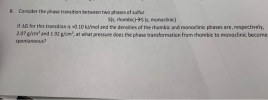
8. Consider the phase transition between two phases of sulfur S(s, rhombic) —S (s, monoclinic) If AG for this transition is +0.10 kJ/mol and the densities of the rhombic and monoclinic phases are, respectively, 2.07 g/cm and 1.92 g/cm, at what pressure does the phase transformation from rhombic to monoclinic become spontaneous?
help please
8. Consider the phase transition between two phases of sulfur S(s, rhombic) —S (s, monoclinic) If AG for this transition is +0.10 kJ/mol and the densities of the rhombic and monoclinic phases are, respectively, 2.07 g/cm and 1.92 g/cm, at what pressure does the phase transformation from rhombic to monoclinic become spontaneous?
Sulfur has two solid forms - a (or rhombic) and b (or monoclinic). The standard enthalpies...
 Sulfur has two solid forms - a (or rhombic) and b (or monoclinic). The standard enthalpies of combustion, in which the product is s02. are -296.53 kJ/mol for S(s,a) and 296.86 kJ/mol for S(s,b) a 298 K. Find the standard reaction enthalpy for the process S(s,a) -> Sts,b) at 298 K.
From the following data, calculate the Enthalpy when Rhombic Sulphur is covered to monoclinic Sulphur S...
From the following data, calculate the Enthalpy when Rhombic Sulphur is covered to monoclinic Sulphur S (rhombic) + O2 (gas) -----> SO2 (gas) delta H = -295.1 kJ/mol S (monoclinic) + O2 -------> SO2 (gas) delta H = -296.4 kJ/mol ___________________________________________________ S (rhombic) -------> S (monoclinic) delta H = [x] kJ/mon
Sulfur exhibits two solid phases, rhombie and monoclinic. Use the Phase Diagram er the following question....
 Sulfur exhibits two solid phases, rhombie and monoclinic. Use the Phase Diagram er the following question. (The phase diagram is not to scale.) 151C. 1420 m Monline 95 1910 lam I am Rhobic 115.15C 95C 51 x 10am How many triple points are in the phase diagram? b. What phases are in equilibrium at the triple point at 9531°C? (Select all that apply.) rhombic liquid monoclinic c. What phases are in equilibrium at the triple point at 115.18°C? Show in...
Show all work. Just part b and d please. Thank you in advance. The density of...
 Show all work. Just part b and d please. Thank you in
advance.
The density of rhombic sulfur is 2.070 g cm3 with a standard molar entropy of 31.80J K mol-1. The density of monoclinic sulfur is 1.957 g cm-3 with a standard molar entropy of 32.60J Kmol a Can an increase in temperature be expected to make monoclinic sulfur more stable than rhombic sulfur? If so, at what temperature will the transition occur at 1 bar? Can an increase...
Show all work. Just part b and d please. Thank you in
advance.
The density of rhombic sulfur is 2.070 g cm3 with a standard molar entropy of 31.80J K mol-1. The density of monoclinic sulfur is 1.957 g cm-3 with a standard molar entropy of 32.60J Kmol a Can an increase in temperature be expected to make monoclinic sulfur more stable than rhombic sulfur? If so, at what temperature will the transition occur at 1 bar? Can an increase...
Entropy and Solid Phase Change It is quite common for a solid to change from one...
 Entropy and Solid Phase Change It is quite common for a solid to change from one solid state structure to another at a temperature below its melting point. For example, sulfur undergoes a phase change from the a-orthorhombic form (Sg; density=2.07 g/cm3) to the B-monoclinic form (Sg; density=2.00 g/cm3) as it is warmed above 95.3 °C. Assuming that AH for this phase change is 0.310 kJ/mol, calculate AS for this phase change. Submit Answer Tries 0/5
Calculate the change in the standard molar entropy of sulfur trioxide gas, SO3, when it is...
Calculate the change in the standard molar entropy of sulfur trioxide gas, SO3, when it is cooled from a temperature of 100°C to 10°C at a constant pressure of 1 bar. *use equation ∆S = nCpln(T2/T1)
 10. Elemental sulfur exists in two crystalline forms, rhombic and monoclinic. From the following data = S(monoclinic) 5° (J/K mol) 31.880 S (rhombic) AHP (kJ/mol) S (rhombic) S(monoclinic) 0.30 a. Calculate the enthalpy change 32.546 b. Calculate the entropy change C. Calculate the Gibbs free energy at 25°C.
 Consider the phase transition between two phases of sulfur S(s, rhombic) S (s, monoclinic) IF AG for this transition is +0.10 kJ/mol and the densities of the rhombic and monoclinic phases are, respectively, 2.07 g/cm and 1.92 g/cm', at what pressure does the phase transformation from rhombic to monoclinic become spontaneous?
 8. Consider the phase transition between two phases of sulfur S(s, rhombic) →S (s, monoclinic) If AG for this transition is +0.10 kl/mol and the densities of the rhombic and monoclinic phases are, respectively, 2.07 g/cm and 1.92 g/cm', at what pressure does the phase transformation from rhombic to monoclinic become spontaneous?
 help please
8. Consider the phase transition between two phases of sulfur S(s, rhombic) —S (s, monoclinic) If AG for this transition is +0.10 kJ/mol and the densities of the rhombic and monoclinic phases are, respectively, 2.07 g/cm and 1.92 g/cm, at what pressure does the phase transformation from rhombic to monoclinic become spontaneous?
help please
8. Consider the phase transition between two phases of sulfur S(s, rhombic) —S (s, monoclinic) If AG for this transition is +0.10 kJ/mol and the densities of the rhombic and monoclinic phases are, respectively, 2.07 g/cm and 1.92 g/cm, at what pressure does the phase transformation from rhombic to monoclinic become spontaneous?
 Sulfur has two solid forms - a (or rhombic) and b (or monoclinic). The standard enthalpies of combustion, in which the product is s02. are -296.53 kJ/mol for S(s,a) and 296.86 kJ/mol for S(s,b) a 298 K. Find the standard reaction enthalpy for the process S(s,a) -> Sts,b) at 298 K.
 Sulfur exhibits two solid phases, rhombie and monoclinic. Use the Phase Diagram er the following question. (The phase diagram is not to scale.) 151C. 1420 m Monline 95 1910 lam I am Rhobic 115.15C 95C 51 x 10am How many triple points are in the phase diagram? b. What phases are in equilibrium at the triple point at 9531°C? (Select all that apply.) rhombic liquid monoclinic c. What phases are in equilibrium at the triple point at 115.18°C? Show in...
 Show all work. Just part b and d please. Thank you in
advance.
The density of rhombic sulfur is 2.070 g cm3 with a standard molar entropy of 31.80J K mol-1. The density of monoclinic sulfur is 1.957 g cm-3 with a standard molar entropy of 32.60J Kmol a Can an increase in temperature be expected to make monoclinic sulfur more stable than rhombic sulfur? If so, at what temperature will the transition occur at 1 bar? Can an increase...
Show all work. Just part b and d please. Thank you in
advance.
The density of rhombic sulfur is 2.070 g cm3 with a standard molar entropy of 31.80J K mol-1. The density of monoclinic sulfur is 1.957 g cm-3 with a standard molar entropy of 32.60J Kmol a Can an increase in temperature be expected to make monoclinic sulfur more stable than rhombic sulfur? If so, at what temperature will the transition occur at 1 bar? Can an increase...
 Entropy and Solid Phase Change It is quite common for a solid to change from one solid state structure to another at a temperature below its melting point. For example, sulfur undergoes a phase change from the a-orthorhombic form (Sg; density=2.07 g/cm3) to the B-monoclinic form (Sg; density=2.00 g/cm3) as it is warmed above 95.3 °C. Assuming that AH for this phase change is 0.310 kJ/mol, calculate AS for this phase change. Submit Answer Tries 0/5
Most questions answered within 3 hours.
-
Where is the error in this code sequence?
String s1 = "Hello";
String s2 = "ello";...
asked 11 months ago -
Financial data for Joel de Paris, Inc., for last year
follow:
Joel de Paris, Inc.
Balance...
asked 11 months ago -
Consider this reaction:
Al2(SO4)3 (aq)+ BaCl3
(aq) Al2Cl6 (aq)- +
3BaSO4(s) . What is the...
asked 11 months ago -
Suppose that Savneet is considering increasing her
recent random sample from 20 car rentals to 40...
asked 11 months ago -
Trucks arrive at an unloading terminal at an average rate of 120
per hour.
Trucks arrive...
asked 11 months ago -
Why are methanol and ethanol completely soluble in water while
octanol is not very little soluble....
asked 11 months ago -
A facilities manager at a university reads in a research report
that the mean amount of...
asked 11 months ago -
When the CuSO4 is rehydrated by adding water to the anhydrous
compound, is this an endothermic...
asked 11 months ago -
A ray of sunlight is passing from diamond into crown glass; the
angle of incidence is...
asked 11 months ago -
A block of mass 0.249 kg is placed on top of a light, vertical
spring of...
asked 11 months ago -
how do the kidneys compensate in the presences of acidosis
a) trigger hyperventilate
b) reserve acid...
asked 11 months ago -
Question 501 pts
The rental rate of capital to the firm increases. Which of the
following...
asked 11 months ago