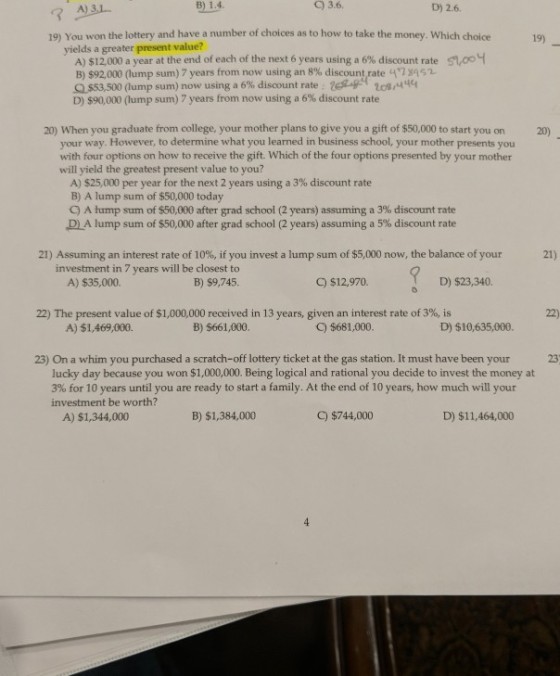
I feel like my professor is asking ambiguous
questions
Homework Answers
| 19) |
| A) | $ 12000 at end of every year for 6 year 6 % Discount rate | ||
| Pv for 6 at rate 6% | 4.917 | ||
| PV of cash infolw = 12000 *4.917 = 59004 | |||
| B) | 92000 Lum sum at end of 7 year 8% Discount rate | ||
| pv on end of 7 year for 8% | 0.5835 | ||
| PV of cash inflow = 92000*.5835 = | 53682 | ||
| C) | $ 53500 now this is already present value | ||
| D) | 90000 Lum sum at end of 7 year 6% Discount rate | ||
| pv on end of 7 year for 6% | 0.665 | ||
| PV of cash inflow = 90000*.665 = | 59850 | ||
|
OPTION D HIGHER PRESENT VALUE
|
|||||||||||||||||||||||||||||||||||||||||||||||||||||||||||||||||||||||||||||||||||||||||||||||||||||||||||||||||||||||||||||||||||||||||||||||||||
| 21) | |||||||||||||||||||||||||||||||||||||||||||||||||||||||||
| Interst 10% | |||||||||||||||||||||||||||||||||||||||||||||||||||||||||
| Investment 5000 | |||||||||||||||||||||||||||||||||||||||||||||||||||||||||
| Balance after 7 year | Computing int | ||||||||||||||||||||||||||||||||||||||||||||||||||||||||
| IF invest $ 1 at the rate of 10 % after 7 year = 1.949 | A=P(1+R)t | t DENOTE POWER OF (1+R) | |||||||||||||||||||||||||||||||||||||||||||||||||||||||
| So after 7 year amount will be = 5000*1.949 =9745 ( Answer B is Right) | |||||||||||||||||||||||||||||||||||||||||||||||||||||||||
|
|||||||||||||||||||||||||||||||||||||||||||||||||||||||||
Add Answer to:
I feel like my professor is asking ambiguous
questions
A) B) 1.4 3.6. D) 2.6. 3...
You won the lottery and have a number of choices as to how to take the money. Which one of the following choices yields...
You won the lottery and have a number of choices as to how to take the money. Which one of the following choices yields the greatest present value? A. $12,000 a year at the end of each of the next 6 years using a 6% discount rate B. $53,500 (lump sum) now using a 6% discount rate C. $84,000 (lump sum) 7 years from now using a 6% discount rate D. $92,000 (lump sum) 7 years from now using an...
You have just won “$10,000,000” in a lottery. However, when you go to collect your check...
You have just won “$10,000,000” in a lottery. However, when you go to collect your check you find that the “$10,000,000” is actually payments of $1,000,000 per year for the next 10 years. How much should you be willing to accept now, in a lump sum, if your opportunity cost discount rate is 10%? Round your answer to the nearest dollar.
You just won the $20,000,000 lottery price. Either you can take the annual payments of $1,000,000...
You just won the $20,000,000 lottery price. Either you can take the annual payments of $1,000,000 per year for 20 years or you can elect to receive a lump sum value of the annual payments using a discount rate of 6%. You have elected to receive the lump sum amount. What is the net lump sum amount you will received after applying Federal and State Income Taxes; 25% and 12% respectively. What is the Net Lump Sum distributed after taxes?...
Congratulations, you won a lottery of $10 million! You are offered three options to receive your...
Congratulations, you won a lottery of $10 million! You are offered three options to receive your windfall: A) A lump sum of $10 million received immediately B) An annual payment of $500,000 for 30 years C) A monthly payment of $50,000 for 30 years a. If the discount rate is 7%, which option would you choose? Show your work. b. Calculate the effective annual rate for option C.
Your grandfather would like to share some of his fortune with you. He offers to give...
Your grandfather would like to share some of his fortune with you. He offers to give you money under one of the following scenarios (you get to choose): 1.$8,750 per year at the end of each of the next five years 2.$47,450 (lump sum) now 3.$98,650 (lump sum) five years from now Requirements 1.Calculate the present value of each scenario using a 6% discount rate. Which scenario yields the highest present value? 2.would your preference change if you used a...
Rita Gonzales won the $62 million lottery. She is to receive $2.8 million...
Rita Gonzales won the $62 million lottery. She is to receive $2.8 million a year for the next 20 years plus an additional lump sum payment of $6 million after 20 years. The discount rate is 14 percent. What is the current value of her winnings? Use Appendix B and Appendix D for an approximate answer, but calculate your final answer using the formula and financial calculator methods. (Do not round intermediate calculations. Round your final answer to 2 decimal places.) Present...
Your grandfather would like to share some of his fortune with you. He offers to give...
Your grandfather would like to share some of his fortune with you. He offers to give you money under one of the following scenarios (you get to choose): Use PV table for $1 and Present Value of Ordinary Annuity of $1 table 1. $8,000 per year at the end of each of the next eight years 2. $49,950 (lump sum) now 3. $100,050 (lump sum) eight years from now Requirements: 1. Calculate the present value of each scenario using an...
39. You bought a painting 10 years ago as an investment. You originally paid for $484,050,...
 39. You bought a painting 10 years ago as an investment. You originally paid for $484,050, what was your annual return on investment? A) 47% B) 47% C) 1996 D) 12.8% Answer: $85,000 for it. If you sold it 40. What is the present value of S12.500 to be received 10 years from today? Assume a discount rate of 8% compounded annually and round to the nearest $10. A) $5,790 B) $11,574 C) $9,210 D) $17,010 Answer il. You wish...
24) Yates, Inc. is evaluating two possible investments in depreciable plant assets. The company uses the straigh...
 24) Yates, Inc. is evaluating two possible investments in depreciable plant assets. The company uses the straight-line method of depreciation. The following information is available Investment A Investment B 225,000 7 years $20,000 Initial capital investment Estimated useful life $275,000 8 years Estimated residual value $15,000 Estimated annual net cash inflow for 10 years Required rate of return $55,000 12% $35,000 12% Compute the payback period for each investment. Which would you prefer? Show your calculations and round to one...
Solve using excel commands/formula A1 You have just received notification that you have won the $1...
 Solve using excel commands/formula
A1 You have just received notification that you have won the $1 million first prize in the Centennial Lottery. However, the prize will be awarded on your 100th birthday (assuming you're around to collect), 80 years from now. What is the present value of your windfall if the appropriate discount rate is 9 percent? 1,000,000 80 Future value Years Interest rate 9% 10 Complete the following analysis. Do not hard code values in your answers. Your...
Solve using excel commands/formula
A1 You have just received notification that you have won the $1 million first prize in the Centennial Lottery. However, the prize will be awarded on your 100th birthday (assuming you're around to collect), 80 years from now. What is the present value of your windfall if the appropriate discount rate is 9 percent? 1,000,000 80 Future value Years Interest rate 9% 10 Complete the following analysis. Do not hard code values in your answers. Your...
 39. You bought a painting 10 years ago as an investment. You originally paid for $484,050, what was your annual return on investment? A) 47% B) 47% C) 1996 D) 12.8% Answer: $85,000 for it. If you sold it 40. What is the present value of S12.500 to be received 10 years from today? Assume a discount rate of 8% compounded annually and round to the nearest $10. A) $5,790 B) $11,574 C) $9,210 D) $17,010 Answer il. You wish...
 24) Yates, Inc. is evaluating two possible investments in depreciable plant assets. The company uses the straight-line method of depreciation. The following information is available Investment A Investment B 225,000 7 years $20,000 Initial capital investment Estimated useful life $275,000 8 years Estimated residual value $15,000 Estimated annual net cash inflow for 10 years Required rate of return $55,000 12% $35,000 12% Compute the payback period for each investment. Which would you prefer? Show your calculations and round to one...
 Solve using excel commands/formula
A1 You have just received notification that you have won the $1 million first prize in the Centennial Lottery. However, the prize will be awarded on your 100th birthday (assuming you're around to collect), 80 years from now. What is the present value of your windfall if the appropriate discount rate is 9 percent? 1,000,000 80 Future value Years Interest rate 9% 10 Complete the following analysis. Do not hard code values in your answers. Your...
Solve using excel commands/formula
A1 You have just received notification that you have won the $1 million first prize in the Centennial Lottery. However, the prize will be awarded on your 100th birthday (assuming you're around to collect), 80 years from now. What is the present value of your windfall if the appropriate discount rate is 9 percent? 1,000,000 80 Future value Years Interest rate 9% 10 Complete the following analysis. Do not hard code values in your answers. Your...
Most questions answered within 3 hours.
-
Where is the error in this code sequence?
String s1 = "Hello";
String s2 = "ello";...
asked 10 months ago -
Financial data for Joel de Paris, Inc., for last year
follow:
Joel de Paris, Inc.
Balance...
asked 10 months ago -
Consider this reaction:
Al2(SO4)3 (aq)+ BaCl3
(aq) Al2Cl6 (aq)- +
3BaSO4(s) . What is the...
asked 10 months ago -
Suppose that Savneet is considering increasing her
recent random sample from 20 car rentals to 40...
asked 10 months ago -
Trucks arrive at an unloading terminal at an average rate of 120
per hour.
Trucks arrive...
asked 10 months ago -
Why are methanol and ethanol completely soluble in water while
octanol is not very little soluble....
asked 10 months ago -
A facilities manager at a university reads in a research report
that the mean amount of...
asked 10 months ago -
When the CuSO4 is rehydrated by adding water to the anhydrous
compound, is this an endothermic...
asked 10 months ago -
A ray of sunlight is passing from diamond into crown glass; the
angle of incidence is...
asked 10 months ago -
A block of mass 0.249 kg is placed on top of a light, vertical
spring of...
asked 10 months ago -
how do the kidneys compensate in the presences of acidosis
a) trigger hyperventilate
b) reserve acid...
asked 10 months ago -
Question 501 pts
The rental rate of capital to the firm increases. Which of the
following...
asked 10 months ago